💥Join UPSC 2027,2028 Mentorship (August Batch) + XFactor Notes & Microthemes PDF

GS Paper: Federalism

  • What is Darbar Move?

    The Jammu and Kashmir High Court asked the Centre and the Union Territory (UT) administration to take a final call on the continuation of the 148-year-old practice Darbar Move i.e. shifting of capitals between Jammu and Srinagar.

    Possible mains question:

    Discuss the feasibility, benefits and constraints caused by multiple administrative capitals in Indian states with special context to Jammu and Kashmir and the state of Andhra Pradesh. (250W)

    Darbar Move

    • Darbar Move is the name given to the bi-annual shift of the secretariat and all other government offices of Jammu and Kashmir from one capital city to another.
    • From May to October, governmental offices are housed in the state’s summer capital, Srinagar, and the other six months in its winter capital, Jammu.
    • The tradition was started during Dogra rule in 1872 by Maharaja Ranbir Singh.
    • It involved shifting of the Maharaja’s government to Jammu to escape the harsh winters of the Kashmir Valley, which, in the 19th century, used to result in the Valley being cut off from outside the world.
    • It is advocated that the continuation of the practice helped in the emotional integration between two diverse linguistic and cultural regions of Jammu and Kashmir.

    A costly practice

    • Ahead of the Darbar Move, Srinagar usually receives a facelift every year. Over 10,000 employees shift capital annually.
    • Roads around and leading to the Civil Secretariat, the seat of the government, are being renovated now.
    • Besides, the government offices and quarters have been renovated and the streetlights restored.
    • Hundreds of trucks are usually plied to carry furniture, office files, computers, and other records to the capital.
    • Over the years, there have been voices raised against the century-old practice which involves heavy funding towards ensuring the smooth conduct of the move.

    Why scrap Darbar Move?

    • If this practice is rationalized, the amount of money, resources and time which could be saved, could be utilized towards the welfare and development of the Union Territory.
    • It could be utilized for the protection and propagation of culture and heritage of the communities.
    • No reason or justification at all is available for requiring the judiciary to shift with the ‘Darbar Move’. The same negatively impact justice dispensation and impedes judicial administration.
  • ECI vague on whether J&K is part of Electoral College of President’s election

    The Election Commission of India (ECI) has replied ambiguously to an RTI query if the Union Territory of Jammu and Kashmir will be part of the Electoral College for the election of the President of India.

    This newscard invokes our basic GYAN acquired from the holy ‘Indian Polity’ by M. Laxmikanth. After reading this, ask yourself questions about the following :

    1) What comprises the electoral college of the President of India?

    2) Cases where the Constitutional Amendment Acts are required and wherever not

    What did ECI say?

    • The RTI request sought a list of the State and UTs Legislative Assemblies which were part of the Electoral College for the election of the President.
    • The query also asked the EC to clarify whether the newly-formed UT of Jammu and Kashmir was part of the Electoral College.
    • The EC sent a single-line response, merely saying- for the information, the applicant may be informed to refer Article 54 of the Constitution of India.

    What is Article 54 of the Constitution?

    • Under Article 54, the President is elected by an Electoral College, which consists of the elected members of both Houses of Parliament and the elected members of the Legislative Assemblies of all the States and also of NCT of Delhi and the UT of Puducherry.
    • The art. 54, thus, only specifically mentions NCT of Delhi and Puducherry as eligible to be part of the Electoral College.
    • There is no word about the newly-formed UTs of J&K and Ladakh.

    Ambiguity over J&K

    • The J&K Reorganization Act, which came into existence from August 2019, does not specify anything about whether the legislature of J&K would be able to vote in the election for a President.
    • A passing mention is made in Section 13 of the 2019 Act, which claims that J&K Legislature would have the same powers as its Puducherry counterpart.
    • The astonishing thing to note is that not a single MP in the parliamentary debate has pointed out this fact yet.

    A constitutional amendment is required

    • Inclusion of new members in the Electoral College in Article 54 would require a Constitutional Amendment to be carried out through two-thirds majority in Parliament and ratification by over 50% of the States.
    • This matter involves principles of federalism, hence constitutional amendment is a must.
    • Delhi and Puducherry were included as Electoral College members under Article 54 through the Constitution (Seventieth) Amendment Act of 1992.
    • Before that, Article 54 consisted of only the elected Members of Parliament as well as the Legislative Assemblies of the States.

    Back2Basics: Presidential Election in India

    • The President is elected by an Electoral College, which consists of the elected members of both Houses of Parliament and the elected members of the Legislative Assemblies of all the States and also of NCT of Delhi and the UT of Puducherry.
    • The authority to conduct elections to the Office of President is vested in the Election Commission of India.
    • The election of the President is held in accordance with the system of proportional representation by means of the single transferable vote and the voting at such election shall be by secret ballot.

    • The notification calling the election to the office of the President can be issued by the Election Commission on any day within the period of sixty days before the expiry of the term of office.
    • The election schedule shall be so fixed, that the President-elect is able to enter upon his office on the day following the expiry of the term of the outgoing President.

    With inputs from: TOI

  • Needed, greater decentralisation of power

    Context

    Even as States have taken up positions of leadership in the pandemic response, federal limitations are becoming hurdles.

    State governments at the position of leadership

    • In the fight against the pandemic, one of the striking features of governance has been the signal role played by State Chief Ministers across India.
    • Proactive measures: Even before the Union government invoked the Disaster Management Act, 2005, many State governments triggered the Epidemic Diseases Act, 1897, and installed a series of measures to combat what was then an oncoming onslaught of COVID-19.
    • These actions have not always been perfect. Some of them have even disproportionately trenched upon basic civil liberties.
    • But, by and large, they have been tailored to the reality faced on the ground by the respective governments.
    • Policies to address local concerns: States such as Maharashtra, Kerala, Tamil Nadu, Rajasthan, and Karnataka have shaped their policies to address their direct, local concerns.
    • They have communicated these decisions to the public with clarity and consideration, helping, in the process, to lay out a broad framework for the nation.
    • Not just the laboratories of democracy: In doing so, they have acted not merely as “laboratories of democracy”, to paraphrase the former U.S. Supreme Court Justice Louis Brandeis, but also as founts of reasoned authority.

    Federal arrangements placing limitations on the states

    • Equally, though, as much as State governments have taken up positions of leadership, they have repeatedly found themselves throttled by the limitations of the extant federal arrangement.
    • The Centre for Policy Research has pointed out at least three specific limitations.
    • Funds and structuring own package: The inability of States to access funds and thereby structure their own welfare packages.
    • Curbs imposed by PFMS: The curbs imposed by a public finance management system (PFMS) that is mired in officialdom.
    • This has prevented States from easily and swiftly making payments for the purchase of health-care apparatus such as ventilators and personal protective equipment.
    • Disruption of supply chains: Three, the colossal disruption of supply chains not only of essential goods and services but also of other systems of production and distribution, which has placed States in a position of grave economic uncertainty.
    • Need to decentralise: As these limitations demonstrate an urgent need to decentralise administration, where States — and local bodies acting through such governments — are allowed greater managerial freedom.
    • Under such a model, the Union government will command less but coordinate more.

    Indian federalism-two distinct levels

    • There are varying accounts of what Indian federalism truly demands.
    • Two levels: What is manifest from a reading of the Constitution is that it creates two distinct levels of government: one at the Centre and the other at each of the States.
    • The Seventh Schedule to the Constitution divides responsibilities between these two layers.
    • The Union government is tasked with matters of national importance, such as foreign affairs, defence, and airways.
    • But the responsibilities vested with the States are no less important. Issues concerning public health and sanitation, agriculture, public order, and police, among other things, have each been assigned to State governments.
    • In these domains, the States’ power is plenary.
    • This federal architecture is fortified by a bicameral Parliament.
    • Significantly, this bicameralism is not achieved through a simple demarcation of two separate houses, but through a creation of two distinct chambers that choose their members differently-
    • A House of the People [Lok Sabha] comprising directly elected representatives and a Council of States [Rajya Sabha] comprising members elected by the legislatures of the States.

    Financial autonomy of the states

    • Ensuring financial autonomy: In formulating this scheme of equal partnership, the framers were also conscious of a need to make States financially autonomous.
    • No overlap: To that end, when they divided the power to tax between the two layers of government they took care to ensure that the authority of the Union and the States did not overlap.
    • Therefore, while the Centre, for example, was accorded the power to tax all income other than agricultural income and to levy indirect taxes in the form of customs and excise duties, the sole power to tax the sale of goods and the entry of goods into a State was vested in the State governments.
    • The underlying rationale was simple: States had to be guaranteed fiscal dominion to enable them to mould their policies according to the needs of their people.

    History of paradox in federal system of India

    • Despite this plainly drawn arrangement, the history of our constitutional practice has been something of a paradox.
    • It is invariably at the level of the States that real development has fructified.
    • But the Union has repeatedly displayed a desire to treat States, as the Supreme Court said in R. Bommai v. Union of India, as mere “appendages of the Centre”.
    • Time and again, efforts have been made to centralise financial and administrative power, to take away from the States their ability to act independently and freely.
    • Following five examples demonstrated that the point made here.

    1 Matters of finance-what was expected in theory did not realise

    • Consider the widely hailed decision to accept the 14th Finance Commission’s recommendation for an increase in the share of the States in total tax revenues from 32% to 42%.
    • While, in theory, this ought to have enabled the States to significantly increase their own spending, in reality, as a paper authored by Amar Nath H.K. and Alka Singh of the National Institute of Public Finance and Policy suggests, this has not happened.
    • What went wrong? Gains made by the States, as the paper underlines, have been entirely offset by a simultaneous decline in share of grants and by a concomitant increase in the States’ own contribution towards expenditures on centrally sponsored schemes.

    2. Goods and Service Tax

    • The decline in the sovereignty of the states: Notably, the creation of a Goods and Services Tax regime, which far from achieving its core purpose of uniformity has rendered nugatory the internal sovereignty vested in the States.
    • By striking at the Constitution’s federal edifice, it has made the very survival of the States dependent on the grace of the Union.
    • The tension today is so palpable that a number of the States are reported to have written to the Union Finance Ministry.
    • More than four months’ worth of Goods and Services Tax compensation to the States — reportedly totalling about a sum of ₹40,000 crore — remains unreleased.

    3. Passing a bill as a money bill

    • The Union government’s centralising instinct, though, has not been restricted to matters of finance.
    • It has also introduced a slew of legislation as money bills, in a bid to bypass the Rajya Sabha’s sanction, even though these laws scarcely fit the constitutional definition.

    4. Role of the Governors

    • Similarly, the role of the Governors has been weaponised to consolidate political power.

    5. Article 370

    • But perhaps most egregious among the moves made is the gutting of Article 370 and the division of Jammu and Kashmir into two Union Territories.
    • It was done without securing consent from the State Legislative Assembly.

    Conclusion

    Perhaps a crisis of the kind that COVID-19 has wrought will show us that India needs greater decentralisation of power; that administration through a single central executive unit is unsuited to its diverse and heterogeneous polity. We cannot continue to regard the intricate niceties of our federal structure as a nettlesome trifle. In seeing it thus, we are reducing the promise of Article 1 of the Constitution, of an India that is a Union of States, to an illusory dream.

  • J&K Reorganization (Adaptation of State Laws) Order, 2020

    • The Ministry of Home Affairs has promulgated the Jammu and Kashmir Reorganization (Adaptation of State Laws) Order, 2020, which comes into force with immediate effect.
    • Earlier this month order for an adaptation of Central Laws was also promulgated. It ordered application of 37 central laws envisaged in the Concurrent List to the newly formed UT.

    About the Order

    • Issued by the Department of J&K and Ladakh Affairs, the Order stems from Section 96 of the J&K Reorganization Act, 2019.
    • The Act was a consequence of the abrogation of Article 370 of the Constitution of India and it reorganized the State into two UTs.
    • The Order notifies changes in the J&K Civil Services (Decentralization and Recruitment) Act (hereafter, “Civil Services Act”), which defines “domicile” for employment in the region
    • Domicile Criteria
      Under the newly inserted Section 3A of the Civil Services Act which is regarding domicile for purposes of appointment to any service in UT of J&K.A person will have to fulfill the following conditions to be deemed to be a domicile of the UT of J&K:
    • She/he has to have resided for period of 15 years in the UT of J&K or has studied for a period of 7 years and appeared in Class 10th/12th examination in an educational institution located in the UT of J&K; or
      She/he is registered as a migrant by the Relief and Rehabilitation Commissioner (Migrants) in the UT of J&K.
    • Scope of Section 3A
    • Children of those fulfilling the aforementioned conditions are also deemed to be included.
    • Section 3A also goes on to include children of those Central Government Officials, All India Services Officers, Officials of PSUs and Autonomous body of Central Government, PSBs, etc. who have served in J&K for a total period of ten years.
    • Additionally, it includes those children of such residents of UT of J&K who reside outside the UT of J&K in connection with their employment or business or other professional and vocational reasons, but the parents fulfill the conditions provided under Section 3A(1).

    Job reservations

    • Section 5A provides for the domicile reservation for the purpose of appointment of any post carrying a pay scale of not more than Level-04 under the UT of J&K or under local or any other (other than cantonment board) within the UT of J&K.
    • Therefore, lowest level of non-gazetted rank jobs would be reserved exclusively for the Jammu and Kashmir domiciles.
  • After the lockdown

    Context

    Lockdown announcement has not been matched by national strategy — on containing fallout for poor.

    Two arguments advanced against lockdown

    • India’s decision to lock down was necessary. Two arguments are being advanced against it.
    • The first argument: India is a poor economy, with millions at the margins of subsistence, who cannot bear the consequences of a lockdown. The density and living conditions in India make social distancing difficult in many cases.
    • The second argument: It is that the extent of community transmission does not justify such drastic measures.

    What are the justifications for the lockdown?

    • The only hope: Precisely because millions in India are vulnerable and will not later have the possibilities of quarantining or medical care, the only hope we have of securing their lives is to slow down the spread of the virus as much as possible.
    • And the only shot you have at it is when community transmission is possibly still at manageable levels.
    • There is, therefore, a bit of bad faith in using the poor as the basis for expressing scepticism at the need for a lockdown. That is the most insidious form of privilege.
    • The risks of any catastrophic spread will be even more incalculable for the poor.

    Underscoring the importance of federalism and decentralisation

    • States responding in innovative ways: One of the more encouraging things has been the way in which several state governments like Punjab, Odisha, Kerala, Delhi and others have come into their own, innovating under difficult circumstances.
    • Role of panchayat and local officials: The much-neglected panchayat and local officials are key nodes in keeping track of possible cases and the creation of quarantining infrastructure.
    • Role of frontline workers: It would also be churlish not to acknowledge the ways in which most of the frontline workers of the state are responding, learning and innovating in this situation.
    • Federalism and decentralisation: If anything, this crisis is bringing home the importance of both federalism and decentralisation as central to a resilient governance architecture.

    The preparation and follow-up of the lockdown

    • But the national preparation and follow-up to take full advantage of the lockdown do not inspire full confidence.
    • Lack of strategy: The announcement of the lockdown has not been matched by a commensurate national strategy.
    • This is manifest, in the early signals on the following two important aspects:
    • Containing the economic fallout for the poor.
    • Building up the health infrastructure.
    • It is, admittedly, early days; but the signs are not good.

    Economic fallout for the poor

    • Focus is not on the poor: In the entire framing of the problem, the poor have been at best an afterthought, at worst expendable damage.
    • Steps taken not adequate: Steps like health insurance cover for frontline workers, increased food rations, are welcome steps. But a crisis of this magnitude required assurance to the most vulnerable that no stops will be pulled to secure their futures.
    • Instead, what you got was incrementalism of the worst kind, masquerading as a big commitment.
    • Low cash transfer: The cash transfers, in particular, through different schemes, are shockingly low.
    • Need for the unprecedented social security support: This crisis is one of the rare instances where economists and even bankers, from across the political spectrum, have rallied around the intellectual argument for unprecedented levels of social security support.
    • So the government’s “support by stealth” strategy is even more mystifying.
    • Impact of lockdown on migrant labour: The magnitude of the crisis unleashed for migrant labour could have been avoided with a little forethought.
    • What could have been done? Early announcement of cash transfers, shelter and food availability, would have obviated the need for migration.

    Opacity on the health infrastructure side

    • Issue of testing: Opacity is often a consequence of scarcity. And nowhere is this more manifest than in our discussion of testing.
    • Underutilisation of capacity: Everyone understands that India has the scarce testing capacity, though it seems it is also under-utilising what it has.
    • No clear testing strategy: The government is procuring more testing kits. But what is worrying is that there seems to be no publicly articulated statement of what exactly our testing strategy is, given the scarce resources.
    • But there is still no sense of how we plan to put a testing strategy in place (not just numbers of tests, but where can they be optimally deployed), that will minimise the need for future lockdowns.
    • What objectives is it trying to meet? There is more than a whiff of suspicion that there is a view that more testing might spread more panic.
    • Or it might put more pressure on the health care system than it can handle.
    • India has never understood that health expenditure is not an expenditure; it is an investment.
    • Building up of health infrastructure: The success of the lockdown strategy is premised on an unprecedentedly vigorous building up of health infrastructure to fight the pandemic.
    • There is a commitment by the Centre to infuse an extra Rs 15,000 crore in this sector. Some steps are being taken in building up capabilities, including ramping up production of ventilators and masks.
    • Need for warlike mobilisation: This is an area where India needs almost a warlike mobilisation, to make sure we have enough testing, tracking, frontline workers, logistics and equipment in place to make sure that the duration of a lockdown is minimised or a repeat is not necessary.
    • The creation of this kind of infrastructure will pay huge dividends even in non-pandemic times.

    Conclusion

    The prime minister is constantly asking the citizens to mobilise, and most of them respond. But it about time the state mobilises: On an economic stimulus that is truly meaningful and health infrastructure push that inspires confidence.

  • Role of Lieutenant Governor

    The Madras High Court has held that the role of Puducherry’s Lieutenant Governor and that of an elected government in the UT were intertwined as per law, and therefore they were expected to act in unison and not in division.

    What did the court rule?

    • The government headed by the CM and the Administrator/Lieutenant Governor of Puducherry shall work in unison and not in division.
    • The Madras HC set aside a single bench judgment that had held that the Lieutenant Governor (LG) does not have the right to interfere in the daily affairs of the elected government of Puducherry.
    • The HC has held that the Administrator is bound by the aid and advice of the Council of Ministers in matters where the Legislative Assembly is competent to enact laws.
    • This power of Assembly is contemplated under Section 44 of the Government of Union Territories Act, 1962.

    How is Puducherry different from other UTs?

    • UT of Puducherry is headed by the Lieutenant Governor of Puducherry as its nominal head, with a democratically elected CM as real head of the executive.
    • Other union territories don’t have an elected government and legislative assembly.
    • Puducherry, National Capital Territory of Delhi and Jammu and Kashmir (newly formed UT) are the three territories which have democratically elected governments like Indian states.
    • The State legislatures were a creation of the Constitution, whereas the UT legislatures were created under a law such as the Government of UTs Act, 1963.
    • The constitutional provisions, the 1963 Act as well as the Rules of Business of the Government of Puducherry lay expect the Lieutenant Governor to act as a bridge between the local government and the Centre.
    • The Administrator is expected to play the role of an umpire whenever there was a disagreement between the Lieutenant Governor and the Council of Ministers.
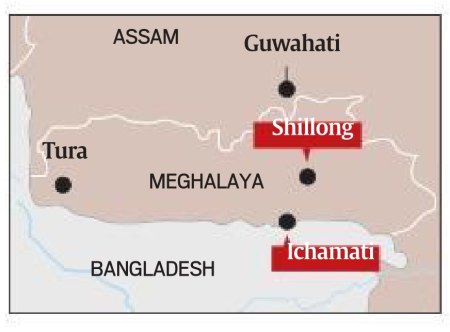
  • Explained: Behind Meghalaya violence


    Last week, ethnic violence left three dead in Meghalaya. The violence underlined the ethnic complexities of Meghalaya, with tensions coming back to the fore following the passage of the Citizenship (Amendment) Act.

    Multi-ethnic Meghalaya

    • Meghalaya became a state in 1972 when it was carved out of Assam. Before that, Shillong, now Meghalaya’s capital, used to be the capital of Assam.
    • Sharing a 443-km border with Bangladesh, Meghalaya has seen decades of migration from areas that are now in Bangladesh, as well as from various Indian states via Assam.
    • Besides the indigenous groups, Meghalaya’s residents include Bengalis, Nepalis, Marwaris, Biharis and members of various other communities.
    • Meghalaya is a tribal majority state, and the indigenous Khasis, Jaintias and Garos are entitled to 80% reservation in government jobs.
    • Various groups have continuously expressed concerns that illegal migration from Bangladesh and the growth of “outsiders” from other states would overwhelm the indigenous communities.

    Meghalaya violence: The CAA context

    • The CAA relaxes the norms for Hindus from Bangladesh (among six religious groups from three countries) for eligibility to apply for Indian citizenship.
    • Long before that, the legislation was already facing protests in the Northeast, including Meghalaya. Eventually, the Centre decided the CAA will not apply in Sixth Schedule areas.
    • The Sixth Schedule of the Constitution has special provisions for administration of certain areas in the Northeast, including almost the whole of Meghalaya.
    • Despite the large exemption, the concerns have persisted in Meghalaya, and demands for an Inner Line Permit (ILP) regime have gathered fresh momentum.
    • If the ILP system is introduced, every Indian citizen from any other state would require a time-bound permit to visit Meghalaya.

    Signals simmering tensions

    • The last four decades have seen numerous incidents of violence in Meghalaya targeted at non-tribals, including from Bengal and Nepal.
    • The latest bout follows a sustained campaign over the implementation of the Inner Line Permit and unrest in the Northeast over the CAA that led to six deaths in Assam two months ago.
    • The violence last week has an immediate context in the anti-CAA campaign and ILP demand.

    Shillong, then and now

    • Shillong has seen violence against “outsiders” several times in the last four decades.
    • The targets were Bengalis in 1979, Nepalis in 1987, and Biharis in 1992.
    • In 2018, Shillong saw clashes between Khasis and Punjab-origin Dalit Sikhs whose ancestors had settled there over 100 years ago.
    • All that began collapsing after Independence, Constitutional institutions set up to safeguard the interest of the tribes came to be popularly perceived as opportunities to convert these tribal areas into exclusive zones of tribal hegemony.
    • The issue of ‘foreigners’ illegally residing in the state of Meghalaya was one of the most important issues which dominated state politics in the 1970s and 1980s.
    • In 1979, the state was plunged into a crisis for the first time since it was created.
  • Still no finality, the third time round

    Context

    There are indications that the new Bodo accord does not spell closure of the statehood movement by Bodo groups.

    Power-sharing experiment under the Sixth Schedule

    • Sixth Schedule expected as a panacea: The experiment of power-sharing and governance under the Sixth Schedule of the Indian Constitution was expected to be the panacea of the ethno-nationalist identity questions in the Northeastern States.
    • Complexities of exclusion: Euphoria, as well as anger over the third Bodo Accord, have, however, held the mirror reflecting the complexities of exclusion of communities in such ethnocentric power-sharing and governance model.

    Specifics of the new Accord

    • The new Accord was signed by the All Bodo Students’ Union (ABSU), United Bodo People’s Organisation and all the four factions of the insurgent outfit- National Democratic Front of Bodoland (NDFB) with Delhi and Dispur on January 27.
      • It promises more legislative, executive and administrative autonomy under the Sixth Schedule to Bodoland Territorial Council (BTC) and expansion of the BTC territory in lieu of statehood.
    • The Bodoland Territorial Area District (BTAD), the autonomous region governed by BTC, will be known as Bodoland Territorial Region (BTR) after demarcation of the augmented territory.

    The emergence of the faultlines in the new Accord

    • What went wrong in the previous Accord? The previous Bodo Accord signed by the erstwhile insurgent outfit, Bodo Liberation Tigers (BLT) with Delhi and Dispur on February 10, 2003, led to the creation of the BTC as a new experiment of territorial autonomy under the Sixth Schedule.
      • No assent by the Governor to any BTC legislation: The constitutionally mandated legislative power of the BTC has been reduced to a farce as the Assam Governor has not given assent to any of the legislation passed by the BTC Legislative Assembly.
    • Intensification of demand for Kamatapur State: Bodo groups have suspended their statehood movement.
      • The new Bodo Accord has triggered the intensification of the movement for Kamatapur State by organisations of the Koch-Rajbongshi community.
      • Overlapping territory: The territory of the demanded Kamatapur State overlaps with the present BTAD, proposed BTR and demanded Bodoland.
    • Demand for ST status: Clamour for Scheduled Tribe (ST) status by the Koch-Rajbongshis, Adivasis and several other non-ST communities has also grown.
    • Faultlines over ST status: Deeper ethnic faultlines in an ethnocentric power-sharing model will become exposed when the Koch-Rajbongshis and the Adivasis are granted ST status, as promised by the government.
      • For, the reservation of seats of BTC is for the STs and not exclusively for the Bodos.
      • The new accord has no clear answer to such critical questions.
      • In BTAD, the ST communities account for 33.50% of the total population and the Bodos account for over 90% of the ST population in the BTAD.
      • The ST populations are an overwhelming majority in territories overseen by nine other autonomous councils under the Sixth Schedule in Assam, Meghalaya, Mizoram and Tripura.
    • Minority governing majority: Such a demographic composition in the BTAD has allowed the space for political mobilisation of other non-Bodo communities.
      • It also allowed the articulation of the campaign that the BTC is a faulty model as it allows the minorities to govern the majorities.
      • Exclusion demand: The organisations of these communities have been demanding exclusion of villages with less than 50% Bodo population from the BTAD.
    • Counter argument by Bodos: Bodo organisations have a counter-argument that non-Bodo is a political identity construction articulated to capture power in the BTAD by certain political forces.
    • The new accord promises to increase the current strength of BTC to 60 from 40 but “without adversely affecting the existing percentage of reservation for tribal[s]”.
    • Constitutional provision for dealing with such situations: Sub-paragraph 2 of the first paragraph of the Sixth Schedule provides that, “If there are different Scheduled Tribes in an autonomous district, the Governor may, by public notification, divide the area or areas inhabited by them into autonomous regions.”
      • However, constitutional amendments were made following the previous Bodo Accord to ensure that this provision shall not apply in respect of the BTAD.
    • What could be the solution to the present situation? The provision of setting up regional autonomous councils under the Sixth Schedule can be explored to create the space for communities aggrieved by exclusion from the power-sharing model of BTC.

    Provision of commission

    • The new accord promises to appoint a commission by the Assam government.
      • What the commission will deal with? It will look into the demands for inclusion of villages with ST majority and contiguous to the BTAD, and exclusion of villages which are contiguous to non-Sixth Schedule areas and have majority non-ST population.
      • However, the core area of the BTAD will continue to have many villages with majority non-ST population which were included for contiguity.

    Evaporating of euphoria over the accord

    • Failure in uniting the four factions: Euphoria among the Bodos over the accord is also fast evaporating with efforts to unite all the four factions of NDFB having turned futile.
      • The factions are divided into two camps.
      • The new accord will be the pivot of political mobilisation in the BTAD during the forthcoming BTC elections due in April.
    • Revival in homeland demand: A shift in the political equilibrium in the BTC resulting from a likely expansion of the ST list in Assam has the potential to keep the Bodos out of power in the BTC and push Bodo organisations to revive their homeland demand

    Conclusion

    Peace will continue to be fragile in Assam’s Bodo heartland until an all-inclusive power-sharing and governance model is evolved under the provisions of the Sixth Schedule.


  • Explained: Assam-Mizoram Boundary Dispute


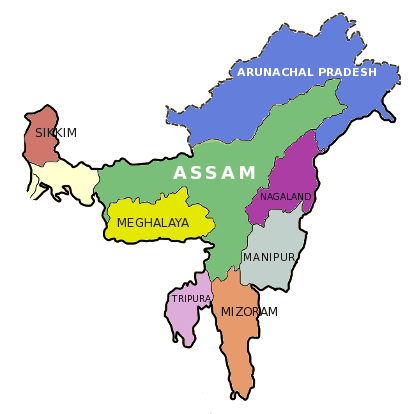
    Assam is at the centre of a fresh inter-State border row in the northeastern region. The Mizoram government has sought the revision of the boundary with Assam, based on the Bengal Eastern Frontier Regulation (BEFR) of 1873 and the Inner Line of the Lushai Hills Notification of 1993.

    Background

    • Since 1962 most of the state borders of states carved out of Assam were divided following the myopic vision of the Central government.
    • On ground these borders still do not run in sync with the tribal territories and identities, creating repetitive conflicts in the region and disturbing its peace.
    • Assam finds itself at the center of all the conflicts since most of the neighboring states were carved out of its territory since independence.
    • This was done to consolidate the Indian Union at the time by catering to the aspirations of the local tribes and including them in the mainstream by giving them independent statehoods.

    What is the dispute?

    • Mizoram shares a 123-km border with southern Assam and has been claiming a 509-square mile stretch “occupied” by the neighbouring State.
    • Mizoram used to be the Lushai Hills district of Assam before being made a Union Territory in 1972 and a State in 1987.
    • Both States have been disputing an extensive stretch of this boundary.

    About Bengal Eastern Frontier Regulation

    • The Inner Line Regulations, commonly referred to as the Inner Line Permit system (ILP), first gained legal effect through the Bengal Eastern Frontier Regulation, 1873.
    • At present the BEFR continues to apply, but only in present-day Arunachal Pradesh, Nagaland and Mizoram.
    • It had been lifted in the whole of Assam, as well as the entirety of present-day Meghalaya.
    • The BEFR allows Arunachal Pradesh, Manipur, Mizoram and Nagaland not to let non-resident Indians in without an inner-line permit for a temporary stay.

    Present status of ILP

    • The Foreigners (Protected Areas) Order, 1958 is the modern embodiment of the ILP.
    • This Order was passed in furtherance of the Foreigners Act, 1946.
    • The Order defined the ‘inner line’ throughout present-day India starting from Jammu and Kashmir and ending at Mizoram.
    • This inner line is different from the one envisioned in the Bengal Frontier Regulations.
    • This line represents the furthest point up to the international border where a foreigner can visit on the strength of a visa alone.
  • Kalasa-Banduri Nala Project


    The cost of Kalasa-Banduri Nala Project on the Mahadayi River skyrockets by 1,674% since inception. It rose from about ₹94 crores (2000) to ₹1,677.30 crores (2020) due to the ongoing inter-State river water dispute.

    Kalasa-Banduri Nala Project

    • The project is undertaken by the Government of Karnataka to improve drinking water supply to the three districts of Belagavi, Dharwad, and Gadag.
    • It was planned in 1989; Goa raised an objection to it.
    • It involves building across Kalasa and Banduri, two tributaries of the Mahadayi river to divert water to the Malaprabha, a tributary of Krishna River.
    • Malaprabha river supplies the drinking water to Dharwad, Belgaum, and Gadag districts.

    About Mahadayi Water Dispute

    • The Mahadayi river basin drains an area of 2032 square kilometres of which 375 square km lies in Karnataka, 77 sq km in Maharashtra and the remaining in Goa.
    • It originates in the Belagavi district of Karnataka, briefly passes through Maharashtra and flows through Goa (where its known as Mandovi), and drains to the Arabian Sea.
    • Since the eighties, Karnataka has been was contemplating linking of Mahadayi with Malaprabha river, a tributary of Krishna.
    • In 2002, Karnataka gave the idea a shape in the form of the Kalasa-Bhanduri project.
    • Goa strongly opposed it as Mahadayi is one of the two rivers the State is dependent on and thus Mahadayi Water Disputes Tribunal was set up in 2010.

    Read more about the Mahadayi Dispute and award of the tribunal at:

    https://www.civilsdaily.com/news/verdict-of-mahadayi-water-disputes-tribunal-comes/