💥Join UPSC 2027,2028 Mentorship (August Batch) + XFactor Notes & Microthemes PDF

GS Paper: Governance, Transparency & Accountability, Citizens Charters

  • Women officers can now get permanent commission in Indian Army

    The Ministry of Defence (MoD) has issued the formal Government Sanction Letter for grant of Permanent Commission (PC) to women officers in the Army.

    Try this question for mains:

    Q.“Concern for equality of sexes or political expediency should not influence defence policies.” Discuss on lines with the debate over the induction of women in the armed forces.

    Also read: https://www.civilsdaily.com/burning-issue-women-in-armed-forces/

    Why such an order?

    • The order follows a Supreme Court verdict in February that directed the government that women Army officers be granted PC and command postings in all services other than combat.
    • Following this, Army Chief had said it was an enabling one and gives a lot of clarity on how to move forward.
    • He had stated that the same procedure for male SSC officers will be followed for women to give PC.

    Women in Army: Background of the case

    • The induction of women officers in the Army started in 1992.
    • They were commissioned for a period of five years in certain chosen streams such as Army Education Corps, Corps of Signals, Intelligence Corps, and Corps of Engineers.
    • Recruits under the Women Special Entry Scheme (WSES) had a shorter pre-commission training period than their male counterparts who were commissioned under the Short Service Commission (SSC) scheme.
    • In 2006, the WSES scheme was replaced with the SSC scheme, which was extended to women officers. They were commissioned for a period of 10 years, extendable up to 14 years.
    • Serving WSES officers were given the option to move to the new SSC scheme or to continue under the erstwhile WSES.
    • They were to be, however, restricted to roles in streams specified earlier — which excluded combat arms such as infantry and armoured corps.

    2 key arguments shot down

    • The Supreme Court rejected arguments against a greater role for women officers, saying this violated equality under the law.
    • They were being kept out of command posts on the reasoning that the largely rural rank and a file will have problems with women as commanding officers. The biological argument was also rejected as disturbing.
    • While male SSC officers could opt for permanent commission at the end of 10 years of service, this option was not available to women officers.
    • They were, thus, kept out of any command appointment, and could not qualify for a government pension, which starts only after 20 years of service as an officer.
    • The first batch of women officers under the new scheme entered the Army in 2008.

    Arguments by the Govt

    • The Centre had mentioned several reasons behind the differential treatment of women officers.
    • It had proposed that women officers with up to 14 years of service would be granted a permanent commission, while those above 14 years would be permitted to serve for up to 20 years and retire with pension without being considered for permanent commission.
    • It also stated that those with more than 20 years of service would immediately be released with pension
    • This order did not grant permanent commission to women with over 14 years of service, and hence discriminatory.
    • Furthermore, the 2019 order granted permanent commission only for staff appointments and not command appointments.
    • The centre justified this by stating that that the units in Army are composed entirely of male soldiers, who are mostly from rural backgrounds and thus, are not mentally prepared to accept women officers in the command of units.
    • It also stated that the lower physical capacity of women officers would be a challenge for them to command units wherein officers are expected to lead the men from the front and need to be in prime physical condition to undertake combat tasks.
    • The government also stated that the adverse conditions, including two unsettled borders and internal security situations in the northeast and Jammu and Kashmir, have a major bearing on the employment of women officers in light of their physiological limitations.
    • Also, it had stated that the isolation and hardships would eat into their resolve and that they have to heed to the call of pregnancy, childbirth and family.
    • The government also argued that women ran the risk of capture by the enemy and being taken as prisoners of war.

    SC Criticized the Government’s Note

    • Reflects Poorly on Women: The note had shown women officers in a poor light, saying isolation and hardships would eat into their resolve and that they would have to heed to the call of pregnancy, childbirth and family. The note had mentioned that women ran the risk of capture by enemy and taken prisoner of war.
    • Patriarchal Notion: The court held that the the note reflected the age-old patriarchal notion that domestic obligations rested only with women.
    • Sex Stereotype: The court also dismissed the point that women are physiologically weaker than men as a “sex stereotype”.
    • Offence to dignity of Indian Army: The court noted that challenging abilities of women on the ground of gender is an offence not only to their dignity as women but to the dignity of the members of the Indian Army – men and women – who serve as equal citizens in a common mission.

    Implications of the judgement

    • The SC did away with all discrimination on the basis of years of service for grant of PC in 10 streams of combat support arms and services, bringing them on a par with male officers.
    • It has also removed the restriction of women officers only being allowed to serve in staff appointments, which is the most significant and far-reaching aspect of the judgment.
    • It means that women officers will be eligible to the tenant all the command appointments, at par with male officers, which would open avenues for further promotions to higher ranks for them.
    • It also means that in junior ranks and career courses, women officers would be attending the same training courses and tenanting critical appointments, which are necessary for higher promotions.

    Back2Basics: Permanent Commission (PC) Vs. Short Service Commission (SSC)

    • SSC means an officer’s career will be of a limited period in the Indian Armed Forces whereas a PC means they shall continue to serve in the Indian Armed Forces, till they retire.
    • The officers inducted through the SSC usually serve for a period of 14 years. At the end of 10 years, the officers have three options.
    • A PC entitles an officer to serve in the Navy till he/she retires unlike SSC, which is currently for 10 years and can be extended by four more years, or a total of 14 years.
    • They can either select for a PC or opt-out or have the option of a 4-years extension. They can resign at any time during this period of 4 years extension.
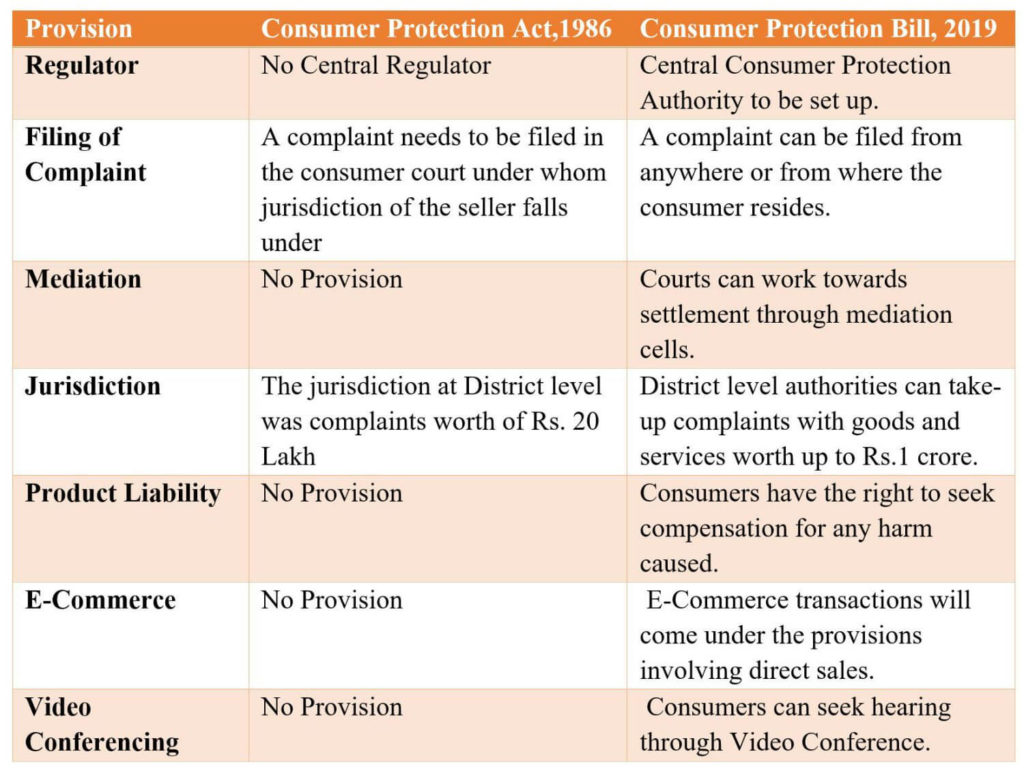
  • Explained: Consumer Protection Act, 2019

    The Consumer Protection Act, 2019 has come into effect from July 20, replacing the earlier Consumer Protection Act, 1986.

    Consumer Protection Act_Provisions of Consumer Protection Act 2019

    What are the Rights of the Consumers?

    Try this question from our AWE initiative 

    Compare and contrast the Consumer Protection Act 1986 with that of the Consumer Protection Bill 2018. How far do you think the changes made are consumer centric towards benefiting the consumer more? Examine. (250 W/ 15 M)

    Consumer Protection Act, 2019: Key Features

    1) Definition of consumer

    • A consumer is defined as a person who buys any good or avails a service for a consideration. 
    • It does not include a person who obtains a good for resale or a good or service for commercial purpose. 
    • It covers transactions through all modes including offline, and online through electronic means, teleshopping, multi-level marketing or direct selling.

    2) Rights of consumers

    The following consumer rights have been defined in the Act, including the right to:

    • be protected against marketing of goods and services which are hazardous to life and property;
    • be informed of the quality, quantity, potency, purity, standard and price of goods or services;
    • be assured of access to a variety of goods or services at competitive prices; and
    • seek redressal against unfair or restrictive trade practices.
       

    3) Establishment of Central Consumer Protection Authority

    • The central government will set up a CCPA to promote, protect and enforce the rights of consumers. 
    • It will regulate matters related to violation of consumer rights, unfair trade practices, and misleading advertisements. 
    • The CCPA will have an investigation wing, headed by a Director-General, which may conduct inquiry or investigation into such violations. 

    4) Penalties for misleading advertisement

    • The CCPA may impose a penalty on a manufacturer or an endorser of up to Rs 10 lakh and imprisonment for up to two years for a false or misleading advertisement. 
    • In case of a subsequent offence, the fine may extend to Rs 50 lakh and imprisonment of up to five years. 
    • CCPA can also prohibit the endorser of a misleading advertisement from endorsing that particular product or service for a period of up to one year.
    • For every subsequent offence, the period of prohibition may extend to three years.  

    5) Consumer Disputes Redressal Commission

    • CDRCs will be set up at the district, state, and national levels. 
    • A consumer can file a complaint with CDRCs in relation to: unfair or restrictive trade practices; defective goods or services etc.
    • Complaints against an unfair contract can be filed with only the State and National   Appeals from a District CDRC will be heard by the State CDRC. 
    • Appeals from the State CDRC will be heard by the National CDRC.  Final appeal will lie before the Supreme Court.

    6) Jurisdiction of CDRCs

    • The District CDRC will entertain complaints where value of goods and services does not exceed Rs one crore. 
    • The State CDRC will entertain complaints when the value is more than Rs one crore but does not exceed Rs 10 crore. 
    • Complaints with value of goods and services over Rs 10 crore will be entertained by the National CDRC.
       

    7) Product liability

    • Product liability means the liability of a product manufacturer, service provider or seller to compensate a consumer for any harm or injury caused by a defective good or deficient service. 
    • To claim compensation, a consumer has to prove any one of the conditions for defect or deficiency, as given in the Act.

    With inputs from: PRS

  • Enabling people to govern themselves

    The article examines the issues exposed by the pandemic with the current system of governance in India as well as the global level. Strengthening the local governments is suggested as the need of the hour.

    How pandemic exposed the limits of systems

    • Governance systems at all levels, i.e. global, national, and local, have experienced stress as a fallout of the COVID-19 pandemic.
    • There was a breakdown in many subsystems in health care, logistics, business, finance, and administration.
    •  Solutions for one subsystem backfired on other subsystems.
    • For example, lockdowns to make it easier to manage the health crisis have made but it was disastrous for the economy.

    Following 3 are the problems exposed in the governance

    1) Mismatch in abilities and functions

    • Human civilisation advances with the evolution of better institutions to manage public affairs.
    • Institutions of parliamentary democracy did not exist 400 years ago.
    • Institutions of global governance, such as the United Nations and the World Trade Organization, did not exist even 100 years ago.
    • These institutions were invented to enable human societies to produce better outcomes for their citizens.
    • The pandemic has revealed a fundamental flaw in their design.
    • There is a mismatch in the design of governance institutions at the global level with the challenges they are required to manage.

    2) Interconnected issues

    • All 17 Sustainable Development Goal are interconnected with each other.
    • Environmental, economic, and social issues cannot be separated from each other.
    • Experts working in silos or by agencies focused only on their own problems cannot solve these problems.
    • As government responses to the novel coronavirus pandemic have revealed, a good solution to one can create more problems for others.

    3) Local solution requires local problems

    • Even if experts in different discipline arrives at silo-ed solutions at the global level, they will not be able to solve the systemic problems of the SDGs.
    • Because, their solutions must fit the specific conditions of each country, and of each locality within countries too, to fit the shape of the environment and the condition of society there.
    • Solutions for environmental sustainability along with sustainable livelihoods cannot be the same in Kerala and Ladakh.
    • Solutions must be local.
    • For the local people to support the implementation of solutions, they must believe the solution is the right one for them.

    Decentralisation of governance

    • Governance of the people must be not only for the people. It must be by the people too.
    • There are scientific explanations for why local systems solutions are the best.
    • Elinor Ostrom, the first woman to win the Nobel Prize in Economics, had developed the principles for self-governing communities from research on the ground in many countries, including India.
    • Indian Constitution requires devolution of powers to local government too.
    • During pandemic States in India, such as Kerala, have weathered the storm better than others.
    • A hypothesis is that those States and countries in which local governance was stronger have done much better than others.

    Consider the question “Examine the issues with the current system of governance which were exposed by the pandemic. Also explain why decentralisation could improve many problems the governance faces.

    Conclusion

    The government has to support and enable people to govern themselves, to realise the vision of ‘government of the people, for the people, by the people’. Which is also the only way humanity will be able to meet the ecological and humanitarian challenges looming over it in the 21st century.

    Original article:

    https://www.thehindu.com/opinion/lead/enabling-people-to-govern-themselves/article32071943.ece

  • Breaking the politicians-criminals-bureaucrats nexus

    The root cause of impunity with which police perpetrated crimes lies in the in a nexus. The nexus between politicians, criminals and government functionaries needs to be broken down. This article suggests the ways to do that.

    The context

    • The recent custodial deaths in Tamil Nadu and encounter of a criminal by the UP police showed the police in a bad light.
    • However, when we dig deeper into the problem we realise that its root lies in the nexus of politicians, criminals and the government functionaries.

    Past attempt to break the nexus

    • In 1993, the Vohra Committee had submitted a report on the nexus between the criminals, politicians and government functionaries.
    • DIB suggested that an institution be set up to effectively deal with the menace.
    • There were discussions in parliament, but the matter ended there.
    • There was hardly any follow-up action.

    Criminalisation of politics

    • The number of members of parliament with criminal background has been going up with every successive election.
    • It was, according to the Association of Democratic Reforms, 30 per cent in 2009, 34 per cent in 2014 and 43 per cent in 2019.
    • The present UP Assembly has 36 per cent or 143 MLAs with criminal cases against them.
    • This lead to the administration turning a blind eye to the illegal activities of the criminals.
    • The nexus has proliferated and grown in strength down the years.
    • It creates an environment where the criminals who are part of the nexus are able to dodge the due processes of law.

    Suggestions

    • 1) We must have a law which debars persons with serious criminal cases from entering the assemblies and the Parliament.
    • 2) The criminal justice system must be revamped as recommended by the Malimath Committee.
    • 3) The Supreme Court’s directions on police reforms must be implemented.
    • 4) An institution comprising representatives of the police/CBI/NIA, IB, IT department, Revenue Intelligence and Enforcement Directorate should be set up to monitor the activities of the mafia and criminal syndicates in the country.
    • 5) A Central act on the lines of MCOCA should be enacted to curb the activities of organised criminal gangs.
    • 6) The concept of federal crime, as recommended by the Second Administrative Reforms Commission, should be accepted.
    • Crimes with all-India ramifications or are trans-national in character, like those of terrorism and organised crimes, should be brought within the ambit of federal crimes.

    Consider the question “The nexus of criminals, politicians and government functionaries is at the root of many problems the country faces today. Examine the problems created by the nexus and suggest ways to deal with the problem.”

    Conclusion

    We must, without further delay, build an environment where police become an instrument of service to the people, where monsters like Dubey do not thrive and become a menace to society.

  • Smart Cities Mission and the public health

    “Smart Cities Mission” lacks the focus on public health. This article highlights the consequences of this. The article suggests strengthening the of local governments and provisions for the livelihood through an urban employment guarantee scheme.

    “Smart Cities Mission”: Progress so far

    • The ‘Smart Cities Mission’, a flagship programme of the government, completed five years, in June 2020.
    •  The Mission had sought to make 100 selected cities “smart”.
    • Cities are being developed under “Area-Based Development” model.
    • Under this model, a small portion of the city would be upgraded by retrofitting or redevelopment.
    • Many of the projects undertaken under the ‘Smart Cities Mission’ are behind schedule.
    • According to the Ministry of Housing and Urban Affairs, of the 5,151 smart city projects, only 1,638 projects have been completed.
    • In terms of expenditure, of the total investment of ₹2,05,018 crore, only projects worth ₹26,700 crore have been completed.

    Lack of focus on Public health in Smart Cities Mission

    • ‘Smart Cities Mission’ has given little importance to basic services such as public health.
    •  An analysis shows that only 69 of over 5,000 projects undertaken under the Mission were for health infrastructure.
    • These projects are for an estimated cost of ₹2,112 crore, amounting to just around one per cent of the total mission cost.
    • Hence, public health seems to be a major blind spot in India’s smart city dreams.

    Public Health: Essential local government function

    • ‘Smart Cities Mission’ had the stated aim of improving the quality of life of urban residents.
    • Further, public health is an essential local government function in India’s constitutional scheme.
    • As per the 74th Amendment ( 12th Schedule), “public health” is one of the 18 functions that are to be devolved to the municipalities.
    • However, public health infrastructure of cities has often been neglected over the years.

    Strengthening Local Governments

    • Success of Kerala in containing the pandemic has shown how a decentralised political and administrative system can be effective.
    • It is important to strengthen local government capacities.
    • Investment in urban public health systems is needed.
    • Promoting programmes that improve the livelihoods of urban vulnerable communities should be the priority.
    • Programs such as the National Urban Livelihoods Mission and National Urban Health Mission, need to be strengthened.

    Focus on Urban Employment

    • It is time to consider the introduction of a national urban employment guarantee programme.
    • Kerala has been running such a scheme since 2010.
    • States such as Odisha, Himachal Pradesh and Jharkhand have also recently launched similar initiatives in the wake of the COVID-19 crisis.

    Consider the question “Covid pandemic has highlighted the lack of focus on public health in our Smart Cities Mission. Suggest the measures to make our cities resilient and source of livelihood. 

    Conclusion

    As Indian cities face an unprecedented challenge, it is important to get the priorities of urban development right and invest in programmes that improve the health and livelihoods of its residents.

  • Policing the police

    Custodial deaths in Tamil Nadu and death of a criminal in UP has brought to the fore the issue of illegalities carried out by the police. This article discusses the ways in which people face such illegalities and need for the reforms.

    Issue of illegalities by police

    • It is common practice in police stations to ignore the statute, laid down processes and Supreme Court guidelines.
    • So frequent is the brazen disobedience to the law that a lot of illegality seems to have morphed into accepted practice.

    Following are the ways in which police illegalities are carried out

    1) Custodial deaths

    •  The National Crime Records Bureau records 853 custodial deaths between 2010 to 2018.
    • At 1,636, the National Human Rights Commission puts the death figure much higher.
    • For this, just 3 policemen have been convicted.

    2) Issues of encounters

    •  The Supreme Court is clear that in each encounter case, an FIR must be registered and the matter probed independently.
    • If false, an “encounter” is premeditated murder.
    • Encounter threaten the basis of the rule of law.

    3) Avoiding registering complaint

    • Avoiding registration of complaint is the most common problem faced by the people.
    •  Even when the complaint is registered its magnitude is often diluted.
    • It is difficult for women, in particular, to get crimes registered.
    • So, in 2013, the law itself had to be changed.
    • Now a policeman who refuses to register a complaint of a sexual assault faces a two-year sentence.
    • The crime rate in India in 2018, it stood at 383.5 per 1,00,000 population.
    • By contrast, the crime rate in the US was over 2,500 per 1,00,000 .
    • This difference in crime rate highlights the reluctance by the police to registering crime.
    • This low crime rate on paper makes a fine excuse for governments to leave vacancies unfilled, go short on equipment and upgrades.
    • At 158, India’s police to population ratio which is police staff per 1,00,000 citizens, is one of the worst in the world. 

    4) Detention without cause

    •  People with prior records form a pool of easy pickings, as do the powerless.
    •  Often it is because the local public wants a quick arrest and the police want a scapegoat.

    5) Discrimination in arrest and investigation

    •  In the Tuticorin custodial murder, it took six days, the Madras High Court’s dogged intervention and a national hue and cry before six policemen could be arrested.
    • While police act swiftly in some cases, it goes soft against in other cases.

    Mechanisms and Checks and balances

    • There are many checks and balances from taluka to the national level to avoid police transgressions.
    • Internally, there are disciplinary mechanisms.
    • Outside, there are the courts.
    • Every state has human rights commissions, special interest bodies like the scheduled castes and scheduled tribes, women, and minorities commissions, and some have the police complaints authorities.
    • The Supreme Court’s clear directions coupled with the criminal code provide ample safeguards against excess.

    Why these checks and balances fail

    • In real life, internal mechanisms are overindulgent of illegal behaviour, obscure and dilatory.
    • The first responder lower courts are constrained by capacity and circumstance.
    • Very few of the over one hundred guardian bodies dotted around the country work effectively

    Issues with the Guardian bodies

    • Many bodies are without any functions and powers.
    • Others are deliberately left understaffed and under-resourced.
    • The Andhra Pradesh SHRC has no chairperson nor members.
    • Gujarat, Bihar, Chhattisgarh, Kerala and Tamil Nadu SHRCs function with acting chairs.
    • The few institutions that have the power and resources restrain their own functioning through terminal timidity.

    Consider the question “Issue of the illegalities by the police raises the question of guarding the guardians. Examine the ways in which police illegalities are manifested and suggest ways to deal with the issue.”

    Conclusion

    The number and regularity of heinous crimes by the police calls out for root and branch repair of the police and the many guardian agencies tasked with keeping them lawful.

  • Rewriting the social contract to deal with the pandemic

    The article examines the theoretical basis on which the governments exercise power. That basis is encapsulated in the ‘social contract theory’. The role of government, however, came under the scanner in the pandemic in which the impact of pandemic was different for the different people.

    Social contract theory: Then and now

    • In the course of evolution, formed the concept of social groups and resultant rules they would abide by.
    • This is the most rudimentary form of what is known as the ‘social contract theory’.
    • When monarchies and empires prevailed, it was easy to understand a social contract.
    • But democratically elected governments have found it more difficult to derive the same legitimacy.
    • Modern society and modern governments also use the social contract theory to claim legitimacy for their actions.
    • The social contract comprises people agreeing to live as one under common laws and in enforcing those common laws justly.

    Modern-day governments’ approach

    • Modern-day governments fundamental credo is that society is best served if a government takes on an executive or sovereign power, with the consent of the people.
    • Governments also use the power democratically invested in them to decide what is in the best interest of the people.
    • Thus, there is a bending of individual free will towards the collective will.
    • So, the social contract is being used by modern governments to justify greater aggrandisement of power in the hands of the sovereign.

    Governments role in pandemic and social contract

    • The novel coronavirus pandemic has laid bare the falsity of this image.
    • Access to information about this pandemic has not been equal.
    • Access to resources to avoid the disease has not been equal.
    • And, of course, access to treatment has not been equal.
    • All this led to uneven impact of the pandemic on people belonging to the different strata of the society.

    Inequality and the impact of pandemic

    •  All societies have some measure of inequality.
    • However, in deeply unequal societies, where the Gini Coefficient exceeds 0.4, for instance, different strata of society will have very different needs to deal with a crisis of this nature.
    • We have seen societies with lower Gini Coefficients deal with the crisis far better.
    • This is because a uniform approach works perfectly when society is perfectly equal.

    Centralised or decentralised approach: Which is better to deal with pandemic?

    • The social contract which imbues a centralised sovereign with overreaching powers has clearly failed on this occasion.
    • The centralised sovereign will work well against a mighty external aggressor, but not against a microscopic pathogen.
    • What is required is not just a decentralised approach but also a state which is sensitive.

    Consider the question “The COVID pandemic has impacted the people with varying intensity and its impact was more on societies with more inequality. This highlights the centrality of the government. Critically examine.”

    Conclusion

    The novel coronavirus cannot be defeated by a centralised government. COVID-19 can only be defeated by an empowered populace. The social contract requires to be rewritten. It does not require anything drastic such as a revolution or anarchy. Rather, it only needs fundamental introspection and rethinking by the governing classes including bureaucrats.

    Oped-snap

    https://www.thehindu.com/opinion/lead/the-social-contract-needs-to-be-rewritten/article32025342.ece

  • Prerak Dauur Samman

    The Ministry of Housing & Urban Affairs (MoHUA) announced a new category of awards titled ‘Prerak Dauur Samman’ as part of Swachh Survekshan 2021.

    Try this question:

    Q. The Prerak Dauur Samman recently seen in news is related to:

    a) Swachh Bharat b) Literature c) Health Services d) Visual Arts

    Prerak Dauur Samman

    • The Prerak Dauur Samman has a total of five additional subcategories -Divya (Platinum), Anupam (Gold), Ujjwal (Silver), Udit (Bronze), Aarohi (Aspiring) – with top three cities being recognized in each.
    • In a departure from the present criteria of evaluating cities on ‘population category’, this new category will categorize cities on the basis of six select indicator wise performance criteria which are as follows:

    1) Segregation of waste into Wet, Dry and Hazard categories

    2) Processing capacity against wet waste generated

    3) Processing and recycling of wet and dry waste

    4) Construction & Demolition (C&D) waste processing

    5) Percentage of waste going to landfills

    6) Sanitation status of cities

  • Role played by judiciary in curbing police violence

    Judiciary has played a significant role in tackling the problems of police violence. Yet, we come across some incident of violence intermittently. So, what went wrong? And what needs to be done? These issues are addressed in this article. 

    Role played by judiciary

    • Supreme Court’s interventioned against police violence came through in cases such as Joginder Kumar v. State of UP [1994] and D.K. Basu v. State of West Bengal [1997].
    • In these cases, guidelines to secure 2 rights – a right to life and a right to know – in the context of any state action were issued.
    • Through these guidelines, the Court sought to curb the power of arrest.
    • It also ensured that an accused person is made aware of all critical information regarding the arrest.
    • Information of arrest also has to be conveyed to friends and family immediately in the event of being taken in custody.
    • It took a decade, and in the form of amendments, as the Code of Criminal Procedure (Amendment) Act, 2008 to give statutory backing to these judicial guidelines.
    • It remains part of the law today.

    Significance of Prakash Singh Case

    • The Supreme Court went even further in the case, Prakash Singh v. Union of India [2006].
    • In this case, it pushed through new legislation for governing police forces to be passed by States across India.
    • A key component of the new legislation was a robust setup for accountability that contemplated a grievance redress mechanism.
    • However, several States are yet to legislate on the matter and remain in contempt of the Supreme Court’s judgment.

    Scientific investigation

    • Judiciary has supported techniques such as narcoanalysis, ensuring video recording of investigations, passing orders for installing closed-circuit television cameras inside police stations.
    • Through technology, one can hope to reduce the need for interacting with the body as a source of evidence.
    • But how often police employ physicality to obtain evidence will remain the deciding factor.

    Impeding issues

    • Despite all this, there are reports suggesting that across India there are as many as five custodial deaths a day.
    • Presence of continued institutional apathy towards the issue of police reform.
    • Judiciary’s approach of simply passing directions and guidelines, has proven to be a failure.
    • It is the ordinary magistrate, and not the constitutional court, who is the judicial actor wielding real power to realise substantial change in police practices. Hence, poor change.
    • There is a gap between the highest court and the lowly police officer in India.
    • Studies show despite criminal laws being struck down as unconstitutional, they continue to be enforced in various parts of the country by local police.

    What can be done?

    • Constitutional courts could reorient their guidelines to try and change the practices of magistrates.
    • It is the local magistrate before whom all arrested and detained persons must be produced within 24 hours.
    • Thus, magistrate becomes the point of first contact for a citizen with the constitutional rule of law.
    • The overworked magistrate, struggling with an ever-exploding docket, is very often in a rush to get done with the remand case.
    • This need to change with more involvement of Constitutional courts.

    Consider the question “Custodial torture is an anathema to democracy. Examine the issues related to custodial torture and how is it against the basic fundamental rights? What steps should be taken to prevent such acts by the police functionaries?”

    Conclusion

    The repeated instances of custodial deaths and tortures point to the inadequacies of the legal framework and lack of implementation. So, there is an urgent need for plugging the loopholes and some changes in approach.

  • Legal principles to reduce custodial deaths and torture

    This article enumerates the existing legal framework to avoid custodial torture and deaths. Judiciary played a major role in the evolution of these procedures. Yet, incidents of custodial deaths happen. This points to the lack of implementation of established guidelines and procedures.

    Understanding the background of problem

    • In wake of custodial deaths in Tamil Nadu, the debate on Roman dilemma: “Who will guard the guardians” rises again.
    • Torture is anathema to democracy and cannot be tolerated in a civilized society.
    • Answer to prevention of torture can be found in multiple sources like Royal Commissions in the UK, Law Commission report and Police Commission reports in India and also Supreme Court’s progressive case law, like Joginder Kumar (1994) and Nilabati Behera (1993).
    • However, the basic loophole which exists even today is that most torture is done before the arrest is recorded by the police.
    • Safeguards obviously kick in only after the arrest is shown. This is a perennial, insoluble dilemma and all devious police forces globally use it.

    Supreme Court judgement in DK Basu case

    • The DK Basu judgment since 1987 is crucial in dealing with issue of custodial deaths.
    • The judgement has origin from a letter complaint in 1986, which was converted into PIL.
    • 4 crucial and comprehensive judgments — in 1996, twice in 2001 and in 2015 — lay down over 20 commandments, forming the complete structure of this judgement.

    Details of judgment:

    First 11 commandments in 1996, focused on vital processual safeguards:

    • All officials must carry name tags and full identification, arrest memo must be prepared, containing all details regarding time and place of arrest, attested by one family member or respectable member of the locality.
    • The location of arrest must be intimated to one family or next friend, details notified to the nearest legal aid organisation and arrestee must be made known of DK Basu judgement.
    • All such compliances must be recorded in the police register, arrestee must get periodical medical examination, inspection memo must be signed by arrestee also and all such information must be centralised in a central police control room.
    • Breach to be culpable with severe departmental action and additionally contempt also, and this would all be in addition to, not substitution of, any existing remedy.
    • All of the above preventive and punitive measures could go with, and were not alternatives to, full civil monetary damage claims for constitutional tort.

    8 other intermediate orders till 2015:

    • Precise detailed compliance reports of above orders to be submitted by all states and UT and any delayed responses to be  looked into by special sub-committees appointed by state human rights body.
    • Also where no SHRC existed, the chief justice of the high courts to monitor it administratively.
    • It emphasised that existing powers for magisterial inquiries under the CrPC were lackadaisical and must be completed in four months, unless sessions court judges recorded reasons for extension.
    • It also directed SHRCs to be set up expeditiously in each part of India.

    The third and last phase of judgment ended in 2015:

    • Stern directions were given to set up SHRCs and also fill up large vacancies in existing bodies.
    • The power of setting up human rights courts under Section 30 of the NHRC Act was directed to be operationalised.
    • All prisons had to have CCTVs within one year.
    • Non-official visitors would do surprise checks on prisons and police stations.
    • Prosecutions and departmental action to be made unhesitatingly mandated.

    Where do we lack?

    • In operationalising the spirit of DK Basu judgment, in punitive measures, in last mile implementation, in breaking intra-departmental solidarity with errant policemen and in ensuring swift, efficacious departmental coercive action plus criminal prosecution.
    • A 1985 Law Commission report directing enactment of section 114-B into our Evidence Act, raising a rebuttable presumption of culpability against the police if anyone in their custody dies or is found with torture, has still not become law, despite a bill introduced as late as 2017.
    • We still have abysmally deplorable rates of even initiating prosecutions against accused police officers. Actual convictions are virtually non-existent.

    Consider the question “Custodial torture is an anathema to democracy. Examine the issues related to custodial torture and how is it against the basic fundamental rights? What steps should be taken to prevent such acts by the police functionaries?”

    Conclusion

    Monitoring and implementation of DK Basu by independent and balanced civil society individuals at each level, under court supervision, is sufficient to minimise this scourge. It is high time we take actions in this direction.