💥Join UPSC 2027,2028 Mentorship (July Batch) + XFactor Notes & Microthemes PDF

GS Paper: GS1-06. Salient features of Indian Society; Diversity of India;

  • Given the diversities among tribal communities in India, in which specific contexts should they be considered as a single category ?

    India’s 110 million tribal population (8.6%) comprise over 705 distinct ethnic groups. However, they are legally and politically unified under the category of “Scheduled Tribes” (STs).

    Diversities Among Tribal Communities in India
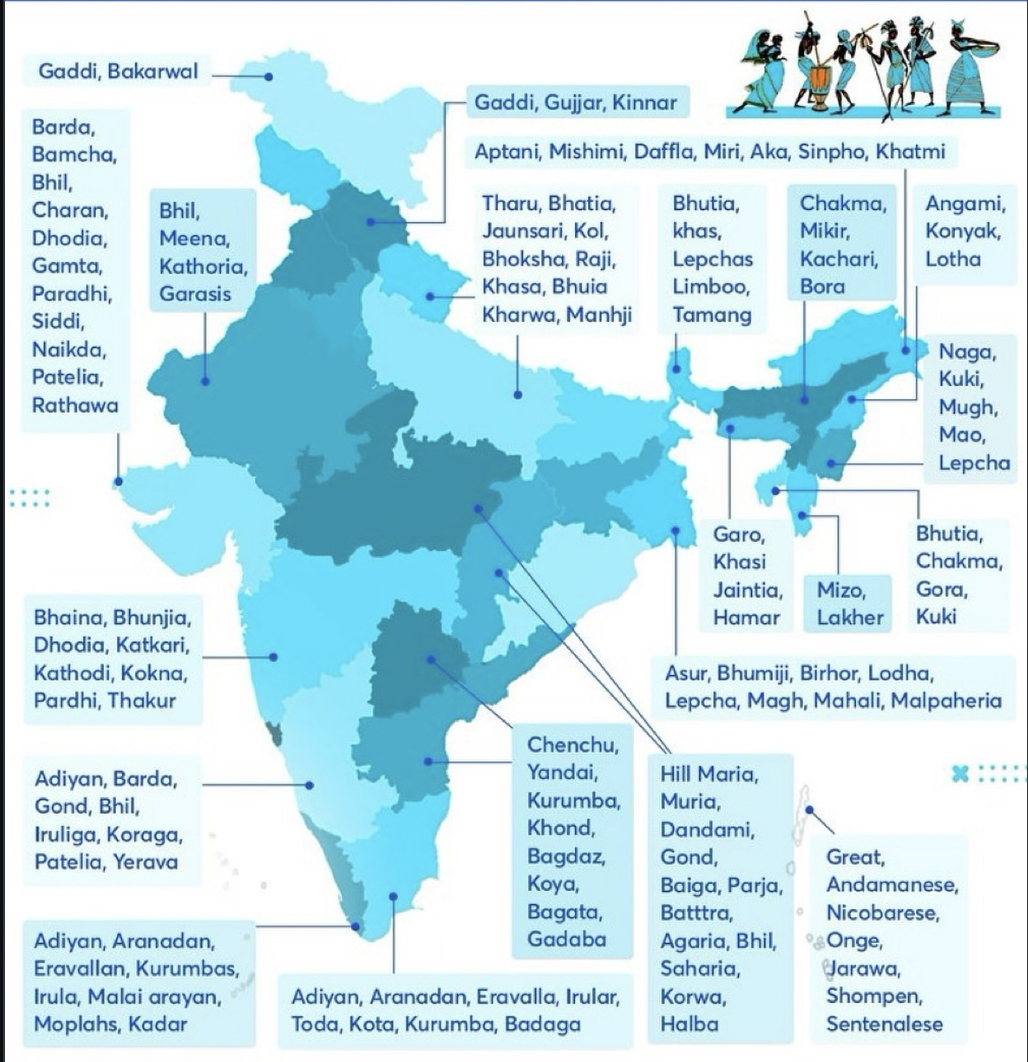
    Ethnic and Racial – Negrito (Andamanese) and Proto-Australoid (Central Indian tribes) to Mongoloid (Northeast tribes).

    Modes of Subsistence- Hunter-Gatherers (Sentinels), Pastoralists (Toda), Shifting Cultivators (Jhumias of Mizoram), Settled Agriculturists (Meenas of).

    Geographical Dispersion- arid deserts of Rajasthan (Bhils), high Himalayas (Gaddis), tropical rainforests of the Andamans.

    Social Organization- Matrilineal societies of Meghalaya (Khasis, Garos), Patrilineal systems of Central India.

    Religious Beliefs- Sarnaism (nature worship), Christianity (Northeast), Buddhism (Ladakh), or Hinduism (Central India).

    Demographic Scale- Gonds and Bhils number in millions, PVTGs like the Great Andamanese fewer than 50 members.

    Educational Attainment- nearly 90% in Mizoram to less than 30% among PVTGs in Chhattisgarh.

    Specific contexts where tribes can be considered as a single category

    Political Representation and Voice – limited representation in “cabinet” as well as in administration. Eg- less than 5% SC/ST at secretary level

    Constitutional and Legal Safeguards – Unified recognition as Scheduled Tribes for protective discrimination. Eg- Fifth and Sixth Schedule, reservations in education, employment, and legislatures.

    Administrative Planning and Resource Allocation – Eg- Tribal Sub-Plan (TSP)

    Historical Experience of Marginalisation – Shared legacy of colonial forest policies, land alienation, and erosion of autonomy.

    Structural Economic Deprivation – Common patterns of poverty, livelihood insecurity, and dependence on primary resources.

    Human Development Deficits – Similar disadvantages in nutrition, health, and education indicators at the aggregate level.

    Vulnerability to Displacement and Development Projects – Disproportionate impact of mining, dams, and conservation projects on tribal regions.

    Social Exclusion and Discrimination – Limited access to education, healthcare, markets, and political institutions across regions.

    Ecological and Livelihood Linkages – Shared dependence on forests, land, and commons for survival. Eg- shifting cultivation

    Implementing SC judgment on sub-categorization (Davinder Singh case) can help avoid over-homogenisation and one-size-fits for all approach

  • Analyse the salience of ‘sect’ in Indian society vis-a-vis caste, region and religion.

    In Indian society, sect refers to a religious-spiritual subgroup organised around a shared doctrine, deity, guru, or ritual practice. Unlike caste, region, and religion, which are largely ascriptive identities, sects are voluntary and belief-based.

    Salience of Sect in Indian Society

    Sect vis-a-vis Caste

    Transcending caste boundaries – Eg- Bhakti sects like Kabir Panth rejecting caste distinctions.

    Alternative social identity – Provides dignity to marginalised castes. Eg- Ravidassia sect among Dalits.

    Avenue for Social Mobility- Eg- Many lower-caste groups in North India joined the Arya Samaj to gain social respectability through Vedic education.

    Sects bridge the divide between different castes by focusing on a shared devotion to a guru or deity.

    However, caste infiltration persists. Eg- Vaishnava sects dominated by upper castes in leadership roles.

    Sect vis-a-vis Religion

    Sub-religious pluralism – Sects allow diversity within a single religion.

    Shaiva, Vaishnava, Shakti and Smartism within Hinduism

    Sunni-Shia within Islam.

    Himayana, Mahayana, Vajrayana within Buddhism

    Digambara and swetambara within Jainism

    Personalised spirituality – Emphasis on devotion rather than dogma. Eg- Bhakti and Sufi sects focusing on bhakti and ishq.

    Instrument of reform – Challenges orthodoxy and ritualism. Eg- Buddhism and Jainism emerging as sect-like reform movements.

    Charismatic Leadership (Guru-Cults) – sects are often centered around a living or historical spiritual guide. Eg- Raja Rammohan Roy (Brahmo Samaj)

    Sectarian identity can sometimes create friction. Eg- Friction between Thenkalai and Vadakalai sects over the prayers offered at the Sri Devarajaswamy Temple in Kanchipuram.

    Modern “New Age” sects help urbanites reconnect with their religion in a contemporary, simplified way. Eg- ISKCON (Hare Krishna movement)

    Sect vis-a-vis Region

    Regional localisation of sects – Sects adapt to local languages and cultures. Eg- Varkari sect in Maharashtra, Lingayat sect in Karnataka.

    Cultural integration – Sect strengthens regional identity while retaining pan-Indian appeal. Eg- Chaitanya Mahaprabhu’s Vaishnavism in Bengal.

    Sect builds social cohesion and strong community bonds within a region. Eg- Sikh Panth.

    Sect as a tool of political and social mobilization within a specific region. Eg- Lingayat movement seeking minority religion status.

    The sect occupies a unique intermediate position in Indian society, less rigid than caste, more flexible than religion, and more fluid than region. It has played a crucial role in spiritual democratisation and social cohesion.

  • Child cuddling is now being replaced by mobile phones. Discuss its impact on the socialization of children.

    Socialization is the process through which children internalize values, norms, emotions, and social skills. Increasing substitution of physical affection with mobile phones is reshaping this process.

    Impact on the Socialization of Children

    Negative Impacts

    Excessive digital mediation risks creating “emotionally under-nurtured but digitally over-stimulated” children.

    Weakening of Emotional Bonding – Reduced physical affection hampers secure attachment formation.

    Delayed Emotional Development as screens cannot reciprocate emotions. Eg- Children struggle to recognise empathy, affection, and emotional cues.

    Impaired Language and Communication Skills due to limited verbal interaction.

    Excessive screen use affects self-regulation. Eg- Short attention span and impulsive behaviour.

    Erosion of Family Interaction – Eg- Children engaged with phones during meals instead of conversation.

    Reduced Moral and Value Transmission – Informal teaching through interaction declines. Eg- absence of grand parents in nuclear families

    Social Isolation – Digital engagement replaces real-world relationships.

    Early Consumerist Socialization – Eg- Desire for gadgets and branded products influenced by online media.

    Decline in physical activities lead to health issues. Eg- Roughly 188 million children (1 in 10) are living with obesity in 2025 (UNICEF)

    Positive Impacts

    Early Cognitive Stimulation – Eg- Storytelling and alphabet-learning apps supporting early literacy.

    Digital Social Skills – Familiarity with digital interaction norms prepares children for digital future. Eg- emojis

    Bridging Physical Distance and maintaining emotional bonds with distant family. Eg- Video calls with grandparents.

    Encourages curiosity and self-directed learning. Eg- Interactive games requiring problem-solving.

    Cultural Awareness- Apps expose children to diverse languages and social norms. Eg- learning about Indian history through an educational YouTube series.

    Healthy socialization requires balanced parenting, where human touch and attention remain central, and screens are used sparingly and purposefully.

  • Do you think marriage as a sacrament in losing its value in Modern India?

    Traditionally, marriage in India has been viewed as a sacrament, symbolising a lifelong, sacred, and indissoluble bond. However, social change has led to a re-evaluation of this sacramental character.

    Marriage as a sacrament losing its value

    The increasing legal and social acceptance of divorce contradicts the sacramental view of marriage as an “eternal union.”

    Decline in the role of family in marital decisions highlights the changing nature of marriage from “duty” to personal choice.

    Rising median age of marriage for women (NFHS-5) highlights preference for education and careers over marriage

    Shift toward “Symmetrical Families” – Traditional hierarchy (Husband as God/Pati-Parmeshwar) is being replaced by egalitarian partnerships. Eg- rise in “dual income” households

    Emergence of Live-in Relationships – The growing preference for cohabitation without religious rituals directly bypasses the sacramental requirement.

    Economic Independence of Women – As per Leela Dube, as women gain property rights and careers, they prioritize “self-respect” over the “sacramental duty” to remain in dysfunctional marriages.

    “De-ritualization” (Yogendra Singh) – Marriage has shifted from a religious rite to a “Big Fat Indian Wedding” focused on conspicuous consumption.

    Commercialization of marriage. Eg- rise of matchmaking sites like shaadi.com

    However, sacramental value still persists

    Continued Importance of Rituals – Eg- Performance of saptapadi, mangalsutra, kanyadaan.

    Persistence of endogamy and arranged marriages

    Marriage remains a key marker of adulthood. Eg- Social pressure to marry across regions.

    Despite the increase, divorce remains low compared to global standards.

    Marriage is still valued as the foundation of family and society.

    The sacramental view is still strong in rural and semi-urban areas.

    Reinterpretation Rather than Rejection – Eg- Love marriages solemnised with traditional rituals.

    SC’s decision to not recognise “same sex marriages” (Supriyo v. Union of India) highlight sacramental value of marriage

    Marriage as a pure sacrament is undergoing transformation in modern India, but it is not losing its value entirely. As Yogendra Singh suggests, we are witnessing a “Modernization of Tradition.”

  • Critically analyse the proposition that there is a high correlation between India’s cultural diversities and socio-economic marginalities.

    India is one of the most culturally diverse countries in the world, characterised by numerous ethnicities, religions, languages, castes, tribes, and regional identities.

    Correlation between India’s cultural diversities and socio-economic marginalities

    Historical Discrimination Legacy in land ownership, credit access, and human capital that correlate with cultural identities.

    Occupational Lock-ins – Traditional caste or community occupations persist, limiting upward mobility. Eg- 96% manual scavengers are Dalits

    Limited Political Voice – Smaller cultural groups historically underrepresented in power structures, affecting resources and development priorities. Eg- <10% SC, STs in secretariat position in GoI

    Tribal communities (Adivasis) living in remote belts face poor education, health, and infrastructure access.

    Geographical Isolation – Culturally distinct groups in hilly or forested areas often lack services and markets. Eg- lack of connectivity in North-East

    Regional disparity – Eg- BIMARU states lag behind southern states in human development indicators

    Minority Religious Communities show lower education and employment outcomes as highlighted in the Sachar Committee report. Eg- higher % of muslim undertrails in Jail

    Linguistic Marginalization – Proficiency in English (a cultural/class marker) creates a divide between the “globalized elite” and those restricted to regional languages.

    Marginalization of transgenders and LGBTQ due to social discrimination and lack of access to basic amenities like health, education

    Other factors for Socio-Economic marginalities

    Economic Inequality – richest 1% control more than 40% of total wealth, while the bottom 50% own merely 3% (Oxfam Report)

    Rural-Urban Divide – Consumption and wage gaps.

    Infrastructure Deficits – Poor connectivity, electricity, and sanitation in backward districts hinder productivity.

    Gender Pay Gap – Women continue to earn significantly less than men

    Policy Implementation Gaps – affirmative policies sometimes fail to reach intended beneficiaries due to bureaucratic and governance bottlenecks. Eg- inclusion-exclusion errors in PDS

    However, cultural diversity has also helped in addressing socio-economic marginalities

    Affirmative action policies

    Reservation for SC, ST, OBC

    Tribal specific schemes like Van Dhan Scheme

    Rise of “Dalit Capitalism”

    Certain minority groups are among the most economically prosperous in India. Eg- Parsi and Jain communities

    Caste-Based Political Mobilization for claiming state resources and welfare. Eg- rise of OBC politics

    With improved data (caste census), better governance, and targeted policies, diversity can be transformed from a potential vulnerability into a driver of inclusive growth.

    Caste

  • Intercaste marriages between castes which have socio-economic parity have increased, to some extent, but this is less true of interreligious marriages. Discuss.

    Marriage in India is a key social institution reflecting patterns of social change and continuity. The changing pattern indicates transition from ritual-based status to socio-economic status as the primary determinant of social acceptance.

    Increase in intercaste marriages

    Decline of Ritual Hierarchy – Purity-pollution norms have weakened among educated and urban groups.

    Class-Caste Convergence – Urban middle class families prioritize “Status Consistency” over traditional ritual ranks. (André Béteille)

    “Individualization of Marriage,” where the couple’s mutual compatibility outweighs the community’s ritual norms. Eg- rise in “love marriages”

    Cultural assimilation and “sanskritization” lead to similar custom, traditions and diets among different casts

    Urbanisation and Migration promote anonymity and social mixing.

    Education and Exposure – Higher education fosters rational attitudes and inter-group interaction.

    Weakening of Caste Panchayats – Eg- declining power of Khap Panchayats in peri-urban areas

    Legal Support and Protection – Eg- Lata Singh v. State of UP (2006) protecting inter-caste couples.

    However, interreligious marriages still face challenges due to

    Sociologist T.K. Oommen argued that religious boundaries are “Thick Identities” compared to the “Thin Identity” of modern urban caste. Eg- differences in dietary habits and household rituals

    Fear of Social Ostracization – social penalty for an inter-religious marriage is more severe than in inter-caste cases. Eg- “Excommunication” (Hukka-Paani Bandh)

    Political and Communal Polarisation – Eg- “love jihad” controversy.

    Concerns over Conversion – Anxiety around forced or strategic religious conversion.

    Legal and Procedural Barriers – Special Marriage Act involves public notice of 30 days.

    Limited Institutional Support compared to inter-caste marriages.

    Indian society demonstrates “Segmented Modernization.” While economic parity acts as a “Social Solvent” for caste boundaries, it fails to dissolve religious walls.

  • What is regional disparity? How does it differ from diversity? How serious is the issue of regional disparity in India?

    Regional disparity refers to the significant imbalance in economic and social development across different geographical regions. It represents the widening inter-state and intra-state gap in terms of per capita income, industrialization, and basic infrastructure.

    Reasons Behind Regional Disparity in India

    Colonial “Presidency” bias (Bombay, Bengal, Madras).

    Geographical Constraints- Landlocked nature of Bihar.

    Uneven distribution of resources

    Green Revolution Bias- focus limited to Punjab, Haryana, and Western UP.

    Infrastructural Gaps- North East India

    Varying literacy rates and skill levels (e.g., Kerala vs. Bihar).

    Political instability in some states deterred long-term investment.

    Difference Between Regional Disparity and Diversity

    Seriousness of Regional Disparity in India

    Political disparity

    80 MPs from UP vs 29 from Kerala and only 2 from Sikkim

    MP from Bihar represents twice as much people as that of TN

    Economic Disparity

    The per capita income of Goa or Sikkim is nearly 5-7 times higher than that of Bihar

    Nearly 60% of India’s FDI is concentrated in just three states- Maharashtra, Karnataka, and Gujarat.

    Infrastructure deficit in poorer regions like North-East, Chhattisgarh, Jharkhand

    Health Outcomes- Infant Mortality Rate (IMR) in Kerala (approx. 6) is comparable to developed nations, while in Madhya Pradesh, it is above 40.

    Internal Migration- over 9 million+ workers migrate annually from the “BIMARU” belt to the South and West. They face

    Poor quality of living. Eg- dharavi slums

    Exclusion from welfare schemes

    Violence and discrimination. Eg- son of soil movement in Maharashtra

    Internal Security- The “Red Corridor” overlaps with regions of high relative deprivation and resource exploitation.

    Urbanization Imbalance- States like Tamil Nadu are over 50% urbanized, while Bihar remains over 85% rural – disparate access to modern services.

    Service sector which contribute 55% of GDP is concentrated in metros like Mumbai, Chennai, Bengaluru, Gurugram, excluding tier 2 and their 3 cities

    Steps Taken

    Aspirational Districts Programme

    Income Distance Criterion (45% weightage) under Finance commission devolution

    North East Special Infrastructure Development Scheme

    PM Gram Sadak Yojana

    Addressing disparities requires cooperative federalism, targeted infrastructure, and human capital investment.

  • Does tribal development in India centre around two axes, those of displacement and of rehabilitation? Give your opinion.

    Tribal development has historically unfolded alongside resource extraction, conservation, and infrastructure expansion, resulting in more focus on displacement and rehabilitation.

    Axes of displacement and rehabilitation in tribal development

    STs constitute only 8.6% of the population but have comprised an estimated 40-55% of all persons displaced by “developmental” projects

    Mining in Tribal Belts – Eg- displacement of Gonds from Hasdeo Arand forest (2025-26) due to coal block allocations.

    Large Dams and Irrigation Projects – Eg- Sardar Sarovar Project displacing over 40000 families of Bhil and Gond communities.

    Hydropower Projects in Himalayas and North-East Eg- Subansiri and Dibang projects (Arunachal Pradesh).

    Wildlife Conservation and Protected Areas – Eg- Relocation of Baiga tribe from Kanha Tiger Reserve (Madhya Pradesh).

    Conflict-Induced Displacement- Eg- The Gutti Koya (Muria Gond) families fled Chhattisgarh during the Salwa Judum era

    Eco-Sensitive Zones – Restrictions on habitation and livelihoods.

    Urban and Industrial Expansion – Eg- Displacement of tribal settlements around Raipur and Ranchi due to industrial corridors.

    Focus on Compensation-Based (Cash-centric) Rehabilitation without livelihood restoration.

    Inadequate Cultural Rehabilitation – Loss of social and cultural ecosystems. Eg- sacred groves

    The “Rehabilitation Backlog”- Eg- less than 50% of those displaced by the Hirakud Dam (1950s) have been fully settled with land titles.

    Counter argument – other aspects of tribal development

    Political Representation and Voice – Eg- Reserved ST constituencies in legislatures.

    Rights-Based Development Framework – Eg- Forest Rights Act, 2006 granting individual and community forest rights.

    Self-Governance and Autonomy – Eg- PESA Act mandating Gram Sabha consent in Scheduled Areas.

    Livelihood-Centred Development – Eg- Minor Forest Produce (MFP) MSP scheme supporting tribal incomes.

    Human Development Interventions – Eg- Eklavya Model Residential Schools for tribal education.

    Cultural Preservation and Identity – Eg- Traditional Knowledge Digital Library (TKDL) – to create digital knowledge repository

    Targeted Welfare and Livelihood Schemes – Eg- Van Dhan Vikas Kendras for value addition to forest produce.

    Gender-Sensitive Tribal Development – Eg- SHGs among tribal women under NRLM.

    Targeted Development schemes – Eg- PM-JANMAN Mission for development of 75 PVTGs

    Way Forward

    Effective Implementation of the Forest Rights Act (FRA), 2006

    Digitizing land records

    Setting up fast-track FRA tribunals

    Involving local Gram Sabhas in claim verification

    Strict implementation of the Right to Fair Compensation and Transparency in Land Acquisition Act, 2013 to prevent forced evictions.

    Revamping Tribal Healthcare through Mobile Health Units and AYUSH Integration

    Linking SHGs with One District One Product (ODOP) initiative for market access to tribal handicrafts.

    Tribal development must transition from “rehabilitation-centric” to “rights-centric”, treating tribal communities not as beneficiaries of charity, but as custodians of nature and partners in national growth.

    Urbanization