Why in the News
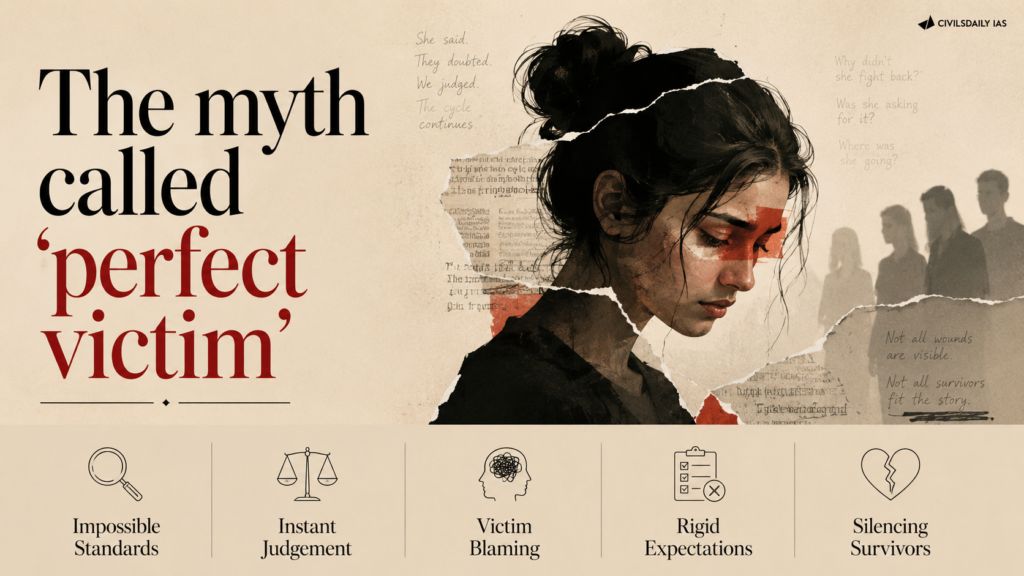
The Goa Division Bench of the Bombay High Court on 6 August set aside a 2021 trial court judgment and convicted a former magazine editor of raping a former colleague, sentencing him to ten years of rigorous imprisonment. The High Court termed the trial court’s ruling perverse and held that it had fallen for the notion that a sexual assault complainant must be a ‘perfect victim’ and conduct herself in a certain way to appear credible. The ruling sets the evidentiary record against a stereotype of expected victim behaviour that has shaped Indian adjudication for four decades.
What is the ‘ideal victim’ concept?
- Who theorised it: The Norwegian criminologist Nils Christie set out the concept of the ‘ideal victim’ or ‘perfect victim’ in a chapter of the same name in the book From Crime Policy to Victim Policy, published in 1986.
- What it claims: Victimhood is not an objective state established by the facts of the offence, it is a status that society grants or denies according to how far the complainant matches an expected profile.
- Where it is produced: The idea is propagated by the media, social media, films and the larger society, and race, class and gender determine who is cast as innocent and deserving and who as undeserving of sympathy.
- Why it matters in court: Once the profile becomes the test of credibility, a complainant who departs from it has her account doubted regardless of the evidence on record.
What five attributes did Nils Christie assign to the ‘ideal victim’?
- Weakness relative to the offender: The victim is often female, disabled, very young or very old, and is therefore weak in relation to the offender.
- Respectability of activity: The victim is engaged in what society treats as respectable activities at the time of the offence.
- Blamelessness of location: The victim cannot reasonably be blamed for being where she was during the crime.
- No prior acquaintance: The victim does not know the offender personally.
- A stereotypically bad offender: The victim is attacked by a perpetrator who is big and bad.
- The additional condition: While being weak, the victim must have enough social power to influence sympathy and have her victim status recognised, which is why the poorest complainants are least often believed.
What is the current status of protection for sexual assault survivors in India?
- The governing offence: Rape is defined and punished under Section 63 and Section 64 of the Bharatiya Nyaya Sanhita, 2023, with the minimum sentence set at ten years of rigorous imprisonment.
- Consent defined in statute: Consent is defined as an unequivocal voluntary agreement, and the absence of physical resistance does not by itself amount to consent.
- Past sexual history excluded: Evidence of a complainant’s general immoral character or previous sexual experience is no longer relevant to the question of consent, following the amendment of the evidence law in 2003 and its retention in the Bharatiya Sakshya Adhiniyam, 2023.
- The presumption on consent: Where sexual intercourse is proved in specified aggravated cases and the woman states she did not consent, the court presumes the absence of consent.
- Procedural protections: Trials are held in camera, the survivor’s identity may not be disclosed, and her statement is to be recorded by a woman officer, with a two month outer limit for completing the trial.
- The workplace framework: Sexual harassment at the workplace is governed by the Sexual Harassment of Women at Workplace (Prevention, Prohibition and Redressal) Act, 2013, which codified the Vishakha guidelines.
- The gap that persists: None of these provisions govern the inferences a judge may draw from a survivor’s demeanour, which is what the Supreme Court’s report of 3 August 2026 addresses.
Constitutional Provisions Related to Gender Justice and Fair Adjudication
- Article 14: Guarantees equality before the law and equal protection of the laws, the basis for challenging a differential standard of credibility applied to women complainants.
- Article 15(1): Prohibits discrimination on grounds of sex.
- Article 15(3): Permits the State to make special provision for women and children.
- Article 21: Guarantees life and personal liberty, read to include the right to live with dignity and bodily integrity.
- Article 39(a) and 39(d): Direct the State to secure an equal right to an adequate means of livelihood and equal pay for equal work for men and women.
- Article 39A: Directs the State to secure equal justice and free legal aid so that opportunities for securing justice are not denied by economic or other disabilities.
- Article 42: Directs the State to make provision for just and humane conditions of work and for maternity relief.
- Article 51A(e): Places a fundamental duty on every citizen to renounce practices derogatory to the dignity of women.
- Article 141: Makes the law declared by the Supreme Court binding on all courts, the route through which the Vishakha guidelines operated before Parliament legislated.
How has the ‘ideal victim’ standard shaped Indian judgments?
- Mathura, 1979: In the custodial rape case of a teenager, the Sessions Court relied on the survivor’s previous sexual experience to reason that she had likely consented, describing her as habituated to sexual intercourse. The Supreme Court, while acquitting the accused policemen, noted the absence of any alarm or resistance from the survivor and of injuries on her body.
- Bhanwari Devi, 1992: In the gang rape of a social worker, the Jaipur District and Sessions Court in 1995 acquitted the accused of gang rape, reasoning that it was unlikely that upper caste men would pollute themselves by having sexual relations with a Dalit woman. Her caste status was what made her an unlikely ‘ideal victim’ in the court’s eyes.
- What that case nonetheless produced: The Bhanwari Devi case became the catalyst for the formulation of the Vishakha guidelines and later for the enactment of the Sexual Harassment of Women at Workplace (Prevention, Prohibition and Redressal) Act, 2013.
- The Jindal case, 2017: A Punjab and Haryana High Court division bench, in an interim order, suspended the sentences and granted bail to three former law school students convicted of gang raping and blackmailing a classmate, describing the survivor’s behaviour as having a perverse streak.
- The reasoning in that order: The bench acknowledged that the allegations of threat and blackmail lent sufficient diabolism to the offence, but read her statement as offering an alternate conclusion of misadventure stemming from a promiscuous attitude and a voyeuristic mind, placing her sexual behaviour at the centre of its assessment.
- The trial court in the present case, 2021: The Goa Sessions Court noted several discrepancies in the survivor’s versions, and held that while she had claimed to be in shock and trauma after exiting the lift on 7 November 2013, the closed circuit television footage showed her composed and smiling.
- The common thread: Each ruling demanded a performance of trauma from the survivor, and treated any departure from the expected behaviour as a reason to doubt her credibility rather than to examine the evidence.
Why did the High Court call the trial court’s reasoning perverse?
- What the trial court examined: It focused on the complainant’s conduct, her reactions and her personal background rather than on the evidence on record.
- What the High Court held about that: It termed the ruling perverse, and identified the specific error as the assumption that a complainant must conduct herself in a certain way to appear credible.
- The finding on trauma response: The High Court noted that a survivor has already faced trauma and might feel too ashamed, nervous or confused to respond clearly when questioned repeatedly in an unfamiliar environment.
- What that does to the demeanour evidence: Composure on camera minutes after an assault ceases to be evidence of consent once trauma is recognised as producing varied responses.
- The outcome: The conviction was recorded and a sentence of ten years of rigorous imprisonment imposed on the former editor for raping a former colleague.
Why does the ‘ideal offender’ stereotype collapse in this case?
- The mirror concept: Christie held that the ‘ideal offender’ must be framed as purely bad, dangerous and a stranger to the victim, so that it becomes easy for society not to like him.
- When the frame breaks: Where the offender is a familiar person with a good background story, the ideal dynamic breaks down.
- How it broke here: The accused’s social status and his image as a liberal intellectual complicated the stereotype of the ‘ideal offender’.
- The consequence for the complainant: On Christie’s argument, when there is no ideal offender to hate, it becomes hard to perceive an ideal victim to sympathise with, so the doubt is transferred to the complainant.
- Why this is the core of the item: The two stereotypes operate as a single mechanism, and a complainant’s credibility is set not by her evidence but by how easily society can dislike the man she accuses.
- The structural result: This produces a hierarchy of victimisation in which those thought undeserving are perceived as having contributed to the situation and receive less sympathy or none at all.
How is the judiciary correcting course?
- The institutional apology: In 2025, a former Chief Justice of India apologised on behalf of the judiciary for the Supreme Court’s judgment in the Mathura case, calling it a moment of institutional embarrassment.
- The report of 3 August 2026: The Supreme Court issued a report recommending greater gender sensitivity in judicial writing.
- What it cautions against: It cautions judges against drawing adverse conclusions from delayed reporting, from a lack of physical injuries, from inconsistencies in testimony, or from a survivor’s demeanour.
- The reasoning it supplies: It records that trauma affects people differently, which removes the empirical basis for treating a uniform behavioural response as a test of truthfulness.
- What the present ruling adds: The Bombay High Court applied that reasoning to set aside a completed acquittal, which converts a recommendation about judicial writing into an operative ground of appeal.
Major debates surrounding the credibility of sexual assault survivors
- Demeanour as evidence: One position treats a complainant’s behaviour after the offence as relevant corroboration, the other holds that trauma responses vary so widely that demeanour carries no evidentiary value.
- The sole testimony rule: Indian law permits conviction on the sole testimony of the prosecutrix if found reliable, and the contest is over what makes testimony reliable when there is no medical or electronic corroboration.
- Delay in reporting: Delay is read by one line of reasoning as weakening the complaint and by another as the ordinary consequence of shame, dependence and fear of the accused’s social position.
- Character evidence in practice: The statutory bar on past sexual history has not removed the use of a complainant’s background and conduct as a proxy, which is precisely the defect the High Court identified here.
- Class and caste in the assessment: The Bhanwari Devi ruling turned on the improbability of upper caste men assaulting a Dalit woman, which shows social hierarchy operating as an evidentiary presumption.
- Judicial training against judicial discretion: Prescribing what inferences a judge may not draw is defended as necessary correction and resisted as an intrusion on the appreciation of evidence.
- The absence of measurement: There is no systematic dataset on how often acquittals turn on demeanour or conduct reasoning, so the scale of the problem is argued from a succession of named cases rather than from evidence.
Challenges to eliminating victim stereotyping in adjudication
- Reasoning migrates to sentencing and bail: Barred from the finding on consent, stereotype reasoning reappears in orders on bail and on suspension of sentence. e.g. the 2017 Punjab and Haryana High Court interim order suspending the sentences of three convicted law students on a reading of the survivor’s promiscuous attitude.
- Social hierarchy operating as evidence: Caste and class assumptions are treated as improbability findings rather than as prejudice. e.g. the 1995 Jaipur District and Sessions Court reasoning that upper caste men would not pollute themselves with a Dalit woman.
- Electronic evidence read against the survivor: Footage recorded minutes after an assault is used to test a trauma response against an expected script. e.g. the 2021 Goa Sessions Court relying on closed circuit television footage showing the complainant composed and smiling after exiting the lift.
- Status of the accused shaping the inquiry: A respected or well connected accused shifts the burden of explanation onto the complainant. e.g. the present case, where the accused’s standing as a magazine editor and liberal intellectual complicated the stereotype of the ideal offender.
- Recommendations without binding force: A report on judicial writing does not bind a trial court in the way a statutory provision does. e.g. the Supreme Court’s report of 3 August 2026, whose recommendations reach trial judges only through appellate correction.
- Time to correction: Reversal comes at the appellate stage, years after an acquittal. e.g. the 6 August 2026 High Court conviction reversing a trial court ruling of 2021 on an incident of November 2013.
- Attrition before trial: Complainants withdraw under social pressure long before any court examines the evidence, so the reported cases understate the problem. e.g. the Mathura case, whose 1979 acquittal produced the nationwide campaign that led to the criminal law amendment of 1983.
Conclusion
The ‘ideal victim’ framework explains why Indian courts have repeatedly assessed a complainant’s respectability, caste, prior sexual history and post assault demeanour rather than the evidence on record. The High Court’s reversal on 6 August is the first appellate ruling to name that framework as the reason a trial verdict was perverse, and it applies the Supreme Court’s report of 3 August 2026 on gender sensitivity in judicial writing to an operative outcome. What remains unaddressed is that the correction arrives only on appeal, years after an acquittal, and that a report on judicial writing does not bind a trial court in the way a statutory bar does.
What is Victimology?
- About: Victimology is the systematic study of the victim of a crime, the victim’s relationship with the offender, and the treatment the victim receives from the criminal justice system and from society.
- Rationale: It emerged because criminal law is framed as a contest between the State and the accused, which leaves the person actually harmed without a defined position in the proceedings.
- Primary victimisation: The harm caused by the offence itself.
- Secondary victimisation: The further harm caused by the response of the police, the courts, the media and the community, including hostile cross examination and disbelief.
- Victim precipitation: An older strand of the discipline that examined the victim’s own conduct as a contributing factor, now largely discredited in sexual offence contexts for shifting responsibility onto the complainant.
- Victim typologies: Classifications of victims by vulnerability and by perceived blameworthiness, of which Christie’s ‘ideal victim’ is the best known.
Key Concerns Regarding Victimology in India
- No statutory standing for the victim: The victim is a witness in the prosecution’s case rather than a party, so the conduct of the trial rests with the State.
- Uneven victim compensation: Compensation schemes framed under the criminal procedure law vary widely between States in quantum and in disbursal time.
- Secondary victimisation in trial practice: Repeated questioning in an unfamiliar environment and cross examination on conduct reproduce the harm the trial is meant to remedy.
- Absence of support services: Trained counsellors, support persons and witness protection are unevenly available across districts.
- Blame allocation persists in reasoning: Discredited victim precipitation logic survives in judicial language about conduct, demeanour and lifestyle.
- No data on outcomes by victim profile: Conviction rates are not disaggregated by the survivor’s caste, class or relationship to the accused, so disparities cannot be measured.
Laws and Rules Governing Sexual Offences and Survivor Protection in India
- Indian Penal Code, 1860: Defined rape under Section 375 and punished it under Section 376 until its replacement in 2023.
- Criminal Law (Amendment) Act, 1983: Enacted after the Mathura acquittal, it created the offence of custodial rape and introduced a presumption against consent in specified cases.
- Indian Evidence Act, 1872, as amended in 2003: Removed the provision permitting evidence of the prosecutrix’s general immoral character in a rape trial.
- Protection of Women from Domestic Violence Act, 2005: Provides civil remedies including protection, residence and monetary orders.
- Protection of Children from Sexual Offences Act, 2012: Creates gender neutral offences against children with child friendly trial procedures and special courts.
- Criminal Law (Amendment) Act, 2013: Enacted on the recommendations of the Justice J.S. Verma Committee, it widened the definition of rape and created offences of stalking, voyeurism and acid attack.
- Sexual Harassment of Women at Workplace (Prevention, Prohibition and Redressal) Act, 2013: Codified the Vishakha guidelines and requires an Internal Committee in every workplace with ten or more employees.
- It also requires a Local Committee at the district level for establishments below that threshold and for the unorganised sector.
- Criminal Law (Amendment) Act, 2018: Introduced the death penalty for the rape of a girl below twelve years and raised minimum sentences.
- Bharatiya Nyaya Sanhita, 2023: Replaced the Indian Penal Code, 1860, with rape defined in Section 63 and punished in Section 64.
- Bharatiya Sakshya Adhiniyam, 2023: Replaced the Indian Evidence Act, 1872 and retains the bar on evidence of the complainant’s past sexual history.
- Bharatiya Nagarik Suraksha Sanhita, 2023: Carries the trial procedure, including in camera proceedings and the recording of the survivor’s statement by a woman officer.
Key Facts about Gender Justice Jurisprudence in India
- Vishakha versus State of Rajasthan, 1997: Laid down binding guidelines on workplace sexual harassment under Article 141, which governed the field for sixteen years until Parliament legislated in 2013.
- Tukaram versus State of Maharashtra, 1979: The Mathura acquittal, which triggered an open letter from four law professors and the nationwide campaign leading to the 1983 amendment.
- State of Punjab versus Gurmit Singh, 1996: Held that the testimony of a rape survivor is on the same footing as that of an injured witness and needs no corroboration as a rule.
- Justice J.S. Verma Committee, 2013: Constituted after the December 2012 Delhi gang rape, it reported within 29 days and its recommendations shaped the Criminal Law (Amendment) Act, 2013.
- Handbook on Combating Gender Stereotypes, 2023: Issued by the Supreme Court, it lists stereotyped terms used in judgments and supplies the neutral alternatives.
- International Day for the Elimination of Violence against Women: Observed on 25 November, marking the start of the sixteen days of activism ending on Human Rights Day.
- National Commission for Women: Established under the National Commission for Women Act, 1990 as the statutory body for the review of legal safeguards for women.
Back2Basics: Sexual Harassment of Women at Workplace (Prevention, Prohibition and Redressal) Act, 2013
- What it is: A central statute creating a civil mechanism for the prevention and redressal of sexual harassment of women at the workplace.
- Origin: It codified the Vishakha guidelines laid down by the Supreme Court in 1997, which themselves arose from the gang rape of a social worker in Rajasthan in 1992.
- Administering ministry: The Ministry of Women and Child Development.
- Internal Committee: Mandatory in every workplace employing ten or more persons, headed by a senior woman employee, with at least half its members being women and one member drawn from a non governmental organisation.
- Local Committee: Constituted by the District Officer for establishments with fewer than ten employees and for complaints against the employer.
- Coverage: It extends to the organised and unorganised sectors, to domestic workers, and to clients, customers and visitors at a workplace.
- Timelines: A complaint is to be filed within three months of the incident, the inquiry completed within ninety days, and action taken within sixty days of the report.
- Duties on the employer: Providing a safe working environment, displaying the penal consequences of harassment, organising awareness programmes and filing an annual report.
Way Forward
- Convert the report into a practice direction: Issuing the 3 August 2026 recommendations as a binding practice direction under Article 141 would reach trial courts directly rather than through appeal.
- Mandatory reasoning standards in acquittals: Requiring a trial court to record why the evidence on record, and not the complainant’s conduct, produced an acquittal would make stereotype reasoning visible on the face of the order.
- Gender sensitisation in judicial academies: Sustained modules in State judicial academies for trial judges and public prosecutors, using the Supreme Court’s handbook on gender stereotypes as the syllabus.
- Trauma informed examination protocols: Recording the survivor’s evidence through a support person and in a single sitting reduces the repeated questioning the High Court identified as producing confused responses.
- Statutory bar on demeanour inference: An express evidentiary provision that a survivor’s demeanour is not relevant to consent would close the gap that the bar on past sexual history left open.
- Disaggregated conviction data: Publishing outcomes by the survivor’s caste, class and relationship to the accused would replace argument from named cases with measured disparity.
- Strengthen victim support infrastructure: Fully staffed one stop centres, district witness protection under the 2018 scheme, and timely compensation reduce the attrition that removes cases before trial.
“[2014, GS4, 10 marks] We are witnessing increasing instances of sexual violence against women in the country. Despite existing legal provisions against it, the number of such incidences is on the rise. Suggest some innovative measures to tackle this menace.”