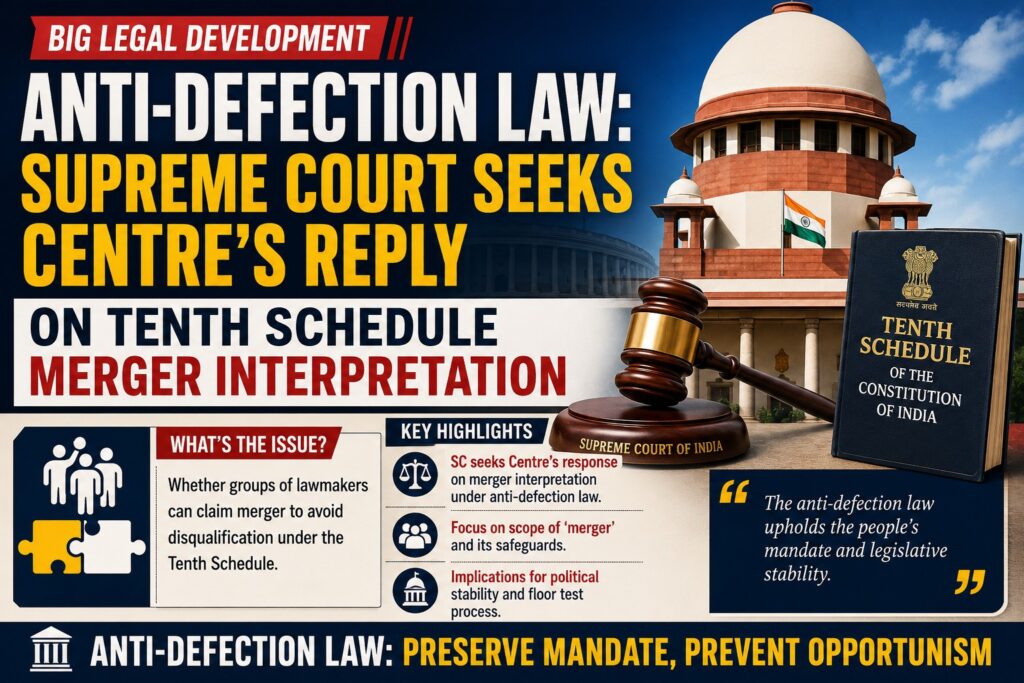
Why in News
The Supreme Court has issued notice on a plea filed by Kapil Sibal challenging the prevailing interpretation of the merger exception under the Tenth Schedule (Anti-Defection Law). The plea, linked to the 2022 Goa defection case, argues that the current interpretation undermines the purpose of the Anti-Defection Law by allowing legislators to avoid disqualification without a genuine party merger.
What is the Merger Exception?
- Paragraph 4 of the Tenth Schedule provides an exception to disqualification in cases of a merger.
- A merger is protected when not less than two-thirds of the legislators of a political party agree to merge with another party.
- The present dispute is whether a legislative party alone can claim a merger, or whether the original political party must also merge.
About the Tenth Schedule (Anti-Defection Law)
- Added by the 52nd Constitutional Amendment Act, 1985.
- Strengthened by the 91st Constitutional Amendment Act, 2003, which removed the earlier exemption for one-third splits.
- Seeks to curb political defections, ensure government stability, and uphold party discipline.
- The Presiding Officer (Speaker/Chairman) decides questions relating to disqualification.
Constitutional Provisions
- Articles 102(2) and 191(2): Provide for disqualification of MPs and MLAs under the Tenth Schedule.
- Tenth Schedule: Contains provisions relating to disqualification on grounds of defection.
Landmark Judgments
- Kihoto Hollohan v. Zachillhu (1992): Upheld the constitutional validity of the Tenth Schedule and held that the Speaker’s decision is subject to judicial review.
- Keisham Meghachandra Singh v. Speaker, Manipur (2020): Directed Speakers to decide disqualification petitions within a reasonable period, ordinarily three months.
Issues with the Current Law
- Delay in deciding disqualification petitions.
- Allegations of partisan conduct by the Speaker.
- Ambiguity regarding the merger exception.
- Weakens representative democracy when mass defections alter electoral mandates.
[2013, GS2, 10M] The role of individual MPs (Members of Parliament) has diminished over the years and as a result healthy constructive debates on policy issues are not usually witnessed. How far can this be attributed to the anti-defection law, which was legislated but with a different intention?”
[2022] With reference to anti-defection law in India, consider the following statements:
1. The law specifies that a nominated legislator cannot join any political party within six months of being appointed to the House.
2. The law does not provide any time-frame within which the presiding officer has to decide a defection case.
Which of the statements given above is/are correct?
(a) 1 only
(b) 2 only
(c) Both 1 and 2
(d) Neither 1 nor 2