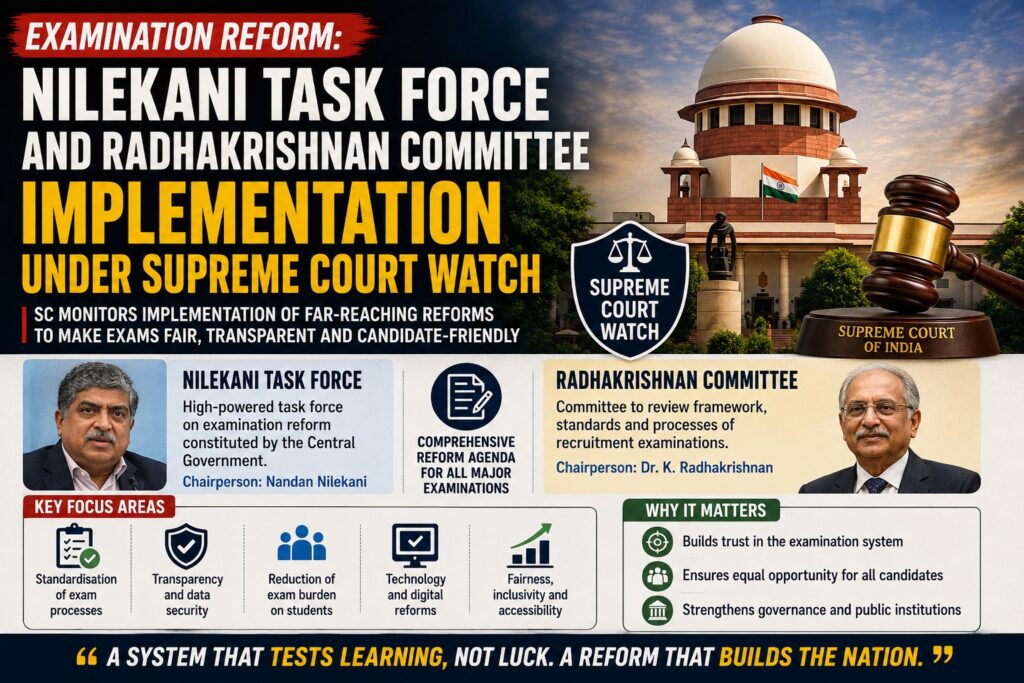
The Supreme Court will consult the Nandan Nilekani-led task force at its next hearing on 3 August 2026 regarding the proposed transition of NEET-UG from a pen-and-paper examination to Computer-Based Testing (CBT). The Court is also examining the government’s progress in implementing the K. Radhakrishnan Committee’s recommendations on examination reforms.
Key Highlights
- Implementation review: The Centre has submitted an affidavit on the implementation status of the 101 recommendations of the K. Radhakrishnan Committee.
- Committee recommendations:
- 60 short-term and 35 medium/long-term reforms.
- Restructuring of the National Testing Agency (NTA).
- Introduction of Computer-assisted Secure Pen-and-Paper Testing (CPPT).
- Adoption of DIGI-EXAM for secure candidate authentication.
- Infrastructure plan: Establishment of 1,000 Secure Testing Centres across the country.
- Related development: Concerns over examination integrity have also emerged in the Jharkhand Combined Civil Services Examination, highlighting the need for broader examination reforms.
About the National Testing Agency (NTA)
- Established in 2017 as an autonomous organisation under the Ministry of Education.
- Conducts major national entrance examinations such as NEET-UG, JEE Main, CUET and UGC-NET.
- Objective is to ensure fair, transparent, efficient and technology-driven examinations.
What is Computer-Based Testing (CBT)?
- Candidates answer questions on a computer terminal instead of paper.
- Responses are digitally recorded and securely transmitted.
- Reduces risks associated with paper leaks, manual handling and evaluation delays.
What is Computer-assisted Secure Pen-and-Paper Testing (CPPT)?
- Question papers are generated digitally and printed securely at authorised centres shortly before the examination.
- Minimises transportation and storage of printed question papers.
- Reduces the possibility of paper leaks while retaining a pen-and-paper examination format.