| Question (2018, GS2): “India’s relations with Israel have, of late, acquired a depth and diversity, which cannot be rolled back. Discuss.” Linkage: This question directly evaluates India’s strategic partnership with Israel. Historically, India’s West Asia policy was heavily anchored in support for the Palestinian cause and the two-state solution. This question asks candidates to analyze how India’s relations with Israel have de-hyphenated from its stance on Palestine, expanding into robust defense, agricultural, and technological cooperation. |
Mentor Comment:
United Nations Security Council Resolution 2803, adopted in November 2025, established a Board of Peace for Gaza, and its annex acknowledges a credible pathway to Palestinian self-determination and statehood once Gaza redevelopment advances and Palestinian Authority reform is carried out. The tension this exposes is that every subsidiary conflict in West Asia turns on a Palestinian state that the war since October 2023 has pushed further out of reach.
What is the two-state solution, and what does it actually require?
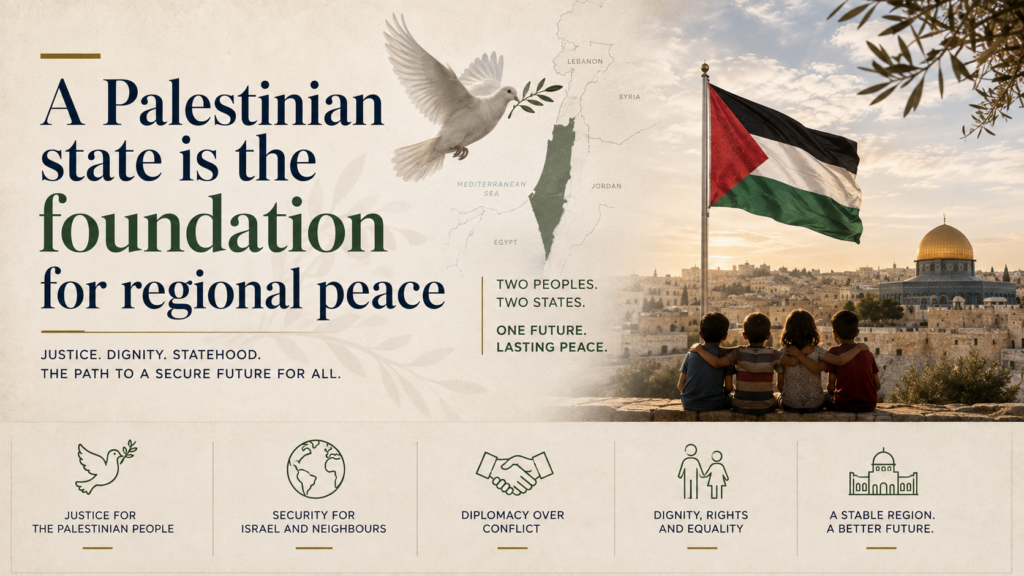
- Core formula: The two-state solution proposes two sovereign states, Israel and Palestine, living side by side in defined borders with mutual recognition.
- The asymmetry inside the phrase: One of the two states already exists, so the operative task is not maintaining a balance but creating a second state that does not yet exist.
- The three qualifying tests: A Palestinian state must be sovereign, independent and viable, meaning it must control its own territory, conduct its own external relations and possess an economic base capable of sustaining a state.
- The claimed consequence: Peace and stability in the region are treated as unattainable until this second state comes into being.
What is Resolution 2803 and the Board of Peace?
- Instrument: United Nations Security Council Resolution 2803, adopted in November 2025, set up a Board of Peace (BoP) as the transitional oversight mechanism for the Gaza Strip.
- The statehood clause: Its annex states that while Gaza redevelopment advances and the Palestinian Authority (PA) reform programme is faithfully carried out, conditions may finally be in place for a credible pathway to Palestinian self-determination and statehood.
Why are the region’s separate conflicts treated as one unresolved question?
- Gaza: Israel’s war on Gaza is framed not as a discrete security operation but as the most violent expression of an unsettled sovereignty question.
- Hezbollah: Hezbollah began launching rockets and missiles at Israel immediately after Israel’s Gaza campaign opened following 7 October 2023, tying the northern front directly to the Palestinian question.
- Iran: The Iran war, Iranian arms supply to Hezbollah and Iranian hostility to Israel are held to rest on the denial of Palestinian self-determination rather than on theological difference.
- The Houthi factor: The Houthi phenomenon in the Red Sea is treated as a further derivative of the same unresolved dispute.
- Arab normalisation: Israel’s relations with its Arab neighbours will remain strained until it accepts the reality of a Palestinian state, in the same way Arab states have reconciled to the reality of Israel.
- The secondary issues: Once an irreversible road map to Palestinian statehood is accepted by all parties, disputes such as freedom of navigation through the Strait of Hormuz become far easier to resolve.
What are the historical roots of regional hostility towards Israel?
- The Balfour Declaration, 1917: British support for a Jewish homeland in Palestine expressly limited the indigenous Arab population to civil and religious rights, converting a holy land claim into a homeland project.
- The founding grievance: Hostility rests on the fact that Israel was created and imposed on the region at the expense of the indigenous Arab population.
- The 1947 partition offer: Palestinians were offered a state under the United Nations resolution of 1947 and on later occasions and rejected each offer, a record an Israeli Foreign Minister summarised as the Arabs never missing an opportunity to miss an opportunity.
- The counter-reading of that rejection: Rejection of a partial offer by a party that holds the underlying title is treated as a defensible refusal rather than as proof of intransigence, since the Zionist slogan itself described the territory as land without people for a people without land.
- The Holocaust and western guilt: Israel’s creation is attributed substantially to the Holocaust and to the sense of guilt felt by western countries, most of which, including the United States, had barred the entry of Jews fleeing Nazi Germany.
- No inherited religious enmity: Islam and Judaism carry no record of perpetual enmity, since the Koran names prophets and patriarchs from the Hebrew bible including Moses and Abraham, the Crusades were fought between Muslims and Christians with Jews not party to them, Jews were persecuted in countries professing Christianity, and the Arabs bore no responsibility for the Holocaust carried out by Nazi Germany and its collaborators.
Why does a Shia axis support a Sunni movement?
- The alignment: Hezbollah, a Shia movement, and Iran, a Shia-majority country, both support Hamas, a Sunni movement.
- The explanation: The alignment rests on a shared commitment to the right of self-determination for the Palestinian people rather than on sectarian affinity.
- Where Israel sits in that logic: Israel attracts hostility as the only power standing in the way of an independent Palestine, not as a religious adversary.
- Iran was not always hostile: Under the Shah, Iran’s relations with Israel were cordial and a sizeable Jewish community lived in Iran.
- The residual community: About 15,000 Jews remain in Iran, and Iran’s Constitution reserves a seat for the Jewish community in Parliament.
- The conditional off-ramp: If Israel accepts a Palestinian state, Hezbollah loses its stated reason to disrupt life in northern Israel and Iran loses its reason to supply Hezbollah with weapons.
Why has the war since October 2023 pushed statehood further away rather than closer?
- Collapse of domestic support: Whatever limited support existed within Israel for the concept of a Palestinian state has evaporated since the Hamas terrorist attack on Israeli civilians in October 2023.
- The cost of the response: Israel’s disproportionate and ruthless strikes on Gaza after 7 October have almost isolated Israel internationally.
- The physical precondition destroyed: The Gaza Strip has been devastated, and with it the territorial and administrative base on which a Palestinian state would have to be built.
- The time horizon pushed out: The possibility of Palestine emerging has receded by many years and possibly decades.
- The resulting deadlock: Peace and stability in the region have become an illusion precisely because the instrument that was to deliver security has removed the conditions for a settlement.
- The development cost: Without peace and stability, the region’s people cannot realise the development potential that new technologies offer.
Why is external mediation, not bilateral negotiation, the only viable route?
- The bargaining asymmetry: The stronger side normally insists on a bilateral approach and the weaker side prefers an outside agency, which is why Israel has insisted on bilateral talks while simultaneously saying there is no one on the other side to negotiate with.
- The only power with leverage: The United States is the only external power with the required influence and residual goodwill with both sides.
- The honest broker objection answered: No broker is genuinely honest, but even a non-honest broker can sell a transaction to the satisfaction, or the equal dissatisfaction, of both parties.
- The single precedent that worked: The only period of real progress came with the Oslo Accord of 1993, negotiated through the mediation and good offices of Norway.
- What Oslo produced: Under Oslo the Palestine Liberation Organization (PLO) formally recognised Israel and the Palestinian Authority was created, and it is a reformed version of that Authority that is now proposed as a caretaker government of Palestine.
- Oslo’s downstream effects: The Accords paved the way for Jordan’s recognition of Israel and eventually for the Abraham Accords.
- The second broker: The United Nations remains the other viable mediator, and although Israel has declared the United Nations Secretary-General persona non grata, Israel owes its existence to the United Nations, and positions in international relations evolve with situations.
- The leadership obstacle: The current Israeli Prime Minister voted against the Oslo Accords and remains opposed to the idea of a Palestinian state.
Conclusion
The West Asian conflict system is not a set of separate wars but one unresolved sovereignty question, and every subsidiary conflict persists because a sovereign, independent and viable Palestinian state has not been created. Resolution 2803 has restored a conditional pathway to statehood in Security Council language, but the material base for that state in Gaza has been destroyed. What remains unaddressed is the absence of leadership on any side willing to accept mediation and convert a conditional pathway into an irreversible road map.
What is the Right of Self-Determination in International Law?
- About: Self-determination is the right of a people to freely determine their political status and pursue their economic, social and cultural development.
- Rationale: It exists to convert the political fact of a distinct people under external or alien rule into a legal claim, so that statehood does not depend solely on the consent of the controlling power.
- Charter basis: It is recorded in Article 1(2) and Article 55 of the United Nations Charter and in Common Article 1 of the two 1966 International Covenants on Civil and Political Rights and on Economic, Social and Cultural Rights.
- External self-determination: The right of a people to determine its international status, including independence, association or integration with another state.
- Internal self-determination: The right of a people to choose its own government and to pursue development within an existing state, without a claim to secession.
- Uti possidetis juris: The principle that new states inherit the administrative boundaries existing at the moment of independence, which limits the redrawing of borders by force.
Key Concerns Regarding the Right of Self-Determination
- Conflict with territorial integrity: The right runs directly against the principle of territorial integrity of existing states, and international law provides no settled test for which prevails.
- No agreed definition of a people: There is no accepted legal test for what constitutes a people entitled to the right, which allows both over-claiming and denial.
- Selective recognition: Recognition of statehood is a political act by individual states, so identical factual situations attract different outcomes depending on great power alignment.
- Enforcement gap: A recognised right of self-determination carries no enforcement mechanism where the controlling power is protected by a Security Council veto.
- Viability threshold: A territory may satisfy the legal criteria for statehood yet lack contiguous territory, revenue base or control over borders, leaving nominal sovereignty without effective sovereignty.
Key Milestones in the Palestine Question
- 1917: The Balfour Declaration records British support for a national home for the Jewish people in Palestine.
- 1947: United Nations General Assembly Resolution 181 proposes partition of Mandate Palestine into an Arab and a Jewish state with Jerusalem under international administration.
- 1948: The State of Israel is declared, followed by the first Arab-Israeli war.
- 1967: The Six Day War brings the West Bank, Gaza, East Jerusalem, the Golan Heights and Sinai under Israeli control, and Security Council Resolution 242 sets out the land for peace principle.
- 1993: The Oslo Accord, mediated by Norway, brings mutual recognition between Israel and the Palestine Liberation Organization and creates the Palestinian Authority.
- 1994: Jordan recognises Israel, following Egypt’s earlier recognition under the 1979 peace treaty.
- 2012: The United Nations General Assembly upgrades Palestine to a non-member observer State.
- 2020: The Abraham Accords normalise Israel’s relations with the United Arab Emirates and Bahrain, later extended to further states.
- 2025: Security Council Resolution 2803 creates the Board of Peace for Gaza and records a conditional pathway to Palestinian statehood.
India’s Position on Palestine and the Two-State Solution
Source: Backgrounder, India-Israel Relations Backgrounder.docx
- Long-standing principled support: India maintains a long-standing principled support for the Palestinian cause and for a negotiated two-state solution.
- De-hyphenation: India separates its Israel policy from its Palestine policy, engaging each on its own terms rather than treating support for one as opposition to the other.
- Recognition timeline: India recognised the State of Israel in 1950 but withheld full diplomatic relations for four decades, shaped by its support for the Palestinian cause, its ties with Arab states and its energy dependence on West Asia.
- Normalisation in 1992: Full diplomatic relations were established in January 1992, in the post-Cold War context and alongside India’s economic liberalisation.
- The 2017 signal: The first visit by an Indian Prime Minister to Israel, in July 2017, elevated the relationship to a Strategic Partnership and notably did not include Ramallah, which signalled de-hyphenation.
- Voting record: India has continued to vote for Palestinian causes at the United Nations even while deepening its ties with Israel.
- The Gulf balance: India’s energy imports, remittance inflows and a large diaspora in Gulf states require its Israel ties to be balanced against Arab partners.
- Strategic autonomy: India frames the Israel relationship as issue-based cooperation and not as alignment against any third party.
Back2Basics: The Palestinian Authority
- Origin: The Palestinian Authority was created under the 1993 Oslo Accord as an interim self-governing body for parts of the West Bank and Gaza.
- Parent body: It was established by the Palestine Liberation Organization, which formally recognised Israel under the same Accord.
- Mandate: It exercises civil and, in designated areas, security administration, with the Oslo framework dividing the West Bank into Areas A, B and C by degree of Palestinian and Israeli control.
- Interim design: It was designed as a transitional arrangement pending a final status agreement covering borders, Jerusalem, refugees and settlements, which was never concluded.
- Current relevance: A reformed Palestinian Authority is the body named in Resolution 2803 as the vehicle through which a pathway to statehood would run.
- Territorial split: Its writ has not extended to Gaza since the 2007 split with Hamas, which is itself a constraint on any single Palestinian government.
Challenges to a Two-State Settlement
- Absence of contiguous territory: A viable Palestinian state requires territorial contiguity that settlement expansion has progressively removed, e.g. the West Bank’s division into Areas A, B and C leaves Palestinian-administered zones as separated enclaves.
- Physical destruction of the state base: Reconstruction must precede governance, since the administrative and economic base has been destroyed, e.g. the devastation of the Gaza Strip after the campaign that followed 7 October 2023.
- Divided Palestinian leadership: No single Palestinian authority commands both territories, e.g. the Palestinian Authority governs parts of the West Bank while Gaza has been under Hamas control since 2007.
- Collapse of political constituencies: Domestic support for a Palestinian state has evaporated inside Israel, e.g. the shift in Israeli opinion after the Hamas attack on Israeli civilians in October 2023.
- Leadership opposition at the top: The settlement requires assent from leaders personally committed against it, e.g. the current Israeli Prime Minister voted against the Oslo Accords and remains opposed to Palestinian statehood.
- Veto-protected deadlock: Security Council action is constrained by permanent member vetoes, e.g. repeated vetoes of ceasefire and membership resolutions have prevented enforceable outcomes.
- Spoiler incentives on both flanks: Armed actors gain standing from continued conflict and lose it from a settlement, e.g. Hezbollah’s rocket campaign against northern Israel began only after the Gaza war opened.
- Refugee and Jerusalem questions unresolved: Final status issues deferred at Oslo remain untouched, e.g. the right of return and the status of East Jerusalem were left to a final agreement that was never negotiated.
Way Forward
- Convert the conditional clause into a road map: Translate the Resolution 2803 annex language on a credible pathway into a sequenced, dated and irreversible road map accepted by all parties.
- Restore a single Palestinian administration: Complete the Palestinian Authority reform programme so that one reformed administration can serve as a caretaker government across both territories.
- Anchor mediation in an external broker: Retain United States mediation, supplemented by United Nations involvement, rather than allowing a return to bilateral talks that the bargaining asymmetry makes unproductive.
- Sequence reconstruction with governance: Tie Gaza reconstruction financing to the standing up of civil administration, policing and revenue functions, so that physical rebuilding creates state capacity rather than only shelter.
- Use regional normalisation as leverage: Make further Arab normalisation with Israel conditional on measurable progress on the statehood pathway, so the Abraham Accords framework reinforces rather than bypasses the Palestinian question.
- Sustain India’s dual-track engagement: Maintain principled support for a negotiated two-state solution alongside development assistance to Palestine and cooperation with Israel, which protects India’s standing across West Asia.
“[2018] The term “two-state solution” is sometimes mentioned in the news in the context of the affairs of (a) China (b) Israel (c) Iraq (d) Yemen Answer: (b)”