💥Mains Ready By December. Smash Mains & Smash PYQ Admissions Open

GS Paper: GS2-20.Important International institutions, agencies and fora- their structure, mandate.

  • IAEA’s board reports Iran to UN Security Council for ‘failure to cooperate in probe’

    Why in the News

    The Board of Governors of the International Atomic Energy Agency (IAEA), the UN nuclear watchdog, has reported Iran to the UN Security Council. The referral cites Iran’s failure to cooperate with a long-running investigation into uranium traces that inspectors detected at undeclared sites. This is the first such referral in 20 years. The step had been under consideration since June 2025, when the Board found Iran officially in non-compliance with its non-proliferation obligations over the same lack of cooperation. Referral opens Iran to sanctions and asset freezes, and Iran’s allies on the Council hold vetoes that make such measures unlikely.

    How did the Board vote?

    1. The margin: Twenty-three of the 35 members of the Board of Governors voted for the resolution at the Agency’s headquarters in Vienna, in a closed-door session.
    2. The opposition: China, Russia and Niger voted against. Eight members abstained and one did not vote because it was in arrears.
    3. The movers: The resolution was put forward by the United States, Britain, France and Germany.

    What is the investigation actually about?

    1. The finding: Inspectors detected uranium traces at sites that Iran had not declared to the Agency.
    2. The Western reading: Western officials suspect the traces could evidence a secret nuclear weapons programme that ran until 2003.
    3. Iran’s stated position: Iran says it is not pursuing nuclear weapons and that its programme is entirely peaceful.

    What does a Security Council referral change?

    1. The formal consequence: Referral opens Iran to possible sanctions and asset freezes decided by the Council.
    2. The practical limit: Russia and China are allies of Iran and hold veto power on the Council, so punitive measures are unlikely to pass.
    3. What it does accomplish: The referral moves a technical safeguards finding onto the agenda of the UN’s political enforcement body.

    How has Iran responded?

    1. Rejection of the resolution: Iran’s Ambassador to the UN in Vienna described the resolution as a “political tool”.
    2. A charge against the Agency: The same response said the resolution ruined confidence in the IAEA’s “independence, impartiality and credibility”.
    3. Access ruled out for the present: Iran indicated that compliance with any obligation to allow UN inspections of nuclear sites inside the country is impossible at the moment.

    Challenges to the IAEA safeguards system

    1. Verification depends on the cooperation of the state being verified: Inspectors reach only what the safeguards agreement and the host state permit. Eg. Iran stopped implementing the Additional Protocol, its expanded access arrangement, in February 2021 and removed Agency surveillance cameras from declared sites in June 2022.
      The Fix: Make continued Additional Protocol implementation a standing condition of any sanctions relief, so access is not the first item traded away.
    2. The Additional Protocol is voluntary: Detection of undeclared activity rests on an instrument states join at their own choice. Eg. Additional Protocols are in force for over 130 states, and several with significant nuclear programmes have never brought one into effect.
      The Fix: Tie nuclear fuel and technology supply to an Additional Protocol in force, so the instrument becomes a condition of trade rather than a favour.
    3. Enforcement stops at the Security Council: The Board can find non-compliance and refer, and only the Council can impose a consequence. Eg. Iran was referred to the Council in 2006 and the sanctions that followed did not end enrichment.
      The Fix: Build graduated Agency-level consequences, such as suspension of technical cooperation and of Board voting rights, that do not require a Council vote.
    4. Referral turns a technical file into a political one: A state that reads a safeguards finding as coercion withdraws the access the finding was meant to secure. Eg. North Korea expelled inspectors in December 2002 and announced withdrawal from the Nuclear Non-Proliferation Treaty (NPT) in January 2003 as its safeguards dispute escalated.
      The Fix: Keep a standing technical channel open alongside the political track, so the inspection relationship survives the escalation.

    Conclusion

    The Board has taken the file as far as its own authority extends. The Council can now take it up and is unlikely to act on it. That leaves an investigation with no route to completion and an inspection relationship that Iran now says it cannot honour. The marker to watch is whether the Agency retains any access inside Iran during the period the matter sits with the Council.

    Back2Basics: International Atomic Energy Agency

    1. Establishment: Set up in 1957 under its own Statute, following the “Atoms for Peace” address to the UN General Assembly in 1953.
    2. Status and reporting: An autonomous organisation within the UN system, headquartered in Vienna, reporting annually to the General Assembly and to the Security Council where required.
    3. Mandate: Promotes peaceful uses of nuclear technology and applies safeguards to verify that nuclear material is not diverted to weapons use.
    4. Safeguards instruments: Comprehensive Safeguards Agreements are required of non-nuclear-weapon states party to the NPT. The Additional Protocol adds inspector access to undeclared locations.

    Matching Previous Year Question

    “[2020] In India, why are some nuclear reactors kept ‘IAEA Safeguards’ while others are not? (a) Some use uranium and others use thorium (b) Some use imported uranium and others use domestic supplies (c) Some are operated by foreign enterprises and others are operated by domestic (d) Some are State-owned and others are privately-owned ANSWER: (b)”
  • Arunachal and Aksai Chin between ‘unspecified’ claim lines on UN-endorsed map

    Why in the News

    A new world map endorsed at the United Nations General Assembly (UNGA) shows Arunachal Pradesh and Aksai Chin as distinct regions lying between Indian and Chinese “claim lines”. The endorsement came through the “Correct the Map” resolution adopted on 4 September 2026, which India backed and voted for. The External Affairs Ministry has stated that its vote covered the underlying principle of promoting equal-area cartographic representation. The Ministry has also stated that the resolution constitutes no endorsement of any specific map, projection or depiction of national boundaries. The contest is over what the vote carried with it. A resolution India supported has put into circulation a boundary depiction India rejects, on a document multilateral institutions worldwide will use.

    What is the “Correct the Map” resolution?

    1. About: It is a UNGA resolution endorsing the Equal Earth cartographic projection, a method that renders every landmass at its true relative area rather than inflating the higher latitudes.
    2. The document it endorsed: The accompanying draft world map was authored by the UN Geospatial office on 1 July 2026 and taken up in informal UNGA consultations.
    3. Its legal weight: The map binds no state, and it will still be used by multilateral institutions worldwide as their reference outline.

    Why did African states push for a new projection?

    1. The founding demand: The African Union supported the Equal Earth projection in March 2026 on the ground that it represents Africa more accurately than the projection then in use.
    2. The framing used: The African Union called this approach “cognitive justice”, treating a distorted world image as a distortion of political standing and not only of geometry.
    3. The route to the Assembly: Togo prompted UNGA consultations on the map in April 2026, and the Assembly opened informal consultations in July 2026.
    4. The sponsorship: Togo sponsored the resolution with African Union support, so the campaign’s centre of gravity sat outside the states whose frontiers the map redraws.

    What does the map show along India’s contested frontiers?

    1. Arunachal Pradesh: The map marks the State’s southern border with Assam as the Chinese line and its northern border as the Indian line, and it eliminates the State’s border with Nagaland altogether.
    2. Aksai Chin: The eastern borders of the region are shown as the Indian line and the western borders as the Chinese line, leaving it as a zone between two competing depictions.
    3. The labelling change: These lines continue earlier UN maps, and unlike the 2011 UN map they are not specified as “claim lines” anywhere on the July 2026 sheet.
    4. Jammu and Kashmir: The map uses a dotted line for the Line of Control (LoC), with a printed note recording that the dotted line represents approximately the LoC agreed upon by India and Pakistan and that the final status of the region has not yet been agreed by the parties.
    5. Kalapani: The depiction runs in India’s favour on the Nepal frontier, reflecting India’s control over the Kalapani-Lipulekh-Limpiyadhura region that Nepal claims.

    Why does India’s vote sit uneasily with the map it endorsed?

    1. The stated basis of the vote: The External Affairs Ministry has framed India’s support as a vote on equal-area representation as a principle, detached from any boundary depiction.
    2. The standing red line: The Ministry’s position is that India’s sovereign territory, including Jammu and Kashmir and Ladakh, must be depicted in accordance with India’s official map, and that any inaccurate or misleading depiction is unacceptable.
    3. The gap the map leaves: No note on the map explains why Arunachal Pradesh and Aksai Chin alone were placed between two claim lines, so the depiction carries no stated cartographic reasoning a state can answer.
    4. The asymmetry in treatment: The disputed status of Jammu and Kashmir is written out in a note on the map, and the northern frontier lines carry no equivalent qualification.

    Challenges to the UN world map’s boundary depiction

    1. A non-binding map still becomes the working outline: Agencies reuse a United Nations base map in reports, datasets and briefings long after the political moment that produced it. Eg. China issued a “standard map” in 2023 placing Arunachal Pradesh and Aksai Chin within its own boundary, and India rejected the depiction formally.
      The Fix: Press for an explicit cartographic note recording the northern lines as unsettled claims, on the pattern the same map already applies to other disputed frontiers.
    2. Third party cartography hardens bilateral disputes: A published depiction gives each side a document to cite in a boundary question only the two states can settle. Eg. Nepal amended its Constitution in 2020 to adopt a map including Kalapani, Lipulekh and Limpiyadhura, and India rejected the amended map.
      The Fix: Route objections through the Working Mechanism for Consultation and Coordination on India-China Border Affairs and the India-Nepal Boundary Working Group rather than through the publisher alone.
    3. Depiction is settled in expert bodies, not in the plenary: Boundary conventions are prepared by geospatial specialists and arrive at member states as a finished draft. Eg. Cartographic standards are developed through the UN Committee of Experts on Global Geospatial Information Management rather than by a floor vote.
      The Fix: Place Indian surveyors and cartographers inside those expert bodies so a depiction is contested at drafting stage rather than after adoption.
    4. Domestic map rules carry no force on foreign publishers: India regulates how its boundaries are shown within its own jurisdiction and holds no equivalent leverage over a document issued abroad. Eg. Foreign platforms have repeatedly shown Jammu and Kashmir with dotted boundaries in editions sold outside India.
      The Fix: Publish the Survey of India’s official outline as a free machine readable dataset, so the authoritative version is the cheapest one for an international user to adopt.

    Conclusion

    A cartographic reform demanded on grounds of equity has produced a frontier depiction India does not accept, on a document India voted to endorse. The projection question and the boundary question travelled together, and only the first was ever put to the Assembly. What to watch is whether the External Affairs Ministry secures a labelling correction from the UN Geospatial office before the map settles into routine multilateral use. The second marker is whether India’s objection is recorded on the sheet itself rather than in a statement alongside it.

    Matching Previous Year Question

    “[2025, GS2, 15 marks] “The reform process in the United Nations remains unresolved, because of the delicate imbalance of East and West and entanglement of the USA vs. Russo-Chinese alliance.” Examine and critically evaluate the East-West policy confrontations in this regard.”

  • India votes in favour of UNGA resolution on new world map

    Why in the News

    India has voted in favour of a United Nations General Assembly resolution aimed at correcting the world map to promote a “more accurate representation” of continental landmasses. The 193-member Assembly adopted the resolution “Correct the map: rebalancing global cartographic representation and promoting equitable representation of the world’s regions, particularly Africa”, which was sponsored by Togo. It encourages governments and institutions around the world to replace the traditional Mercator map with the Equal Earth projection, which “shows locations more accurately”. The resolution carried 164 votes in favour, with a lone vote against from the United States. The question the vote raises is whether a projection designed in the sixteenth century for navigation should continue to set how the world’s regions are seen.

    What is a map projection, and what does the Mercator do to area?

    1. The underlying problem: A projection is the rule for transferring a curved surface onto a flat sheet, and no flat map can preserve shape, area, distance and direction at the same time. Every projection therefore chooses which property to keep and which to sacrifice.
    2. What the Mercator keeps: It preserves angles, so a line of constant compass bearing plots as a straight line. That property is what made it a navigator’s map.
    3. What it sacrifices: Scale grows with distance from the equator, so landmasses near the poles are inflated and those near the equator are compressed. Eg. Greenland reads as roughly the size of Africa, though Africa is about 14 times larger.
    4. What Equal Earth does instead: It is an equal-area projection, so every region occupies its true share of the map’s surface. The cost is a controlled distortion of shape rather than of size.

    What did the Assembly actually adopt?

    1. The instrument is a recommendation: The resolution encourages governments and institutions to switch projection. A General Assembly resolution of this kind carries no binding force on any member state.
    2. The sponsor and the stated purpose: Togo sponsored the text, and its stated aim is the equitable representation of the world’s regions, and of Africa in particular.
    3. The campaign behind it: It carries forward an African Union-backed campaign to limit use of the Mercator map on the ground that visual under-representation reinforces a perception of the continent as peripheral.
    4. India’s vote: India voted in favour, placing it with the large majority rather than with the abstaining or dissenting group.

    What does the voting pattern show?

    1. The scale of support: 164 of the 193 members voted in favour, which is an overwhelming margin for a text with a contested premise.
    2. The single dissent: The United States cast the lone vote against.
    3. The abstentions: Estonia, Georgia, Lithuania, Moldova, Serbia and Ukraine abstained.
    4. What a wide margin does not settle: Adoption records agreement on a principle. It creates no obligation on any national mapping agency, publisher or platform to change what it prints.

    Challenges to replacing the Mercator projection

    1. No projection is politically neutral, and equal-area maps distort in their own way: Preserving area forces a distortion of shape, so a switch trades one visual misrepresentation for another. Eg. The Gall-Peters projection was promoted on the same equity argument in the 1970s and 1980s, and it stretched Africa vertically enough that seven North American geographic bodies passed a joint resolution in 1989 against rectangular projections of that kind.
      The Fix: Pair any recommendation with published guidance on which projection suits which purpose, so a navigation chart and a thematic world map are not held to one standard.
    2. The digital map layer is locked into Mercator by design: Web mapping tiles use a Mercator variant because it keeps north upward and shapes locally correct at every zoom level, which is what makes seamless zooming possible. Eg. Web Mercator underlies the standard tile schemes of the major online mapping services.
      The Fix: Require default map interfaces to switch to an equal-area view at continental and global zoom levels, where the distortion is largest and the navigation property is not being used.
    3. The change has to travel through textbooks and curricula, which move slowly: School atlases, examination material and classroom wall maps are procured on multi-year cycles, so a resolution adopted in one year reaches a classroom several later. Eg. Boston’s public school district switched its classroom maps to an equal-area projection in 2017, and the change stayed confined to that district.
      The Fix: Route the recommendation through national survey agencies and curriculum bodies, which specify the base maps that textbook publishers are obliged to reproduce.

    Conclusion

    The vote settles a question of principle that was never seriously contested and leaves the operative one untouched. What people actually see is set by the default projection of a handful of digital mapping services and by the atlases that education departments procure, and none of them is bound by this text. The measure of the resolution is therefore not the margin it passed by. It is whether a national mapping agency or a major platform changes its default in the year that follows.

    Matching Previous Year Question

    “With reference to the United Nations General Assembly, consider the following statements : 1. The UN General Assembly can grant observer status to the non-member States. 2. Inter-governmental organisations can seek observer status in the UN General Assembly. 3. Permanent Observers in the UN General Assembly can maintain missions at the UN headquarters. Which of the statements given above are correct ? (a) 1 and 2 only (b) 2 and 3 only (c) 1 and 3 only (d) 1, 2 and 3”

  • 128 countries agree text on lethal autonomous weapons

    Why in the News

    Nearly 130 countries have agreed on a text defining lethal autonomous weapons systems (LAWS), called “killer robots” by their critics. The agreement, announced by 128 countries at Geneva, is a first step towards talks on a possible international treaty to regulate them. The text agreed upon has not yet been made public. Campaign groups following the talks say the definition and the measures meant to reduce harm to civilians were watered down before agreement was reached. The contest is between a definition that now exists on paper and a negotiating mandate that several of the largest military powers are resisting.

    What is a lethal autonomous weapons system?

    1. The defining capability: It is a weapon capable of selecting targets and using force against them without human intervention.
    2. The name its critics use: Campaign groups call these systems “killer robots”, and that label has framed the public argument around them.
    3. The category is not hypothetical: Countries are already developing and using weapons with this capability, which is why the definition is being written now rather than ahead of deployment.

    What was agreed at Geneva, and what was left open?

    1. Who agreed: The Dutch Foreign Minister announced the agreement by 128 countries, and the Netherlands has been overseeing the talks.
    2. What the text does: It defines the category of weapon and sets out measures to reduce the possible harmful effects of such weapons on civilians.
    3. What it does not do: It creates no obligation on any state, and it is described only as a first step towards talks on a possible treaty.
    4. Where the decision sits: UN member states will decide at the November talks of the Convention on Certain Conventional Weapons (CCW) whether to move towards a treaty regulating such weapons.

    Why do campaign groups say the outcome is already weakened?

    1. The substance was diluted: One rights group said the text’s definition of an autonomous weapon, and the measures to reduce their possible harmful effects on civilians, appeared to have been watered down.
    2. The named obstruction: The executive director of Stop Killer Robots, an international alliance of campaign groups, accused the United States, Russia and their allies of trying to weaken the agreed text.
    3. The named opponents: Lex International, a Geneva-based philanthropic group that funds work on key policy issues, said the U.S., Russia, India and Israel are among the key opponents of negotiations.
    4. The named sponsors: The same group said the governments of Brazil, Ireland and Norway are leading efforts to get such negotiations started in November.

    What do humanitarian bodies want instead?

    1. The stated warning: The International Committee of the Red Cross (ICRC) said the unconstrained development and use of autonomous weapon systems pose serious legal, ethical and humanitarian challenges.
    2. The demand: The ICRC and several campaigning groups have called for international legally binding rules to restrict and regulate the use of these weapons.
    3. Why a definition alone will not deliver that: The CCW works by consensus, so a single state party can block the opening of treaty negotiations whatever the size of the majority behind them.

    Challenges to regulating lethal autonomous weapons

    1. Nobody is clearly answerable when the machine chooses wrongly: Responsibility for an unlawful strike is split between the commander, the operator, the programmer and the manufacturer, and no existing rule allocates it. Eg. Article 36 of Additional Protocol I to the Geneva Conventions, 1977 requires a state to legally review every new weapon, and there is no shared standard for reviewing software whose behaviour changes after deployment.
      The Fix: Require states to publish the methodology of their Article 36 reviews for autonomous systems, so the review becomes checkable rather than declaratory.
    2. States do not agree on how much human control is enough: The negotiations have run for a decade on competing formulations, and a treaty cannot be drafted around a threshold nobody has fixed. Eg. “Meaningful human control”, “appropriate human judgement” and “human-machine interaction” have all been advanced as the operative test at the Group of Governmental Experts on LAWS.
      The Fix: Settle one operative term in the agreed text before the negotiating mandate is voted on, rather than after.
    3. Verification cannot see software: Arms control regimes are built to count and inspect physical objects, and autonomy is a line of code that can be loaded or removed before an inspection. Eg. The Chemical Weapons Convention, 1993 verifies a declared substance at a declared facility, and the same inspection tells an inspector nothing about a targeting algorithm.
      The Fix: Shift verification onto declared doctrine, test logs and procurement records, which are documentary and can be audited.
    4. The technology diffuses through civilian supply chains: Autonomy rides on commercial drones, cameras and machine vision software that no arms control list covers. Eg. Commercially available quadcopters have been modified for strike use at scale in the Russia-Ukraine war.
      The Fix: Add autonomous targeting software and machine vision payloads to the dual-use control lists of the Wassenaar Arrangement, so transfers are licensed rather than untracked.

    Conclusion

    A definition is the cheapest thing a negotiation can produce, and it has taken a decade to produce this one. The states that field the most advanced autonomous systems are the ones resisting a mandate to negotiate, which means the majority behind the text does not translate into a treaty. The next meeting of the Convention’s states parties is where that gap is either closed or carried forward. Whether the agreed definition survives publication intact is the first thing to check when the text is released.

    Back2Basics: Convention on Certain Conventional Weapons

    1. What it is: The Convention on Prohibitions or Restrictions on the Use of Certain Conventional Weapons Which May Be Deemed to Be Excessively Injurious or to Have Indiscriminate Effects was adopted at Geneva in 1980 and entered into force in 1983.
    2. How it is structured: It is a framework convention that carries no prohibitions itself, and the substantive bans sit in protocols that states join separately.
    3. The protocols: Five protocols cover non-detectable fragments, mines and booby-traps, incendiary weapons, blinding laser weapons and explosive remnants of war.
    4. India’s position: India is a party to the Convention, and the LAWS discussion has been conducted within its Group of Governmental Experts rather than in a separate forum.

    Matching Previous Year Question

    “With reference to ‘Organisation for the Prohibition of Chemical Weapons (OPCW)’, consider the following statements: 1. It is an organization of European Union in working relation with NATO and WHO. 2. It monitors chemical industry to prevent new weapons from emerging. 3. It provides assistance and protection to States (Parties) against chemical weapons threats. Which of the statements given above is/are correct? (a) 1 only (b) 2 and 3 only (c) 1 and 3 only (d) 1, 2 and 3”

  • ‘UN Convention on the Law of the Sea is still the constitution of oceans’

    ‘UN Convention on the Law of the Sea is still the constitution of oceans’

    Why in the News

    The United Nations Convention on the Law of the Sea (UNCLOS) remains the governing framework for the world’s oceans, in the assessment of Tommy Koh. He presided over the Third United Nations Conference on the Law of the Sea, and led more than 150 nations to adopt the Convention in 1982. He is among this year’s Ramon Magsaysay award winners. He puts the number of parties at 172 and treats that as near universal. The United States has never ratified the Convention and still regards it as the authoritative law of the sea. Iran is not a party either, and the regime of transit passage binds it as customary international law. The Convention’s authority is therefore being tested in the Strait of Hormuz against a state that never accepted the treaty.

    What is UNCLOS?

    1. What it is: A comprehensive treaty setting the legal order for the world’s oceans, adopted in 1982 after nine years of negotiation and in force since 1994.
    2. What it allocates: It fixes the maritime zones a coastal state may claim and the rights it holds in each, running outward from the territorial sea to the exclusive economic zone, the continental shelf and the high seas.
    3. What it does with the deep seabed: Part XI treats the deep seabed and its minerals as the “common heritage of mankind”, to be administered for all states rather than claimed by any one of them.
    4. Why it is described as a constitution: It settles jurisdiction, resource rights and dispute settlement in one instrument, so later ocean agreements are negotiated inside its framework rather than beside it.

    Why has the United States never ratified UNCLOS?

    1. The objection was to the seabed regime, not to the law of the sea: The Reagan Administration rejected Part XI as incompatible with free enterprise and private property norms.
    2. It reversed an earlier American position: The stance taken during the Carter Administration was changed under President Reagan, and the demands that followed were rejected by the developing countries.
    3. The 1994 repair did not change the outcome: A separate agreement in 1994 revised the Part XI arrangements to meet those objections, and ratification still did not follow.
    4. Non ratification is not confined to one objector: Iran and a number of other states have also stayed outside the Convention.

    What binds a state that is not a party?

    1. The count itself does the work: With 172 parties, the Convention’s rules describe general state practice rather than the internal arrangements of a treaty club.
    2. Custom reaches the non party: Transit passage through international straits has passed into customary international law, so it binds Iran although Iran never joined the Convention.
    3. The dispute is political rather than legal: There was no trouble in the Strait of Hormuz before the war, so the priority is ending the war rather than rewriting the law that governs the strait.
    4. A fourth conference answers the wrong question: Reopening the Convention to bring the remaining states in would put a settled architecture back on the negotiating table, and near universal participation already exists without it.

    Where does the Convention not reach?

    1. Dark fleet enforcement is happening outside it: States are designating vessels as a “dark fleet” and taking punitive material action against them, including on the high seas.
    2. The forum named for that problem is the IMO: The International Maritime Organization, rather than a law of the sea conference, is where the practice should be addressed.
    3. Boundary disputes are read as application, not failure: Exclusive economic zone and seabed contests in the South China Sea and over Indian Ocean boundaries are treated as arguments inside the Convention’s architecture rather than as evidence that the architecture has stopped working.

    Conclusion

    A treaty honoured by states that never signed it is strong in one sense and weak in another. Its rules describe how states actually behave, which is precisely what turns them into custom. It carries no way of compelling a state that decides to behave differently, because the states outside it are the ones its dispute settlement machinery cannot reach. That gap is where a closed strait sits, and no further round of accessions would close it.

    Back2Basics: International Maritime Organization

    1. What it is: The United Nations specialised agency responsible for the safety and security of shipping and for preventing marine pollution by ships.
    2. When it was established: It was created by a convention adopted in 1948, began functioning in 1959, and is headquartered in London.
    3. What it produces: Its principal instruments are the International Convention for the Safety of Life at Sea (SOLAS) and the International Convention for the Prevention of Pollution from Ships (MARPOL).
    4. How it enforces: It sets standards that flag states then apply to ships registered with them, so it regulates through member state implementation rather than by direct enforcement at sea.

    [2022] With reference to the United Nations Convention on the Law of Sea, consider the following statements :

    1. A coastal state has the right to establish the breadth of its territorial sea up to a limit not exceeding 12 nautical miles, measured from baseline determined in accordance with the convention.

    2. Ships of all states, whether coastal or land-locked, enjoy the right of innocent passage through the territorial sea.

    3. The Exclusive Economic Zone shall not extend beyond 200 nautical miles from the baseline from which the breadth of the territorial sea is measured.

    Which of the statements given above are correct ?

    (a) 1 and 2 only

    (b) 2 and 3 only

    (c) 1 and 3 only

    (d) 1, 2 and 3

  • Magsaysay honour for Myanmar activist, Singapore lawyer, Bangladeshi aid giver

    Magsaysay honour for Myanmar activist, Singapore lawyer, Bangladeshi aid giver

    Why in the News

    The 2026 Ramon Magsaysay Awards have been announced for a Singaporean lawyer and diplomat, a Myanmar democracy activist and a Bangladeshi development worker. The award is administered from Manila and is commonly described as Asia’s Nobel Prize. The exam value of the announcement sits in the award’s origin and administering body and in the identity of its laureates rather than in the announcement itself.

    About the Ramon Magsaysay Award

    1. Instituted in 1957: It was created in memory of Ramon Magsaysay, the third President of the Philippines, who died in an aircraft crash that year.
    2. Founding body: The trustees of the Rockefeller Brothers Fund established the award with the agreement of the Philippine government.
    3. Administering body: The Ramon Magsaysay Award Foundation, based in Manila, selects and confers the awards each year.
    4. Scope: It honours individuals and organisations of Asian origin for greatness of spirit and transformative leadership in Asia.
    5. Presentation date: The awards are conferred around 31 August, the birth anniversary of Ramon Magsaysay.
    6. Categories were discontinued: The five original categories, including Government Service and Community Leadership, were set aside in 2009, and the Emergent Leadership category added in 2001 continued alongside awards given without a fixed category.

    Who are the 2026 laureates?

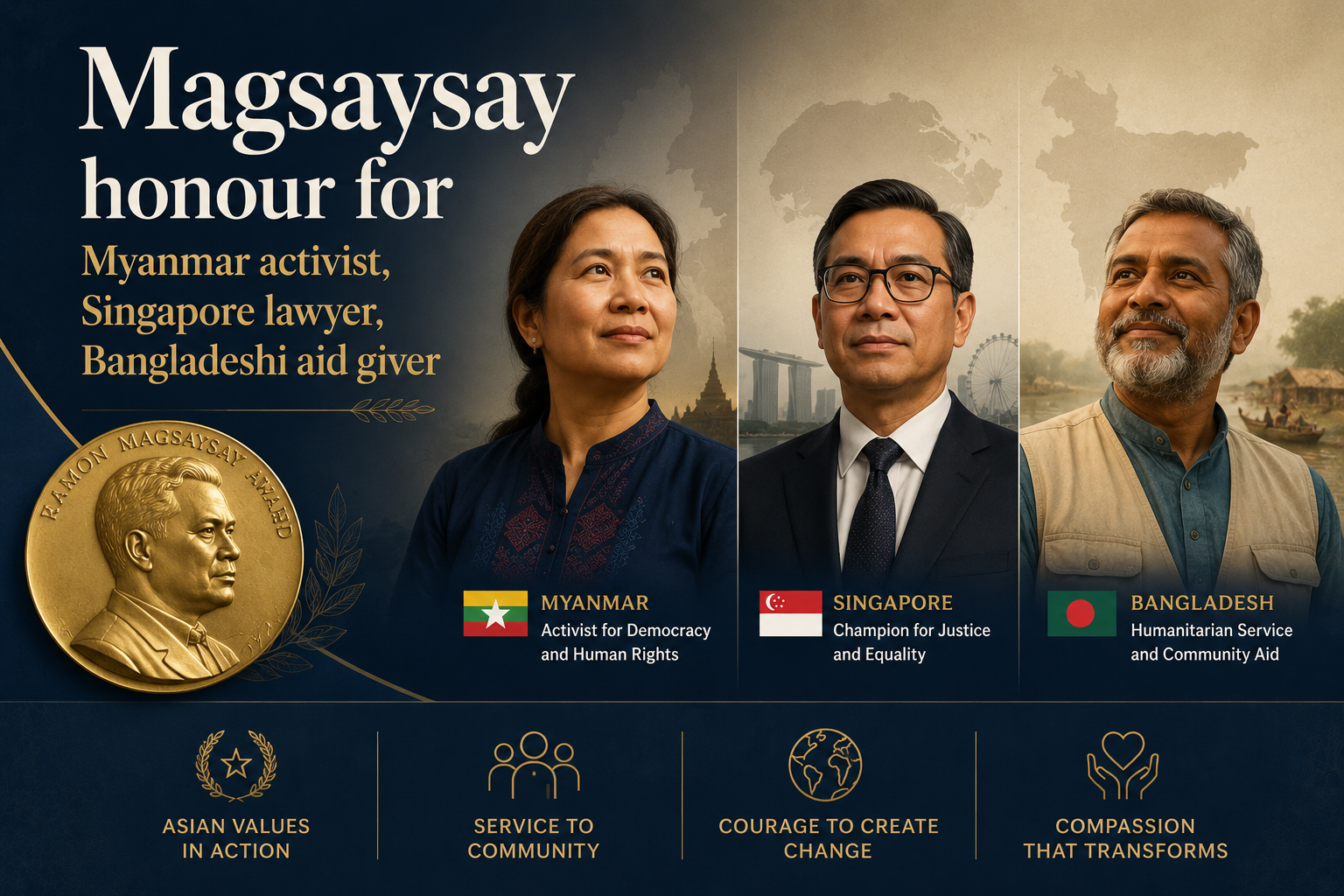
    1. Tommy Koh, Singapore: The 88 year old lawyer and diplomat was recognised for promoting international dialogue and the rule of law. He presided over the United Nations conference of more than 150 countries that adopted the United Nations Convention on the Law of the Sea (UNCLOS) in 1982, described by the awards body as a “constitution for the oceans” that defined territorial waters and coastal economic rights.
    2. Bo Kyi, Myanmar: The 61 year old activist spent seven years in prison and was recognised for a life spent in resistance to human rights violations by Myanmar’s military. He organised the Assistance Association for Political Prisoners in March 2000 with fellow former political prisoners, which documents political imprisonment and supports detainees and their families.
    3. Runa Khan, Bangladesh: The 67 year old was recognised for her empathy for the poorest in her country, having first taught poor children in 1979. She established Friendship Bangladesh in 2002, which works on climate change adaptation, education, women’s empowerment, livelihoods and social justice for excluded groups.

    Which Indians have received the award?

    1. The first Indian recipient: Vinoba Bhave received the award in 1958 for Community Leadership.
    2. Early Indian laureates: Mother Teresa in 1962, Verghese Kurien in 1963, Jayaprakash Narayan in 1965, Satyajit Ray in 1967 and M.S. Subbulakshmi in 1974 are among them.
    3. Later Indian laureates: Kiran Bedi in 1994, Arvind Kejriwal in 2006, T.M. Krishna and Bezwada Wilson in 2016, Sonam Wangchuk in 2018 and Ravish Kumar in 2019 have received it.
    4. India’s standing: India has more recipients of the award than any country other than the Philippines itself.

    Conclusion

    The 2026 laureates have been announced and the awards are conferred at a ceremony in Manila. The next milestone is that ceremony, and the testable content of this item is the award’s origin, its administering foundation and the identity and work of its laureates.

    [2025] Who amongst the following are members of the Jury to select the recipient of ‘Gandhi Peace Prize’?

    I. The President of India

    II. The Prime Minister of India

    III. The Chief Justice of India

    IV. The Leader of Opposition in the Lok Sabha

    Select the correct answer using the code given below:

    (a) II and IV only

    (b) I, II and III

    (c) II, III and IV

    (d) I and III only

  • V-Dem’s democracy index rates India at its lowest since 1975

    V-Dem’s democracy index rates India at its lowest since 1975

    Why in the News?

    India is in the news after the UN Committee on the Elimination of Racial Discrimination (CERD) expressed serious concern over reported large-scale violations by law enforcement agencies and the exclusion of voters, particularly Muslims, during the Special Intensive Revision (SIR) of electoral rolls. The issue has gained further attention because the V-Dem Institute has also classified India among countries experiencing gradual autocratisation, reporting a decline in its electoral democracy score.

    About the V-Dem Institute

    1. Host and status: Varieties of Democracy (V-Dem) is an independent research institute based at the Department of Political Science, University of Gothenburg, Sweden.
    2. Method: It uses a multidimensional approach to conceptualising and measuring democracy, aggregating ratings supplied by country experts rather than issuing a single composite judgement.
    3. Five principles measured: The dataset is organised around the electoral, liberal, participatory, deliberative and egalitarian principles of democracy.
    4. Flagship output: It publishes an annual Democracy Report, releasing the index in March and naming the countries it assesses as autocratising or democratising.

    About the Electoral Democracy Index

    1. What it measures: It scores how far the ideal of electoral democracy is achieved in a country, on a scale from 0 to 1.
    2. Its conceptual base: It builds on the polyarchy concept, which requires elected officials, free and fair elections, freedom of expression, alternative sources of information, freedom of association and inclusive suffrage.
    3. Regime classes: V-Dem sorts countries into closed autocracy, electoral autocracy, electoral democracy and liberal democracy.
    4. The comparator to know: The Economist Intelligence Unit’s Democracy Index is a separate exercise, scoring 60 indicators from 0 to 10 across five categories and classifying India as a flawed democracy.

    India in the latest reading

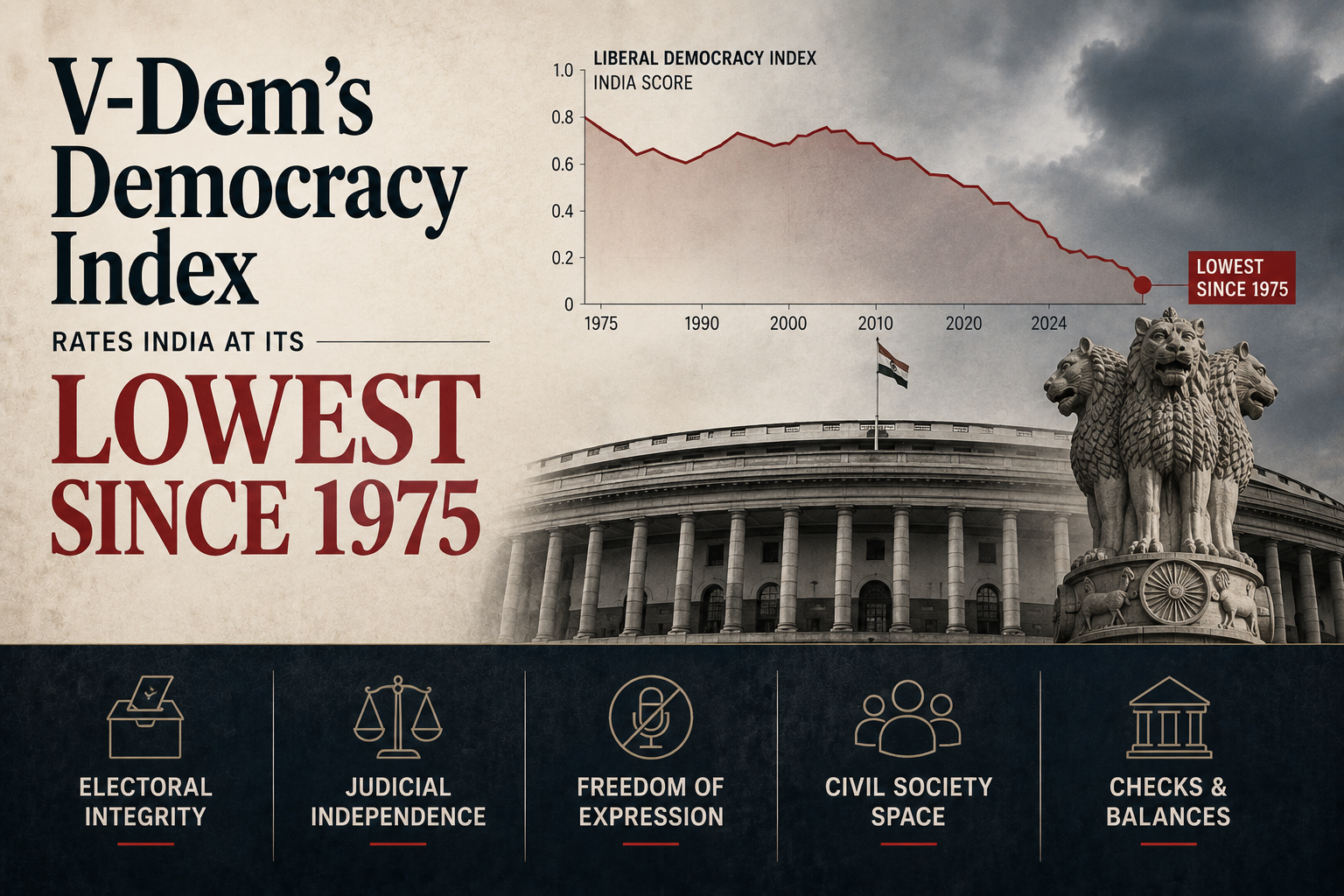
    1. The score is a 50 year low: India’s electoral democracy index score was 0.38 in 2025, below the 0.39 recorded in 1975 under Emergency rule.
    2. The ranking: India stands 106th among 179 countries, against Denmark at the top with a score of 0.9 in 2025.
    3. The classification: V-Dem lists India among countries autocratising slowly, with a systematic dismantling of democratic institutions.
    4. The decline is not new: India’s performance on the index has fallen gradually since 2009.
    5. The parameters at 50 year lows: Judicial accountability and judicial corruption, autonomy of the Election Management Body (EMB), impartial administration by public officials, media freedom and academic freedom are all at their lowest in 50 years.
    6. A parallel United Nations finding: The Committee on the Elimination of Racial Discrimination, in its first review of India since 2007, recorded grave concern over reports of large-scale violations by law enforcement officials and over the exclusion of large numbers of voters, Muslims in particular, under the Special Intensive Revision of electoral rolls.

    [2016] Which of the following is/are the indicator/ indicators used by IFPRI to compute the Global Hunger Index Report?

    1. Undernourishment

    2. Child stunting

    3. Child mortality

    Select the correct answer using the code given below.

    (a) 1 only

    (b) 2 and 3 only

    (c) 1, 2 and 3

    (d) 1 and 3 only

  • UN panel presents legal case for broad slavery reparations

    Why in the News

    The United Nations Committee on the Elimination of Racial Discrimination (CERD) has issued a fresh interpretation of the International Convention on the Elimination of All Forms of Racial Discrimination, 1965.

    What is a general recommendation, and what weight does it carry?

    1. It is a treaty body’s authoritative reading of the text: A general recommendation is an interpretation of a convention’s provisions issued by the expert committee that monitors it, addressed to every State party rather than to one government.
    2. It creates no new obligation: The instrument does not amend the convention. It states what the committee holds the existing text already requires.
    3. It is unenforceable but not without effect: The findings carry authoritative weight and can inform judicial review, serve courts as an interpretative tool, and be relied on in litigation.

    What does the interpretation require of States parties?

    1. The measures must be comprehensive: States parties are required to implement reparatory measures for people of African descent covering all aspects of remedies.
    2. Three classes of measure are named: Reparatory justice is stated to combine a wide range of measures conceived as monetary, non monetary and structural.
    3. Indirect involvement is included: The duty attaches to States that profited from or facilitated the trade, not only to those that transported and sold people.
    4. Redress is framed as an obligation: The Committee treats reparation as flowing from the convention itself rather than as a policy choice available to a government.

    What is the historical record the finding rests on?

    1. At least 12.5 million Africans were taken and sold: The Committee places that transport and sale between the fifteenth and nineteenth centuries.
    2. It is characterised as the largest forced displacement in history: That characterisation is the basis on which the Committee treats the harm as continuing rather than closed.
    3. The United Nations has already classed slavery a crime against humanity: The Durban Declaration and Programme of Action, adopted at the World Conference against Racism in 2001, recorded slavery and the slave trade as crimes against humanity.
    4. A standing forum already exists: The General Assembly established the Permanent Forum on People of African Descent in 2021 as an advisory body on the rights of that population.
    5. The observance period has been extended: The International Decade for People of African Descent ran from 2015 to 2024, and a second decade was proclaimed for 2025 to 2034.

    Challenges to reparations for the transatlantic slave trade

    1. No forum can compel a State to pay: The Committee reviews reports and issues findings, and it holds no power to order a remedy against a State party. Eg. An inter-State claim under the convention reaches the International Court of Justice only where both States accept that jurisdiction, and several former slave trading States have entered reservations to the clause.
      The Fix: Route the claim through a negotiated inter-governmental commission with a fixed mandate and a reporting cycle, so the obligation is settled by agreement rather than left to a forum neither side can reach.
    2. Successor States dispute liability for pre-independence conduct: A modern government argues it is not the legal person that carried on a trade abolished two centuries ago. Eg. The United Kingdom has expressed regret for the slave trade and has declined to accept legal liability for reparations.
      The Fix: Separate acknowledgement from transfer by fixing a development finance commitment tied to identified harms, which avoids the succession question without abandoning the remedy.
    3. Quantifying the harm has no accepted method: Monetary, non monetary and structural measures rest on different bases, and no agreed formula converts historical injury into a present figure. Eg. The Caribbean Community’s Ten Point Plan for Reparatory Justice, adopted in 2013, sets out categories of remedy without attaching a sum to any of them.
      The Fix: Commission a standing statistical exercise on health, education and land outcomes for the affected population, so remedies are sized against measurable present day gaps.
    4. Domestic litigation fails on procedure before it reaches merit: Claims are dismissed on limitation, standing and sovereign immunity rather than decided on the underlying wrong. Eg. Reparations suits filed in United States courts against corporations linked to slavery were dismissed on standing and limitation grounds.
      The Fix: Enact a statutory limitation waiver for historic gross rights violations, which is what allowed residential school and forced sterilisation claims to be heard in other jurisdictions.
    5. A non binding finding can harden a State’s position: A government that rejects the interpretation gains a reason to disengage from the reporting process the Committee depends on. Eg. Treaty body reporting is already years in arrears across the system, with overdue State reports running into the hundreds.
      The Fix: Pair the interpretation with a technical assistance track, so a State that accepts the framing has a route to comply that does not begin with a payment.

    Conclusion

    The Committee has moved reparations from a political demand to a stated treaty obligation. What it cannot supply is the machinery that would make the obligation operate. The unresolved tension is that the same text a claimant will now cite in court is one a government can decline to act on without breaching anything enforceable. The point to watch is whether a national court anywhere treats the interpretation as a live legal standard rather than as commentary.

    Back2Basics: Committee on the Elimination of Racial Discrimination

    1. Parent instrument: Created by the International Convention on the Elimination of All Forms of Racial Discrimination, 1965, which entered into force in 1969.
    2. Composition: Eighteen independent experts elected by States parties, serving in their personal capacity rather than as government representatives.
    3. Core function: It examines periodic reports from States parties on the measures taken to give effect to the convention.
    4. Additional procedures: It operates an early warning and urgent action procedure, and it can consider individual complaints against a State that has made a declaration under Article 14.

    [2017, GS2, 10 marks] What are the main functions of the United Nations Economic and Social Council (ECOSOC)? Explain different functional commissions attached to it.”

  • Insurers can invest in NDB’s onshore rupee bonds, says IRDAI

    Insurers can invest in NDB’s onshore rupee bonds, says IRDAI

    Why in the News

    The Insurance Regulatory and Development Authority of India (IRDAI) has permitted insurers to invest in Maharajah INR Bonds, the onshore rupee bonds of the New Development Bank (NDB). The approval follows a representation from the NDB seeking clearance for the bonds, under which the bank proposes to raise Rs 25,000 crore over a five year period. The move assumes significance ahead of next month’s BRICS Summit in New Delhi.

    What is a Maharajah INR Bond?

    1. Definition: It is an onshore rupee bond issued in the Indian market by the New Development Bank.
    2. Purpose: Proceeds are intended to be raised over a five year period, totalling Rs 25,000 crore, for general corporate purposes and for financing or onward lending to sustainable development, sustainable infrastructure, and green and social projects in India.
    3. Legal classification: IRDAI has clarified that the proposed onshore rupee bond issuances by the NDB fall under the definition of securities under the Securities Contracts (Regulation) Act, 1956.

    What has IRDAI approved and why does it matter now?

    1. The approval itself: IRDAI communicated its approval to insurers through a circular, permitting them to invest in the NDB’s Maharajah INR Bonds.
    2. What triggered it: The approval follows a representation from the NDB seeking clearance for the bond programme.
    3. Its timing: The approval assumes significance ahead of next month’s BRICS Summit in New Delhi, where the New Development Bank’s fundraising plans are likely to draw attention.

    Under what conditions can insurers invest, and what is the intent behind the approval?

    1. Widening the investment universe: IRDAI is permitting the investment to give insurers more scope for investments.
    2. Regulatory treatment: The investment will be treated as part of insurers’ approved investments and remains subject to norms laid down by the Government of India and to SEBI (Securities and Exchange Board of India) approval, among other conditions.
    3. Who stands behind the bonds: The New Development Bank is a multilateral development bank established by Brazil, Russia, India, China and South Africa, the BRICS grouping.

    Conclusion

    IRDAI’s approval is a procedural but enabling step that widens the pool of domestic capital available to the New Development Bank ahead of the BRICS Summit in New Delhi. How much of the proposed Rs 25,000 crore is actually raised will depend on the bond issuance itself and on insurer appetite once it opens.

    Back2Basics: New Development Bank

    1. Formation: The New Development Bank was established in 2014 under the founding agreement of the BRICS grouping and became operational the following year.
    2. Headquarters: It is headquartered in Shanghai, China.
    3. Mandate: It mobilises resources for infrastructure and sustainable development projects in BRICS and other emerging and developing economies.
    4. Membership: It has since expanded its membership beyond its five founding countries to include other developing nations.

    [2014] “India has recently signed to become founding a New Development Bank (NDB) and also the Asian Infrastructure Investment Bank (AIIB). How will the role of the two Banks be different? Discuss the significance of these two Banks for India.”

  • UN panel flags ‘human rights violations’ in India, urges Delhi to suspend, review NRC

    UN panel flags ‘human rights violations’ in India, urges Delhi to suspend, review NRC

    Why in the News

    The UN Committee on the Elimination of Racial Discrimination (CERD) has released concluding observations, following its eleventh periodic review of India on August 11-12, criticising the implementation of the National Register of Citizens (NRC) in Assam and calling for its suspension. This is a One development, one row item; The Hindu and The Indian Express both carried the Committee’s findings, and this entry is filed from the Indian Express account, which reports the call to suspend the NRC and the Committee’s specific concern about the Special Intensive Revision (SIR) process, in more detail.

    What did the Committee find, and what did it call on India to do?

    1. The Committee criticised the NRC’s implementation in Assam: It found that the process subjected Bengali-speaking Muslims to what it described as “systematic and structural racial discrimination,” and called for the NRC to be suspended and India’s legislative framework around it to be reviewed.
    2. The Special Intensive Revision process was separately flagged: The Committee raised concern that Bengali-speaking Muslim voters were reportedly disproportionately affected by the Election Commission’s SIR process in West Bengal and Assam.
    3. The Committee’s concern extends to Scheduled Castes, Scheduled Tribes, and Rohingya refugees: It said it was “gravely concerned” about reports of large-scale violations by law enforcement officials against ethnic and ethno-religious groups, including Scheduled Tribes, Scheduled Castes (particularly Dalits), and non-citizens, and cited allegations of racially motivated violence, excessive use of force, extrajudicial killings, arbitrary detention, torture and sexual violence.
    4. It called for accountability, not merely acknowledgement: The Committee asked India to conduct prompt, thorough and impartial investigations into these allegations and ensure accountability for those responsible, and to urgently address hate speech and hate crimes against Rohingya, Bengali-speaking Muslims, migrants and asylum-seekers.
    5. India’s response came through its review delegation: India sent the Solicitor-General as head of delegation for the underlying periodic review held on August 11-12, ahead of these concluding observations.

    Conclusion

    CERD’s concluding observations place NRC suspension, a review of the associated legislative framework, and law enforcement accountability toward Scheduled Castes, Scheduled Tribes and Rohingya refugees on record as a formal treaty-body finding against India, made under the same UN human rights review process, rather than as commentary on a single incident, with India’s substantive reply yet to be reported.

    Back2Basics

    1. UN Committee on the Elimination of Racial Discrimination (CERD): The treaty body of independent experts that monitors States parties’ implementation of the International Convention on the Elimination of All Forms of Racial Discrimination (ICERD), which India ratified in 1968, through periodic reviews and concluding observations.
    2. National Register of Citizens (NRC), Assam: A register, first prepared in 1951 and updated under Supreme Court supervision, intended to identify genuine Indian citizens in Assam by excluding illegal migrants, particularly in the context of the Assam Accord (1985).