Mains Ready By December. Smash Mains & Smash PYQ Admissions Open

GS Paper: GS3

  • Solar Orbiter (SolO) Probe


    Yesterday, the Solar Orbiter, a collaborative mission between the European Space Agency and NASA to study the Sun, took off from Cape Canaveral in Florida.

    What is the Solar Orbiter?

    • Carrying four in situ instruments and six remote-sensing imagers, the Solar Orbiter (called SolO) will face the sun at approximately 42 million kilometres from its surface.
    • Before SolO, all solar imaging instruments have been within the ecliptic plane, in which all planets orbit and which is aligned with the sun’s equator.
    • The new spacecraft will use the gravity of Venus and Earth to swing itself out of the ecliptic plane, passing inside the orbit of Mercury, and will be able to get a bird’s eye view of the sun’s poles for the first time.

    Objectives of the mission

    • The Orbiter will take pictures using telescopes through a heat shield that is partly made of baked animal bones, to help it withstand temperatures of up to 600 degree Celsius.
    • By understanding the behaviour of the sun, the Orbiter aims to provide information on how the former would affect technology such as satellites, navigation systems, power grids, and telecommunication services.
    • The Orbiter will help scientists understand the sun’s dynamic behaviour, and solve mysteries such as the sunspot cycle, or why the star spews out high velocity charged particles through the solar system.
    • With more data on the global magnetic field of the star, scientists would be able to forecast space weather events.

    Earlier missions

    • In 1990, NASA and ESA had sent the Ulysses mission, which also passed over the sun’s poles but at much farther distances, and did not carry a camera.
  • [pib] 13th COP of the Convention on the Conservation of Migratory Species of Wild Animals (CMS)


    The 13th Conference of Parties (COP) of the Convention on the Conservation of Migratory Species of Wild Animals (CMS) is going to be hosted by India at Gandhinagar in Gujarat.

    13th COP of CMS

    • The theme of CMS COP13 in India is, “Migratory species connect the planet and we welcome them home.
    • The CMS COP 13 logo is inspired by ‘Kolam’, a traditional artform from southern India.
    • In the logo of CMS COP-13, Kolam art form is used to depict key migratory species in India like Amur falcon, humpback whale and marine turtles.
    • The mascot for CMS COP13, “Gibi – The Great Indian Bustard” is a critically endangered species which has been accorded the highest protection status under the Wildlife Protection Act, 1972.

    About CMS

    • CMS is an international treaty concluded under aegis of UN Environment Programme (UNEP), concerned with conservation of wildlife and habitats on a global scale.
    • It is commonly abbreviated as Convention on Migratory Species (CMS) or the Bonn Convention.
    • It aims to conserve terrestrial, marine and avian migratory species throughout their range.
    • It was signed in 1979 in Bonn (hence the name), Germany and entered into force in 1983.
    • Its headquarters are in Bonn, Germany.
    • CMS is only global and UN-based intergovernmental organization established exclusively for conservation and management of terrestrial, aquatic and avian migratory species throughout their range.

    Prospects for India

    • As the host, India shall be designated the President for the next three years.
    • India is Signatory to the CMS since 1983.
    • India has been taking necessary actions to protect and conserve migratory marine species.
    • Seven species that include Dugong, Whale Shark, Marine Turtle (two species), have been identified for preparation of Conservation and Recovery Action Plan.

    Other facts

    • The Indian sub-continent is also part of the major bird flyway network, i.e, the Central Asian Flyway (CAF) that covers areas between the Arctic and Indian Oceans, and covers at least 279 populations of 182 migratory water bird species, including 29 globally threatened species.
    • India is home to several migratory species of wildlife including snow leopard, Amur falcons, bar headed Geese, black necked cranes, marine turtles, dugongs, humpbacked whales, etc.
    • It has signed non legally binding MOU with CMS on the conservation and management of Siberian Cranes (1998), Marine Turtles (2007), Dugongs (2008) and Raptors (2016).
  • [pib] Godavari and Cauvery River Linking Project


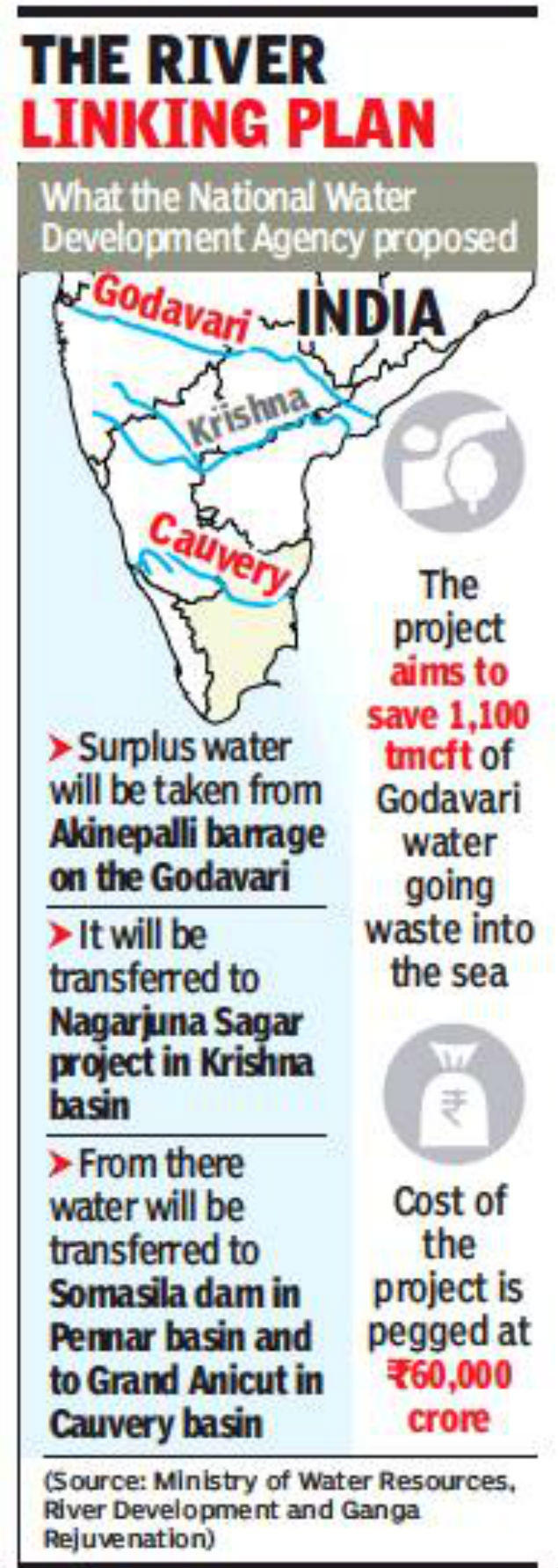
    The draft Detailed Project Report (DPR) of the Godavari and Cauvery River Linking Project has been completed by National Water Development Agency (NWDA).

    Godavari– Cauvery Link Project

    • The project consists of 3 links viz., Godavari (Inchampalli/Janampet) – Krishna (Nagarjunasagar), Krishna (Nagarjunasagar) – Pennar (Somasila) and Pennar (Somasila) – Cauvery (Grand Anicut).
    • This proposal to link Godavari, which is prone to flooding, and Krishna, which doesn’t have enough water, has been around for several decades.
    • While river-interlinking for the purposes of navigation as an idea was mooted by the British in India, in 1972, engineer and Union Minister KL Rao proposed the linking of Godavari and Krishna for irrigation.
    • The decades-old proposal finally took shape in the 2000s, and in 2016, the Andhra government linked the two rivers with the Pattiseema-Polavaram Lift Irrigation project, in Andhra’s West Godavari district.
  • [pib] Exercise AJEYA WARRIOR-2020

    Fifth edition of Joint Military Exercise AJEYA WARRIOR-2020 between India and United Kingdom will be conducted at Salisbury Plains, United Kingdom.

    Ex. AJEYA WARRIOR

    • Exercise AJEYA WARRIOR with United Kingdom is an important exercise in terms of the security challenges faced by both the nations in the realm of changing facets of global terrorism.
    • The exercise will comprise of 120 soldiers each from Indian and United Kingdom Army who would be sharing their experiences gained during conduct of various counter insurgency and counter terrorist operations in the past.
    • The aim of this exercise is to conduct company level joint training with emphasis on counter terrorists operation in Urban and Semi Urban areas.
    • The exercise is conducted alternatively in United Kingdom and India.
  • India’s rerun of its protectionist folly mars the liberalization era

    Context

    The latest budget’s import tariff hikes signal that a three-decade commitment to trade openness has been all but abandoned.

    Detrimental effects of protectionism

    • In brief, both economic theory and a vast weight of evidence point to the detrimental effects of protectionism. These are-
      • Fostering inefficiency: Far from jump-starting the domestic industry, tariffs, quotas and other trade restrictions foster inefficiency among domestic firms that survive only because of
      • And do not become more productive under it, as the government’s threat to withdraw the protection is never credible.
      • The consumer is the ultimate loser: Meanwhile, upstream industries suffer higher than necessary input costs.
      • Consumers of final goods end up footing the bill.
      • Governments earn some tariff revenue, but never enough to warrant the distortion costs to the economy.
    • Tariff inversion: The tariff “spikes” cause greater distortion than a revenue-equivalent uniform tariff, and may lead to the problem of tariff “inversion”.
      • What is tariff inversion? A situation in which intermediate goods are taxed more heavily than final goods, thus paradoxically further disadvantaging, rather than aiding, domestic producers of final goods.
    • Rent-seeking by domestic industries: Tariffs worsens rent-seeking by domestic industries-
      • Protectionism increases lobbying: A force which would be muted in a world where tariffs are locked at a uniform level by statute, and, as a result, industries individually have less of an incentive to lobby for tariffs that are to be applied economy-wide rather than only for their own benefit.
      • Economists Arvind Panagariya and Dani Rodrik had formalized this intuition many years ago, and it matches both common sense and observation.
      • The apparently random list of sectors that would benefit from tariff increases in the recent budget-strongly suggests the possibility of rent-seeking behaviour.

    Conclusion

    Ample experience of import substitution in economies across the emerging world and over many decades, including in India until 1991, attest to the fact that protectionism, especially abetted by rent-seeking behaviour, is like a rabbit-hole: once inside, one keeps going deeper and deeper, and egress is difficult at best.

  • RO-based water filtration systems

    • The Union Environment Ministry has issued a draft notification that seeks to regulate membrane-based water filtration systems in areas where the source of water meets drinking water norms of the Bureau of Indian Standards.
    • This primarily affects reverse osmosis (RO)-based water filtration systems and the rules, at least in letter, effectively prohibit homes from installing domestic RO systems.

    What is reverse osmosis (RO)?

    • RO was originally a technology devised to desalinate sea water. The idea exploits the principle of osmosis.
    • Take a tube, twist it into a ‘U’-shape and insert a semi-permeable membrane (a material with very small holes that will allow only certain molecules to filter through) at the point where the tube curves.
    • Fill half the tube with salt water and the other with freshwater. Over time, fresh water will cross over into the salty arm until the proportion of salt and water in both arms is the same.
    • This is due to osmotic pressure which dilutes a region with a higher concentration of solute (in this case, the salt).
    • It would need to create some external pressure that will counter the osmotic pressure and suck all the water from the salty arm into the freshwater arm while leaving the salt behind. This is the essential principle of an RO system.
    • To create external pressure, RO relies on a pump and electric motors. It uses “activated carbon” components, such as charcoal and carbon black that can filter out contaminants as well as organic substances such as bacteria.
    • It all depends on the filtering material and the number of filters that incoming tap water must pass through.
    • However, it is possible to deploy a wide array of membranes and multiple stages of filters to filter a wide variety of solutes — arsenic, fluoride, hexavalent chromium, nitrates, bacteria — that come mixed in water.

    What is the problem with RO?

    • In making tap water pass through multiple stages of cleaning, RO systems end up wasting a lot of water.
    • Anywhere between three-five times more water is wasted by them than they produce and given the challenges that cities and government face in providing potable water.
    • It is as part of this legal dispute, which began in March 2019 that led the Environment Ministry to move to regulate RO systems.
    • Another concern with RO is that it filters out calcium, zinc, magnesium, which are essential salts needed by the body; drinking such water over time could be harmful.
    • However, many manufacturers claim to overcome this challenge by “post-treatment”.
    • This increases costs and reduces the incentive for public-funded water distribution systems to supply clean water to the vast majority of the country who can ill-afford such systems.
    • The average RO system only aims to reduce Total Dissolved Solids, ensure water is odourless and has a pH from 6.5-8.5.
    • The National Institute of Virology (NIV) claimed that most filtration methods did not eliminate Hepatitis E virus. A combination of filtration systems can eliminate most contaminants.

    How is the quality of piped water in the country?

    • Under the Jal Jeevan Mission, the Prime Minister has committed to provide tap water to the entire country by 2024. However, studies show that the existing quality of piped water is deficient in much of India.
    • Last year, the Department of Consumer Affairs undertook a study through the Bureau of Indian Standards (BIS) on the quality of piped drinking water being supplied in the country.
    • Most samples drawn from various places did not comply with the BIS’s requirements.
  • Genome India Project


    The Union Govt. has given clearance to an ambitious gene-mapping project, estimated to be worth Rs 238 crore.

    Genome India Project

    • The Genome India Project has been described by those involved as the “first scratching of the surface of the vast genetic diversity of India”.
    • It involves over 20 scientists from institutions including the Indian Institute of Science (IISc) in Bengaluru and a few IITs.
    • One of the most comprehensive genome mapping projects in the world is the Human Genome Project (HGP), which began in 1990 and reached completion in 2003.
    • The international project, which was coordinated by the National Institutes of Health and the US Department of Energy, was undertaken with the aim of sequencing the human genome and identifying the genes that contain it.
    • The project was able to identify the locations of many human genes and provide information about their structure and organisation.

    What is Genome Mapping?

    • According to the Human Genome Project, there are estimated to be over 20,500 human genes.
    • Genome refers to an organism’s complete set of DNA, which includes all its genes and mapping these genes simply means finding out the location of these genes in a chromosome.
    • In humans, each cell consists of 23 pairs of chromosomes for a total of 46 chromosomes, which means that for 23 pairs of chromosomes in each cell, there are roughly 20,500 genes located on them.
    • Some of the genes are lined up in a row on each chromosome, while others are lined up quite close to one another and this arrangement might affect the way they are inherited.
    • For example, if the genes are placed sufficiently close together, there is a probability that they get inherited as a pair.
    • Genome mapping, therefore, essentially means figuring out the location of a specific gene on a particular region of the chromosome and also determining the location of and relative distances between other genes on that chromosome.

    Applications

    • Significantly, genome mapping enables scientists to gather evidence if a disease transmitted from the parent to the child is linked to one or more genes.
    • Furthermore, mapping also helps in determining the particular chromosome which contains that gene and the location of that gene in the chromosome.
    • Genome maps have been used to find out genes that are responsible for relatively rare, single-gene inherited disorders such as cystic fibrosis and Duchene muscular dystrophy.
    • Genetic maps may also point out scientists to the genes that play a role in more common disorders and diseases such as asthma, cancer and heart disease among others.
    • Researchers from several international institutions mapped the handful of genes whose mutation causes several different kinds of cancers.
  • New rice variety: Muktoshri (IET 21845)

    Researchers have developed and commercialized a rice variety that is resistant to arsenic.

    Muktoshri

    • The new rice variety, Muktoshri — also called IET 21845 —, was developed jointly by the Rice Research Station at Chinsurah coming under West Bengal’s Agriculture Department and the National Botanical Research Institute, Lucknow.
    • A gazette notification for the commercial use of Muktoshri was made by West Bengal last year.
    • During our multilocational trials, it was found that this variety uptakes very less amount of arsenic from soil and water in comparison to other varieties of rice.
    • The rice is long and thin, and aromatic. Across the State, thousands of farmers have started cultivation, even in areas where arsenic in groundwater is not an issue, because of the aroma and the yield.

    Significance

    • West Bengal is among the States with the highest concentration of arsenic in groundwater, with as many as 83 blocks across seven districts having higher arsenic levels than permissible limits.
    • Several studies have shown that arsenic from groundwater and the soil can enter the food chain through paddy.
    • According to the WHO, long-term exposure to arsenic, mainly through drinking water and food, can lead to poisoning. Skin lesions and skin cancer are the most characteristic effects.
  • What is Fermentophone?


    Fermentation, the chemical breakdown of a substance by microorganisms such as bacteria or yeasts, results in some of the most delicious foods and beverages, including cheese, chocolate and wine.  Now, research has shown it can result in music, too.

    Fermentophone

    • The chemical processes of fermentation can be used to create spontaneous tunes.
    • Researchers has built multiple art exhibits called Fermentophone to showcase how fermentation can make music.
    • First, different fruits and veggies are placed in glass jars and fermented.
    • As the fermentation kicks off, the yeast — or bacteria — present in the food chows down on the foods’ sugars, which results in the release of carbon dioxide bubbles.
    • The release of these bubbles creates a tiny sound, which is picked up by underwater microphones.
    • A computer processes the sounds and, with the help of algorithms plugged in, electronic music is created.
  • Agartala-Akhaura Railway Link


    The landmark Agartala-Akhaura railway line to connect the northeastern region with Bangladesh is expected to be ready by the end of 2021.

    About Agartala-Akhaura Link

    • MoU for Indo-Bangla Railway connectivity project viz. Agartala-Akhaura new Broad Gauge line (15.06 Km) was signed on 16.02.2013 between India and Bangladesh.
    • The link will connect Gangasagar in Bangladesh to Nischintapur in India and from there to Agartala.
    • The Project was at standstill because of the sharp increase in the cost of land for the sections in India.
    • The Railway Ministry would bear the cost of laying the 5.46-km track on the Indian side and the cost of the 10.6-km track on the Bangladesh side was being borne by the Ministry of External Affairs.