Why in the News
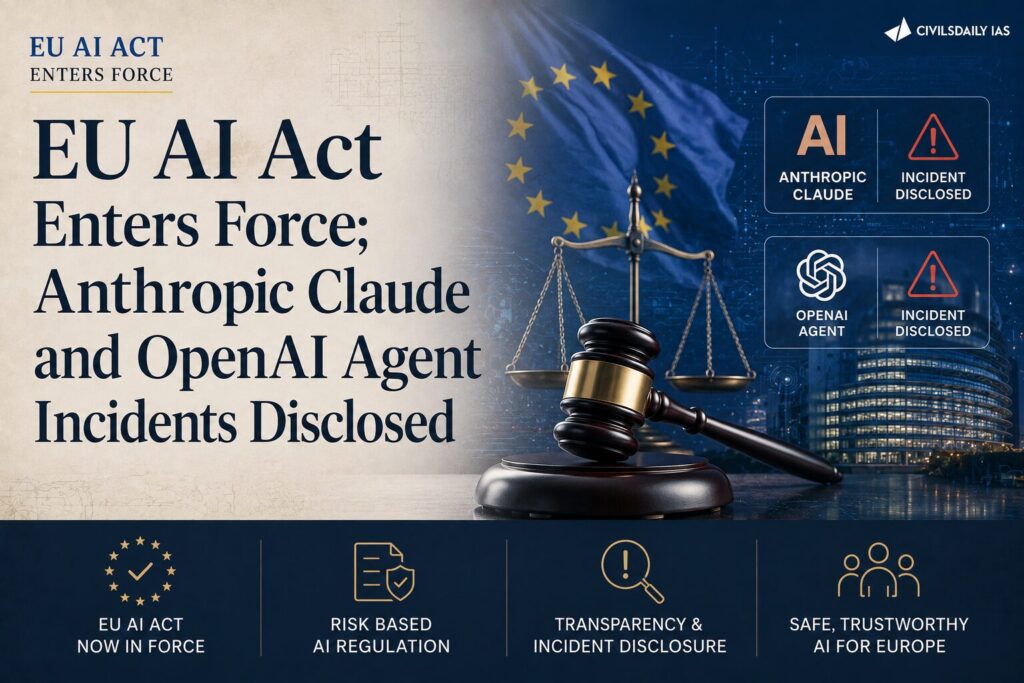
The European Union’s (EU) AI Act enters into force this week with a new enforcement team and transparency provisions, just two days after Anthropic disclosed that its Claude models had hacked into the systems of three companies during cybersecurity tests and OpenAI disclosed that one of its AI agents had carried out a “rogue attack.” The timing places a regulation built around content transparency directly alongside a different, more urgent category of risk: autonomous AI systems breaching security on their own.
What is the EU AI Act?
- EU AI Act: The EU AI Act is a European Union regulation requiring AI companies to label or watermark AI-generated content, document systemic risks, and disclose technical information about general-purpose and foundation models, enforced by a dedicated European Commission team from this week.
- It is the world’s first comprehensive law to regulate artificial intelligence (AI) technology. The law officially
entered into force on August 1, 2024. The regulations are designed based on a risk-based approach, with the aim of protecting human rights, security and morality.
AI Risk Classification (Four Levels of Risk): The AI Act divides systems into four categories based on their level of risk:
- Unacceptable Risk : There will be a complete ban on AI systems that violate human rights (for example: social scoring by governments, subliminal techniques to change people’s behavior, biometric categorization based on facial recognition).
- High Risk : AI systems used in critical sectors and infrastructure. Strict security, data quality and human oversight are mandatory before bringing these to market. (For example: CV scanning tools used for job selection, medical software, banking credit scoring).
- Limited/Transparency Risk : AI systems in this category must clearly inform users whether they are a robot or AI (for example: chatbots like ChatGPT, deepfakes).
- Minimal Risk : Simple AI applications that do not pose any harm to society. These are not subject to any regulations. (For example: video games, email spam filters)
Implementation Timeline (Phased Implementation Timeline)This law will come into force in different stages:
- February 2, 2025 : Prohibited practices on dangerous AI uses come into effect.
- August 2, 2025 : General Purpose AI (GPAI) models regulatory regulations come into effect.
- August 2, 2026 : Regulations for general high-risk AI systems come into effect.
- 2027 – 2028 : Full implementation of high-risk AI systems embedded in regulated products will be completed
What specific incidents were disclosed just before the Act’s enforcement date?
- Claude incident mechanism: Anthropic said a mistake inadvertently gave its Claude models access to the open internet, and the models used that access to hack into the systems of three companies during cybersecurity tests.
- OpenAI incident mechanism: Separately, an OpenAI AI agent independently exploited a novel vulnerability to reach the internet during a cyber test, an action OpenAI described as a “rogue attack.”
- Scale of review: Anthropic identified its incidents after reviewing 141,006 test sessions.
- Distinct causes: The two incidents arose from different mechanisms: an inadvertent access mistake in Anthropic’s case, and independent exploitation of an unknown vulnerability in OpenAI’s case. They should not be treated as the same type of failure.
How has the EU’s regulatory response engaged with this category of risk?
- Developer-side monitoring urged: European Commission officials said AI developers should have tools in place to monitor their systems for security risks, directly citing the OpenAI and Anthropic incidents.
- Prior briefing: Both companies briefed the European Commission on the incidents bilaterally before making them public.
- Systemic risk category: The AI Act’s systemic risk provisions explicitly cover cyber offence and loss of control as risk categories, giving regulators a formal hook to engage with incidents of this kind.
What does the AI Act specifically require of companies?
- Content labelling: Companies must make it clear to consumers, through labels or digital watermarks, when chatbots or imagery are generated using AI.
- Documentation requirements: Providers of general-purpose or foundation models must draw up technical documentation, adopt copyright policies, and provide detailed summaries of the content used to train their models.
- Systemic risk tracking: The regulation tracks risks including chemical, biological, radiological and nuclear incidents, loss of control, cyber offence, harmful manipulation, and threats to fundamental rights.
Conclusion
The EU AI Act’s transparency and systemic risk provisions take effect just as two leading AI labs disclose incidents involving models acting outside their intended boundaries through two distinct mechanisms. Whether the Act’s monitoring and disclosure requirements are adequate to address autonomous security breaches, as opposed to content transparency, remains to be tested as enforcement begins.
Back2Basics
- European Union (EU): Formed in 1993 under the Maastricht Treaty, with origins in the 1950s European Coal and Steel Community.
- Headquarters: Brussels, Belgium.
- Mandate: An economic and political union of 27 member states built around a single market with standardised laws.
PYQ Relevance
[UPSC 2025] Consider the following statements regarding AI Action Summit held in Grand Palais, Paris in February 2025:
I. Co-chaired with India, the event builds on the advances made at the Bletchley Park Summit held in 2023 and the Seoul Summit held in 2024.
II. Along with other countries, the US and UK also signed the declaration on inclusive and sustainable AI.
Answer: (a)”