| PYQ Relevance [UPSC 2022] What are the maritime security challenges in India? Discuss the organisational, technical and procedural initiatives taken to improve the maritime security. Linkage: It examines India’s maritime security challenges and initiatives to strengthen regional maritime governance.The article analyses SHANTI as India’s new framework to enhance maritime cooperation, security, and resilience in the Bay of Bengal through BIMSTEC. |
Mentor’s Comment
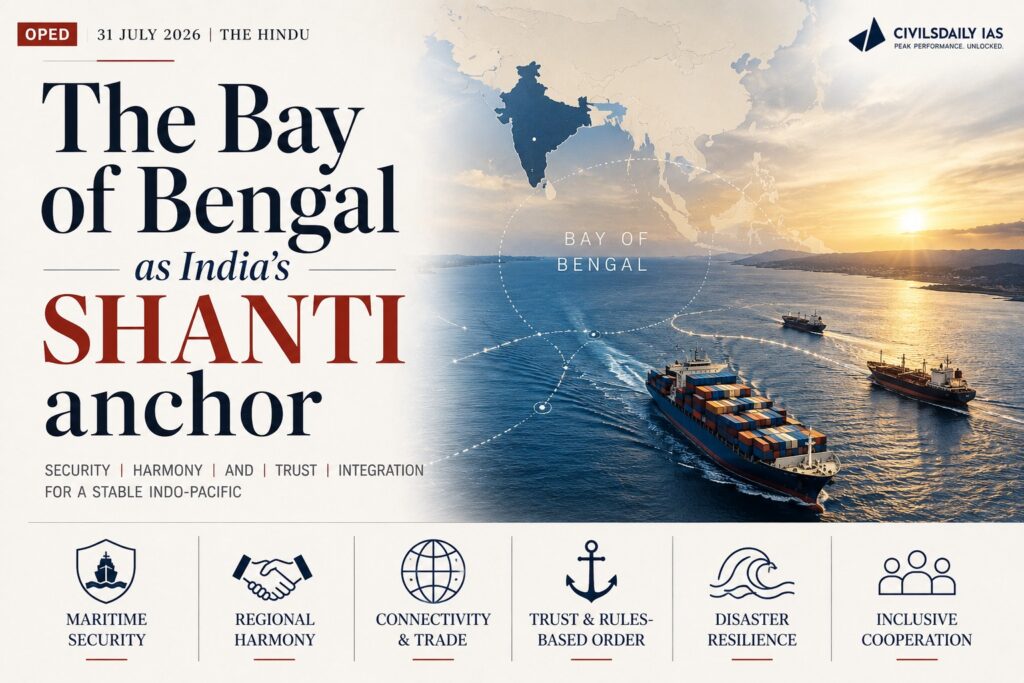
The External Affairs Minister introduced Securing Holistic Advancement through Norms, Trust and Integrity (SHANTI) on 13 July while launching India’s candidature for the United Nations Security Council (UNSC) 2028-29 term, naming the Bay of Bengal as the region to operationalise it first. The framework arrives in a region where growing naval and infrastructure capacity has outpaced any shared set of maritime norms among its littoral states.
What is SHANTI?
- Full form and origin: SHANTI stands for Securing Holistic Advancement through Norms, Trust and Integrity, introduced on 13 July alongside India’s UNSC candidature announcement.
- Lineage: It builds on Security and Growth for All in the Region (SAGAR), articulated in 2015 around the idea of equity in development, and Mutual and Holistic Advancement for Security and Growth Across Regions (MAHASAGAR), announced in 2025 to widen that vision to the interconnectedness of security across the Indo Pacific and the Global South.
- Function: SHANTI is presented as a normative framework, offering shared principles for maritime security, disaster response, the blue economy and environmental resilience, rather than a new institution or treaty.
- Rollout sequence: The Bay of Bengal is named as the first region where SHANTI is meant to move from principle to practice, before any wider application across the Indo Pacific.
What is BIMSTEC?
- The Bay of Bengal Initiative for Multi Sectoral Technical and Economic Cooperation (BIMSTEC) is a regional grouping of Bangladesh, Bhutan, India, Myanmar, Nepal, Sri Lanka and Thailand, connecting South and Southeast Asia around the Bay of Bengal.
- At its National Security Advisers’ meeting in New Delhi in July 2026, BIMSTEC members adopted common principles for maritime law enforcement and humanitarian assistance and disaster relief. They also agreed to hold their first joint maritime security exercise in the Bay in November 2026.
Why is the Bay of Bengal treated as SHANTI’s proving ground?
- Strategic centrality: The Bay links India’s Act East policy with the Association of Southeast Asian Nations (ASEAN), gives access to the Malacca Strait, and connects the eastern Indian Ocean to major global trade and energy routes.
- Comparative advantage: The western Indian Ocean is marked by active conflict and fragile economies. The Bay’s littoral states instead face similar, non military challenges such as cyclones, coastal erosion, fisheries management and undersea cable protection, which makes cooperation more feasible than confrontation.
- Institutional gap: The region is not short of institutions but suffers from fragmentation among them, and SHANTI is framed as a common framework to align existing mechanisms rather than add another one.
- Geopolitical pressure: China’s reliance on the Malacca Strait, often called its Malacca dilemma, has driven an expanding Chinese presence through ports and infrastructure projects in the same littoral states SHANTI seeks to anchor.
Can SHANTI move beyond being another acronym?
- Fragmentation risk: The region’s stated problem is institutional fragmentation, and a new framework risks adding to that fragmentation unless it visibly aligns existing mechanisms.
- Stewardship versus dominance: India’s convening role depends on being accepted as a preferred security partner and first responder, a position that rests on restraint rather than the naval and economic weight India commands in the region.
- Early stage outputs: Concrete outcomes so far are limited to a declaration of common principles, a first joint maritime exercise scheduled for November 2026, and a white shipping information sharing agreement still under discussion, none of which are yet operational.
- Norms without enforcement: SHANTI rests on shared principles rather than a binding treaty, leaving compliance dependent on the willingness of littoral states rather than an enforceable obligation.
What are the challenges to SHANTI?
- Overlap with existing bodies: SHANTI must coordinate with, rather than duplicate, existing mechanisms such as BIMSTEC, the Indian Ocean Rim Association and the Indian Ocean Naval Symposium, each with its own membership and mandate.
- Financing gap: Disaster response, undersea cable protection and blue economy cooperation require capital that several BIMSTEC members cannot supply on their own, raising the risk that shared projects become dependent on Indian or external financing.
- Limited replicability: The Bay of Bengal is easier ground precisely because it lacks the active conflict of the western Indian Ocean, so success there does not guarantee the same framework will work in more contested Indo Pacific waters.
- Competing infrastructure presence: Continued Chinese port and infrastructure investment in the same littoral states complicates India’s claim to a natural convening role.
- Dependence on voluntary compliance: Because SHANTI is a set of norms rather than a binding agreement, its durability depends on continued political will among BIMSTEC members rather than any enforcement mechanism.
Conclusion
SHANTI’s substance will not be judged by its acronym but by whether the Bay of Bengal’s BIMSTEC linked initiatives, the first joint maritime exercise due in November 2026 and the pending white shipping information sharing agreement, convert shared principles into functioning practice. Until those steps are completed, SHANTI remains a stated framework rather than a demonstrated one.
Back2Basics:
BIMSTEC
- The Bay of Bengal Initiative for Multi Sectoral Technical and Economic Cooperation was formed in 1997 and renamed after Bhutan and Nepal joined in 2004, expanding it from its original five members to seven.
- Its secretariat is based in Dhaka, Bangladesh, and its membership spans Bangladesh, Bhutan, India, Myanmar, Nepal, Sri Lanka and Thailand.
- The 6th BIMSTEC Summit, held in Bangkok in April 2025, adopted the Bangkok Vision 2030 and a Maritime Transport Agreement covering national treatment for vessels, crew and cargo among member states.
- BIMSTEC connects South Asia and Southeast Asia and has expanded its cooperation beyond trade into security, disaster management, energy and connectivity.