Urban flooding is defined as the inundation of property in a built environment, caused by rainfall overwhelming the capacity of drainage systems. As per NDMA, it is distinct from rural flooding, as developed catchments increase flood peaks by 1.8 to 8 times and flood volumes by up to 6 times.
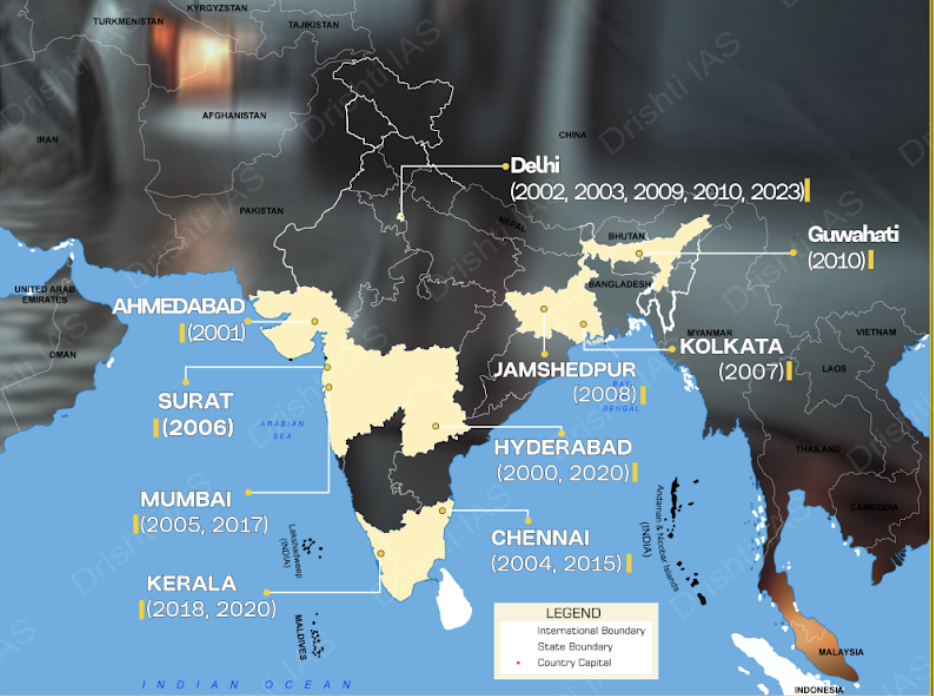
Reasons Behind Urban Flooding
Natural causes
Natural meteorological phenomena like cyclones, cloud bursts. Eg- Cyclone Tauktae in Mumbai.
Topography- Many Indian cities are located in floodplains or low-lying coastal zones. Eg- Mumbai on the Konkan coast, Kolkata in the Ganga-Brahmaputra delta.
Anthropogenic causes
Outdated Drainage Standards- Most Indian city drains are designed for 12-25 mm/hour rainfall, whereas 2024-2026 patterns show frequent events of 80-120 mm/hour. Eg- Mumbai’s British-era drainage
Climate Change – Increase in short-duration, high-intensity rainfall events. Eg- In 2005 Mumbai witnessed 37 inches of rainfall in only 24 hours.
Poor urban planning and encroachment on wetlands
Bengaluru has lost 80% of its lakes
Chennai has lost 85% of its wetlands. (WWF)
Concretisation – Expansion of concrete roads, pavements, and buildings reducing infiltration.
Unregulated dumping of solid waste blocks drains, and stormwater systems
Deforestation reduces the land’s ability to absorb water, causing rapid runoff into urban areas.
Weak Enforcement – Lack of floodplain zoning and non-compliance with building regulations.
Sudden release of water from dams and lakes – Eg- Pune Floods due to Opening of Khadakwasla dam.
Illegal river sand mining reduces the water retention capacity of the waterbody, increasing the speed and scale of stormwater flow. Eg- Cauvery River bed, Tamil Nadu.
Urban Heat Island (UHI) Effect- increases localized rainfall intensity over cities. Eg- Delhi and Mumbai experience 30% higher rainfall than their rural outskirts during the same storm.
Fragmented Urban Governance – Separate authorities for planning, drainage, water, and environment leads to poor coordination.
Remedial Measures- Towards Lasting Resilience
Governance and Planning Measures
Integrated Urban Flood Management Plans – City-specific flood resilience strategies aligned with master plans.
Blue-Green Master Planning under the AMRUT 2.0 scheme. Eg- No-Development Zones on floodplains and wetlands.
Unified Urban Water Authority on lines of Hyderabad Disaster Response and Asset Protection Agency
Empowering local ward committees to conduct “desilting audits” and manage localized waste collection.
Urban Climate Emergency Fund- Creating a dedicated fund for “Climate-Proofing” old infrastructure. Eg- widening British-era drains in Mumbai.
Technological measures
Adopting the “Sponge City” model by using permeable pavements, rain gardens, and bioswales to absorb 70% of rainwater at the source.
Nature-Based Solutions (NBS) – Urban wetlands and green corridors as flood buffers. Eg- Netherlands’ “Room for the River” concept.
Upgrading Urban Drainage Systems (SUDS)- Eg- Tokyo’s G-Cans – During typhoons or torrential rains, it diverts the overflowing waters of various rivers.
Real-Time Dam Management- Using AI-driven simulations to coordinate dam releases with downstream urban capacity.
Urban flooding in 2026 is a “crisis of governance”. There is a need to move from construction-centric growth to hydrology-centric planning for truly SMART cities.