As per UNDRR, disaster preparedness refers to the knowledge and capacities developed by governments, institutions, communities and individuals to effectively anticipate, respond to and recover from disasters.
Importance of Disaster preparedness
Reduces Loss of Life and Property – Eg-Zero casualties during Cyclone Biparjoy (2023) due to preparedness.
Strengthens Community Capacity – Training local communities in early response, evacuation routes, and safe zones, reduces panic and damage. Eg-Aapda Mitra volunteers.
Enables Early Warning and Timely Decision-Making
Minimises Economic Disruptions – Preparedness plans protect critical infrastructure like roads, power lines and bridges. (Türkiye earthquake (2021) resulted in a loss of 4% of GDP.)
Ensures continuity of critical services such as healthcare, transportation, and communication during disasters
Role of hazard zonation mapping in landslide risk mitigation
Identifies Risk areas based on geology, slope angle, rainfall, land use and soil type.
Guides Land-Use Planning and Regulation- Eg-Building restrictions in Munnar and Wayanad based on hazard maps.
Helps Design Safer Infrastructure – Eg-Stabilisation measures on NH-44 (Uttarakhand-Himachal) based on zonation inputs.
Mitigation Measures – Eg- slope strengthening, terracing, afforestation, and drainage correction.
Integrates with Early Warning Systems (EWS) – Hazard zones combined with rainfall thresholds enable real-time warnings.
Build community resilience – Locals identify unsafe slopes, evacuation routes and shelter locations using simplified maps.
Resource allocationNational Landslide Risk Mitigation Programme targets mapped hotspots first.
Assists in Environmental Regulation – Eg- Quarrying, mining, ban in Western Ghats (Madhav gadgil committee recommendation)
Hazard zonation mapping in India
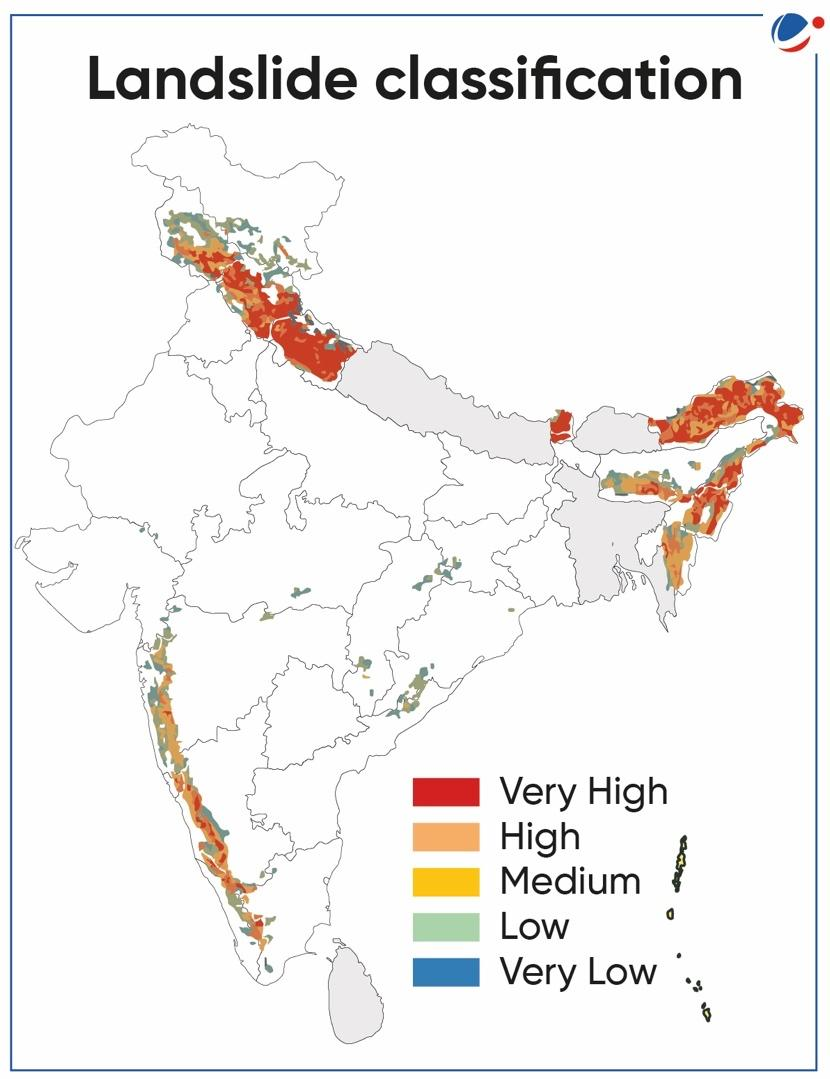
National Landslide Susceptibility Mapping (NLSM) by GSI
National Landslide Inventory created with 80,000+ mapped landslides.
ISRO “Landslide Atlas of India” (2023).
State-level LHZ mapping by SDMAs (Kerala, Uttarakhand, Himachal, Sikkim, Meghalaya).
LiDAR, UAV & DEM-based mapping in critical areas (Joshimath, Munnar, Gangtok, Nilgiris).
Rainfall threshold modelling (IMD + IITs) integrated with zonation maps for landslide triggers.
Earthquake Zonation Map of India (Zone II to Zone V) by BIS/IMD.
Flood Hazard Atlas for 15+ states by CWC-NRSC (ISRO)
Drought Vulnerability Atlas of India (IMD + NRSC).
To prevent a catastrophe like the Wayanad Landslide of 2024, engineering as well as nature-based solutions along with early warning systems, and effective land use practices are essential.