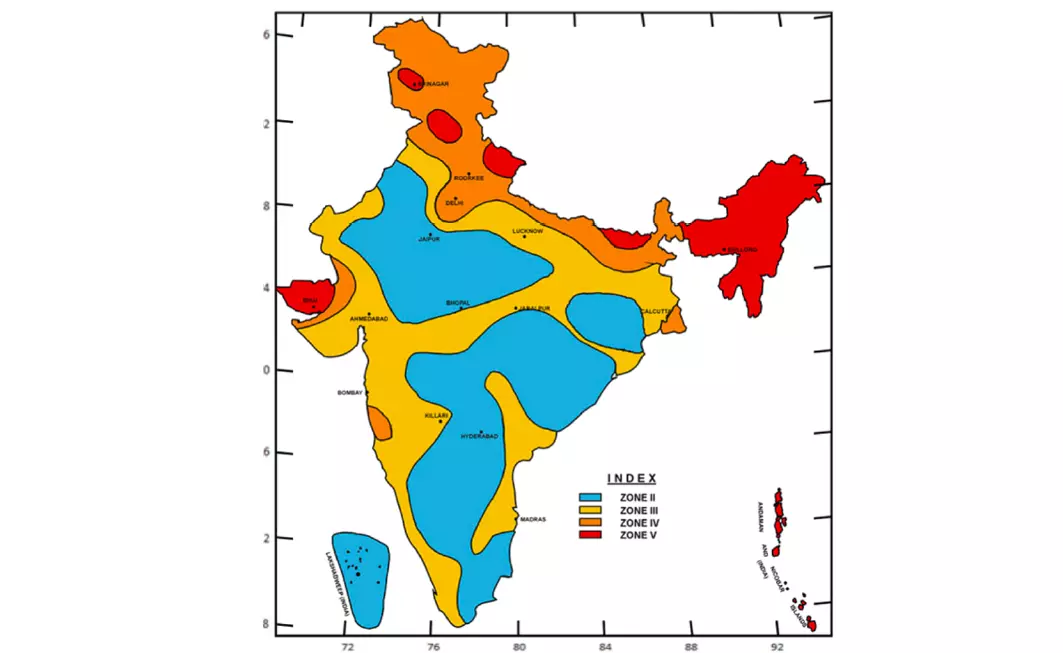
Vulnerability of India to Earthquake-Related Hazards
Active Plate Tectonics – High seismicity in the Himalayan belt, North-East India, Kutch region, and Andaman-Nicobar Islands.
Wide Seismic Zonation
Zone V (Very High Risk) – Himalayan states, Kutch, Andaman & Nicobar.
Zone IV – Delhi, Bihar, parts of J&K and NE India.
Major cities such as Delhi, Guwahati, Srinagar, Imphal lie in high-risk zones.
Weak enforcement of earthquake-resistant building codes (BIS).
Rapid and Unplanned Urbanisation without seismic safety.
Secondary and Cascading Hazards – Landslides, liquefaction, fires, dam failure, and infrastructure collapse.
Vulnerability of critical infrastructure – Disruption of transport, power, water, and communication networks.
Examples of Major Earthquake Disasters in India (Last Three Decades)
Latur Earthquake, Maharashtra (1993)
Magnitude – ~6.3
Intraplate earthquake caused by reactivation of ancient fault lines in the Deccan Plateau
Over 9,000 deaths.
Bhuj Earthquake, Gujarat (2001)
Magnitude – 7.7
Intraplate fault movement due to stress transmitted from the Indian Plate-Eurasian Plate collision
Around 13,800 deaths and massive infrastructure loss.
Kashmir Earthquake (2005)
Magnitude – 7.6
Thrust faulting due to ongoing collision of the Indian Plate with the Eurasian Plate
Extensive landslides and isolation of remote villages.
Sikkim Earthquake (2011)
Magnitude – 6.9
Active tectonics of the Himalayan collision zone
Triggered widespread landslides.
Damage to roads, bridges, and hydropower projects.
Hazard zonation mapping, disaster resilient infrastructure and institutional strengthening for quick response and recovery is essential to achieve Sendai targets on disaster risk reduction.