Global warming refers to the long-term rise in Earth’s average surface temperature due to increased concentration of greenhouse gases (GHGs) from human activities.
Effects of Global Warming on Global Climate
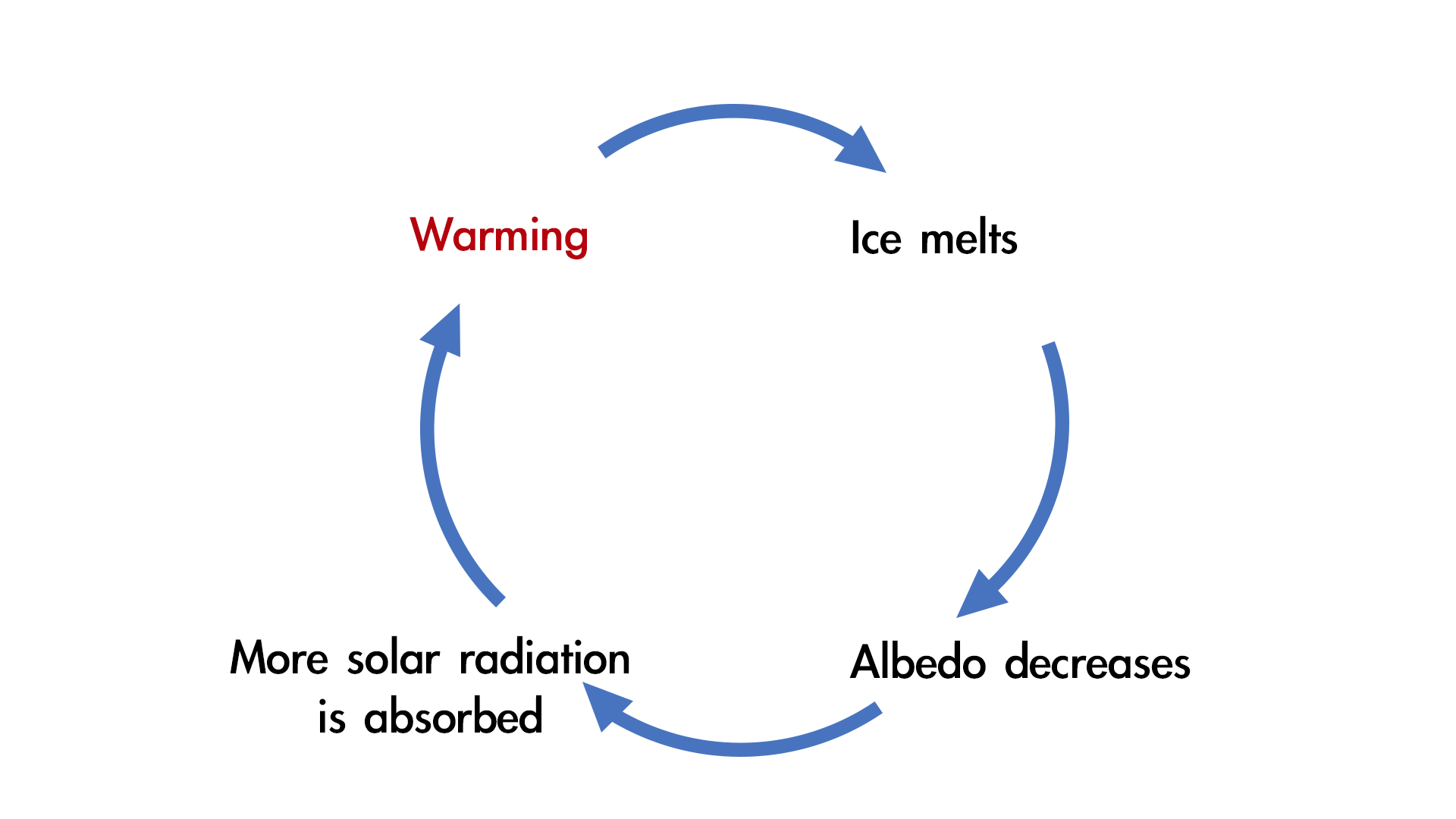
Melting Glaciers & Polar Ice – Eg – Greenland and Antarctic ice sheets losing mass at record rates.
Sea-Level Rise – IPCC projects 1.3-1.6 m SLR by 2100 under high-emission scenarios – Submergence of low-lying coasts, salinity intrusion and displacement.
Extreme Weather Events – Eg – Increasing frequency of Category 4-5 cyclones in the Indian Ocean.
Disruption of Monsoons – Erratic and unpredictable rainfall.
Ocean Acidification – Elevated CO₂ lowers pH, affecting coral reefs and fisheries. Eg – Mass bleaching events on the Great Barrier Reef.
Biodiversity Decline – Species migration and extinction risks rise.
Intensification of feedback loops – Eg- Permafrost thaw releases methane, warming oceans release less CO₂, and forest dieback reduces carbon sinks
Expansion of arid zones – Higher temperatures increase evapotranspiration and reduce soil moisture. Eg – Prolonged droughts in Horn of Africa
Disruption of Global Thermohaline Circulation – Eg- weakening of Atlantic Meridional Overturning Circulation (AMOC)
Hotter, drier conditions raise wildfire risks – Eg – Australian bushfires (2019-20) and California wildfires
Control Measures to Reduce GHGs (under Kyoto Protocol, 1997)
The Kyoto Protocol was the first legally binding global framework mandating GHG reduction by industrialised nations.
Binding Emission Reduction Targets – Annex-I countries committed to reducing emissions by 5% below 1990 levels during 2008-2012.
Clean Development Mechanism (CDM) – Allows developed countries to invest in emission-reduction projects in developing nations and earn carbon credits.
Joint Implementation (JI) – Developed nations can meet their Kyoto targets via emission-reduction projects in other Annex-I countries.
International Emissions Trading (IET) – countries with surplus emission units trade them with those exceeding their limits.
Other Measures
Enhancing Carbon Sinks through afforestation, reforestation and improved land management. Eg- Miyawaki method of Urban Forestry
Low-Carbon Technologies to reduce fossil-fuel use. Eg- EVs
Energy Efficiency – Efficiency standards, industrial retrofits, transport reforms and building codes reduce GHG intensity.
Policy Support for Green Finance – Eg- tax breaks, green bonds, climate insurance etc
Implementing these through enhanced national commitments, equitable climate finance and rapid decarbonization remains essential for achieving SDG 13 (Climate Action)