Petroleum reserves are found in sedimentary basins, where organic matter is trapped under pressure. Offshore reserves account for ~30% of global crude oil production. Their distribution is linked to continental shelf geology, passive margins, and deep-water basins.
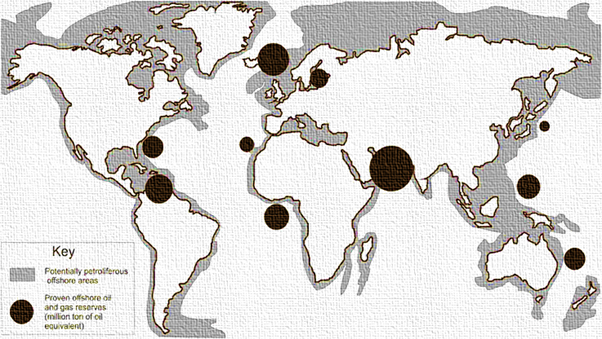
Geographical distribution
The Persian Gulf (Middle East)- result of the collision between the Arabian and Eurasian plates, which created perfect “anticline” traps for oil. Eg- Safaniya field (Saudi Arabia), largest offshore oil field in the world.
The Gulf of Mexico (North America)- It is characterized by salt domes that trap oil in the surrounding porous rock.
The North Sea (Europe)- Situated between the UK, Norway, and Denmark. This region is a rift basin, with deep depressions where organic matter could settle.
The South Atlantic Margins (Brazil & West Africa)- formed when South America and Africa drifted apart.
Southeast Asia & India- in the South China Sea and India’s Mumbai High and Krishna-Godavari (KG) Basin
Difference between off-shore and on-shore oil reserves
Implications of uneven distribution of mineral oils in the world
Energy security challenges – Oil-deficient countries face high import bills and current account deficits. Eg- India imports ~85% of its crude oil requirement.
Resource Curse in Oil-rich Nations (Paradox of Plenty) – Overdependence on oil leads to limited economic diversification. Eg- Venezuela’s economic crisis.
Energy trade is one of the key drivers of global geopolitics. Eg- US sanctions on Russian and Iran oil trade
Competition for oil resources leads to wars and regional instability. Eg- Gulf Wars, Saudi-Iran rivalry.
Oil-rich regions face oil spills, land degradation, and marine pollution. Eg- Niger Delta pollution.
Global Carbon Emissions – oil and gas industry is responsible for over 5 billion tonnes of CO2 equivalent in direct emissions annually (15% of total energy-related emissions)
In the long run, reducing oil dependence through clean energy, strategic reserves, and diversified supply chains is essential for ensuring equitable and sustainable global development.