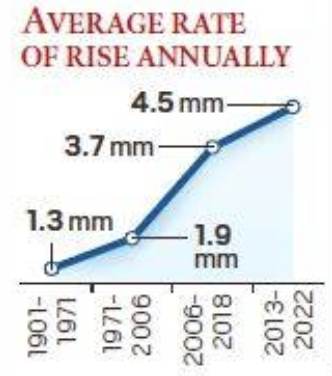
As per the IPCC, global mean sea level rose by 0.20 m between 1901 and 2018. It has projected a global mean SLR of 1.3 to 1.6 m by 2100 under the high-emission scenario.
Permanent submergence of land – Eg- Kiribati has already seen two small uninhabited islets (Tebua Tarawa and Abanuea) disappear underwater.
Coastal erosion – Wave action and storm surges remove shoreline. Eg- Shoreline retreat in the Maldives.
Salinisation of freshwater lenses – Sea water enters groundwater and contaminates wells leading to drinking water shortage.
Frequent flooding during high tides and storms can lead to large scale displacement. Eg- “King tide” flooding in Tuvalu.
Damage to housing and public infrastructure – Eg- Majuro Airport in the Marshall Islands frequently faces flooding
Loss of agriculture – Salinity affects soil fertility and traditional crops. Eg- Taro cultivation affected in Kiribati and Tuvalu.
Coral reef degradation – Ocean warming and acidification damage reefs that act as wave barriers. Eg- Coral bleaching in Fiji and Maldives.
Impact on fisheries – Changes in ocean temperature and reef systems reduce fish catch, impacting livelihood
Climate-induced migration – Eg- Kiribati purchased land in Fiji for future resettlement.
Way Forward
Hard Engineering Measures
Seawalls to block wave attack.
Groynes – Trap sand and widen beaches. Eg- Puducherry groyne field.
Breakwaters – Offshore barriers that reduce wave energy. Eg- Chennai port.
Revetments – Sloped rock armour to absorb wave impact.
Soft Engineering Measures
Mangrove Restoration – Eg- MISHTI-based efforts in Sundarbans.
Coral and Seagrass Restoration – Eg- Andaman reef rehabilitation.
Integrated Coastal Zone Management (ICZM)
Ecosystem-Based Coastal Planning – Combines geomorphology, ecology and socio-economic factors.
Regulatory Tools (CRZ Norms) – no-development zones and hazard mapping reduce vulnerability.
Early Warning Systems – INCOIS alerts for timely action.
Strengthening coastal resilience and climate mitigation is essential to safeguard communities and advance SDG 13 (Climate Action) and SDG 14 (Life Below Water).