A cropping pattern is the distribution of various crops within a specific area at a given time. Though the rice-wheat system became the backbone of Indian agriculture after the Green Revolution, in recent years India’s cropping pattern has moved towards diversification and high-value crops.
Emphasis on certain crops – changing cropping pattern
Dominance of rice-wheat in Green Revolution regions – account for over 75% of GCA in Punjab & Haryana
Shift from food crops to commercial crops- Area under commercial crops increased from 30.4 million ha (2000-01) to 41.2 million ha (2022-23)
Expansion of sugarcane due to ethanol policy- increased from 285 MT (2010-11) to 405 MT (2022-23)
Rise in horticulture crops – Eg- In 2022-23, fruits and vegetables accounted for 28.3% of the Gross Value Output, surpassing cereals
Expansion of oilseeds under National Mission on Edible Oils- increased from 25 MT (2010-11) to 41 MT (2022-23)
Growth of organic farming- 2.9 million hectares under organic farming, highest globally. Eg- Sikkim fully organic
Climate change impact on crop choice- Eg- 14% decline in sugarcane area in Marathwada (2015-2023) due to water stress
Commercialisation and mechanisation- BT cotton covers 95% of cotton area, promoting
Emphasis on millet production
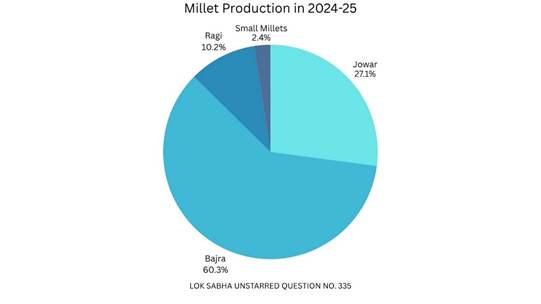
Total millet production: 180.15 lakh tonnes in 2024-25 (Increase of 4.43 lakh tonnes)
Millet exports (2024-25): 89,164.96 tonnes worth $37 million
MSP for Ragi (2025-26): Second highest absolute MSP increase among crops
Policy focus
National Millet Mission
NFSM – Nutri Cereals
International Year of Millets 2023 (India-led)
Branding as Shree Anna
Increase in millet exports
1.5 million tonnes exported in 2023
50% increase over 2022
Climate-resilient nature – Drought resistant, low water, heat tolerant
Expansion in dryland states – Increased area in Rajasthan, Karnataka, Telangana, MP, Maharashtra
Emphasis on millet consumption
Rising health consciousness
High in iron, calcium, fibre and protein
Helpful against diabetes & malnutrition
Improvement in nutrition security – Reduces hidden hunger and micronutrient deficiency
Inclusion in government schemes – PDS, Mid-Day Meal, ICDS, Anganwadi
Urban & processed food demand – Used in biscuits, noodles, bakery & breakfast foods
MSME & startup growth – Eg- “Millet Challenge” for startups,, with a seed grant of Rs 1 crore each to three winners.
Policy and market-driven emphasis on selected crops is transforming India’s cropping pattern, with millets emerging as a sustainable pillar of nutrition and livelihood security.