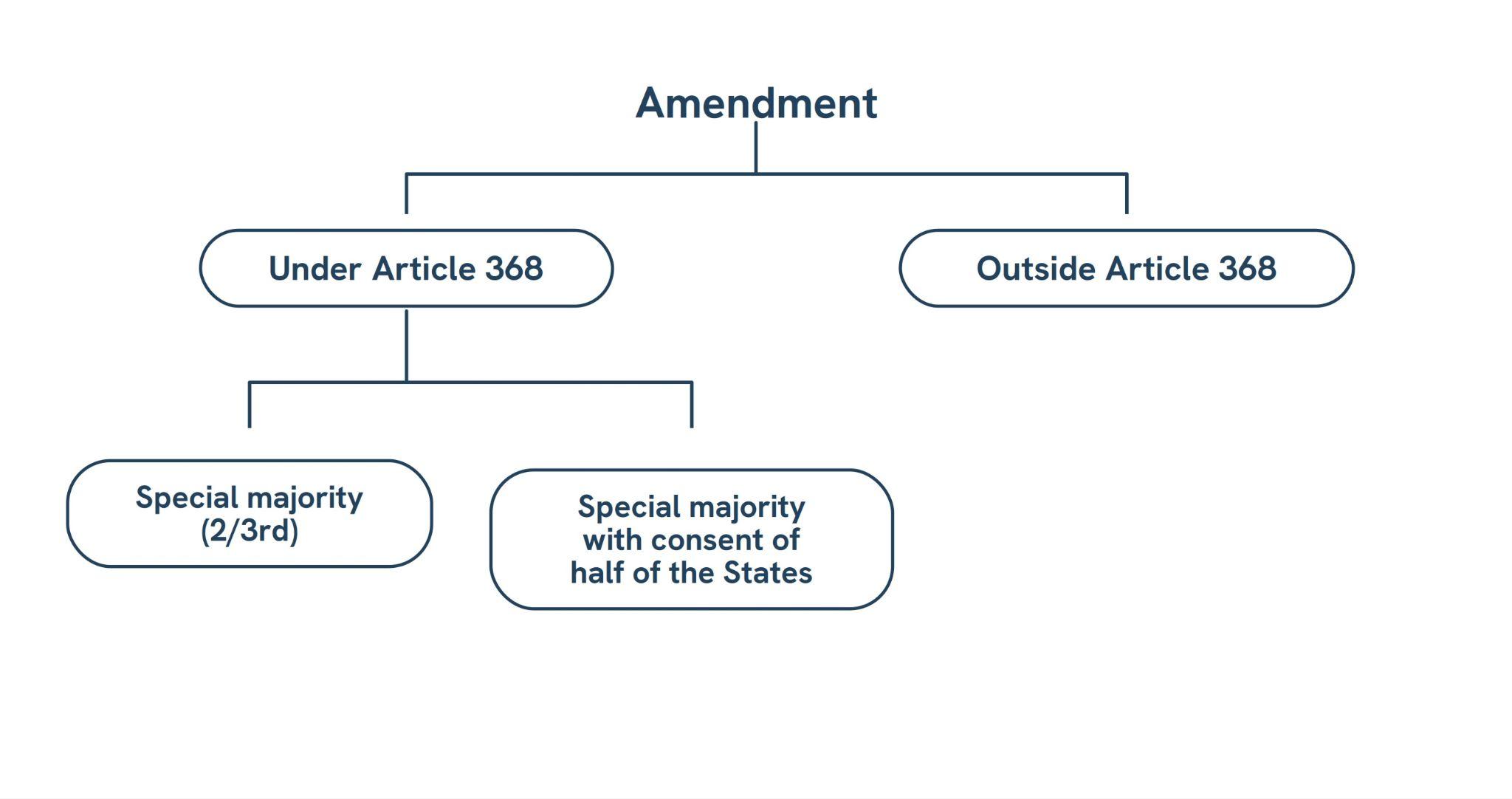
The Indian Constitution, under Article 368, confers the power of amendment on Parliament. However, this power is neither absolute nor unlimited, being subject to procedural and substantive limitations.
Procedural Limitations
These are explicit constitutional conditions laid down in Article 368. Violation of any renders the amendment invalid.
Special Majority Requirement – Majority of total membership of each House, and Two-thirds of members present and voting.
Separate Approval by Each House – No joint sitting is allowed under Article 108.
Ratification by Half States for Federal Provisions – Eg- 101st Amendment (GST) required ratification.
Presidential Assent under Article 368(2).
Bill must follow all legislative procedures – notice, debate, quorum, and voting. Procedural irregularities can invite judicial scrutiny (as per Raj Narain v. Indira Gandhi, 1975).
Substantive Limitations on the Amending Power
These are judicially evolved constraints that restrict Parliament from altering the core identity of the Constitution.
Doctrine of Basic Structure (Kesavananda Bharati v. State of Kerala (1973))
Limited Amending Power Itself is Basic Structure (Minerva Mills, 1980) – Clauses (4) and (5) of Article 368 (inserted by the 42nd Amendment) were struck down.
I.R. Coelho v. State of Tamil Nadu (2007) held that even laws placed in the Ninth Schedule after 1973 are open to Basic Structure review.
Parliament cannot amend to abrogate or emasculate Fundamental Rights forming part of the Basic Structure (e.g., equality, liberty).
Parliament cannot alter the essential federal balance between Centre and States. (Kuldip Nayar v. Union of India (2006))
Indira Nehru Gandhi v. Raj Narain (1975)- Free and fair elections, rule of law, and judicial review are part of Basic Structure.
Harmony between Fundamental Rights and Directive Principles – Both must coexist; destroying one in favor of the other violates Basic Structure.
Examination of limitations
Thus, the limited amending power under Article 368 makes the Indian Constitution a living document, capable of growth yet immune from destruction.