Conscience is the “inner voice” or the internal moral sense of what is right or wrong in one’s conduct.
“There is a higher court than courts of justice and that is the court of conscience. It supersedes all other courts.” – Mahatma Gandhi
Conscience as a Reliable Guide
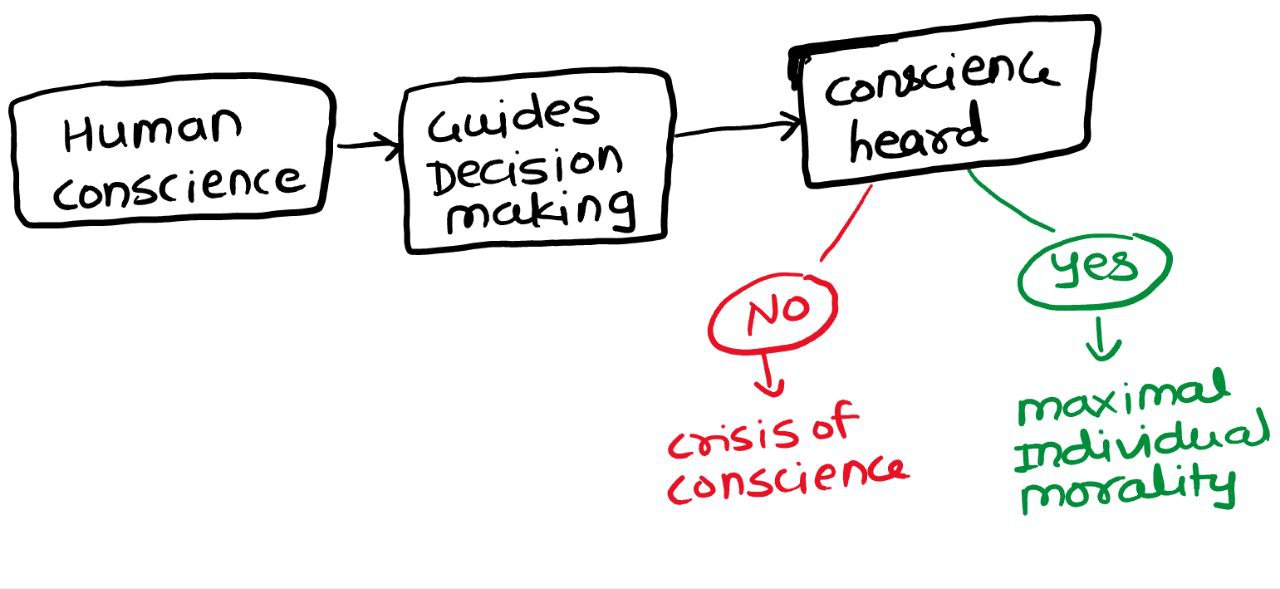
Addressing the “Legal Vacuum”- Laws cannot predict every future scenario. In these situations, conscience is the only navigator.
Humanizing Bureaucracy- While rules are rigid, conscience provides the empathy needed for substantive justice.
Upholding Scientific Responsibility- Eg- Robert Oppenheimer faced crisis of conscience after the atomic bomb’s use, leading him to advocate for international nuclear control.
Whistleblowing against Corporate Fraud (moral courage) – Eg- Sherron Watkins exposed the Enron scandal.
Guide for social and legal reforms- Eg- Martin Luther King’s fight for Civil Rights Act.
Environmental Stewardship- Laws often lag behind ecological destruction. Eg- Sunderlal Bahuguna led the Chipko Movement based on a conscience-driven duty to protect nature.
Integrity in Sports (“fair play”) – Eg- Sachin Tendulkar walking off before the umpire gives a decision.
Handling Political Pressure- Eg- Ashok Khemka has prioritized his conscience over political convenience, resulting in over 50 transfers.
In conflict zones where local laws are absent, conscience remains the sole guide. Eg- Malala Yousafzai’s campaign for girls’ education despite Taliban ban.
Prevents moral blindness. Eg- Oskar Schindler saved Jews despite Nazi laws.
Challenges with conscience as a guide
Subjectivity. Eg- Extremists justify violence as moral duty.
Cultural bias. Eg- Honour killings defended as conscience by communities.
Moral relativism. Eg- Different consciences produce conflicting actions.
Conflict with rule of law. Eg- Mob lynching violates “justice as fairness”
Inconsistency– Personal morals change across time and contexts.
The “Slippery Slope”- Once an official starts bypassing rules for “good” reasons, it becomes easier to bypass them for “convenient” or “bad” reasons later.
Synthesis of Law and Conscience
Constitutional morality as the bridge – Align personal conscience with constitutional values like justice, liberty and equality.
Ethics training for public officials under Mission Karmayogi.
Updation of laws with evolving ethical standards. Eg- DPDP Act
Discretion should be subject to transparency and review.
Institutional ethical safeguards – Ethics committees, ombudsmen and judicial oversight
The synthesis of the two can create a “Compassionate State.”