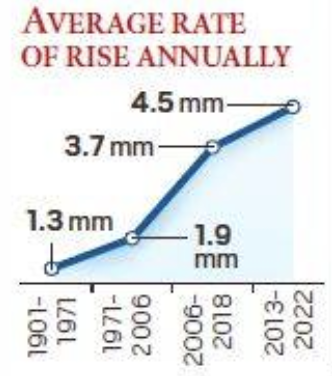
Impact of 1-metre Sea-Level Rise in India
Submergence of Low-Lying Coastal Areas – Eg- Large parts of the Kolkata, Mumbai, Kochi, Chennai
Enhanced Coastal Erosion – Eg- as per National Centre for Coastal Research (NCCR) report around 34% of India’s coastline is eroded
Salinity Intrusion into Aquifers & Rivers impacting drinking water and agriculture.
Mangroves & Wetlands like Sundarbans, Mahanadi delta wetlands, Gulf of Kachchh mangroves risk drowning and biodiversity loss.
Intensification of cyclones due to more moisture and heat from ocean warming.
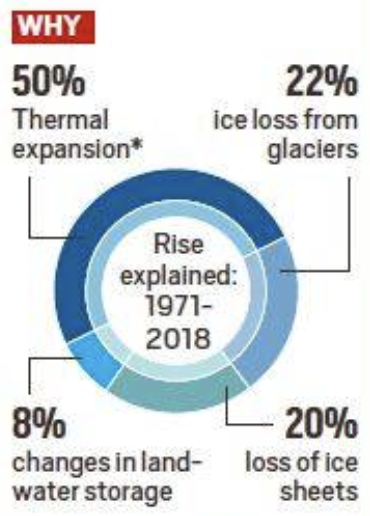
Millions from deltaic regions may face climate-induced migration. Around 3.6 million people have been displaced in South Asia over the past decade. (Internal Displacement Monitoring Centre)
Ports & Coastal Infrastructure face higher flooding risk, economic losses, and costly adaptation needs.
Island Submergence – Eg- Sundarbans (Ghoramara, Sagar) and Lakshadweep (Chetlat, Amini, Kavaratti)
Impact on Other Indian Ocean Region Countries
Maldives – Existential Threat as 80% of land below 1 metre
Bangladesh – Massive Displacement in Ganga-Brahmaputra-Meghna delta
Sri Lanka – damage to fisheries and tourism economy.
Myanmar – The Irrawaddy delta—a food-producing zone—faces salinity, crop losses and intensified cyclone impact.
Indonesia – Severe Impacts on Islands & Cities. Eg- Jakarta already sinking
East African Coast – Countries like Kenya, Tanzania, Mozambique would face mangrove loss, storm surges, and fishery declines.
Increased Maritime Instability – Changes in ocean temperature and circulation will affect monsoons, fisheries, and regional climate systems across the Indian Ocean basin.
Way Forward
Hard Engineering Measures
Seawalls to block wave attack.
Groynes – Trap sand and widen beaches. Eg- Puducherry groyne field.
Breakwaters – Offshore barriers that reduce wave energy. Eg- Chennai port.
Revetments – Sloped rock armour to absorb wave impact.
Soft Engineering Measures
Mangrove Restoration – Eg- MISHTI-based efforts in Sundarbans.
Coral and Seagrass Restoration – Eg- Andaman reef rehabilitation.
Integrated Coastal Zone Management (ICZM)
Ecosystem-Based Coastal Planning – Combines geomorphology, ecology and socio-economic factors.
Regulatory Tools (CRZ Norms) – no-development zones and hazard mapping reduce vulnerability.
Early Warning Systems – INCOIS alerts for timely action.
Strengthening coastal resilience and climate mitigation is essential to safeguard communities and advance SDG 13 (Climate Action) and SDG 14 (Life Below Water).