Interlinking of Rivers refers to the transfer of water from surplus river basins to deficit basins through a network of canals and reservoirs. Proposed under the National Perspective Plan (1980), the project envisages 30 river links (14 Himalayan and 16 Peninsular).
Significance of River Interlinking
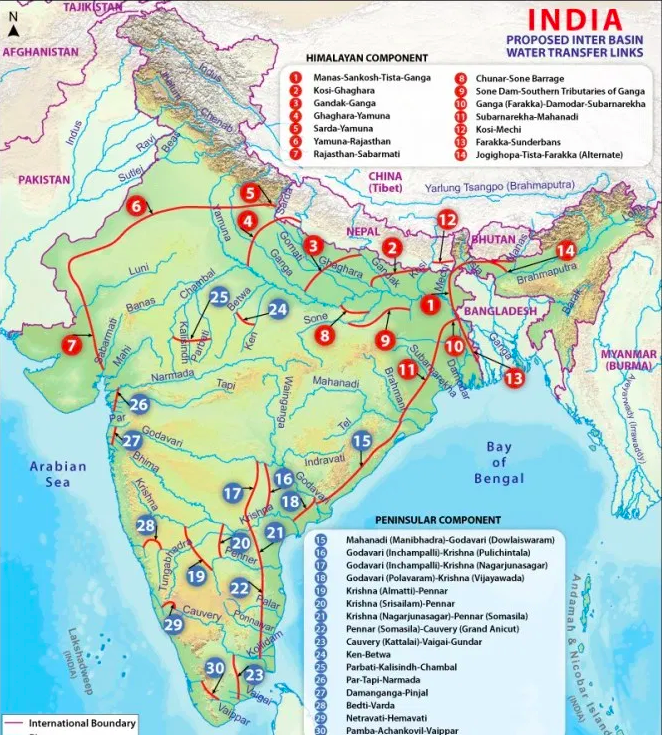
Flood Control by diverting excess monsoon flows from “surplus” rivers. Eg- Diverting water from the Kosi-Mechi link can alleviate the annual “Sorrow of Bihar.”
Year-round Navigation-Permanent water levels in canals can facilitate a network of inland waterways. Eg- Linking Godavari-Krishna rivers may improve navigation along peninsular waterways.
Hydropower Generation-Eg- The ILR project is estimated to add 34,000 MW to the national grid.
Drinking Water Security-Ensures a stable supply of potable water for growing urban and rural populations.
Regional Water Balance – Redistribution helps address spatial inequality in water availability. Eg- Water from Mahanadi or Godavari basins could support water-deficit areas of TN and Karnataka.
Groundwater Recharge-Increased surface water availability can reduce the “blind pumping” of aquifers.
Agricultural Intensity-Allows for multiple cropping seasons (Kharif, Rabi, and Zaid) in previously single-crop areas. Eg- in Bundelkhand and Marathwada regions
Fisheries and Livelihoods-Creation of new reservoirs provides opportunities for large-scale aquaculture.
Salinity Control-Freshwater diversion to deltas can prevent the ingress of seawater during low-flow seasons.
Climate Resilience-Acts as a “National Water Grid” to buffer against the erratic monsoons expected by 2026-2030.
Challenges in River Interlinking
Ecological Disruption-Altering natural river flows can destroy riverine habitats and aquatic biodiversity. Eg- The Ken-Betwa link will submerge 98 km^2 of the Panna Tiger Reserve.
Questionable Surplus-Deficit Concept – Climate variability affects river flows. Eg- Changing monsoon patterns may reduce flows in so-called surplus rivers like the Brahmaputra
Social Displacement-Massive land acquisition leads to the uprooting of indigenous and farming communities.
Fiscal Burden-Estimated costs exceed ₹5.5 lakh crore, leading to concerns over debt-to-benefit ratios.
Inter-State Disputes-Water is a “State Subject,” making consensus difficult between “donor” and “recipient” states.
Sediment Starvation-Diverting water also diverts silt, which is essential for maintaining deltas and soil fertility downstream.
Water-Logging and Salinity-Introduction of excess surface water in arid regions can lead to “alkalinization” of soil. Similar issues were seen after the Indira Gandhi Canal project in Rajasthan.
International Complications-Interlinking Himalayan rivers requires treaties with neighbors. Eg- Indus water treaty with Pakistan.
Project Delays-Long gestation periods often lead to massive cost overruns.
Large projects may overshadow decentralized water management. Eg- Watershed development programmes in Maharashtra have effectively addressed drought without large river transfers.
Way Forward
Scientific Assessment of Water Surplus and Deficit – Basin-level hydrological studies considering climate change impacts.
Intra-State Prioritization-Focus on smaller links within states (like Kosi-Mechi) to avoid federal and legal hurdles.
Virtual Water Trade-Optimize crop patterns so that water-rich regions grow thirsty crops, effectively moving water through food trade.
Implement rainwater harvesting and watershed management before resorting to inter-basin transfers.
Mandatory drip and sprinkler systems (Israel model) to ensure transferred water is used efficiently.
Independent EIA that goes beyond engineering feasibility.
A balanced approach is essential to ensure long-term water security and environmental sustainability.