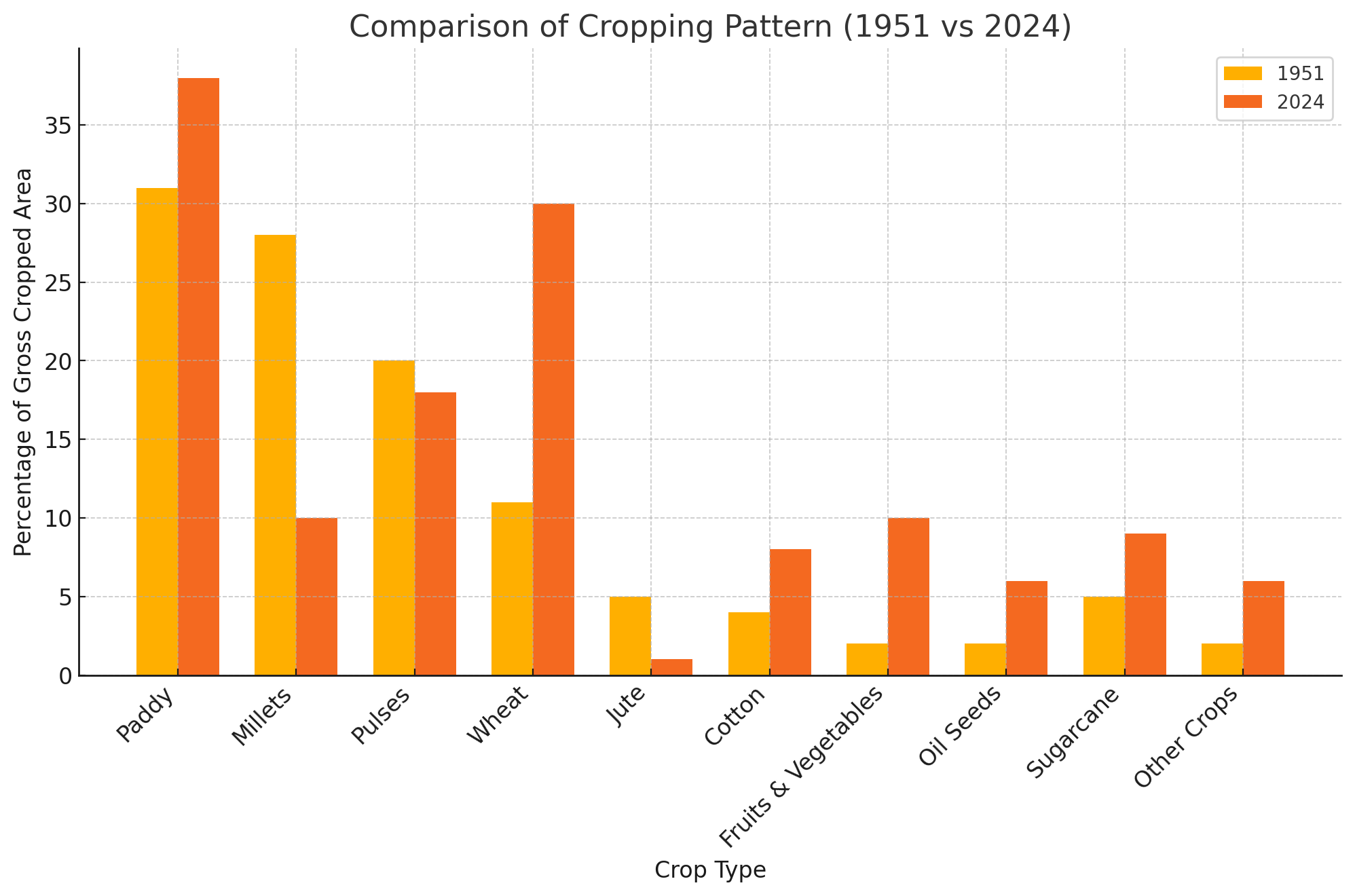
The rice-wheat system emerged as the backbone of Indian agriculture after the Green Revolution. It led to food self-sufficiency, but over-time it has become ecologically and economically unsustainable.
Major Factors Responsible for the Success of the Rice-Wheat System
Assured Irrigation- Expansion of canal irrigation and tube wells in Punjab and Haryana.
MSP and Procurement Support through FCI and PDS gave farmers assured income.
Favourable Agro-climatic Conditions- alluvial soil, flat terrain and suitable climate of the Indo-Gangetic plains favoured rice-wheat double cropping.
Mechanisation – Availability of tractors, combine harvesters, threshers, storage facilities and rural roads reduced labour costs and increased efficiency.
Input Subsidies- Heavy subsidies on electricity, fertilisers and water made cultivation economically attractive.
Institutional Credit Availability- Access to cooperative banks, KCC and PSBs enabled farmers to invest in modern inputs.
Export potential – Eg- High demand for Indian Basmati Rice in international markets.
However, this system has become bane for India
Excess Use of Fertilizers leads to nutrient imbalances and soil degradation. Eg-Punjab uses 244 kg/ha of fertilizers vs the national average of 140 kg/ha.
Deteriorating Soil Health
N:P:K imbalance 7.7:3.1:1.
Over 30% of Indian soils is degraded
Groundwater Depletion: Eg- Punjab’s water table dropping 50 cm annually (Central Ground Water Board).
Decreasing Productivity: Wheat yields have stagnated at 3.5-4 tonnes/ha due to resource depletion and climate change (ICAR, 2023).
Pollution from Residue Burning: over 20 million tonnes of paddy straw burned annually (SAFAR).
Increased Fiscal Burden due to high MSP and fertilizer subsidies. Eg- fertilizer subsidies exceeding in 2024-25.
Reducing agro-biodiversity – focus on only two crops has displaced millets, pulses and oilseeds.
Neglect of nutri-cereals and pulses has contributed to hidden hunger and malnutrition.
Climate Vulnerability – Rice-wheat system is highly sensitive to heatwaves, erratic rainfall and declining water availability.
Way Forward
Diversification to Millets, Pulses & Oilseeds
Efficient Water Management – Drip irrigation, System of Rice Intensification (SRI)
Soil Health Restoration – organic fertilizers, bio-compost, and crop rotation
Stubble Management Alternatives – Happy Seeder, bio-decomposers, and straw recycling
Climate-Resilient Varieties
Rationalise MSP to break the monoculture cycle.
Crop diversification is key for doubling farmers’ income and nutritional security.