Why in the News
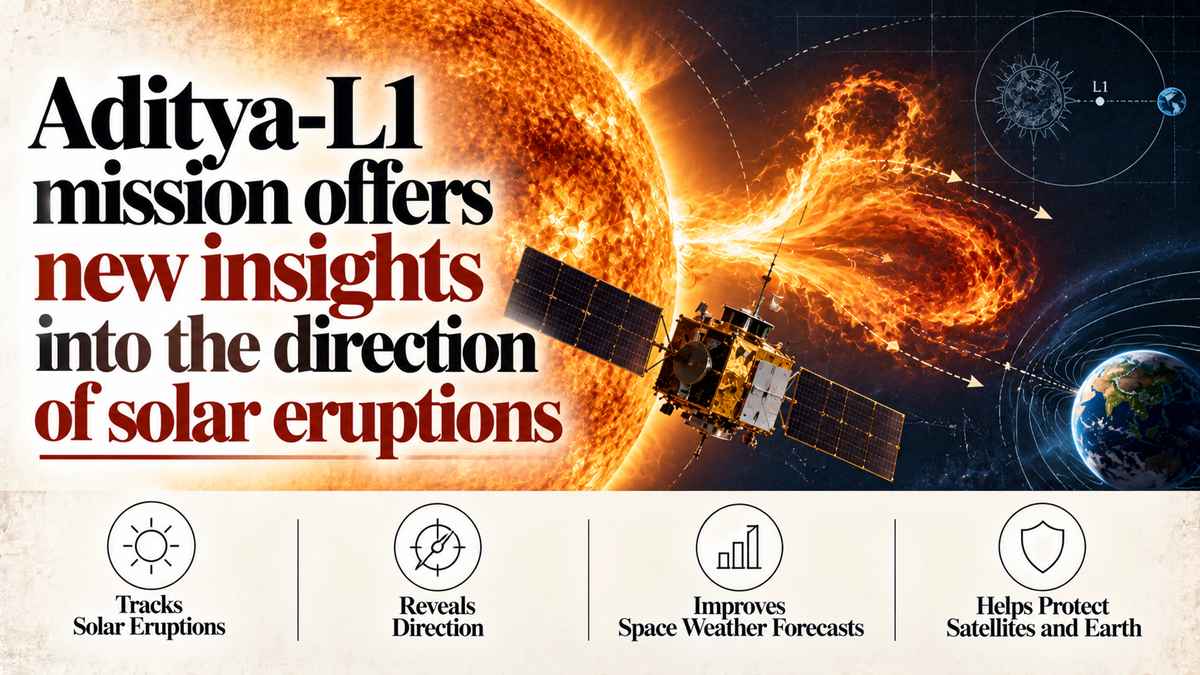
Until now there was no information on how coronal mass ejections (CMEs), huge clouds of plasma thrown out by the Sun, travel along the Sun-Earth direction. New Doppler velocity images of the solar corona are expected to supply it. Scientists at the Indian Institute of Astrophysics (IIA) made them with data from the Visible Emission Line Coronagraph (VELC) payload on Aditya-L1, India’s maiden solar mission.
What is a coronal mass ejection, and why track its direction?
- Hot plasma from the Sun: Solar activity throws out hot plasma, electrically charged gas, from the corona, the Sun’s outer atmosphere.
- Coronal mass ejection: A CME is a massive, energetic cloud of plasma ejected during a powerful solar eruption.
- Direction varies: A CME can travel towards the Earth or in any other direction from the Sun.
- Why direction matters: CMEs can disrupt near-Earth space, so scientists need to know their direction of travel as they erupt.
- The takeaway: Knowing which way an eruption is moving tells scientists whether it is headed for Earth.
How do Doppler velocity images show the direction?
- Doppler effect in sound: A train’s whistle sounds higher in pitch as it approaches a platform and lower as it moves away. This shift in pitch is the Doppler effect.
- Same idea in light: The scientists applied the same Doppler effect concept to light waves to build velocity images of the corona.
- Reading the images: Positive Doppler velocities show plasma moving away from the observer, and negative ones show plasma moving towards the observer.
What makes the VELC result distinctive?
- Only instrument able to do it: At present only VELC can generate such images, because of its one-of-a-kind spectroscopic observing capability in the visible wavelength range.
- Indian-built processing: The VELC payload operations team at IIA developed the detailed software that processes the VELC data.
- Peer-reviewed method: The data processing details were published in the Astrophysical Journal after international peer review.
- Wider use: The processed images will be shared with the scientific community.
Conclusion
Aditya-L1’s coronagraph now gives Indian scientists a measurement earlier observations lacked: the direction in which an eruption’s plasma is moving. What to watch is whether researchers using these images can tell, at the moment of eruption, which CMEs are headed for Earth.
Back2Basics: Aditya-L1
- Mission: Aditya-L1 is the Indian Space Research Organisation’s (ISRO) first space-based observatory-class solar mission, its second astronomy observatory after AstroSat (2015).
- Orbit: It circles in a halo orbit around the first Lagrange point (L1) of the Sun-Earth system, about 1.5 million km from Earth.
- Lagrange point: A Lagrange point is a position where the gravitational pulls of two large orbiting bodies, here the Sun and Earth, balance.
- Objectives: It studies the Sun’s photosphere, chromosphere, corona and solar wind, and how they affect Earth, over a planned mission life of five years.
Matching Previous Year Question
“[2025] Consider the following statements: Statement I: Scientific studies suggest that a shift is taking place in the Earth’s rotation and axis. Statement II: Solar flares and associated coronal mass ejections bombarded the Earth’s outermost atmosphere with tremendous amount of energy. Statement III: As the Earth’s polar ice melts, the water tends to move towards the equator. Which one of the following is correct in respect of the above statements? (a) Both Statement II and Statement III are correct and both of them explain Statement I (b) Both Statement II and Statement III are correct but only one of them explains Statement I (c) Only one of the Statements II and III is correct and that explains Statement I (d) Neither Statement II nor Statement III is correct ANSWER: (b)”
