Why in the News
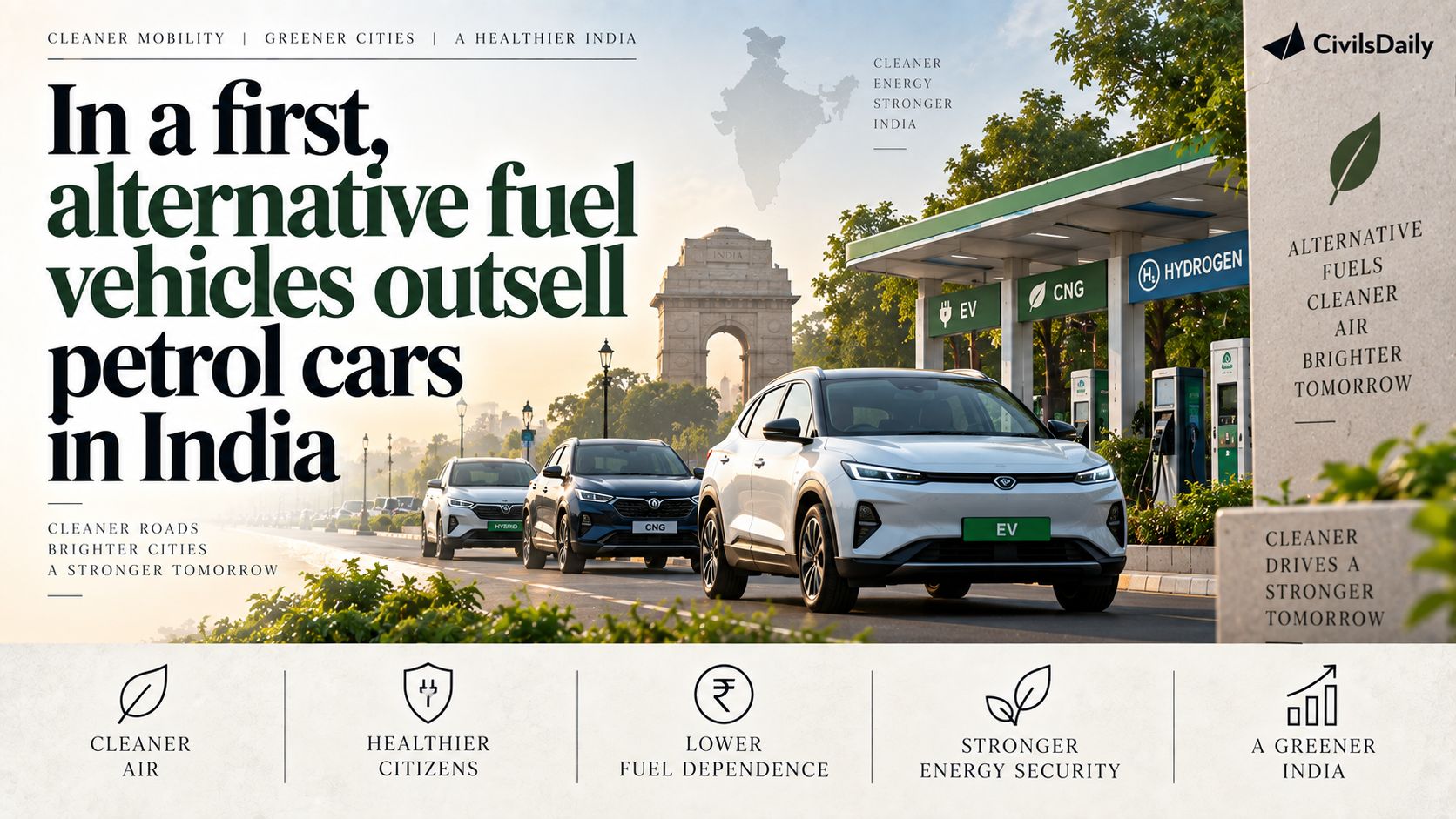
Alternative fuel vehicles outsold petrol cars in India’s passenger vehicle market for the first time in August 2026. Compressed natural gas (CNG), hybrid and electric vehicles together accounted for 41.95 percent of passenger vehicle retail sales against petrol’s 40.85 percent. The month also set a volume record across every segment, with 24,23,201 units retailed in all. The crossover was reported in the monthly retail registration data of the Federation of Automobile Dealers Associations (FADA). Petrol remains the largest single fuel in the market, so the crossover is three powertrains adding up rather than one substitute displacing petrol.
What does the August 2026 retail data show across segments?
- A record month by volume: Total retail sales reached 24,23,201 units, a rise of 17.51 percent year on year. Two wheelers, passenger vehicles, commercial vehicles, tractors and three wheelers each set a fresh August record.
- Growth was uneven across segments: Wheeled construction equipment grew 31.45 percent, two wheelers 19.69 percent, passenger vehicles 16.14 percent and commercial vehicles 14.45 percent. Three wheelers grew 8.64 percent and tractor sales were effectively flat at 0.84 percent.
- Segment volumes set new marks: Two wheelers retailed 17,14,610 units, the best August since 2018. Passenger vehicles crossed the four lakh mark in an August for the first time at 4,02,398 units, and commercial vehicles came in at 90,769 units.
- The lighter commercial categories led: Light commercial vehicles grew 15.32 percent year on year, heavy commercial vehicles 13.98 percent and medium commercial vehicles 10.38 percent. Dealers attribute the demand to infrastructure execution, mining and logistics linked to e-commerce, alongside steady financing.
- Sales fell against the previous month: Retails were 6.48 percent lower than in July 2026. The seasonal monsoon lull and a festival calendar that shifted Ganesh Chaturthi and pushed Onam linked buying into September account for the fall.
- Dealer stock is building: Passenger vehicle inventory rose by a further five days over the end of July to about 38 to 40 days, against the 21 day benchmark the dealers’ body recommends. Higher stock than the previous month was reported by 56 percent of passenger vehicle dealers.
Why does the change in fuel mix matter more than the volume record?
- The alternative fuel share is three distinct powertrains: CNG vehicles accounted for 25.28 percent of passenger vehicle sales, hybrids 9.04 percent and electric vehicles 7.63 percent. CNG alone is more than three times the electric share.
- No single alternative fuel has replaced petrol: Petrol is still the largest individual fuel in the segment. The threshold crossed is a share of the market held collectively, not a substitution of one fuel by another.
- Running cost is the stated driver: Dealers attribute the movement of petrol buyers towards CNG, hybrids and electric vehicles to running cost economics rather than to purchase price.
- Ethanol blending has become a demand factor: Continuing consumer hesitation around the E20 transition, the shift to petrol blended with 20 percent ethanol, is nudging buyers away from petrol. Part of the shift is avoidance of an uncertain fuel rather than preference for a new powertrain.
How far has electrification moved beyond passenger cars?
- Electric two wheelers crossed a tenth of their market: Their share reached 10.68 percent against 7.66 percent a year earlier. It was the first time the 10 percent mark was crossed in a non festival month.
- Electric commercial vehicles hit a record share: Their share rose to an all time high of 5.18 percent from 2.06 percent a year earlier, with monthly volumes setting a fresh record.
- Three wheelers are already structurally electric: Electric penetration in the three wheeler segment stands at 65.30 percent. Electrification there has stopped being a transition and become the default.
Challenges to the shift to alternative fuel vehicles
- Charging access lags electric vehicle sales: Public charging remains concentrated in large cities and on a few highway corridors, so buyers without private parking carry the highest switching cost. Eg. The PM Electric Drive Revolution in Innovative Vehicle Enhancement (PM E-DRIVE) scheme, notified in 2024, set aside about Rs 2,000 crore of its outlay specifically for public charging infrastructure.
- CNG supply is geographically uneven: The fuel is dense in a few city gas distribution areas and thin elsewhere, which caps how far its cost advantage can travel. Eg. Delhi and Gujarat hold a large share of India’s CNG stations while much of eastern India remains sparsely covered.
- Hybrid incentives vary by State: Hybrids sit outside most electric vehicle subsidy schemes, so their running cost advantage depends on where the vehicle is registered. Eg. Uttar Pradesh waived the registration tax on strong hybrid vehicles in 2024, a concession most States do not offer.
- Battery manufacture depends on imported inputs: Cell manufacturing and the lithium, cobalt and graphite feeding it are largely imported, so electric vehicle prices track external supply. Eg. The National Critical Mineral Mission, launched in 2025, was created to secure exactly these inputs.
- A share built on hesitation can reverse: Buyers moving away from petrol over blending concerns can move back once those concerns are answered. Eg. E20 petrol was rolled out across the country by 2025 amid disputes over fuel efficiency and engine compatibility in vehicles built for lower blends.
Way Forward
- Expand public charging infrastructure: Tie charging point rollout targets to electricity distribution licence areas, so coverage follows the grid rather than following sales volumes.
- Ensure wider CNG availability: Make station rollout milestones an enforceable condition of every city gas distribution licence rather than a projected commitment.
- Create uniform hybrid incentives: Settle one national treatment of hybrids in the motor vehicle tax structure so the segment is not priced by State discretion.
- Strengthen domestic battery value chains: Link production linked incentive disbursal for cells to domestic value addition milestones rather than to assembly volumes.
- Build evidence based consumer confidence: Publish independent test results on efficiency loss and material compatibility by vehicle vintage, so the choice rests on evidence rather than uncertainty.
Conclusion
The fuel mix has moved ahead of the infrastructure that has to support it. The festival quarter is the next test, when discounting and volume peak together and dealer stock is either absorbed or deepens. The second marker is whether the alternative fuel share holds once the ethanol blending question is settled, because a share built partly on avoidance is not the same as a share built on preference.
Back2Basics: Federation of Automobile Dealers Associations (FADA)
- What it is: FADA is the apex national body of automobile retail dealers in India, representing dealerships across vehicle segments.
- What its data measures: It compiles retail sales from vehicle registration records at regional transport offices. Its figures therefore track vehicles sold to customers, not vehicles dispatched from factories to dealerships.
- Why the distinction matters: Manufacturer dispatch numbers can rise while retail sales stall, with the difference sitting as unsold stock at dealerships. FADA’s monthly inventory reading is what exposes that gap.
[2025] Consider the following types of vehicles:
I. Full battery electric vehicles
II. Hydrogen fuel cell vehicles
III. Fuel cell electric hybrid vehicles
How many of the above are considered as alternative (powertrain) vehicles?
(a) Only one
(b) Only two
(c) All the three
(d) None
