Why in the News?
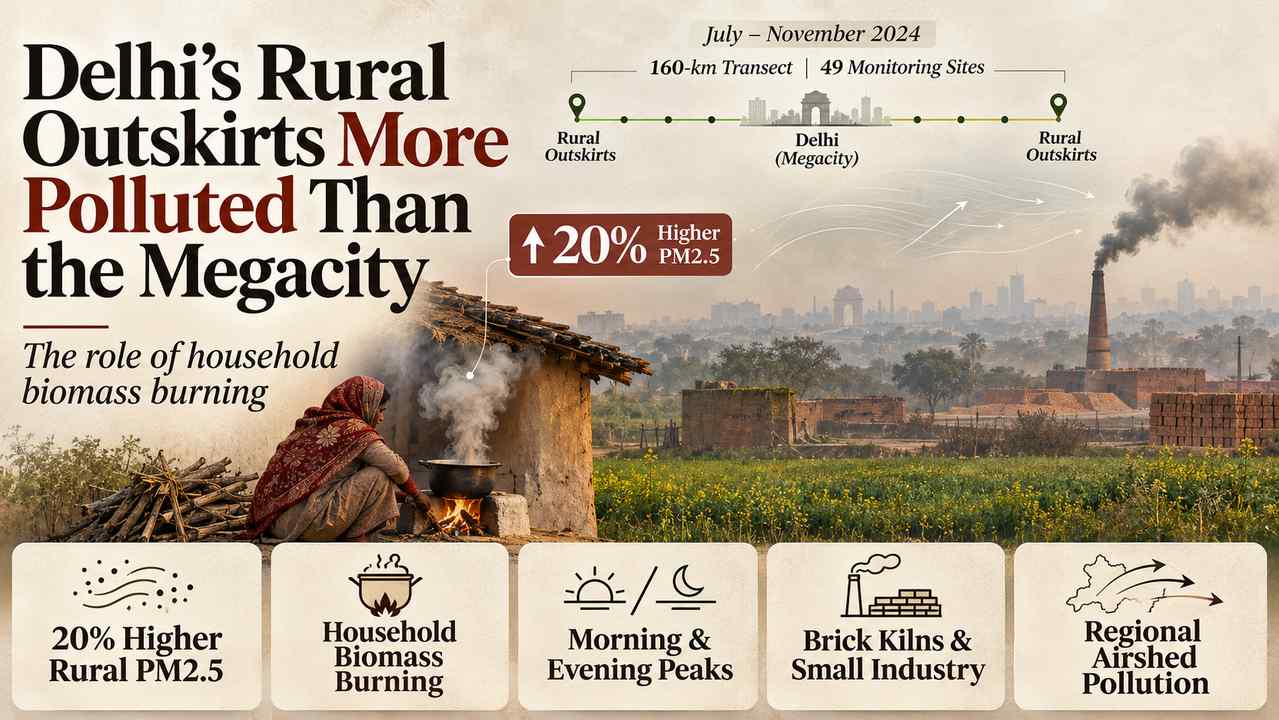
- A study published in the Proceedings of the National Academy of Sciences (PNAS) found that PM2.5 concentrations in rural areas surrounding Delhi were approximately 20% higher than in urban Delhi.
- The study challenges the perception that cities are always more polluted than rural areas and identifies household solid-fuel combustion, rather than stubble burning, as a major contributor.
Key Highlights
- Study compared two locations:
- Urban Delhi
- Nuran Khera village, approximately 80 km from Delhi.
- Rural PM2.5 concentrations consistently exceeded urban levels by around 20%.
- Observations covered July to December 2025.
- Rural areas experienced sharp morning and evening pollution spikes.
- Major sources of rural pollution:
- Wood and dung burning.
- Biomass fuels for cooking and heating.
- Fodder preparation.
- Small-scale industries and brick kilns.
- Municipal waste burning.
- Older vehicles.
- Urban Delhi’s major pollution sources included vehicular emissions and construction dust.
- Stubble burning was not identified as the major driver because rural pollution patterns persisted across seasons.
PM2.5 and Household Air Pollution
- PM2.5 refers to particulate matter with a diameter of 2.5 micrometres or less.
- These particles can penetrate deep into the lungs and contribute to serious health problems.
- Household solid fuels include:
- Firewood
- Dung cakes
- Other biomass fuels
- Burning these fuels releases particulate matter and other harmful pollutants.
- Morning and evening pollution peaks correspond to periods of cooking, water heating and space heating.
Major Challenges
- Fuel stacking: Households simultaneously use multiple fuels and appliances, such as LPG and biomass.
- Affordability: Economic constraints discourage regular use of cleaner fuels.
- Inadequate monitoring: Rural areas lack sufficient ground-based air-quality monitoring stations.
- Policy gap: Existing air pollution interventions largely focus on urban centres.
- Multiple emission sources: Brick kilns, small industries, waste burning and older vehicles contribute to rural pollution.
Government Initiatives
– Pradhan Mantri Ujjwala Yojana (PMUY)
- Promotes access to LPG connections for eligible rural and deprived households.
- Helps reduce dependence on traditional biomass cooking fuels.
– Saubhagya Scheme
- Aimed at providing household electricity connections.
- Improved electricity access can reduce dependence on polluting fuels for certain household activities.
– National Clean Air Programme (NCAP)
- Focuses on reducing air pollution in Indian cities.
- Supports interventions such as road-dust management and air-quality monitoring.
- The study highlights the need to extend pollution-control efforts beyond urban areas.
Prelims Quick Revision
- Rural PM2.5 concentrations around Delhi were approximately 20% higher than urban Delhi.
- Study published in PNAS.
- Rural study location: Nuran Khera village, around 80 km from Delhi.
- Study observation period: July-December 2025.
- Major rural pollution source: Household solid-fuel combustion.
- PM2.5 diameter: 2.5 micrometres or less.
- Fuel stacking means simultaneous use of multiple fuels, including clean and polluting fuels.
- NCAP primarily targets urban air pollution.
- Ujjwala Yojana promotes LPG adoption, while Saubhagya focused on household electricity access.
