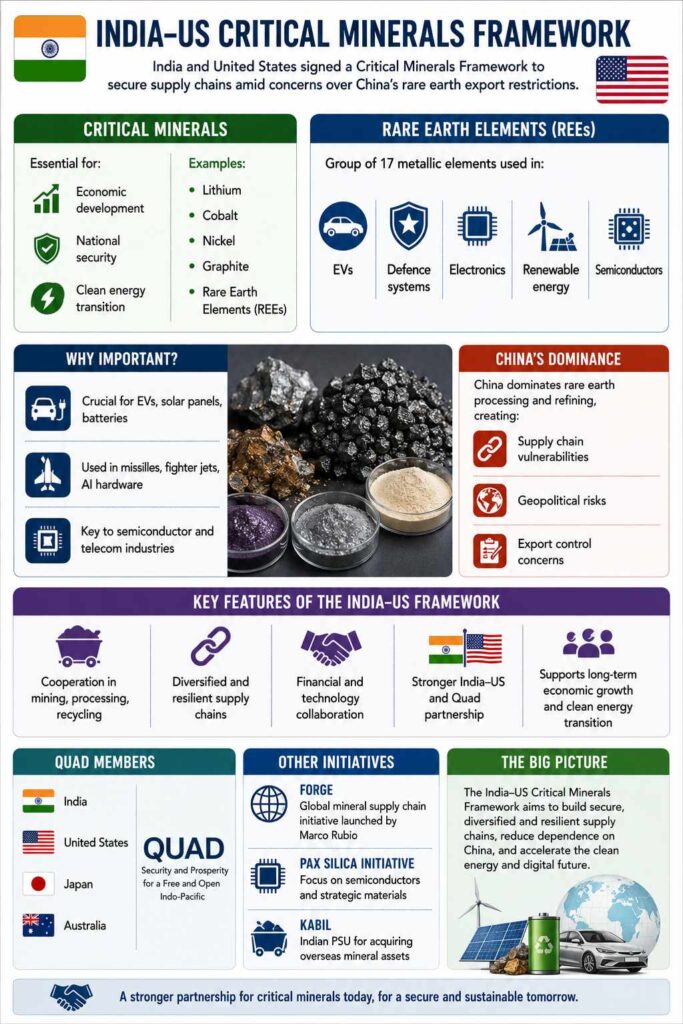
India and the United States signed a Critical Minerals Framework to secure supply chains amid concerns over China’s rare earth export restrictions.
Critical Minerals
Essential for:
Economic development
National security
Clean energy transition
Examples: Lithium, Cobalt, Nickel, Graphite, and Rare Earth Elements (REEs)
Rare Earth Elements (REEs)
Group of 17 metallic elements used in: EVs, Defence systems, Electronics, Renewable energy, and Semiconductors
Why Important?
Crucial for EVs, solar panels, batteries
Used in missiles, fighter jets, AI hardware
Key to semiconductor and telecom industries
China’s Dominance
China dominates rare earth processing and refining, creating:
Supply chain vulnerabilities
Geopolitical risks
Export control concerns
[2025] Consider the following statements: I. India has joined the Minerals Security Partnership as a member. II. India is a resource-rich country in all the 30 critical minerals that it has identified. III. The Parliament in 2023 has amended the Mines and Minerals (Development and Regulation) Act, 1957 empowering the Central Government to exclusively auction mining lease and composite license for certain critical minerals. Which of the statements given above are correct?
Muslim pilgrims gathered at the Mount of Mercy (Jabal al-Rahmah) on the plain of Arafat near Mecca during the annual Hajj pilgrimage.
What is Hajj?
Hajj is the annual Islamic pilgrimage to Mecca and one of the Five Pillars of Islam. It is performed during the Islamic month of Dhu al-Hijjah, mainly from the 8th to 12th day.
Importance
Mandatory once in a lifetime for every financially and physically capable Muslim.
Five Pillars of Islam
Shahada (Faith)
Salah (Prayer)
Zakat (Charity)
Sawm (Fasting during Ramadan)
Hajj (Pilgrimage)
What is Arafat?
Arafat is a plain about 20 km southeast of Mecca where pilgrims gather on the 9th day of Dhu al-Hijjah. It is considered the most important ritual site of Hajj.
Mount of Mercy (Jabal al-Rahmah)
Religious significance:
Prophet Muhammad delivered his Farewell Sermon here.
Islamic tradition believes Adam and Eve reunited here after separation.
[2022] The term “Levant” often heard in the news roughly corresponds to which of the following regions?
[A] Region along the eastern Mediterranean shores
[B] Region along North African shores stretching from Egypt to Morocco
PYQ Relevance[UPSC 2021] How have the recommendations of the 14th Finance Commission of India enabled the States to improve their fiscal position?Linkage:It directly examines the role of the Finance Commission in Centre-State fiscal relations and State finances. The present article extends this debate by questioning whether Finance Commission transfers under the 15th and emerging 16th FC framework are ensuring equity or disproportionately benefiting certain States while penalising economically stronger ones.
Mentor’s Comment
Consultations for the 16th Finance Commission have revived the debate on the fairness of tax devolution, with several States demanding changes in transfer criteria and a higher share in central taxes. The issue has gained urgency as large disparities in health and education spending persist despite decades of fiscal transfers. At the same time, the southern and economically stronger States argue that current formulas disproportionately favour poorer States.
Why has the Finance Commission become central to the debate on fiscal federalism?
The Finance Commission (FC) is central to the fiscal federalism debate because it acts as the primary constitutional arbitrator balancing the financial powers of the Centre with the development responsibilities of the States .
Correction of Structural Imbalances: Under Article 280, the FC resolves the vertical imbalance (Centre vs. States) and horizontal imbalance (richer vs. poorer States) to ensure uniform national development.
Tension over Resource Sharing through Vertical Devolution: While the 15th FC maintained a 41% vertical devolution to States, the actual money transferred has shrunk due to the Centre’s increasing reliance on cesses and surcharges, which are not shared with States.
The Equity vs. Efficiency Dilemma: Horizontal distribution criteria like “income distance” favor less-developed States. This leads to growing protests from highly performing southern States that feel penalized for their demographic and economic successes.
Compounded Fiscal Stress: The aftermath of the GST transition, volatile public debt levels, and rigid fiscal deficit targets have left States highly dependent on FC recommendations for survival.
Erosion of Autonomy: The proliferation of Centrally Sponsored Schemes (CSS) forces States to spend their own matching funds on federal priorities, severely limiting their local budgeting freedom.
Why are States dissatisfied with the present structure of fiscal transfers?
Cesses and Surcharges: Exceeded 15% of gross tax revenues and remain outside the divisible pool, reducing States’ effective share to around 8-10% lower than expected transfers.
Non-Tax Revenues: Centre retains significant revenues from natural resource extraction, asset monetisation, and RBI surplus transfers, limiting fiscal decentralisation.
GST Constraints: Structural changes after GST reduced States’ tax flexibility and independent fiscal capacity.
Borrowing Restrictions: States face tighter fiscal discipline norms despite increasing expenditure obligations.
CSS Burden: Restructuring of schemes such as MGNREGA requires States to bear 40% programme costs, increasing expenditure pressure.
Demand for Higher Share: Several States demanded 50% vertical devolution, citing shrinking fiscal space.
How have Finance Commission criteria altered interstate equity outcomes?
Changing Criteria: Successive Finance Commissions frequently changed weights assigned to devolution criteria, creating uncertainty for States.
Reduced Role of Income Distance: States argued for lower weightage or purchasing-power adjustments due to cost-of-living variations.
Shift in State Shares: Combined share of four major beneficiary States, Bihar, Madhya Pradesh, Uttar Pradesh and West Bengal, increased from 42.5% under the 15th FC period to 51% under the 16th FC calculations.
Southern States’ Decline: Share of Andhra Pradesh, Telangana, Karnataka, Kerala and Tamil Nadu fell from 24.8% to 15.8%, widening perceived inequities.
Fiscal Incentive Concern: Heavy reliance on unconditional equalisation transfers may weaken incentives for revenue mobilisation and fiscal discipline.
Why have fiscal transfers failed to ensure convergence in public service delivery?
Evidence: Bihar spent ₹937 per capita on health (2022-23) compared to Arunachal Pradesh’s ₹10,148, despite transfer mechanisms. Bihar’s per-student elementary education expenditure stood at ₹20,282, compared to Sikkim’s ₹1,30,498 (2023-24).
The Absorptive Capacity Deficit: Fiscally weaker states often lack the administrative machinery, technical staff, and institutional systems required to efficiently deploy and spend massive inflows of capital.
Input-Centric Transfer Architecture: Financial allocations are traditionally tied to rigid, historical spending inputs rather than measurable quality-of-service metrics or regional development outcomes.
Conditional Funding Rigidities: Centrally Sponsored Schemes (CSS) enforce strict, uniform guidelines across the country, preventing states from adapting funds to meet unique regional needs.
Distorted Capital-to-Revenue Mix: A massive portion of devolved funds is consumed by fixed revenue expenditures, such as state salaries and pensions, leaving minimal capital for public infrastructure.
Varying Cost of Delivery: Geographical terrain, population density, and existing infrastructure deficits mean the actual cost of delivering identical healthcare or education units varies drastically between states.
Limited Outcome Orientation: Existing transfer systems prioritise redistribution rather than measurable governance outcomes.
What major changes did the 15th Finance Commission introduce and why are they contested?
Retention of State Share: Maintained 41% vertical devolution.
Removal of Revenue Deficit Grants: Abolished revenue-deficit grants, sector-specific grants, and State-specific grants.
Fiscal Discipline Measures: Recommended States discontinue off-budget borrowings, integrate liabilities into budgets, and maintain fiscal deficit below 3% of GSDP.
Criteria Weightage: Assigned:
Income Distance: 42.5%
Population: 17.5%
Area: 10%
Forest Cover: 10%
Demographic Performance: 10%
Contribution to National GDP: 10%
Square Root GSDP Formula: Used square-root transformation of GSDP shares rather than actual GDP shares, reducing the advantage of economically stronger States.
Major Reduction in Shares:
Maharashtra: From 14.23% to 8.31%
Tamil Nadu: From 9.09% to 6.67%
Karnataka: From 8.95% to 6.59%
Marginal Gains: Smaller States witnessed increased allocations.
Would alternative devolution criteria produce fairer outcomes?
Higher GDP Weightage Scenario: A 25% weight to square-root GDP contribution with reduced income-distance weight could increase:
Karnataka:6.441% – 7.131%
Maharashtra:4.928% – 7.218%
Tamil Nadu:4.097% – 4.867%
Equal Weight Formula: Could increase shares further:
Karnataka:5.544%
Maharashtra:7.845%
Tamil Nadu:5.246%
Actual GSDP Share Formula: Even 10% weight using actual GSDP shares would increase:
Maharashtra:8.698%
Karnataka:5.517%
Tamil Nadu:5.478%
Financial Implications: Under estimated transfers of ₹104 lakh crore, changes could yield annual gains:
Maharashtra: ~₹49,744 crore
Karnataka: ~₹37,565 crore
Tamil Nadu: ~₹32,365 crore
How does the Finance Commission reflect the broader tension between equity and efficiency?
Equity Principle: Supports fiscally weaker States through redistributive transfers to reduce regional inequality.
Efficiency Principle: Rewards States demonstrating higher tax effort, demographic control, fiscal prudence, and stronger economic output.
Political Economy Concern: States with greater parliamentary representation often receive higher transfers despite weaker fiscal performance.
Delimitation Anxiety: Southern States fear demographic success may reduce political representation while redistribution continues to favour higher-population States.
Future Challenge: Balancing need-based redistribution with performance-based incentives.
Conclusion
Finance Commission transfers remain central to India’s cooperative federal architecture. The debate increasingly reflects a deeper conflict between redistributive justice and fiscal efficiency. While poorer States require sustained support to ensure minimum public service standards, economically stronger States seek recognition for fiscal prudence and demographic performance. Future Finance Commissions may need to adopt outcome-based indicators, fiscal capacity measures, and balanced weighting frameworks to preserve both equity and federal trust.
The Indian rupee recently crossed ₹96 per U.S. dollar in May 2025, compared to nearly ₹85 a year earlier. This marked a sharp depreciation amid global geopolitical tensions, foreign portfolio outflows, and rising import dependence.
Why does the Indian rupee continue to depreciate despite India’s growing economy?
Demand-Supply Dynamics: Currency prices depend on market demand relative to other currencies. A higher demand for dollars than rupees weakens the rupee.
Import Dependence: India imports large quantities of crude oil, electronics, machinery, and industrial inputs, increasing demand for dollars.
Data Point: Merchandise trade deficit worsened from USD 244.9 billion (2023-24) to USD 286.9 billion (2024-25).
Geopolitical Uncertainty: Global instability encourages investors to shift funds toward safer assets such as the U.S. dollar, strengthening it relative to emerging market currencies.
Dollar Strength: Higher U.S. interest rates attract global capital into dollar-denominated assets.
How does India’s Balance of Payments (BoP) shape the rupee’s exchange rate?
India’s Balance of Payments (BoP) directly shapes the rupee’s exchange rate by determining the net demand and supply of foreign currency within the economy.
Analyze Current Account ImpactThe Current Account reflects the net balance of trade in goods, services, and transfer payments
Merchandise Trade Deficit: Increased from USD 244.9 billion (2023-24) to USD 286.9 billion (2024-25).
Invisibles Surplus Buffers Rupee: Strong software services exports and remittances from workers abroad (especially West Asia) created a net invisible surplus rise from USD 218.8 billion to USD 263.9 billion. This creates massive inflows of foreign currency, supporting rupee stability.
Net Deficit Weakens Rupee: Because the merchandise deficit outweighs the invisibles surplus, the overall current account remains in a deficit (CAD).
Evaluate Capital Account Dynamics: The Capital Account tracks the flow of investment capital, loans, and banking capital across national borders.
Financing the Gap: India relies on foreign capital inflows to bridge the CAD.
FDI and Portfolio Inflows: Inflows from Foreign Direct Investment (FDI) and Foreign Portfolio Investment (FPI) demand Indian currency. Foreigners convert USD to INR to buy assets, which strengthens the rupee.
External Borrowing Risks: Relying on short-term loans and external borrowings can cause sudden rupee volatility if global interest rates spike or investors pull funds out rapidly.
Review Exchange Rate Outcomes: The final value of the rupee hinges on the net interaction between these two accounts.
BoP Condition
Market Mechanism
Impact on Indian Rupee
Overall BoP Surplus
Capital Inflows > Current Account Deficit
Appreciates (Rupee strengthens)
Overall BoP Deficit
Capital Inflows < Current Account Deficit
Depreciates (Rupee weakens)
India’s BoP Snapshot (Figures in USD billion)
Component
2023-24
2024-25
Current Account
-26.1
-23.1
Merchandise Trade
-244.9
-286.9
Invisibles
218.8
263.9
Capital Account
89.4
116.6
FDI
54.2
4.52
Loans
6.5
29.3
Others
28.7
-17.2
Forex Reserves Change
-63.7
+5
How do foreign capital outflows weaken the rupee?
Foreign capital outflows weaken the rupee through a direct market mechanism of asset liquidation and currency conversion.
The Conversion Mechanism: When foreign portfolio investors (FPIs) decide to exit the Indian market, they liquidate their holdings in domestic stocks and bonds. This process unfolds in two distinct steps that put downward pressure on the currency:
Asset Liquidation: Investors sell Indian equities and debt instruments, receiving payments in Indian Rupees (INR).
Currency Conversion: To repatriate their capital, these investors must immediately sell their newly acquired rupees in the foreign exchange market to buy US Dollars (USD).
Supply and Demand Imbalance: The mass exit of foreign capital disrupts the equilibrium of the foreign exchange market:
Surplus of Rupee: The market experiences a sudden, heavy supply of rupees as exiting investors rush to dump the currency.
Scarcity of Dollars: Simultaneously, the demand for US dollars spikes sharply.
Depreciation: According to standard economic laws of supply and demand, an oversupply of a currency combined with intense demand for a foreign counterparty currency causes the domestic currency (the rupee) to lose value.
FPI vs. FDI Stability: The nature of the capital leaving the country dictates the severity of the exchange rate impact:
High Volatility (FPI): Foreign Portfolio Investment is highly liquid and seeking short-term financial returns. It can exit a country almost instantly, earning it the label “hot money.” This makes FPI the primary driver of sudden, sharp currency depreciation during global market panics.
Resilient Cushion (FDI): Foreign Direct Investment (FDI) involves long-term, physical investments like building factories or buying corporate infrastructure. Because these assets cannot be quickly liquidated, FDI remains stable during crises and serves as a critical structural anchor for the rupee.
Why does a falling rupee become costly for India’s economy?
Imported Inflation: Depreciation raises costs of imported goods.
Oil Burden: India imports a substantial share of crude oil, making energy prices vulnerable to currency depreciation.
Data Illustration: At ₹96 per dollar, purchasing USD 100 worth of oil requires ₹9,600, compared to ₹8,500 at ₹85 per dollar.
Inflationary Transmission: Higher fuel costs increase logistics and transportation expenses across sectors.
Manufacturing Constraints: Expensive imported raw materials raise production costs.
Growth Trade-off: Depreciation may support exports but simultaneously increases import dependence.
Does a weaker rupee improve India’s exports automatically?
Export Competitiveness: A cheaper rupee can make Indian goods more affordable globally.
Structural Constraints: Export gains remain limited when manufacturing competitiveness is weak.
Even if the rupee depreciates from ₹96 to ₹120, export gains may remain modest due to supply-side constraints.
Import Dependence in Manufacturing: Many exporters rely on imported inputs, reducing net gains from depreciation.
What role does the Reserve Bank of India (RBI) play in defending the rupee?
Forex Intervention: RBI sells dollars from reserves to reduce excessive rupee depreciation.
Market Stabilisation: Dollar sales increase dollar supply in forex markets and support rupee demand.
Forex Reserve Strength: India’s reserves stood at approximately USD 691 billion by March 2026, sufficient for around 10.8 months of imports.
Intervention Evidence: RBI actively intervened during October 2024-January 2025 and August-December 2025.
Limitation: RBI can moderate volatility but cannot permanently reverse depreciation caused by structural deficits.
Why is oil dependency central to rupee vulnerability?
Crude Oil Imports: India imports nearly 85% of its crude oil requirement, increasing dollar demand.
Geopolitical Linkage: Conflicts in energy-producing regions raise crude prices, amplifying pressure on the rupee.
Policy Imperative: Reducing oil dependence through renewables, EVs, ethanol blending, and domestic energy diversification strengthens currency stability.
Conclusion
The rupee’s depreciation reflects deeper structural realities of India’s external sector rather than merely short-term market fluctuations. Persistent trade deficits, dependence on imported oil, volatile portfolio flows, and geopolitical disruptions continue to pressure the currency. While RBI intervention and strong forex reserves provide temporary insulation, durable currency stability ultimately depends on strengthening exports, reducing import dependence, and improving external sector resilience.
PYQ Relevance
[UPSC 2018] How would the recent phenomena of protectionism and currency manipulations in world trade affect macroeconomic stability of India?
Linkage: The PYQ tests understanding of exchange rate volatility, external sector vulnerabilities, capital flows, and macroeconomic stability. The article explains how rupee depreciation, trade deficits, foreign capital outflows, geopolitical tensions, and dollar strengthening affect India’s macroeconomic stability and Balance of Payments.
India’s water challenge is increasingly shifting to peri-urban areas that are growing rapidly but lack proper governance and services. This has become important because India’s urban expansion is accelerating fast: the number of Census towns rose from 1,362 to 3,784 in two decades. While the Jal Jeevan Mission has brought tap water to nearly 80% of rural households, peri-urban regions still face urban-level pressures without reliable water and sanitation services.
What are Peri-Urban Areas?
Peri-urban areas are transitional zones located on the outskirts of metropolitan regions where urban and rural activities mix.
They are characterized by rapid, often unplanned, land-use changes, overlapping jurisdictions, and a heterogeneous population with diverse socio-economic backgrounds.
India’s peri-urban landscape represents the transition zone where farmlands, fragmented settlements, industrial units, and expanding cities intersect.
These areas are neither fully rural nor formally urban, resulting in governance ambiguity.
Why are peri-urban areas emerging as the “missing middle” in India’s water governance framework?
Institutional Vacuum: Creates governance ambiguity as peri-urban areas remain outside effective rural governance but lack urban administrative integration.
Rapid Urbanisation: Expands peri-urban settlements at a pace faster than institutional adaptation. Census towns increased from 1,362 to 3,784, registering a 178% rise over two decades.
Unplanned Settlement Growth: Converts agricultural land into industrial sheds and densely clustered settlements without parallel expansion of water and sanitation infrastructure.
Administrative Limbo: Produces fragmented accountability as these regions are “no longer villages but not recognised cities.”
Service Deficit: Imposes urban-level costs without corresponding urban-level services, creating dual vulnerabilities.
How does governance fragmentation intensify water insecurity in peri-urban regions?
Intermittent Water Supply: Forces residents into uncertain access arrangements. In Rawta village near Delhi, water is supplied only on alternate days between 7 p.m. and midnight, compelling households to sacrifice sleep for water collection.
Dependence on Informal Markets: Encourages exploitation by private water vendors, particularly where piped access remains unreliable.
Municipal Overstretch: Weakens service delivery when peri-urban regions are absorbed into municipal corporations without administrative preparedness. In Gurugram, abolition of rural governance exposed residents to urban prices without adequate services.
Governance Discontinuity: Generates inefficiencies during transitions from panchayat systems to municipal administration.
How does peri-urban expansion transfer environmental burdens onto vulnerable communities?
Groundwater Contamination: Intensifies due to waste dumping and untreated urban spillovers. In peri-urban Hyderabad, toxic leachate from waste dumps contaminated groundwater systems.
Urban Resource Extraction: Diverts water away from downstream users. The Bisalpur Dam, originally built for Tonk and Sawai Madhopur irrigation, increasingly prioritises Jaipur’s urban demand, shifting costs to rural farmers.
Sacrifice Zones: Converts peri-urban regions into sites bearing ecological costs of urban growth without compensatory governance mechanisms.
Water Inequity: Expands when rural water sources are appropriated for urban consumption without accountable regulatory systems.
Why is sanitation failure becoming a major peri-urban governance crisis?
Septic Tank Dependence: Leaves nearly 40 million urban households dependent on on-site sanitation systems such as septic tanks.
Irregular Desludging: Creates public health risks because septic tanks are often cleaned only after overflow.
Illegal Disposal: Encourages dumping of untreated septage into rivers and open fields, undermining sanitation outcomes.
Infrastructure Reversal: Weakens gains achieved under the Swachh Bharat Mission, as a single 5,000-litre tanker dumping untreated waste can negate sanitation improvements created by thousands of constructed toilets.
Public Health Risk: Increases groundwater contamination, vector-borne diseases, and ecological degradation.
Institutional reforms necessary to address the peri-urban water governance vacuum:
How can governance structures be redesigned for peri-urban settlements?
Nagar Panchayats: Ensure institutional continuity for all Census towns, as envisioned under the 74th Constitutional Amendment.
Functional Reclassification: Strengthens governance capacity after rural-to-urban transitions.
Collaborative Governance: Improves accountability through local coordination. The Sultanpur village platform experiment brought together engineers, panchayat representatives, and residents, demonstrating better coordination outcomes.
Why must water-source sustainability become central to urban water planning?
Catchment Protection: Prevents encroachment and ecological degradation at water origins.
Solid Waste Regulation: Reduces contamination risks near drinking water sources.
Community Monitoring: Strengthens local accountability through sanitation inspections of water bodies.
Source Sustainability: Addresses a key gap in Jal Jeevan Mission, which expanded tap access but requires stronger long-term water source protection.
Why is a ‘Swachh Bharat Mission 3.0’ necessary for peri-urban India?
Faecal Sludge Management: Prioritises safe collection and treatment of septage.
Decentralised Treatment Infrastructure: Facilitates establishment of faecal sludge treatment plants where sewerage systems remain economically unviable beyond 15-20 km.
Technology Integration: Deploys GPS-equipped desludging trucks to prevent illegal dumping.
Narrow-Lane Accessibility: Introduces mini-cesspool vehicles, as demonstrated in Berhampur, Odisha.
Financial Integration: Internalises desludging expenses (₹1,500-₹6,000 per trip) into monthly water charges through sanitation levies.
Rural Employment Linkage: Leverages employment guarantee programmes for sanitation implementation.
Can decentralised wastewater treatment improve peri-urban water resilience?
Modular Systems: Support localised treatment close to wastewater generation points.
High Water Recovery: Technologies developed by Indra Water and Tigreen recover over 95% of used water.
Low Resource Requirement: Minimises land and energy consumption.
Policy Support: Requires single-window clearances, green procurement mandates, and government-backed guarantees to create treated-water markets.
Why should peri-urban water infrastructure be treated as strategic infrastructure?
Future Urbanisation: India will require 230 million housing units and nearly 500 cities by 2047, increasing water demand sharply.
Blended Financing: Strengthens investment capacity through models such as Uttarakhand’s financing framework, combining State risk-bearing with World Bank concessional loans linked to performance indicators.
Infrastructure Prioritisation: Ensures financing for sanitation, decentralised treatment, and water reuse systems.
Conclusion
Peri-urban India represents the decisive frontier of India’s water future. Continued institutional neglect risks creating zones of ecological degradation, sanitation failure, and social inequity. Governance continuity, decentralised treatment, source sustainability, and strategic financing are necessary to transform peri-urban regions into resilient urban transitions rather than sacrifice zones of growth.
Value Addition
Jal Jeevan Mission (JJM), 2019
Objective: Ensures Functional Household Tap Connections (FHTCs) to every rural household under the Ministry of Jal Shakti.
Coverage Expansion: Increased rural tap water access from nearly 17% in 2019 to around 80%+ households, marking one of India’s largest public service delivery programmes.
Community Participation: Strengthens local ownership through Village Water and Sanitation Committees (VWSCs/Pani Samitis).
Source Sustainability: Supports rainwater harvesting, groundwater recharge, watershed management, and local water conservation to ensure long-term water security.
Swachh Bharat Mission (Urban & Grameen)
Objective: Ensures Open Defecation Free (ODF) status, improved sanitation infrastructure, and behavioural transformation.
SBM-Grameen: Strengthens household toilets, solid-liquid waste management, and village sanitation systems.
SBM 2.0 Focus: Expands from toilet construction to ODF+, ODF++ standards, ensuring safe treatment of faecal waste.
Behavioural Change: Promotes sanitation through Jan Andolan (people’s movement) and awareness campaigns.
AMRUT Mission (Atal Mission for Rejuvenation and Urban Transformation), 2015
Objective: Strengthens urban water supply, sewerage networks, septage management, stormwater drainage, and green spaces.
Coverage: Targets 500+ cities, particularly focusing on basic urban infrastructure.
Water Security Focus: Ensures universal water supply, reduction of non-revenue water losses, and sewage treatment expansion.
AMRUT 2.0: Prioritises water circularity, reuse of treated wastewater, rejuvenation of water bodies, and drinking water security.
Atal Bhujal Yojana (Atal Jal), 2019
Objective: Ensures sustainable groundwater management in water-stressed regions through community participation.
Coverage: Implemented across 7 water-stressed States, Gujarat, Haryana, Karnataka, Madhya Pradesh, Maharashtra, Rajasthan, and Uttar Pradesh.
Demand-side Management: Promotes water budgeting, crop diversification, efficient irrigation, and community-led groundwater monitoring.
Institutional Innovation: Uses performance-based incentives for States linked to groundwater outcomes.
World Bank Support: Implemented with financial and technical assistance from the World Bank.
Case Studies / Examples
Rawta Village (Delhi): Example of Intermittent Water Access
Issue: Residents receive piped water only on alternate days between 7 p.m. and midnight.
Governance Challenge: Reflects irregular service delivery despite physical infrastructure presence.
Gurugram: Example of Municipal Absorption Challenges
Issue: Rural governance structures were abolished and peri-urban areas absorbed under the municipal corporation.
Challenge: Municipal institutions struggled with administrative capacity and service provision.
Outcome: Residents experienced urban-level costs without adequate urban services.
Berhampur, Odisha: Example of Sanitation Innovation
Innovation: Introduced mini-cesspool vehicles for desludging in narrow peri-urban lanes inaccessible to large trucks.
Outcome: Improved faecal sludge management and reduced illegal dumping risks.
Bisalpur Dam, Rajasthan: Example of Urban-Rural Water Conflict
Issue: Originally constructed for irrigation in Tonk and Sawai Madhopur, but increasingly redirected to meet Jaipur’s urban water demand.
Challenge: Creates tensions between urban consumption priorities and rural livelihoods.
Hyderabad: Example of Groundwater Contamination
Issue:Toxic landfill leachate from waste dumps contaminated peri-urban groundwater.
Challenge: Demonstrates environmental costs of unregulated urban expansion and weak waste management.
Uttarakhand Financing Model: Example of Blended Infrastructure Financing
Model: Combines State risk-bearing with concessional World Bank loans linked to performance indicators.
Objective: Ensures financing for water, sanitation, and decentralised treatment infrastructure.
Outcome: Encourages result-based financing and accountability.
PYQ Relevance
[UPSC 2024] Analyse the role of local bodies in providing good governance at local level and bring out the pros and cons of merging the rural local bodies with the urban local bodies
Linkage: The PYQ directly tests peri-urban governance transition. The article discusses how peri-urban areas fall into a governance vacuum during transition from Gram Panchayat to municipal governance, creating water and sanitation failures.
The Ministry of Environment, Forest and Climate Change released insights from India’s first national report on the Nagoya Protocol related to Access and Benefit Sharing (ABS), highlighting India’s progress in ensuring equitable sharing of benefits arising from biological resources.
About the Nagoya Protocol
Adopted Under: Convention on Biological Diversity (CBD)
Objective: To ensure Fair and equitable sharing of benefits arising from the utilisation of genetic resources and associated traditional knowledge.
What is Access and Benefit Sharing (ABS)?
ABS means: Users of biological resources must share benefits with:
Local communities
Indigenous groups
Traditional knowledge holders
Benefits can include:
Monetary compensation
Technology transfer
Community development
Conservation support
Key Findings of the Report
Large-Scale Implementation Between 2017 and 2025: 12,830 ABS approvals granted.
India’s Global Contribution
India issued:
3,556 Internationally Recognised Certificates of Compliance (IRCCs)
Around 60% of global issuance.
Revenue Generated: ₹216.31 crore realised by: National Biodiversity Authority (NBA)
Community Benefit: ₹139.69 crore disbursed to benefit claimers and local communities.
[2023] Consider the following statements: 1. In Biodiversity the India, Management Committees are key to the realization of the objectives of the Nagoya Protocol. 2. The Biodiversity Management Committees have important functions in determining access and benefit sharing, including the power to levy collection fees on the access of biological resources within its jurisdiction. Which of the statements given above is/are correct?
Finance Minister Nirmala Sitharaman highlighted concerns regarding “3Fs” Fuel, Fertiliser and Foreign Exchange amid the economic impact of the ongoing West Asia crisis.
Key Economic Concerns
Rupee Depreciation
Rupee weakened sharply against the U.S. dollar after the war began.
RBI reportedly intervened heavily in forex markets.
Foreign Portfolio Investment (FPI) Outflows
Foreign investors sold: Indian stocks and bonds leading to:
Capital outflows
Pressure on forex reserves
Forex Reserves Decline
India’s forex reserves reportedly fell significantly compared to pre-war levels.
Government Measures Taken
Higher import duty on:
Gold
Silver
Platinum
Restrictions on duty-free gold imports
Fuel price hikes
Appeals to reduce non-essential imports and foreign travel
[2022] With reference to the Indian economy, consider the following statements: 1. If the inflation is too high, Reserve Bank of India (RBI) is likely to buy government securities. 2. If the rupee is rapidly depreciating, RBI is likely to sell dollars in the market. 3. If interest rates in the USA or European Union were to fall, that is likely to induce RBI to buy dollars
An article in The Hindu explained the scientific principles behind thermometers, temperature scales, absolute zero, and ultra-cold atomic physics, highlighting how measurement of temperature evolved from mercury thermometers to quantum physics-based studies of cold atoms.
What is Temperature?
Temperature is a measure of the average kinetic energy of atoms and molecules in a substance.
When heat is supplied:
Atoms and molecules move faster.
When heat is removed:
Their motion slows down.
Thus, temperature reflects the degree of atomic agitation inside matter.
Celsius Scale
Developed by: Anders Celsius
Basis of the Scale
0°C: Freezing point of water
100°C: Boiling point of water
The interval between these two points is divided into 100 equal parts.
Mercury Thermometers
Why Mercury is Used
Uniform expansion on heating
Easily visible liquid metal
Good thermal conductor
Digital Thermometers
Modern digital thermometers use Semiconductor materials
Principle
Semiconductors conduct limited electricity.
Higher temperature releases more free electrons.
Increased electric current is measured electronically and converted into temperature readings.
[2021] In a pressure cooker, the temperature at which the food is cooked depends mainly upon which of the following? 1. Area of the hole in the lid 2. Temperature of the flame
3. Weight of the lid Select the correct answer using the code given below.
The Ministry of Statistics and Programme Implementation (MoSPI) released the report of the Technical Advisory Committee (TAC) on revising the base year of the All-India Index of Industrial Production (IIP) from 2011-12 to 2022-23.
About IIP
The Index of Industrial Production (IIP) measures: Growth in industrial activity in India.
Published By: National Statistical Office (NSO) Under MoSPI
Technical Advisory Committee (TAC-IIP)
Chairman: Mridul K. Saggar
Constituted: September 2024
Purpose
Guide the revision of IIP base year.
Improve methodology, coverage, and accuracy.
Major Changes in New IIP Series (2022-23)
Expanded Coverage: New sectors included:
Minor minerals
Rare earth minerals
Gas supply
Water supply
Sewerage and waste management
Revised Item Basket
Total products: 1,042
Mapped into: 463 item groups
Based on: National Industrial Classification (NIC)-2025
National Industrial Classification (NIC)-2025
National Industrial Classification (NIC) is India’s official system for classifying economic and industrial activities.
It helps in:
Collection of statistical data
Industrial surveys
National accounts compilation
Economic analysis and policy formulation
Released by the Ministry of Statistics and Programme Implementation (MoSPI) through the National Statistical Office (NSO).
[2012] In India the overall Index of Industrial Production, the Indices of Eighth Core Industries have combined weight of 37.90%. Which of the following are among those Eight Core Industries? 1. Cement 2. Fertilizers 3. Natural Gas 4. Refinery products 5. Textiles Select the correct answer using the codes given below:
PYQ Relevance[UPSC 2018] In what ways would the ongoing US-Iran Nuclear Pact Controversy affect the national interest of India? How should India respond to this situation?Linkage: The PYQ examines the impact of West Asian geopolitical instability and sanctions regimes on India’s energy security and foreign policy. The article discusses how sanctions, maritime insecurity, and disruptions around the Strait of Hormuz directly threaten India’s crude imports and economic stability.
Mentor’s Comment
The United States has allowed a key sanctions waiver on Russian seaborne crude to expire. This has forced major buyers like India to navigate stricter compliance amid volatile global energy markets. This shift restricts access to discounted Russian oil. The development comes at a time of heightened geopolitical instability in West Asia, maritime disruptions in critical sea lanes, and increasing vulnerability of global supply chains.
How does the U.S. decision alter the global energy equilibrium?
Sanctions Tightening: Restricts Russia’s ability to export seaborne oil freely, potentially reducing global supply flexibility and increasing market volatility.
Fragile Balancing Mechanism: Disturbs the earlier Western approach of sanctioning Russia while simultaneously preventing global price spikes through selective flexibility.
Geopolitical Spillover: Intensifies vulnerabilities caused by the Ukraine conflict, Red Sea disruptions, Iran-related tensions, and maritime insecurity.
Price Sensitivity: Alters freight rates, insurance premiums, and tanker availability, creating ripple effects across oil-importing nations.
Contradiction in Western Objectives: Creates tension between reducing Russia’s oil revenues and maintaining lower inflation and uninterrupted energy flows globally.
Why is India particularly vulnerable to disruptions in Russian oil trade?
Import Dependence: India imports nearly 90% of its crude oil requirements, making external energy shocks economically significant.
Third-Largest Oil Importer: India ranks among the world’s largest energy consumers, increasing exposure to global price fluctuations.
Discounted Russian Crude: Russian oil after 2022 acted as an economic stabiliser by reducing import bills and improving refinery margins.
Inflation Transmission: Rising crude prices increase transport costs, food inflation, fertiliser subsidies, and household expenditure.
Industrial Competitiveness: Expensive energy raises manufacturing costs and affects export competitiveness.
Supply Diversification: Russian imports reduced overdependence on West Asian suppliers and provided flexibility during global disruptions.
How do energy shocks transmit into India’s economy?
Higher Crude Prices: Increase landed import costs, widen the current account deficit, and pressure the rupee.
Strait of Hormuz Vulnerability: Disruptions create supply uncertainty because a large share of India’s crude and LPG imports transit through these waters.
Shipping Insurance Surge: Raises transportation costs due to higher war-risk premiums during geopolitical tensions.
Refinery Stress: Constrains refining margins and increases sourcing complexity.
Fuel Logistics Pressure: Affects LPG and petroleum product supply chains, increasing domestic energy stress.
Table: How Energy Shocks Affect India
Energy Shock
Immediate Impact
Secondary Impact on India
Higher crude oil prices
Costlier imports
Inflation and rupee pressure
Strait of Hormuz disruption
Supply uncertainty
LPG and fuel logistics stress
Shipping insurance surge
Higher landed crude cost
Refining margin pressure
Russian crude restrictions
Reduced supply flexibility
Higher sourcing costs
Freight disruptions
Delayed cargoes
Inventory management stress
Why are sanctions increasingly colliding with market realities?
Fear Premium: Oil prices react not only to shortages but also to anticipated disruptions, often driving prices sharply upward.
Hydrocarbon Dependence: Despite renewable expansion, global transport, aviation, petrochemicals, agriculture, and trade logistics remain heavily oil-dependent.
Revenue Resilience: Russia can continue earning substantial revenues through elevated prices despite reduced export volumes.
Market Pragmatism: Previous temporary waivers reflected recognition that excessive restrictions destabilise global markets.
Energy-Economics Contradiction: Harder sanctions risk worsening inflation and energy insecurity for importing economies.
How is energy security being redefined in the 21st century?
Shift from Physical Scarcity: Energy insecurity now stems less from supply shortages and more from disruptions in shipping, sanctions, tanker blacklisting, financial restrictions, and payment barriers.
Geopolitical Embeddedness: Energy flows increasingly reflect geopolitical alignments rather than purely commercial logic.
Maritime Risks: Strategic chokepoints such as the Strait of Hormuz and Bab-el-Mandeb have become central to global energy security.
Financial Vulnerability: Banking restrictions and sanctions increasingly shape energy access.
Strategic Competition: Energy trade is increasingly influenced by rival geopolitical blocs.
What long-term energy strategy should India adopt?
Strategic Autonomy: Preserves independent energy decision-making amid competing geopolitical blocs.
Conclusion
The tightening of restrictions on Russian oil underscores the growing fusion of geopolitics and energy economics. For India, the challenge extends beyond temporary price volatility to structural energy vulnerability. Long-term resilience will depend on diversified sourcing, stronger reserves, domestic exploration, maritime preparedness, and accelerated clean-energy transition. In an increasingly fragmented world, energy security will remain central to economic sovereignty and strategic autonomy.