The Delhi Police urged the Supreme Court of India to refer the issue of bail under the Unlawful Activities (Prevention) Act, 1967 (UAPA) to a larger Bench, citing “conflicting” judgments on prolonged incarceration and bail.
Key Issue Before the Court
The question is whether: Long incarceration and delay in trial can override strict bail restrictions under UAPA.
Delhi Police’s Argument
Additional Solicitor General S. V. Raju argued:
Under Section 43D(5) of UAPA, the presumption of innocence takes a “backseat”.
If accusations appear “prima facie true”, bail restrictions become mandatory.
Conflicting Supreme Court judgments require consideration by a larger Bench.
Background of the Case
The hearing concerned bail pleas of:
Abdul Khalid Saifi
Tasleem Ahmad
Accused in the 2020 Delhi riots conspiracy case.
Reference to Recent Supreme Court Judgment
A Bench led by: B. V. Nagarathna and Ujjal Bhuyan recently observed:
“Bail is the rule and jail is the exception” even under UAPA.
Prolonged incarceration violates:
Right to life
Personal liberty
Speedy trial under Article 21 of the Constitution of India
K.A. Najeeb Judgment
The Court referred to the Union of India v. K.A. Najeeb case, which held: Constitutional courts can grant bail despite UAPA restrictions when trials are excessively delayed.
Section 43D(5) of UAPA
Restricts bail if accusations appear prima facie true.
Considered one of the strictest bail provisions in Indian law.
Related Development
A Delhi court dismissed interim bail plea of Umar Khalid for attending bereavement rituals and caring for his ailing mother.
UPSC Prelims Pointers
UAPA is India’s anti-terror law.
Section 43D(5) imposes strict bail conditions.
Article 21 guarantees life and personal liberty.
K.A. Najeeb judgment recognised prolonged incarceration as ground for bail.
[2020] Consider the following statements: 1. The Constitution of India defines its ‘basic structure’ in terms of federalism, secularism, fundamental rights and democracy. 2. The Constitution of India provides for ‘judicial review’ to safeguard the citizens’ liberties and to preserve the ideals on which the Constitution is based. Which of the statements given above is/are correct? a) 1 only b) 2 only c) Both 1 and 2 d) Neither 1 nor 2
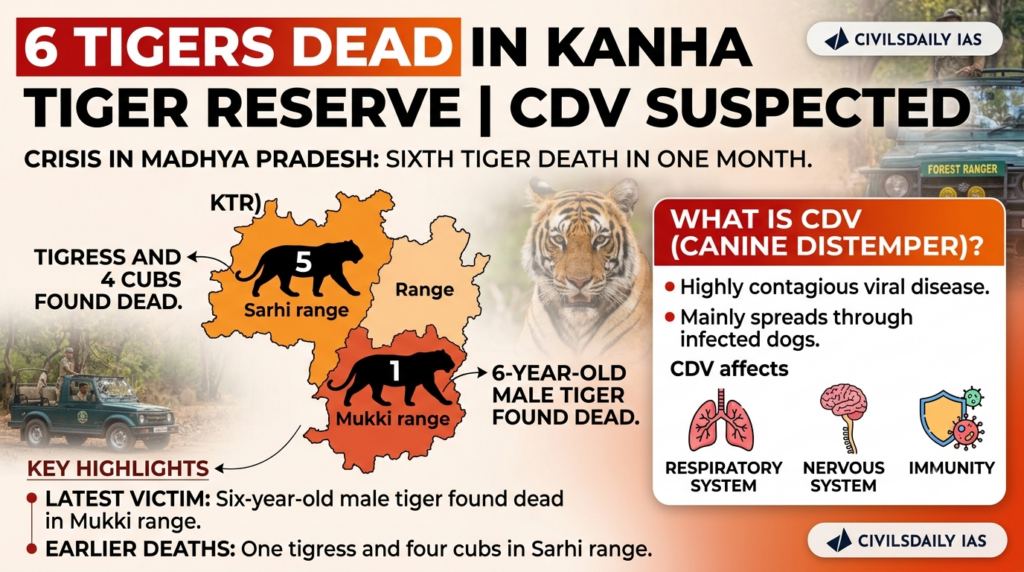
A sixth tiger has died in Madhya Pradesh’s Kanha Tiger Reserve within a month, with authorities suspecting infection by the Canine Distemper Virus (CDV).
Key Highlights
Latest victim:
Six-year-old male tiger
Found dead in Mukki range of KTR
Earlier deaths: One tigress and four cubs in Sarhi range
What is CDV (Canine Distemper)?
Highly contagious viral disease.
Mainly spreads through infected dogs.
Affects:
Respiratory system
Nervous system
Immune system
Why is it a Concern?
Virus may be spreading across different ranges of the reserve.
Stray dogs entering buffer and core forest areas are suspected carriers.
Role of Authorities
The National Tiger Conservation Authority (NTCA) and Union government have sought reports from State officials regarding the tiger deaths.
About Kanha Tiger Reserve
Located in Madhya Pradesh.
One of India’s major tiger reserves.
Part of the Project Tiger network.
Consider the following statements about National Tiger Conservation Authority (NTCA): 1.It was constituted under Biodiversity act, 2002. 2.It is a statutory authority to implement Project Tiger. Which of the statements given above is/are correct? [A] 1 only [B] 2 only [C] Both 1 and 2 [D] Neither 1 nor 2
PYQ Relevance[UPSC 2020] What are the major factors responsible for making rice-wheat system a success? In spite of this success, how has this system become bane in India? Linkage: This PYQ is highly relevant because the article directly critiques the rice-wheat dominated cropping system, driven by MSP and fertilizer subsidies, for causing soil degradation and excessive fertilizer dependence. The article’s core argument on the “fertilizer trap,” monocropping, and need for pulse diversification can be used as contemporary value addition to enrich this answer.
Mentor’s Comment
India’s fertilizer policy has entered a structural paradox: despite spending over ₹2 lakh crore annually on fertilizer subsidies, a substantial share of nutrients fails to translate into food output and instead leaks into the environment through air and water pollution. The core challenge before Indian agriculture is no longer fertilizer availability, but fertilizer-use efficiency, as excessive and imbalanced use has created a “fertilizer trap”. This trap weakens soil health, inflates fiscal burdens, and threatens long-term food security.
Why has India’s fertilizer ecosystem become structurally vulnerable?
Urea Dependence: India produces nearly 80% of domestic urea requirements, yet remains dependent on imported natural gas feedstock, exposing domestic prices to global energy shocks.
Phosphatic Vulnerability: India imports almost the entire requirement of mineral rock phosphate, creating dependence for phosphatic fertilizer manufacturing.
West Asia Risk: Regional conflicts in West Asia increase shipping, fuel, and raw material costs, directly inflating India’s subsidy burden.
Fiscal Exposure: Global fertilizer price volatility automatically raises government subsidy expenditure because domestic fertilizer prices remain politically controlled.
Strategic Concern
Food Security Risk: Fertilizer supply disruptions directly threaten agricultural productivity in a country where nearly half the workforce depends on agriculture.
What is the Fertilizer Trap?
A condition where excessive chemical fertilizer use reduces soil productivity, forcing farmers to apply even larger quantities to maintain the same yield.
Declining Water Retention: Chemically degraded soils lose moisture-holding capacity, increasing vulnerability to drought and erratic monsoons.
Diminishing Marginal Returns: Rising fertilizer application fails to produce proportional increases in output, increasing input costs without equivalent yield gains.
Nutrient Imbalance: Over-reliance on nitrogenous fertilizers (urea) disturbs the NPK balance (Nitrogen-Phosphorus-Potassium).
Environmental Consequences
Air Pollution: Nitrogen fertilizers release ammonia emissions, contributing to air pollution.
Water Pollution: Excess phosphates trigger water eutrophication, damaging aquatic ecosystems.
Climate Impact: Fertilizer misuse increases greenhouse gas emissions, accelerating global warming.
Biodiversity Loss: Soil microbial diversity declines due to excessive chemical exposure.
Data
Subsidy Inefficiency: More than two-thirds of India’s ₹2 lakh crore fertilizer subsidy reportedly fails to become food output and is instead lost to environmental leakages.
Why has India’s fertilizer subsidy regime failed to improve efficiency?
Subsidy Distortion
Cheap Urea Incentive: Heavy subsidy makes urea disproportionately cheaper than phosphatic and potassic fertilizers, encouraging overuse.
Nutrient-Based Subsidy (NBS) Limitation: Although introduced to rationalize fertilizer use, urea remains outside effective market pricing reforms, weakening impact.
Technology Limitations
Neem-Coated Urea: Reduces diversion and slows nitrogen release but fails to eliminate significant nitrogen losses through ammonia volatilization.
Policy Failure
Consumption Growth: Fertilizer use continues to rise despite repeated policy attempts to improve efficiency.
Weak Incentives: Subsidies reward quantity consumed, not efficiency achieved.
Institutional Gap
Defunct Coordination: The Interministerial National Nitrogen Steering Committee ceased functioning before implementing major reforms.
How do MSP distortions and cropping patterns worsen fertilizer inefficiency?
Procurement Bias
MSP Concentration: Although MSP exists for 20+ crops, effective procurement remains concentrated in rice, wheat, and sugarcane.
Monoculture Incentives: Farmers shift toward fertilizer-intensive crops due to procurement certainty.
Decline of Traditional Rotations
Pulse-Cereal Breakdown: Traditional pulse-based crop rotations have weakened substantially.
Lower Urea Requirement: Pulses require nearly 90% less nitrogen fertilizer than cereals.
Residual Soil Benefits
Nutrient Carryover: Nitrogen fixed by pulses benefits succeeding crops.
Soil Regeneration: Pulse rotations improve soil structure and microbial activity.
Climate Resilience
Rain-fed Suitability: Pulses perform relatively better in water-stressed regions.
Historical Lesson
Traditional Sustainability: Pulse-cereal systems sustained Indian agriculture for centuries before synthetic fertilizer dependence expanded.
Why has the Dalhan Aatmanirbharta Mission struggled to alter cropping patterns?
Mission Objectives
MSP Assurance: Guarantees 100% procurement of Tur, Urad, and Masoor.
Financial Commitment: Allocates ₹11,440 crore to increase pulse production to 350 lakh tonnes annually within five years.
Limited Ground Impact
Minimal Acreage Expansion: Pulse acreage increased by only 1.26% in 2025-26.
Persistent Decline: Expansion remains inadequate after nearly 10% contraction in pulse cultivation during 2021-22 to 2024-25.
Implementation Challenges
Weak Procurement Infrastructure: State agencies struggle to operationalize procurement guarantees.
Monsoon Dependency: Pulse cultivation remains vulnerable to rainfall fluctuations.
Judicial Concern
Supreme Court Observation (March 2026): Called for stronger implementation mechanisms.
What reforms can break India’s fertilizer dependence without compromising food security?
Organic Basal Dosing
Organic Priority: Ensures compost, manure, and biochar form the base nutrient layer.
Chemical Top-Up: Restricts fertilizers to supplementary nutrient requirements.
Integrated Nutrient Management (INM)
Balanced Nutrition: Combines organic manure, crop residues, biofertilizers, and chemical fertilizers.
Evidence-Based Fertilizer Reduction
Crop Trials: Agricultural experiments demonstrate that up to 50% of fertilizer use can be replaced by manure or biochar without yield loss.
Seed Innovation
Nitrogen-Efficient Germplasm: Existing rice varieties may potentially double nitrogen-use efficiency per unit of urea supplied.
Cropping Diversification/Pulse Expansion: Strengthens procurement and market support for pulses and oilseeds.
Institutional Revival through National Nitrogen Governance: Revives inter-ministerial coordination for fertilizer-use reforms.
Conclusion
India’s fertilizer crisis is increasingly one of inefficient use rather than inadequate supply. Excessive chemical dependence, MSP-driven monocropping, and weak policy coordination have deepened the fertilizer trap, harming soil health and sustainability. Improving fertilizer-use efficiency through pulse diversification, organic supplementation, and targeted reforms is essential for balancing food security with ecological sustainability.
Important Concepts
Integrated Nutrient Management (INM)
Balanced Input Mix: Combines organic and inorganic nutrient sources to improve soil productivity.
4R Nutrient Stewardship
Right Source: Appropriate fertilizer selection.
Right Dose: Optimum nutrient quantity.
Right Time: Synchronised nutrient application.
Right Place: Efficient nutrient placement.
Nutrient Use Efficiency (NUE): Measures agricultural output per unit of nutrient applied.
Government Schemes
PM-PRANAM gives Fertilizer Reduction Incentive: Rewards states reducing chemical fertilizer consumption.
Soil Health Card Scheme talks about scientific fertilizer application: Enables crop-specific nutrient recommendations.
Neem-Coated Urea Scheme helps in nitrogen efficiency: Reduces diversion and improves slow nutrient release.
National Mission on Sustainable Agriculture (NMSA)/Climate-Smart Agriculture: Promotes sustainable farming practices.
International Best Practices
European Union-Farm to Fork Strategy
Nutrient Reduction: Targets 20% fertilizer-use reduction and 50% nutrient-loss reduction by 2030.
China-Zero Growth Fertilizer Strategy
Consumption Cap: Limits chemical fertilizer growth through precision nutrient management.
India’s rising energy import dependence and recurring global fuel disruptions have renewed policy focus on strengthening domestic energy security through indigenous energy sources. Simultaneously, the push for compressed biogas (CBG), waste-to-energy systems, and biomass utilisation under initiatives such as Sustainable Alternative Towards Affordable Transportation (SATAT) and the National Bioenergy Programme has brought decentralised bioenergy systems into the centre of India’s clean energy transition.
What are decentralised bioenergy systems?
They are localized energy-generation systems that convert biological waste (biomass and organic waste) into usable energy near the place where the waste is produced, instead of relying on large, centralized power plants. In simple terms, these systems turn local waste into local energy.
Key Features
Decentralised: Energy is produced at the village, town, farm, dairy cluster, factory, or municipal level rather than a distant central plant.
Bioenergy-based: Uses organic materials such as crop residue, cattle dung, sewage sludge, food waste, municipal organic waste, and agro-waste.
Waste-to-Energy Model: Converts waste into biogas, electricity, heat, compressed biogas (CBG), syngas, ethanol, methanol, or biochar.
Why are decentralised bioenergy systems emerging as a strategic pillar of India’s energy security?
Import Dependence: India imports more than 85% of its crude oil requirement and nearly 50% of its natural gas, exposing the economy to geopolitical disruptions and volatile fuel prices.
Domestic Resource Utilisation: Converts locally available agricultural residue, food waste, sewage sludge, and municipal organic waste into productive energy assets.
Energy Resilience: Reduces vulnerability arising from centralized fuel supply chains and external energy shocks.
Distributed Energy Generation: Enables localized production and consumption of energy, reducing transmission losses and transportation costs.
Circular Economy Transition: Shifts waste management from disposal-centric systems toward resource recovery and economic reuse.
How does India’s biomass surplus create a major untapped energy opportunity?
Biomass refers to organic material derived from plants, animals, or biodegradable waste that can be used to produce energy.
Biomass Availability: India generates nearly 750 million tonnes of agricultural biomass annually.
Surplus Potential: Around 230 million metric tonnes remain surplus and underutilised, especially crop residue and agro-waste.
Import Substitution: Efficient utilisation of surplus biomass can potentially replace nearly one-third of India’s fossil fuel imports.
Municipal organic waste: Food waste, vegetable waste, biodegradable garbage;
Industrial organic waste: Waste from food-processing industries;
Sewage sludge: Organic matter from wastewater treatment plants.
How does thermal gasification convert dry biomass into usable energy?
Thermal gasification is a high-temperature process that converts dry biomass into an energy-rich gas (called syngas) by heating it with limited oxygen.
Feedstock Suitability: Processes dry biomass such as crop residue, husk, woody waste, and solid organic materials.
Thermochemical Conversion: Uses drying, pyrolysis, oxidation, and reduction at nearly 800°C-1000°C to convert biomass into energy-rich gas.
Fuel Diversification: Enables production of renewable methane, methanol, ethanol, and hydrogen.
Industrial Application: Supports decentralized electricity generation and industrial thermal applications.
Biochar Generation: Produces biochar, which improves soil quality and facilitates long-term carbon sequestration.
Example: Agricultural residue and woody biomass can be converted into syngas for localized industrial and power-generation use.
Why is anaerobic digestion critical for India’s wet waste management challenge?
Anaerobic digestion is a biological process in which microorganisms break down wet organic waste in the absence of oxygen to produce biogas and organic fertilizer
Financial Hesitation: Capital-intensive systems discourage private investment without policy certainty.
Why is bioenergy not a single-technology solution?
Technology Diversity: Requires different technological pathways based on waste type and energy objective.
Multi-product Capability: Enables production of biogas, compressed biogas (CBG), hydrogen, syngas, renewable methane, ethanol, and methanol.
Sectoral Flexibility: Supports transport, industry, agriculture, waste management, and local electricity generation.
Example: The SATAT scheme demonstrates conversion of biomass into compressed biogas (CBG) as a renewable alternative to natural gas.
What are the key Government initiatives?
SATAT (Sustainable Alternative Towards Affordable Transportation): Strengthens compressed biogas production from agricultural and organic waste.
National Bioenergy Programme: Supports biomass, biogas, and waste-to-energy deployment.
GOBAR-Dhan Scheme: Facilitates village-level waste-to-wealth models through organic waste management.
National Policy on Biofuels, 2018: Supports ethanol blending and advanced biofuel ecosystems.
Waste-to-Energy Programme: Encourages scientific municipal waste utilization.
Conclusion
India’s energy transition cannot rely solely on large-scale renewable expansion and imported fuels. Decentralised bioenergy systems offer a practical pathway to strengthen domestic energy security by converting agricultural residue, sewage sludge, food waste, and municipal organic waste into reliable energy. A well-integrated bioenergy ecosystem can simultaneously advance energy resilience, waste management, rural livelihoods, and climate goals. This will help in making waste a strategic national resource rather than an environmental burden.
PYQ Relevance
[UPSC 2018] Access to affordable, reliable, sustainable and modern energy is the sine qua non to achieve Sustainable Development Goals (SDGs). Comment on the progress made in India in this regard.
Linkage: This PYQ is directly relevant because the article focuses on sustainable, decentralized, and affordable energy systems as instruments of energy security. The present issue expands the renewable-energy debate beyond solar and wind toward waste-to-energy, biomass utilisation, circular economy, and domestic fuel resilience.
India’s federalism debate has regained urgency because the post-2026 delimitation exercise could significantly reshape parliamentary representation due to changing demographic patterns. The discussion has gained further traction through a book, A Sixth of Humanity, which identifies a growing democratic deficit in representation, rising fiscal resentments, and weakening democratic sensitivity as emerging fault lines in Indian federalism.
How Is India Witnessing a Rising Democratic Deficit in Representation?
Equal Citizenship: Democracy requires that citizens possess broadly equal political weight, making periodic adjustment of parliamentary representation inevitable.
Constitutional Freeze: Constitutional amendments in 1976 and 2002 froze delimitation until the first Census after 2026 to avoid penalising states that achieved population control.
Demographic Divergence: Southern states and West Bengal have reached or fallen below replacement fertility levels, while parts of the Hindi heartland continue to record relatively higher population growth.
Population Redistribution: Population share has increasingly shifted toward northern states, raising pressure for seat redistribution in Parliament.
Striking Data: Based on recent population estimates:
Southern States: Andhra Pradesh, Karnataka, Kerala, Tamil Nadu, Telangana, may collectively lose approximately 23 Lok Sabha seats.
Northern States: Bihar, Madhya Pradesh, Rajasthan, Uttar Pradesh, may collectively gain around 31 seats.
Governance Disincentive: States that successfully implemented family planning increasingly perceive delimitation as penalising demographic success.
Democratic Deficit: Federal tensions are no longer restricted to administrative authority; they increasingly concern the distribution of political voice itself.
How Are Rising Fiscal Transfers Intensifying Federal Strains?
Rising Fiscal Transfers: Finance Commission transfers have increased significantly over time. Redistribution has become a major federal issue.
Widening Fiscal Gap: The gap between contributing and beneficiary states has widened sharply, especially after the 1990s.
Hindi Heartland Gains: By 2023, Hindi heartland states received nearly 90% more transfers relative to economic contribution.
Southern States’ Loss: Southern states received nearly 44% less relative to contribution, despite stronger economic and demographic performance.
Western States’ Loss: Western states received around 58% less relative to contribution, increasing perceptions of fiscal imbalance.
Beyond North-South Divide: The divide is not purely regional.
Major contributors:Gujarat, Maharashtra, Haryana, besides southern states.
Major beneficiaries:Odisha and West Bengal, alongside Hindi belt states.
Redistributive Tension: Better-performing states increasingly view transfers as penalising economic and demographic success.
Federal Concern: Redistribution is necessary for national cohesion. However, prolonged asymmetry risks creating regional resentment and combative federal politics.
Why Is Cooperative Federalism Gradually Turning Combative?
Cooperative Federalism ensures consultation, negotiation, and consensus-building between the Centre and States in policymaking. States function as partners rather than subordinates.
Combative Federalism reflects increasing political confrontation, distrust, and unilateral decision-making, where Centre-State relations become adversarial.
Consultative Deficit: Several major policy decisions are increasingly perceived to involve limited state consultation, weakening institutional trust.
Policy Examples:
Demonetisation (2016): Implemented with minimal prior state consultation.
CAA, 2019: Triggered opposition from several states.
Farm Laws: Generated strong resistance, especially from Punjab and other agrarian states.
Criminal Law Reforms: Replacement of IPC, CrPC, and Evidence Act raised concerns over inadequate deliberation.
Electoral Changes: Perceived centralisation in electoral processes created federal sensitivities.
Power Asymmetry: India’s federal system gives the Union greater institutional power, increasing the need for restraint and accommodation.
Changing Federal Culture: Earlier federal bargaining and compromise are increasingly perceived as giving way to majoritarian policymaking.
Visible Consequence: Federal dissatisfaction has surfaced in Kashmir, Ladakh, Manipur, southern states, and among religious minorities, reflecting declining political trust.
Resultant Shift: Weak consultation risks transforming cooperative federalism into combative federalism, where negotiation is replaced by confrontation.
Visible Grievances: Federal dissatisfaction has surfaced in Kashmir, Ladakh, Manipur, southern states, and among religious minorities, reflecting weakening trust in institutions.
What are the Deeper Causes Behind Federal Strains?
Divergent Economic and Demographic Performance
Economic Divergence: Since the 1980s, southern and western states, along with Haryana and West Bengal, have recorded faster growth in per capita GDP.
Developmental Gap: Better-performing states increasingly generate greater economic output while simultaneously experiencing slower population growth.
Migration Dynamics: Faster-growing regions attract labour migration, increasing demands on infrastructure and public expenditure
Federal Contradiction: States generating greater economic value increasingly demand greater fiscal retention and political influence, whereas poorer states remain dependent on redistribution.
High-Stakes Politics: Federal debates now concern both power and resources simultaneously, making compromise more difficult.
Erosion of Democratic Sensitivity
Democratic Sensitivity: Federal systems require consultation, accommodation, compromise, and respect for dissent, especially within diverse societies.
Historical Practice: Earlier federalism functioned through negotiation and bargaining, even amid political disagreements.
GST Council Example (2018): The then Union Finance Minister reportedly avoided pushing through a vote on gambling taxation due to lack of consensus, preserving cooperative legitimacy.
Current Challenge: Increasing unilateralism weakens the trust that sustains federal systems beyond constitutional text.
Political Risk: Weakening democratic sensitivity may convert manageable disagreements into structural federal crises.
What is Consensus-based federalism?
Consensus-Based Federalism refers to a model of federalism where the Centre and States resolve disputes through consultation, negotiation, compromise, and mutual accommodation rather than unilateral decision-making. It prioritises trust-building and shared decision-making in managing political, fiscal, and administrative differences.
Examples of Consensus-Based Federalism
GST Council: Ensures Centre-State bargaining through consensus-based tax decisions. In 2018, the Union government reportedly avoided forcing a vote on gambling taxation due to lack of consensus.
Linguistic Reorganisation (1956): Prevented regional alienation through negotiated accommodation of linguistic identities instead of coercive centralisation.
14th Finance Commission: Increased states’ share in the divisible tax pool from 32% to 42%, strengthening fiscal autonomy and cooperative federalism.
COVID-19 Coordination: Facilitated Centre-State cooperation on vaccination, containment measures, and disaster response despite political differences.
Creation of Telangana (2014): Reflected constitutional accommodation of regional aspirations through democratic negotiation.
Inter-State Water Sharing Arrangements: Agreements on Krishna and Ravi-Beas rivers demonstrate negotiated, though contested, federal settlements.
Key Outcome: Consensus-based federalism reduces regional alienation, strengthens legitimacy, and prevents cooperative federalism from turning combative.
Can Consensus-Based Federalism Provide a Sustainable Solution?
Institutional Consultation: Strengthens cooperative mechanisms such as the Inter-State Council (Article 263) and structured Centre-State dialogue.
Delimitation Safeguards: Balances demographic justice with protection against penalising population-control success.
Fiscal Reform: Ensures transparent and legitimate redistribution through balanced Finance Commission criteria.
Consensus-based Policymaking: Reduces adversarial politics by prioritising negotiation over unilateral assertion.
Democratic Self-restraint: Requires stronger constitutional actors to exercise restraint for preserving federal legitimacy.
Conclusion
India’s federal challenge today is not solely about constitutional distribution of powers but about preserving trust between unequals. Demographic shifts, fiscal redistribution disputes, and political centralisation have exposed tensions within the federal compact. Sustainable solutions require consultation, accommodation, compromise, and democratic self-restraint, ensuring that federalism remains an instrument of national integration rather than regional alienation.
Value Addition
Constitutional Provisions Related to Federalism
Article 1: India as a “Union of States”.
Seventh Schedule: Union, State and Concurrent Lists.
Article 246: Legislative competence.
Article 263: Inter-State Council.
Article 280: Finance Commission.
Article 275: Grants-in-aid.
Article 356: President’s Rule.
73rd & 74th Amendments: Decentralisation.
Key Commissions/Reports
Sarkaria Commission (1983): Recommended cooperative rather than coercive federalism.
Punchhi Commission (2007): Recommended greater consultation and state autonomy.
15th Finance Commission: Added demographic performance as a criterion.
Key Supreme Court Judgments
S.R. Bommai v. Union of India: Strengthened federalism and limited misuse of Article 356.
Government of NCT of Delhi v. Union of India: Reinforced cooperative federalism and constitutional morality.
PYQ Relevance
[UPSC 2024] What changes has the Union Government recently introduced in the domain of Centre-State relations? Suggest measures to be adopted to build the trust between the Centre and the States and for strengthening federalism.Linkage: This PYQ is directly aligned with the article’s core argument on eroding cooperative federalism, consultation deficit, and trust deficit between Centre and States.The article provides contemporary examples to enrich answers on strengthening federalism.
Scientists have developed advanced “DNA maps” to identify the origin and trafficking routes of illegally traded pangolins, helping expose international wildlife smuggling networks.
Key Highlights
Study published in PLOS Biology on May 7, 2026.
Researchers mapped trafficking routes of:
White-bellied pangolin
Sunda pangolin
Chinese pangolin
How the DNA Mapping Works
Scientists analysed 671 specific locations in the pangolin genome that differ across populations.
Used:
Museum specimens
Recent pangolin samples
Created a large geo-referenced genetic database to identify the origin of trafficked pangolins.
Major Findings
Researchers found evidence of trafficking routes from: Arunachal Pradesh and Assam
feeding illegal trade networks through Yunnan in China.
Significance
Helps identify poaching hotspots accurately.
Assists enforcement agencies in tracking wildlife crime networks.
Can improve international cooperation against illegal wildlife trade.
About Pangolins
Pangolins are scaly mammals threatened by:
Habitat loss
Illegal trafficking
Hunted mainly for:
Scales
Meat
Conservation Status
Protected under: Schedule I of the Wild Life (Protection) Act, 1972
Listed under: Appendix I of Convention on International Trade in Endangered Species of Wild Fauna and Flora
[2022] Consider the following statements: DNA Barcoding can be a tool to: 1. Assess the age of a plant or animal. 2. Distinguish among species that look alike. 3. Identify undesirable animal or plant materials in processed foods. Which of the statements given above is/are correct? [A] 1 only [B] 3 only [C] 1and 2 [D] 2 and 3
The Union Health Ministry stated that India has no reported Ebola cases and the current risk remains minimal, while closely monitoring the outbreak in Central Africa.
Key Highlights
The outbreak involves Ebola Virus Disease caused by the Bundibugyo virus strain.
Affected regions include:
Democratic Republic of the Congo
Uganda
Measures Taken by India
Enhanced surveillance at airports and ports
Monitoring of international travellers from affected regions
Isolation and quarantine preparedness
Coordination with relevant ministries and agencies
Agencies Involved
National Centre for Disease Control (NCDC)
Integrated Disease Surveillance Programme (IDSP)
Indian Council of Medical Research (ICMR)
About Ebola Virus Disease (EVD)
Severe viral haemorrhagic fever affecting humans and primates.
Spread through:
Direct contact with infected bodily fluids
Contaminated surfaces
Infected animals
Symptoms
Fever
Weakness
Bleeding
Organ failure in severe cases
What is PHEIC?
A Public Health Emergency of International Concern is declared by WHO under the International Health Regulations (IHR) when an outbreak:
Poses international public health risk
Requires coordinated global response
[2015] Among the following, which were frequently mentioned in the news for the outbreak of Ebola virus recently? (a) Syria and Jordan (b) Guinea, Sierra Leone and Liberia (c) Philippines and Papua New Guinea (d) Jamaica, Haiti and Surinam
Officials of the Directorate of Revenue Intelligence (DRI) seized two live Indian Red Sand Boa snakes in Warangal, Telangana, during an operation against illegal wildlife trade.
Key Highlights
The operation was conducted by the Hyderabad zonal unit of DRI.
Officials acted on intelligence regarding illegal sale of live snakes in the grey market.
Two live snakes were recovered from the suspect’s bag during an undercover decoy operation.
About Indian Red Sand Boa
Scientific name: Eryx johnii
Non-venomous burrowing snake species found in India.
Often targeted in illegal wildlife trade due to superstitions and false medicinal beliefs.
Legal Protection
The species is protected under: Schedule I of the Wild Life (Protection) Act, 1972
Significance of Schedule I
Provides the highest level of legal protection.
Hunting, possession, and trade are prohibited.
Action Taken
The snakes and accused were handed over to the Forest Range Officer, Warangal.
Further investigation is underway to identify possible wildlife trafficking networks.
[2017] In India, if a species of tortoise is declared protected under Schedule I of the Wildlife (Protection) Act, 1972, what does it imply? [A] It enjoys the same level of protection as the tiger. [B] It no longer exists in the wild, a few individuals are under captive protection; and not it is impossible to prevent its extinction. [C] It is endemic to a particular region of India. [D] Both (b) and (c) stated above are correct in this context.
The Supreme Court of India expressed “serious reservations” about aspects of its earlier judgment denying bail to Umar Khalid and Sharjeel Imam in the Delhi riots conspiracy case under the Unlawful Activities (Prevention) Act, 1967 (UAPA).
Key Observations by the Court
The Court reaffirmed that:
“Bail is the rule, jail is the exception.”
Justice Ujjal Bhuyan stated that prolonged incarceration without timely trial violates:
Right to life
Personal liberty
Speedy trial under Article 21 of the Constitution of India
Section 43-D(5) of UAPA
Restricts grant of bail if accusations appear “prima facie true”.
Creates a very low threshold for the prosecution to oppose bail.
Court’s Observation
Courts cannot keep an accused indefinitely jailed merely because charges appear prima facie true.
Delayed trials can convert pre-trial detention into punishment itself.
Reference to K.A. Najeeb Judgment
The Court referred to the K.A. Najeeb Judgment, which held that constitutional courts can grant bail despite UAPA restrictions when incarceration becomes excessively prolonged.
Constitutional Principle
Presumption of innocence remains a cornerstone of criminal justice.
Section 43-D(5) remains subordinate to Article 21.
Background of the Case
Delhi Police booked Umar Khalid and others under UAPA in connection with the 2020 Delhi riots conspiracy case linked to protests against the Citizenship Amendment Act (CAA).
Umar Khalid had spent over five years in prison as an undertrial.
[2020] Consider the following statements: 1. The Constitution of India defines its ‘basic structure’ in terms of federalism, secularism, fundamental rights and democracy. 2. The Constitution of India provides for ‘judicial review’ to safeguard the citizens’ liberties and to preserve the ideals on which the Constitution is based. Which of the statements given above is/are correct? a) 1 only b) 2 only c) Both 1 and 2 d) Neither 1 nor 2
PYQ Relevance[UPSC 2023] The expansion and strengthening of NATO and a stronger US-Europe strategic partnership works well in India.” What is your opinion about this statement? Give reasons and examples to support your answer.Linkage: The PYQ tests understanding of how changing geopolitical alignments in Europe affect India’s strategic interests. Similar to the PYQ, the article examines how evolving European security architecture creates new strategic opportunities and challenges for India.
Mentor’s Comment
The Prime Minister of India visited Oslo, Norway on May 18 and 19 for the 3rd India-Nordic Summit. This visit was important as India’s ties with Nordic countries are entering a strategic phase. Earlier, relations focused on climate, innovation and digitalisation. However, the Ukraine war, NATO expansion, Arctic competition and critical mineral concerns have increased the region’s strategic importance for India. The Arctic is warming over three times faster than the global average, affecting India’s monsoon, Himalayan glaciers and maritime security, making closer Nordic engagement increasingly important.
How Has the Strategic Context of India-Nordic Relations Changed?
Shift in geopolitical environment
Ukraine War: Reshaped Europe’s security architecture and altered strategic calculations.
Trans-Atlantic Strains: Renewed uncertainty in European security has increased Nordic strategic importance.
NATO Expansion:Finland and Sweden joining NATO has transformed Nordic security architecture.
Russia-China Polar Partnership: Expands geopolitical competition into Arctic spaces through cooperation on shipping and energy.
Transition from functional to strategic cooperation
Earlier Focus: Climate cooperation, digitalisation, innovation and blue economy dominated engagement.
What Are the Challenges Before India’s Arctic Turn?
Insufficient Ice-Class Ships: Restricts India’s ability to utilise Arctic routes.
Great Power Rivalries: Russia-West tensions complicate Arctic engagement.
High Infrastructure Costs: Arctic operations require advanced technology and significant investments.
Governance Constraints/ Observer Status: India lacks formal decision-making power in the Arctic Council.
Conclusion
The Oslo Summit represents a strategic inflection point in India-Nordic relations. The Arctic’s growing geopolitical and economic relevance means that India can no longer treat Nordic engagement as peripheral or climate-centric. A calibrated “northward turn” through Arctic diplomacy, resilient supply chains, maritime cooperation and clean-energy partnerships can strengthen India’s strategic autonomy, climate resilience and economic competitiveness.
India’s Arctic Policy (2022): Key Pillars Science and Research: Expands polar research and climate studies. Climate and Environmental Protection: Supports sustainable Arctic governance. Economic and Human Development: Facilitates investment and connectivity. Transportation and Connectivity: Examines emerging shipping routes.Governance and International Cooperation: Strengthens multilateral engagement. National Capacity Building: Enhances polar expertise. Arctic CouncilEstablished: 1996 (Ottawa Declaration) Members: Canada, Denmark, Finland, Iceland, Norway, Russia, Sweden and USA. India’s Status: Observer since 2013. Function: Facilitates cooperation on environmental protection and sustainable development. Northern Sea RouteDefinition: Shipping corridor along Russia’s Arctic coast. Importance: Reduces travel distance between Europe and Asia.