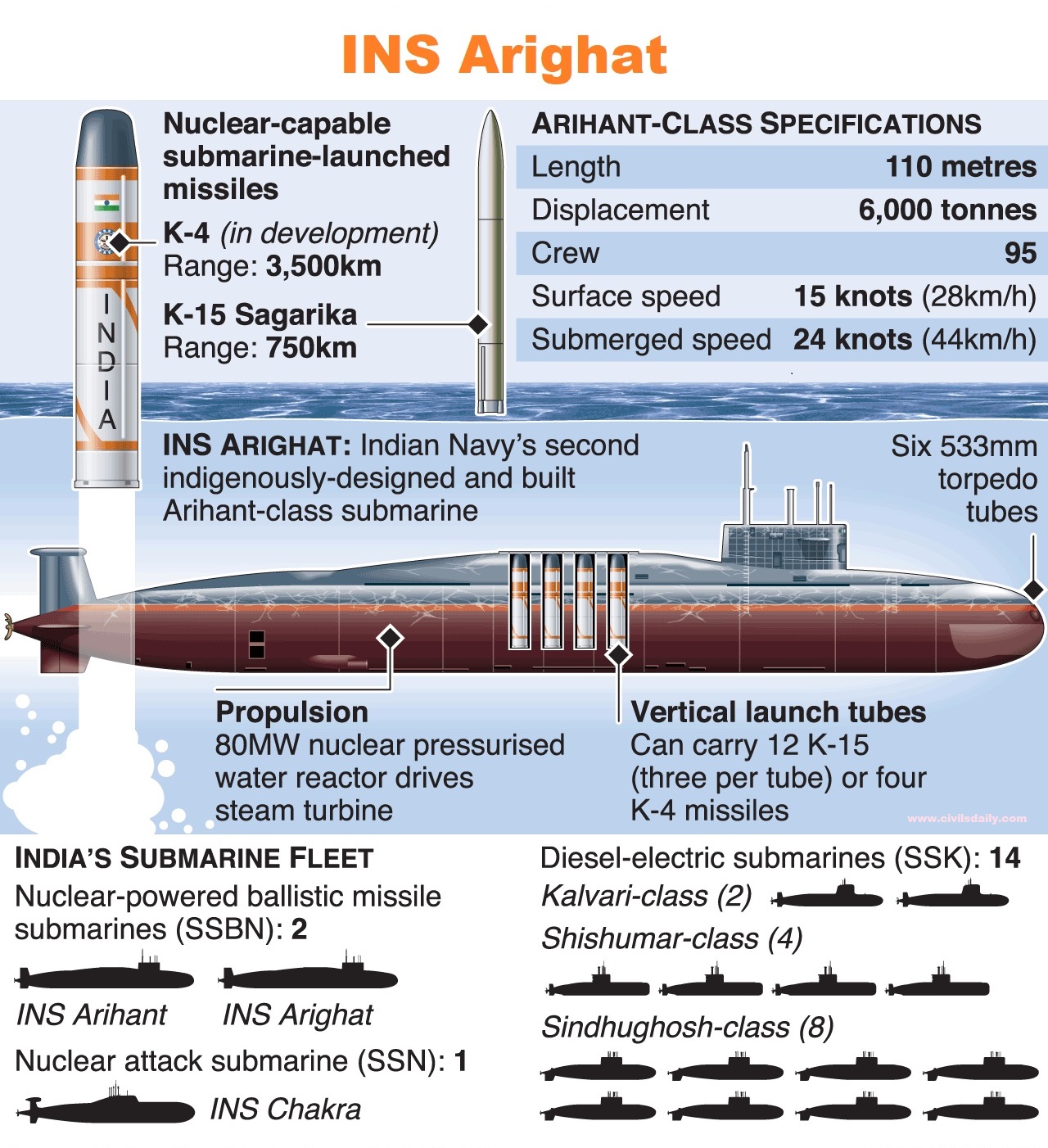
India’s second nuclear submarine, the Arighaat, was officially commissioned into the Indian Navy in Visakhapatnam, following rigorous trials conducted over the past few months.
Status of Navy’s Submarines in India:
Current Fleet: The Indian Navy’s submarine fleet includes two nuclear-powered ballistic missile submarines (INS Arihant and INS Arighaat) and 16 conventional submarines. The Navy is also constructing two additional larger SSBNs.
Operational Readiness: The Navy is authorized to maintain a fleet of 18 submarines, but operational availability can be affected by maintenance and refitting schedules, with about 30% of the fleet typically under repair.
About the newly inducted INS Arighaat
INS Arighaat is a 6,000-tonne Arihant-class ballistic missile submarine, which will join its predecessor, INS Arihant, as a vital component of India’s nuclear triad.
The submarine can carry up to 12 K-15 SLBMs with a range of approximately 750 km or four K-4 SLBMs exceeding 3,500 km.
It is powered by an 83 MW pressurized light-water nuclear reactor, allowing it to remain submerged for extended periods without surfacing compared to the diesel-electric submarine.
It will enhance India’s nuclear deterrence, support strategic balance in the region, and play a crucial role in national security.
How does it significantly strengthen India’s nuclear triad?
Enhances Second-Strike Capability: With two nuclear submarines now operational, India can maintain a constant presence of a submarine patrolling its waters, ready to launch a nuclear strike at short notice in retaliation.
Expands Missile Reach: INS Arighaat is equipped with indigenously developed K-15 missiles with a range of over 700 km and long-lasting availability underwater due to a nuclear-powered engine without surfacing.
From the South China Sea, these submarines can potentially target locations in China, including its capital Beijing.
Both of this major developments will provide India with a more balanced and robust nuclear deterrent capability across all three domains – land, air, and sea.
Way forward:
Indigenous Submarine Development: Accelerate the development and commissioning of indigenous SSBNs (Submersible Ship Ballistic Missile Nuclear) and advanced SLBMs (Submarine-Launched Ballistic Missiles) to further strengthen India’s strategic autonomy and ensure sustained deterrence capabilities.
Strategic Partnerships and Modernization: Enhance collaboration with global naval powers for technology transfers and expertise while modernizing the current submarine fleet to ensure continued operational readiness and address emerging maritime security challenges.
Mains PYQ:
Q What are the maritime security challenges in India? Discuss the organisational, technical and procedural initiatives taken to improve maritime security. (UPSC IAS/2022)
Pacific leaders endorsed a significant joint policing initiative and rejected attempts by China’s allies to marginalize Taiwan in the Pacific Islands Forum (PIF), held in Tonga.
(Note: India and Taiwan are not a member countries.)
Why are the countries sticking to Taiwan despite the pressure?
Reaffirmation of Taiwan’s Status: The Pacific Islands Forum (PIF) leaders reaffirmed Taiwan’s participation as a “development partner,” despite efforts from China and the Solomon Islands to sideline Taiwan.
Countries emphasize the importance of maintaining existing agreements from 1992 that recognize Taiwan’s role in the forum.
Support from Allies: Countries like New Zealand and the United States expressed support for Taiwan’s inclusion in the PIF, highlighting that any decision regarding the exclusion of parties should be made through consensus.
Resistance to Chinese Influence: Many nations recognize the strategic importance of Taiwan and its contributions against China’s increasing influence, leading them to uphold its involvement.
Significance of Taiwan for India:
Strategic Balance in the Indo-Pacific: Taiwan is a crucial player in the Indo-Pacific region, and India’s engagement with Taiwan serves as a counterbalance to China.
Economic and Technological Cooperation: Taiwan is a global leader in semiconductor manufacturing and advanced technology, areas where India seeks to enhance its capabilities.
People-to-People Ties and Education: Taiwan offers significant opportunities for Indian students and professionals in education and skill development.
For example, in 2018, the number of Indian students enrolled in Taiwanese universities reached 2,398, marking a 56% increase from the previous year.
Diversifying Supply Chains: In the wake of global disruptions due to COVID-19, India aims to diversify its supply chains. Taiwan’s expertise in manufacturing and electronics presents opportunities for India to reduce its dependence on other countries, particularly China, for critical components and technology.
What did the forum say on the Climate cash and French press?
Climate Finance Initiatives: The forum committed to organizing a “global pledging event” to raise funds for climate initiatives, with a goal of $500 million.
This decision was supported by UN Secretary-General Antonio Guterres, who emphasized the urgent need for climate finance in the Pacific, which is disproportionately affected by rising sea levels.
Although not officially on the agenda, deep-sea mining generated significant discussion among forum members. A company backed by Nauru plans to scale up ocean mining operations, while other members, like Palau, called for a moratorium due to environmental concerns.
Concerns Over French Governance: The French government faced criticism during the forum for its handling of unrest in New Caledonia. A Pacific delegation is expected to conduct a fact-finding mission there, indicating ongoing tensions regarding French governance in the region and the need for improved oversight.
Conclusion: India should enhance diplomatic and economic ties with Taiwan by establishing formal mechanisms for regular dialogue and collaboration in areas such as technology, trade, education, and healthcare. This will reinforce strategic partnerships while respecting the “One China” policy framework.
During his Independence Day address from the Red Fort this August, Prime Minister Narendra Modi announced India’s aspiration to host the 2036 Olympic Games, stating that preparations are already underway to realize this dream.
Issue of Sports Infrastructure in Some States:
Limited Olympic-Standard Facilities: Currently, only about 10.4% of India’s mapped sports infrastructure meets Olympic standards. This includes only 1,645 completed facilities out of 15,822 across the country.
State-Level Disparities:Tamil Nadu leads with nearly 390 Olympic-standard facilities, followed by Delhi with 161 and Odisha with 153. This highlights a significant disparity in sports infrastructure across different states.
The Gujarat government has earmarked Rs 6,000 crore for developing sports complexes in Ahmedabad.
Potential in the present state of Infrastructure:
Current Infrastructure Landscape: India’s sports infrastructure is still developing, with significant investments needed to meet international standards.
The Khelo India Scheme, launched in 2017, aims to enhance sports infrastructure and promote talent development, focusing on grassroots improvements.
Future Developments: Plans are underway to upgrade existing facilities and build new ones, particularly in states like Tamil Nadu and Gujarat, which have shown commitment to developing world-class sports venues.
Leveraging Existing Facilities: By utilizing existing sports infrastructure in states like Tamil Nadu, Delhi, and Odisha, India can advance a cost-efficient and eco-friendly bid for the Olympics. This strategy involves repurposing venues for public use post-games, ensuring lasting benefits.
Need for Collaborative Approach:
Multi-Stakeholder Involvement: A successful bid will require collaboration among various stakeholders, including state governments, sports associations, and the central government. A multi-stakeholder committee is essential to ensure that all voices are heard and that the bid reflects the country’s potential.
Building Consensus: The bid’s success hinges on building consensus both within India and with international stakeholders. This involves strategic planning and cooperation across political and territorial lines to present a unified front.
Significance for India:
Catalyst for Sports Development: Hosting the 2036 Olympics would necessitate significant investments in sports infrastructure across India. This would not only enhance existing facilities but also promote grassroots sports development through initiatives like the Khelo India Scheme.
Economic and Tourism Boost: The event is expected to generate substantial economic benefits, including job creation and increased tourism. The influx of international visitors and media attention would provide a platform to showcase India’s cultural heritage.
National Pride and Unity: The successful hosting of the Olympics would serve as a symbol of national achievement, fostering unity and pride among citizens.
Conclusion: India should prioritize the expansion and upgradation of sports infrastructure across all states, focusing on creating new Olympic-standard facilities while enhancing existing ones. Leveraging the Khelo India Scheme, investments should be directed towards grassroots development to ensure widespread access to quality sports venues.
National Sports Day is celebrated on August 29 in India to honor the memory of “Major Dhyan Chand”, widely regarded as the first superstar of Indian hockey and arguably India’s first sporting superstar.
About MajorDhyan Chand:
Details
Birth
Born on August 29, 1905, in Allahabad, India
Olympic Achievements
Led India to three Olympic gold medals in 1928 (Amsterdam), 1932 (Los Angeles), and 1936 (Berlin).
Career Goals
Scored 33 goals in 12 Olympic matches, nearly averaging a hat-trick per game.
Signature Skill
Renowned for his exceptional dribbling and ball control.
Anecdotes
Famous for his stick work so effective that his hockey stick was checked for magnets;
Declined an offer from Adolf Hitler to change nationality after the 1936 Olympics.
National Recognition
In honour of his contributions, August 29 is celebrated as National Sports Day in India.
Rajiv Gandhi Khel Ratna Award was renamed the Major Dhyan Chand Khel RatnaAward in 2021.
It is the highest sporting award given by the Ministry of Youth Affairs and Sports for the spectacular and most outstanding performance in the field of sports by a sportsperson over four years.
The award comes with a cash prize of Rs 25 lakh.
The Khel Ratna Award was instituted in 1991-1992 and the first recipient was Chess legend Viswanathan Anand.
Winners: Leander Paes, Sachin Tendulkar, Dhanraj Pillay, Pullela Gopichand, Abhinav Bindra, Anju Bobby George, Mary Kom and Rani Rampal in 2020.
Legacy
Major Dhyan Chand National Stadium in New Delhi is named after him, underscoring his impact on Indian sports infrastructure.
The Indian Army has launched the first phase of Project NAMAN, aimed at providing comprehensive support and services to Defence Pensioners, Veterans, and their families.
About Project NAMAN:
Details
Launched By
Army Wives Welfare Association (AWWA)
Purpose
To provide dedicated support and services to Defence Pensioners, Veterans, and their families.
Core Implementation
Centered on the SPARSH (System for Pension Administration Raksha) digital pension system, which streamlines pension-related processes.
Key Features
Establishment of Common Service Centres (CSCs) for offering SPARSH-enabled pension services, Government to Citizen (G2C) services, and Business to Consumer (B2C) services.
Initial Deployment
14 CSCs established across key locations in India including New Delhi (first center), Jalandhar, Leh, Dehradun, Lucknow, Jodhpur etc.
Expansion Plans
Approximately 200 centers are planned nationwide over the next 2-3 years.
Infrastructure Support
HDFC Bank provided the necessary IT infrastructure for the CSCs, while local military stations contributed essential physical infrastructure and facilities.
Community Impact
Enhances access to essential services for veterans and their families like grievance redressal and also provides entrepreneurial opportunities for Veterans and Next of Kin (NOKs), who manage the CSCs.
Support for Operators
Village Level Entrepreneurs (VLEs), selected from among the veterans or NOKs, manage each CSC.
Comprehensive training and a monthly monetary grant of ₹20,000 from HDFC Bank for the first 12 months to assist in stabilization.
Researchers at the Institute of Nano Science and Technology (INST) Mohali, have developed novel electrochemical and optical sensors using a new group of nano polymer materials.
About the Novel Nanopolymer:
Novel nanopolymers are innovative polymer materials that incorporate nanostructures or nanoparticles to impart unique properties.
They are prepared using various methods like vapor condensation, vacuum evaporation, electrospinning, and chemical synthesis to create nanofibers, core-shell structures, hollow fibers, and tubes with diameters down to a few nanometers.
Examples: Silicon nanospheres that are much harder than regular silicon, with hardness between sapphire and diamond, and bio-based N-heterocyclic poly(aryl ether ketone) with high biomass content and superior properties
Applications of Novel Nanopolymers:
Biosensors and optoelectronics utilizing the fluorescence and magnetic properties of nanoparticles.
Drug delivery, tissue engineering, and gene therapy using biodegradable nanoparticle systems.
Forensics for drug detection, fingerprinting, DNA analysis, and sensors.
High-temperature-resistant plastics with improved properties.
These are the Novel Nanopolymers developed by INST:
Metal-Organic Frameworks (MOFs)
2-dimensional (2D) Materials
Details
Crystalline materials with metal ions and organic ligands form porous structures.
Materials a few atomic layers thick with unique electrical, optical, and mechanical properties.
Surface Area
Extremely high (over 10,000 m²/g), ideal for adsorption.
High surface-to-volume ratio, enhancing interactions for sensing and energy storage.
Versatility
Customizable for gas storage, separation, catalysis, and sensing.
Functionalizable for bio-sensing and environmental monitoring.
Properties
High porosity and stability in harsh environments.
Excellent conductivity, flexibility, and strength, useful in electronics and optoelectronics.
Sensing Applications
Detects gases, toxins, and biomarkers with high sensitivity.
Detects gases, biomolecules, and pollutants quickly and efficiently.
Examples
Various MOFs designed for specific uses.
Includes graphene, MoS2, MXenes.
PYQ:
[2015] With reference to the use of nanotechnology in health sector, which of the following statements is/are correct?
1. Targeted drug delivery is made possible by nanotechnology.
2. Nanotechnology can largely contribute to gene therapy.
Select the correct answer using the codes given below:
The term of the 22nd Law Commission has ended, with its key report on the Uniform Civil Code still in progress.
About the Law Commission of India:
Details
Nature
Non-statutory body periodically constituted by the Government of India. It is an Executive Body.
Establishment
• First Commission During British India: Established in 1834 under the Charter Act of 1833, chaired by Lord Macaulay, Focused on the codification of laws like the Penal Code and Criminal Procedure Code.
• First Commission in Independent India: Established in 1955, chaired by M. C. Setalvad, then Attorney-General of India.
Primary Role
Advises the Ministry of Law and Justice on legal reform and reviews existing laws to suggest improvements and draft new legislation.
Recommendations are advisory and NOT binding on the government.
Composition
Headed by a Chairperson (usually a retired Supreme Court Judge or Chief Justice of a High Court),
4 full-time members (including a Member-Secretary), ex-officio members (Secretaries of the Departments of Legal Affairs and Legislative Department), and
Up to 5 part-time members.
Tenure
3 years, with provisions for reconstitution or extension as required by the government.
Key Functions
• Undertakes legal research.
• Review existing laws for reforms.
• Recommends repeal of obsolete laws.
• Suggest amendments and new legislations.
• Examines laws that affect the poor and marginalized.
Notable Recommendations by 22nd law Commission
• Uniform Civil Code.
• Amendments to the sedition law.
• Repeal of obsolete laws.
• Gender equality in personal laws.
• Improvements in judicial administration.
Reports Submitted
Over 277 reports on various legal issues including the implementation of international conventions, compulsory registration of marriages, etc.
Recent Activity
The 22nd Law Commission is focusing on issues like the Uniform Civil Code and amendments to the sedition law (Section 124A), among other legislative reforms.
PYQ:
[2014] The power to increase the number of judges in the Supreme Court of India is vested in:
Q Russia and Ukraine war has been going on for the last seven months. Different countries have taken independent stands and actions keeping in view their own national interests. We are all aware that war has its own impact on the different aspects of society, including human tragedy. What are those ethical issues that are crucial to be considered while launching the war and its continuation so far? Illustrate with justification the ethical issues involved in the given state of affairs. (2022)
Q “What introduces friction into the ties between India and the United States is that Washington is still unable to find for India a position in its global strategy, which would satisfy India’s National self-esteem. (2019)
Mentors’ Comment: PM Narendra Modi visited Kyiv (Ukraine) and met with President Volodymyr Zelenskyy on August 23, 2024. This was the first visit by an Indian PM to Ukraine since its independence in 1991. The visit garnered significant global attention, particularly regarding India’s potential role in mediating the Russia-Ukraine conflict.
Despite India’s cautious stance, PM Modi emphasized India’s commitment to supporting Ukraine’s sovereignty and territorial integrity. He advocated for a peaceful resolution through dialogue, stating “No problem can be resolved on a battlefield.” India has maintained a neutral stance, abstaining from UN resolutions critical of Russia while advocating for direct dialogue.
Let’s learn –
Why in the News?
There are strong reasons to believe that Prime Minister Modi’s visit to Ukraine may have included a peace initiative as part of its agenda.
India’s Consistent Foreign Policy Approach:
Non-Alignment and Strategic Autonomy: India’s foreign policy is historically rooted in non-alignment and strategic autonomy, focusing on balancing relationships with global powers and addressing territorial disputes peacefully.
Neutral Stance on Russia-Ukraine Conflict: Since the Russia-Ukraine war began in February 2022, India has maintained neutrality, avoiding condemnation of Russia, which has drawn criticism from Western nations.
Foreign Minister S. Jaishankar has indicated that India might be interested in mediating the conflict between Russia and Ukraine, if approached but would not initiate the mediation on its own.
Commitment to UN Principles: India advocates for respect for the United Nations charter and peaceful resolution of disputes through international institutions like the UN.
A Possible Broader Strategy
Peace Initiative: The Indian Prime Minister’s visit to Ukraine involved a peace initiative, though enhancing bilateral relations with Ukraine appears unlikely due to India’s lack of dependency on Ukraine for trade, defence, or technology.
Balancing Act: The visit could be a balancing act following the PM’s visit to Russia, positioning India as a neutral party and reinforcing its role as a responsible global actor committed to peace.
Active Mediation Role: The visit may align with a broader strategy for India to take a more active role as a mediator or “communicator,” leveraging its ties with both Moscow and Washington.
Global South Involvement: India, as a prominent member of the Global South, aims to contribute to peace efforts, reflecting its role in international negotiations.
Interests of Key Stakeholders
United States: The U.S. prefers negotiations from a position of strength. A temporary ceasefire or limited peace agreement facilitated by a neutral party like India could relieve conflict pressures and allow President Biden to focus on other foreign policy issues.
European Countries: Europe seeks a resolution to the conflict to address economic hardships and energy security concerns exacerbated by the war. A temporary peace could ease these challenges and provide breathing room.
What should India do further?
Leverage Diplomatic Neutrality to Facilitate Dialogue: India should continue to maintain its neutral stance and offer to facilitate dialogue between Russia and Ukraine. By positioning itself as a neutral mediator, India can help create channels for communication, potentially leading to a ceasefire or limited peace agreement.
Engage with Global South and Key Stakeholders: India should actively engage with other Global South countries and key stakeholders, including the U.S. and European nations, to build consensus on a peaceful resolution.
Balance Relations with Global Powers: India should carefully balance its relationships with both Russia and the West. By maintaining strong ties with both sides, India can ensure its strategic autonomy while contributing to a peaceful resolution.
Conclusion: Successfully mediating the conflict could elevate India’s global stature and align with hisvision of India as a “Vishwamitra,” actively contributing to global peace and security. However, achieving even temporary peace is challenging due to deeply entrenched positions and the involvement of numerous international actors in the conflict.
The Union Cabinet has approved the ‘BioE3 (Biotechnology for Economy, Environment, and Employment) Policy’ proposed by the Department of Biotechnology to promote advanced biomanufacturing.
What is the BioE3 Policy?
The BioE3 (Biotechnology for Economy, Environment and Employment) Policy is a strategic initiative approved by the Indian Cabinet to foster high-performance biomanufacturing.
Aims and Objectives of the Policy:
Innovation Support: The policy promotes research and development (R&D) and entrepreneurship in various thematic sectors, facilitating technological advancement and commercialization.
Biomanufacturing Hubs: It proposes the establishment of Biomanufacturing & Bio-AI hubs and Biofoundries to enhance India’s bioeconomy.
Focus Areas: The policy targets several strategic sectors, including high-value bio-based chemicals, biopolymers, smart proteins, precision biotherapeutics, climate-resilient agriculture, carbon capture, and marine and space research.
Significance of the Policy
Economic Growth: It is expected to catalyze a “bio revolution” similar to the IT revolution, generating substantial job opportunities in biotechnology and biosciences.
Sustainability Goals: The policy aligns with government initiatives for achieving a ‘Net Zero’ carbon economy and promotes sustainable lifestyles, thereby steering India towards accelerated green growth and a circular bio-economy.
Job Creation: By expanding the skilled workforce in biotechnology, the policy aims to create various kinds of employment opportunities, addressing critical societal issues such as climate change, food security, and human health.
Present Status of Indian Bio-economy
Growing Potential: The biotechnology sector is seen as a key player in addressing challenges in health, agriculture, environment, and energy. India has a large pool of young, skilled workers, with 47% of its population under the age of 25.
Investment in R&D: Despite its potential, India spends less than 1% of its GDP on research, compared to countries like Israel and South Korea, which invest over 4%.
Existing Infrastructure: The government has established 9 biotech parks and 60 bio-incubators, which support the growth of the biotechnology sector.
Challenges Ahead
Educational Gaps: The current educational curriculum does not adequately prepare students for industry demands, creating a skills mismatch.
Funding Issues: There is a lack of venture capital funding due to information asymmetry regarding the biotech industry, which hampers innovation and growth.
Clinical Trials: India conducts a low percentage of clinical trials compared to global standards, which is a concern for the development of biopharmaceuticals.
Research Investment: The government currently covers over 60% of total R&D spending, which is very different from countries where the private sector contributes a large portion.
Way forward:
Enhance Industry-Academia Collaboration: Encourage partnerships between educational institutions and biotech companies to align curricula with industry needs, thereby reducing the skills mismatch and preparing students for emerging job markets.
Increase Private Sector Investment: Implement policies and incentives to attract more private sector investment in R&D, such as tax benefits, public-private partnerships, and improved access to venture capital, to stimulate innovation and reduce reliance on government funding.
The Election Commission of India (ECI) has established itself as one of India’s most credible institutions, known for consistently conducting free, fair, and timely elections to Parliament and State legislatures. However, the 34 State Election Commissions (SECs) still require significant attention and strengthening.
Issue of Disempowerment of State Election Commissions (SECs)
The Constitution (73rd and 74th amendments) vested SECs with the responsibility of conducting elections to panchayats and urban local governments, but in reality, SECs are increasingly disempowered by state governments.
Legal and Administrative Challenges: SECs sometimes find themselves in litigation with state governments. For instance, the Karnataka SEC has had to file contempt petitions against the state government for failing to fulfill commitments related to the conduct of elections, highlighting a lack of cooperation from state authorities.
Inadequate Empowerment: Many SECs do not have the power to conduct delimitation of wards or manage the electoral rolls independently. This results in reliance on the Election Commission of India (ECI) and state governments, which can lead to arbitrary decisions that delay elections.
Only 11 out of 34 states and UTs have empowered SECs to conduct ward delimitation, accounting for just 35% of India’s population.
Lack of Resources: SECs are legally entitled to request funds and assistance from state governments, but they often do not receive adequate resources, which hampers their ability to conduct elections effectively.
Public Trust Erosion: The delays and challenges faced by SECs undermine public confidence in local governance and electoral processes, leading to a perception that local elections are not as credible as those conducted by the ECI for national and state elections
Election not on time: Performance audits by the CAG found that 70% of urban local governments in 18 states did not have elected councils at the time of the audit due to delays caused by disempowered SECs.
Electoral Reforms Needed to Strengthen the Third Tier
Parity with the Election Commission of India: SECs should be made as transparent and independent as the Election Commission of India.
This could be achieved by appointing a three-member SEC through a committee comprising the Chief Minister, Leader of Opposition, and Chief Justice of the High Court, rather than by the State government alone.
Fixed Intervals for Delimitation: The delimitation of ward boundaries and reservations should be conducted at fixed intervals, such as every 10 years, to prevent arbitrary actions by State governments that delay elections.
Transfer of Powers to SECs: The powers of delimitation and reservation of seats for local governments should be vested in the SECs. SECs should also handle reservations for positions like mayors and presidents to avoid delays caused by State governments.
Conclusion: Strengthening SECs through these reforms is essential to ensure timely, transparent, and credible local elections, thereby reinforcing grassroots democracy and public trust in local governance.
Australia’s Education Minister announced a plan to establish a National Planning Level (NPL) that will cap the number of new international students at 2.7 lakh for the 2025 calendar year, subject to parliamentary approval.
What does the 2025 Cap entail?
Australia plans to introduce a cap on new international students at 2.7 lakh for the calendar year 2025.
Distribution of Seats:
Publicly funded universities: 1.45 lakh students (maintaining 2023 levels).
Vocational education and training (VET) sector: 95,000 new students.
Other universities and non-university providers: 30,000 students.
Certain categories, such as school students, research degree pursuers, students in standalone English language courses, government-sponsored scholars, and students from specific regions (e.g., Asia Pacific), are exempt from the cap.
Trends in Indian Student Enrollment in Australia:
In 2023, Australia admitted 5.61 lakh international students, in 2022, it saw 3.88 lakhs, in 2021, it had 2.82 lakhs, in 2020, it had 3.96 lakhs, and in 2019, it saw 5.19 lakh students.
2024 Projections: Between January and May 2024, the total student commencements reached 2.89 lakh, with additional intakes expected later in the year, possibly surpassing 2023 levels.
Five-Year Trend: The 2025 cap will result in the lowest intake in the past five years, considering the effects of the COVID-19 pandemic on previous years’ admissions.
Possible Impacts on Indians Since Last Year:
Enrollment Numbers: The number of Indian students in Australia saw a decline from 126,487 in 2023 to 118,109 in 2024.
This comes on the back of moves by the Australian government to curb migration over the past six months, including higher IELTS band score requirements and the Genuine Student Test for applicants.
Universities, especially the Group of Eight (Go8) research-intensive universities, have criticized the capping as a “bad policy” that will adversely impact them.
Rising Costs: The Australian government increased the visa processing fee from AUD 710 to AUD 1,600 (approximately Rs 40,524 to Rs 91,321) as of July 1, 2024. This could deter prospective applicants due to financial constraints.
Way Forward:
Increase Scholarships and Financial Aid: The Australian government and universities should offer more scholarships and financial aid packages to offset the higher costs and attract international students, particularly from India.
Strengthen Bilateral Education Ties: Enhance collaboration between Australian and Indian educational institutions to create joint programs and exchange opportunities, ensuring a steady flow of students despite the cap.
Women-led development is central in this year’s Budget, with Gender Budget allocations reaching 1% of GDP and over ₹3 lakh crore for pro-women programs.
About Gender Budgeting in India:
The Gender Budget Statement (GBS) was introduced in the 2005-06 budget.
GBS has consistently represented an average of 5% of total budgetary allocations since its introduction, with minor fluctuations.
In the 2024-25 budget, the share of allocations to pro-women schemes has increased to approximately 6.8% of the total budget expenditure.
Different Components of the Gender Budget Statement
The Gender Budget Statement (GBS) is structured into three main parts:
Part A: This section includes schemes and programs that have 100% allocation specifically for women.
Part B: This part covers schemes with more than 30% but less than 100% of their allocations directed towards women.
Part C: Introduced recently, this section reports pro-women schemes that have less than 30% provisioning for women.
Instances of Missing Allocations Reported by Experts:
Pradhan Mantri Awas Yojana (PMAY): Initially, only a portion of PMAY’s budget was reported under Part B, which led to an underrepresentation of its impact on women. The entire allocation of ₹80,670 crore for 2024-25 was later moved to Part A, raising concerns about the accuracy of reporting since not all beneficiaries are women.
PM Employment Generation Programme (PMEGP): The GBS reported an allocation of ₹920 crore, which was claimed to be 40% of the total allocation to PMEGP, without a clear rationale for this percentage.
Mahatma Gandhi National Rural Employment Guarantee Scheme (MGNREGS): Although women constituted 59.3% of all person-days under MGNREGS, only 33.6% of its total outlay was reflected in the GBS, indicating a significant underreporting of women’s engagement and benefits from the scheme.
How should these anomalies be rectified by the Government (Way forward):
Incorporate Explanations: Providing clear explanations for the allocations reported in the GBS would enhance transparency and accountability.
Audit of Budgetary Allocation: The government should involve regular audits and assessments of how budgetary allocations impact gender equality.
Engage Stakeholders: Involving experts and stakeholders in the process of developing the GBS can provide insights into the specific needs of women and help ensure that the budget effectively addresses those needs.
Mains PYQ:
Q Women empowerment in India needs gender budgeting. What are requirements and status of gender budgeting in the Indian context? (2016)
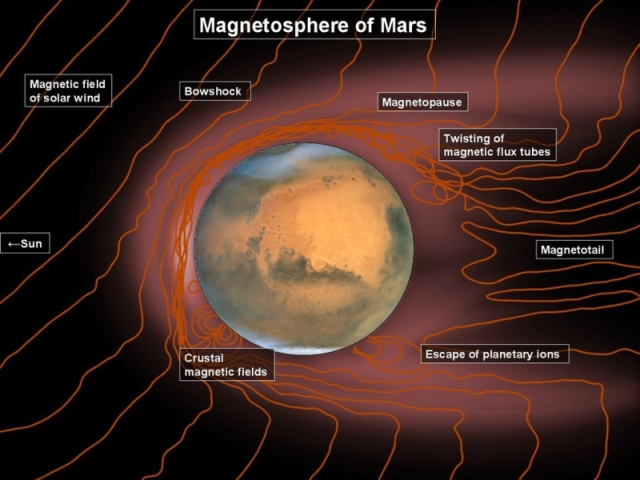
A study conducted by the Indian Institute of Geomagnetism (IIG) revealed significant variations in the strength of Mars’ crustal magnetic field between day and night.
Notable facts about Mars:
Mars is the fourth planet from the Sun and the second-smallest in the Solar System, larger only than Mercury.
Named after the Roman god of war, Mars is often called the “Red Planet” due to its reddish appearance from iron oxide on its surface.
It is a terrestrial planet with a thin atmosphere, featuring surface characteristics like impact craters, valleys, deserts, and polar ice caps.
Mars shares similar days and seasons to Earth because of its comparable rotational period and axial tilt.
It hosts Olympus Mons, the largest volcano and highest mountain on any planet, and Valles Marineris, one of the largest canyons in the Solar System.
MAVEN’s data on electron density and magnetic field were critical in investigating how Mars’ crustal magnetic field affects its plasma environment and ionosphere.
Significance of the Study
Understanding Mars’ crustal magnetic field is essential for future robotic and manned missions, as it provides natural magnetic shielding against space radiation.
The insights from the study can help in developing strategies to mitigate the effects of space weather on spacecraft and astronauts.
PYQ:
[2016] The Mangalyaan launched by ISRO
is also called the Mars Orbiter Mission.
made India the second country to have a spacecraft orbit the Mars after USA
made India the only country to be successful in making its spacecraft orbit Mars in its very first attempt.
Which of the statements given above is/are correct?
(a) 1 only
(b) 2 and 3 only
(c) 1 and 3 only
(d) 1, 2 and 3
The Ministry of Youth Affairs & Sports launched the “RESET Programme” to empower retired sportspersons with career skills on National Sports Day.
What is RESET Programme?
Details
Launch Date
August 29, 2024 (National Sports Day)
Nodal Ministry
Ministry of Youth Affairs & Sports
Objective
To empower retired sportspersons with skills and knowledge for career development and employability
Eligibility
– Retired athletes aged 20-50 years
– Winners/participants in international events, national/state medallists
– Recognized by National Sports Federations/IOA/Ministry of Youth Affairs and Sports
Programme Levels
Two levels based on educational qualifications:
– Class 12th and above
– Class 11th and below
Implementation
Lead institute: Lakshmibai National Institute of Physical Education (LNIPE)
Learning Mode
Hybrid mode: Self-paced online learning and on-ground training
Additional Support
Placement assistance, guidance for entrepreneurial ventures
PYQ:
[2017] Consider the following in respect of ‘National Career Service’:
1. National Career Service is an initiative of the Department of Personnel and Training, Government of India.
2. National Career Service has been launched in a Mission Mode to improve the employment opportunities to uneducated youth of the country.
Gujarat and parts of Rajasthan are facing severe flooding caused by a land-based deep depression.
The unusual formation of this deep depression over land was intensified by moisture influx from soils or the Bay of Bengal and the Arabian Sea.
What is Land-Based Deep Depression?
A land-based deep depression is a type of cyclonic system characterized by a significant drop in atmospheric pressure leading to sustained wind and significant weather impact.
They form and intensify over land, which is relatively rare due to the limited availability of moisture.
Characteristics:
It forms over land or water.
Wind Speed ranges from 51 to 62 km/h, just below the threshold for a tropical cyclone (62-88 km/h).
Relies on moisture from soilandsurrounding environments rather than oceanic sources.
It often has an unpredictable path and can cause significant rainfall and localized flooding.
Implications of Land-Based Deep Depressions
These systems can bring prolonged and intense rainfall, leading to widespread flooding, especially in regions unaccustomed to high levels of precipitation.
Heavy rainfall can lead to significant soil erosion, affecting agricultural productivity and altering landscapes.
Prolonged flooding can cause waterlogging in agricultural fields, leading to soil salinization and reduced fertility.
PYQ:
[2012] Consider the following statements:
1. The duration of the monsoon decreases from southern India to northern India.
2. The amount of annual rainfall in the northern plains of India decreases from east to west.
Which of the statements given above is/are correct?
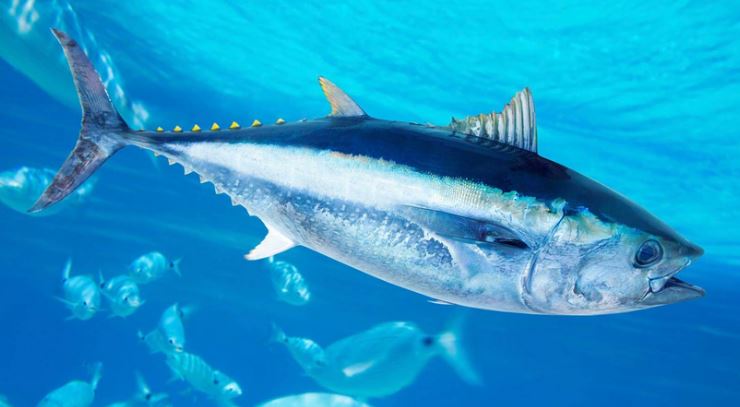
The Atlantic bluefin tuna, already heavily overfished, now faces a new threat from warming seas, causing it to migrate further north.
Atlantic Bluefin Tuna (Thunnus thynnus)
Details
Scientific Classification
Family: Scombridae; Species: Thunnus thynnus.
Common Names
Northern bluefin tuna, Giant bluefin tuna (for individuals over 150 kg), formerly known as “tunny”.
Habitat and Range
Western and Eastern Atlantic Ocean, Mediterranean Sea; extinct in the Black Sea.
Size
Can weigh up to 680 kg; one of the largest Perciformes.
Commercial Importance
Highly valued in the Japanese market for sushi and sashimi; foundation of a major global fishery.
Conservation Status
Overfished; dramatic stock declines (72% in Eastern Atlantic, 82% in Western Atlantic);
Moved to “Least Concern” by IUCN in 2021 due to some population recovery;
Proposed for CITES Appendix I.
PYQ:
[2015] With reference to the International Union for Conservation of Nature and Natural Resources (IUCN) and the Convention on International Trade in Endangered Species of Wild Fauna and Flora (CITES), which of the following statements is/are correct?
1. IUCN is an organ of the United Nations and CITES is an international agreement between governments
2. IUCN runs thousands of field projects around the world to better manage natural environments.
3. CITES is legally binding on the States that have joined it, but this Convention does not take the place of national laws.
Select the correct answer using the codes given below:
“My UPSC preparation and the academic rigour I applied in the process help me today to deal with the complex challenges of the ministry.”
Gautam Mohakul, Deputy Controller of Accounts, Ministry of Finance
Read what Gautam Sir has to say about UPSC Journey and Post Selection Life As An Officer
As aspirants preparing for the UPSC exam, we are tested on many levels—maintaining consistency, managing time, and having a never-give-up attitude, while ensuring deadlines are met at any cost. Perhaps that’s why this exam is considered more of an attitude-based exam than one based solely on aptitude. So, why does the UPSC CSE exam focus so much on temperament and other virtues like patience and perseverance?
The answer to this question lies in the challenges that civil servants face in their everyday lives. Civil services are not just another 9-to-5 job; the behavioural traits that aspirants develop during their preparation help them navigate the challenges they encounter in service. The rigor that aspirants apply during their exam preparation proves invaluable when taking on important positions in districts or handling complex tasks in ministries.
Join us this Sunday, 1st September 2024, at 5:30 PM, for a session with Gautam Mohakul Sir, who is at the helm of affairs at the Ministry of Finance. He will share his in-service experiences and how he applied the skills he learned during his exam preparation to handle various challenges. This session will provide insights into the right mindset required to clear the exam and what life and work are like after becoming a civil servant. See you all this Sunday at 5:30 PM!
Join this session on 1st Sept 2024 at 5:30 p.m. This session is a must-attend for you If you are attempting UPSC for the first time in 2025 or have attempted earlier and now preparing for next year, then it is going to be a valuable session for you too.
(Don’t wait—the next webinar won’t be until October’24)
These masterclasses are packed with value. They are conducted in private with a closed community. We rarely open these webinars for everyone for free. This time we are keeping it for 300 seats only.
Q The proposed withdrawal of the International Security Assistance Force (ISAF) from Afghanistan in 2014 is fraught with major security implications for the region’s countries. Examine in light of the fact that India is faced with a plethora of challenges and needs to safeguard its own strategic interests. (UPSC IAS/2013)
Q ‘India is an age-old friend of Sri Lanka.’ Discuss India’s role in the recent political crisis in Sri Lanka in the light of the preceding statement. (UPSC IAS/2022)
Mentor comment: The political landscape in countries like India, Pakistan, and Bangladesh, where governments have faced criticism for undermining democratic institutions and processes. Elections in Bangladesh (January 7, 2024) resulted in PM Sheikh Hasina securing a fourth consecutive term. However, the elections were widely condemned by boycotting, demanding a caretaker government to oversee the electoral process. Similarly in Pakistan, the elections (February 8, 2024), were marred by allegations of irregularities and military influence. International observers and analysts have raised alarms about the military’s increasing control over political processes, which has led to Pakistan being classified as an authoritarian regime by the Economist Intelligence Unit.
This backlash may be attributed to various factors, including economic challenges, social unrest, and the manipulation of electoral systems, which have led to a deterioration of public trust in democratic norms and practices. Today’s editorial emphasizes the importance of recognizing these trends as they pose risks to the stability and future of democracy in South Asia, urging a reevaluation of the political dynamics at play in the region.
Let’s learn!
__
Why in the News?
South Asian region is experiencing a subtle yet significant backlash against democratic governance, characterized by increasing authoritarian tendencies and a decline in civil liberties.
On Emerging Democratic Backlash in India and Pakistan:
Middle-Class Attitudes: Historically, the middle classes in both countries have shown ambivalence towards democracy, sometimes favoring military rule, though a younger generation in Pakistan is becoming critical of military involvement in politics.
Presently, in India, there has been a democratic pushback against the BJP’s authoritarianism. People also fought against the dictatorship during the Emergency in 1975.
In Pakistan, the PTI emerged as a major political force, resonating with public sentiment against military influence, despite state machinery working against it.
Digital Backlash: Both countries are witnessing a silent democratic backlash, with citizens utilizing digital platforms and electoral participation to reclaim democratic spaces.
What are the main causes of the democratic backlash in South Asia?
Authoritarian Tendencies: The noticeable shift towards authoritarianism is often characterized by the erosion of civil liberties, media suppression, and the undermining of democratic institutions.
For example, in India, the Modi government has been accused of implementing divisive policies and attacking minority rights, leading to a downgrade in its democratic status.
Electoral Integrity Issues: In Bangladesh, the 2024 elections were described as a “sham” and Pakistan’s elections faced accusations of military interference and manipulation, particularly against the Pakistan Tehreek-e-Insaf (PTI) party.
Polarization and Social Unrest: Politically, there are rising tensions between various social and ethnic groups. This leads to social unrest and can create an environment where authoritarian measures are justified as necessary for maintaining order.
Political Culture: In India, the middle class has at times expressed a preference for authoritarian rule when faced with perceived chaos, reflecting a complex relationship with democracy.
Similarly in Pakistan, the military’s historical role in politics has fostered a culture where military intervention is sometimes seen as a stabilizing force.
Economic Challenges: Issues such as poverty and unemployment exacerbate political discontent and can lead citizens to support more authoritarian governance as a means of achieving stability and order.
Pakistan towards authoritarianism since its inception:
•1971 Events: Major protests led to significant political changes, including the first general election in 1970 and the eventual disintegration of East Pakistan in 1971, countering military intentions. •2008 Events: Since 2008, Pakistan has experienced a relative transition to democracy with four general elections, but this has been met with military pushback. •Present Dynamics: Recent elections (2018 and 2024) reveal a troubling trend of political elites forming alliances with the military, undermining democratic processes and targeting political opponents.
India’s Democratic Trajectory: •1975 Events: India was seen as a model democracy with a history of free elections and separation of powers, barring the Emergency period in 1975. •Since 2014: Indian Politics marked a shift towards an authoritarian model of governance characterized by executive overreach and a campaign for an “Opposition-free democracy”. •Judicial Activism and Overreach: Judicial activism has played a role in protecting rights and promoting social justice in India, filling legislative vacuums and enhancing administrative efficiency. However, judicial overreach can undermine parliamentary democracy by interfering with the functioning of the legislative and executive branches, damaging the balance between organs of government.
Implication for South Asia
Silent democratic backlash: Factors like authoritarian tendencies, electoral integrity issues, military influence, economic challenges, and social unrest have contributed to the erosion of democratic norms and public trust in the region.
The international community has expressed concerns about the deteriorating state of democracy in South Asia, particularly in Pakistan where the military’s influence has led to its classification as an authoritarian regime.
Conclusion: As citizens in both countries increasingly advocate for democratic governance, it is crucial to observe how these movements evolve, particularly in Pakistan, where the political landscape is more volatile.
The Himachal Pradesh Assembly passed a Bill on tuesday to increase the minimum marriage age for women from 18 to 21 years.
Why did the Himachal Pradesh Assembly pass the Bill?
For Empowerment: The bill aims to provide them with more opportunities for education, career development, and overall personal growth.
For Health and Well-being: The Bill addresses the adverse health impacts associated with early marriage and motherhood, emphasizing the importance of allowing women to mature physically before starting a family.
For Social Justice: The bill aims for equal opportunities and ensures that women are not deprived of opportunities due to early marriage.
What is theProhibition of Child Marriage Act (PCM) Act?
The PCM Act, 2006 is a significant piece of legislation in India aimed at preventing child marriages and protecting the rights of children.
Under the Act, a “child” is defined as a male who has not completed 21 years of age and a female who has not completed 18 years of age.
What are the new proposed Amendments to the PCM Act?
Uniform Marriage Age: The Bill amends Section 2(a) of the PCM Act, redefining a “child” as any male or female who has not completed 21 years of age, eliminating the previous gender-based distinction.
Overriding Clause: The Bill amends Section 2(b) to include a clause that gives the new marriage age an overriding effect over any other law, custom, or usage, making it universally applicable in Himachal Pradesh.
Extension of Annulment Period: The Bill increases the period for filing a petition to annul a child marriage from two years after attaining majority to five years, allowing both men and women to annul their marriage until they turn 23.
How will the Bill’s amendments to the PCM Act come into force?
Concurrent List Consideration: Marriage is a subject under the Concurrent List, allowing both the central and state governments to legislate on it. However, the Bill introduces amendments to a central law, making it potentially “repugnant” to the PCM Act.
Note:
In the legal context, “repugnant” refers to a situation where a law enacted by a state legislature conflicts with or is contradictory to an existing central law on the same subject.
Article 254(1): If there is a conflict between a central law and a state law on a subject listed in the Concurrent List, the central law will prevail, and the repugnant portion of the state law will be considered void.
Governor’s Assent: As the Bill amends a central law, it must be reserved for the President’s consideration under Article 254(2) of the Constitution after being passed by the state Assembly and receiving the Governor’s assent.
President’s Approval: The Bill will become law only if the President of India gives her assent. This process ensures that the state’s amendments are consistent with the Constitution and central laws.
Way Forward:
Align with National Law: Coordinate with the central government to harmonize the amended marriage age with national legislation, ensuring legal consistency.
Community Awareness: Implement targeted awareness campaigns to educate the public on the benefits of delaying marriage, emphasizing women’s education and health.
Mains PYQ:
Q Empowering women is the key to control the population growth.” Discuss. (UPSC IAS/2019)
In the present context, in India, there are groundbreaking new treatments available, but we need to rethink and update the program to eliminate TB.
Current status of TB in India:
Incidence Rate: As of 2022, the incidence rate of TB in India was reported at 199 cases per 100,000 population, a decline from 237 per lakh population in 2015. This reflects a 16% decrease in new TB cases since 2015.
Prevalence: The estimated prevalence of tuberculosis infection (TBI) among individuals over 15 years of age was around 31% according to a national survey conducted from 2019 to 2021.
Global Contribution: India accounted for approximately 26% of the global incidence of TB cases in 2020. In that year, India also represented 38% of global TB deaths among HIV-negative individuals.
Mortality Rate: The mortality rate due to TB decreased from 28 per lakh population in 2015 to 23 per lakh population in 2022, indicating progress in managing the disease.
Total Cases: Estimates suggest that the total number of TB cases in India has increased from 2.2 million to 2.6 million in recent years, reflecting ongoing challenges in detection and treatment.
What were the problems with previous Extended Treatment Regimen?
Lengthy and Complex: Traditional TB treatment regimens are long and require patients to take 13 to 14 tablets daily for 9 to 11 months, or 4 to 5 tablets daily for 18 to 24 months.
Severe Side Effects: These regimens are physically and psychologically draining, causing side effects like loss of hearing and psychosis.
Economic Impact: Prolonged treatment leads to loss of employment and drives many families into poverty due to the need for frequent clinic visits.
WHO-Recommended Effective Regimen:
BPaL/M Regimen: WHO has recommended a shorter, safer, and more effective regimen called BPaL/M for drug-resistant TB patients.
Advantages: This regimen requires only 3 to 4 tablets daily for six months, with fewer side effects and higher success rates (89% compared to 68% for traditional treatments).
Close to 80 countries have procured the BPaL/M regimen, and 20 high-burden countries are already rolling it out.
Present TB Elimination Policy in India:
The deficiency in the NTP was identified in 1963 and the Revised National TB Control Programme was developed.
Presently, India’s National TB Elimination Programme 2023 is leading the effort to meet the goal of eliminating TB by 2025, five years ahead of the SDGs.
Ending the TB epidemic by 2030 is among the health targets of the UN’s Sustainable Development Goals.
How India can make the best use of new treatments?
Proactive Screening and Diagnosis: Focus on modernizing health datasets,GIS mapping, and conducting targeted multi-disease screening drives, especially in vulnerable populations (e.g., those with comorbidities, slum dwellers, and prisoners).
Advanced Diagnostic Tools: Expand the use of portable X-ray machines with AI-driven tools and rapid molecular tests for faster and more accurate detection and drug resistance profiling.
Early Detection and Treatment: Leveraging new technologies and proactive measures will help improve TB detection rates, reduce delays, and enhance treatment outcomes, ultimately aiding in the elimination of TB in India.
Conclusion: India need to invest in advanced diagnostic tools like AI-driven portable X-ray machines and rapid molecular tests to ensure early and accurate detection of TB, particularly in high-risk and underserved populations, to support timely treatment and reduce TB incidence.
Mains PYQ:
Q Can overuse and free availability of antibiotics without Doctor’s prescription, be contributors to the emergence of drug-resistant diseases in India? What are the available mechanisms for monitoring and control? Critically discuss the various issues involved. (UPSC IAS/2014)
![[30th August 2024] The Hindu Op-ed: Connecting the dots in the Kyiv visit](https://www.civilsdaily.com/wp-content/uploads/2024/08/30-Aug-1568x882.jpg)
![[UPSC Free Openhouse] Mr. Gautam Mohakul, Ministry of Finance On Why is UPSC Preparation Crucial for In-Service Work? || Join on 1st Sept 2024 at 5:30 PM](https://www.civilsdaily.com/wp-content/uploads/2024/08/Gautam-1568x882.jpg)


![[29th August 2024] The Hindu Op-ed: A Silent democratic backlash in South Asia](https://www.civilsdaily.com/wp-content/uploads/2024/08/29-Aug-1568x882.jpg)