💥UPSC 2026, 2027, 2028 UAP Mentorship (March Batch) + Access XFactor Notes & Microthemes PDF

Search results for: “”

  • India and Bangladesh Relations


    India’s links with Bangladesh are civilisational, cultural, social and economic. There is much that unites the two countries – a shared history and common heritage, linguistic and cultural ties, passion for music, literature and the arts. The two nations were strong allies during the Bangladesh Liberation War in 1971. However, they developed different Cold War alliances in the late 1970s and 80s. With the onset of economic liberalization in South Asia, they forged greater bilateral engagement and trade. The historic Ganges Water Sharing Treaty was concluded in 1996. India and Bangladesh are close strategic partners in counter-terrorism. They are also the largest trading partners in South Asia.Two-way trade is estimated to be over US $7 billion.

    Backgrounder

    A chronology of key events:

    1947 – British colonial rule over India ends. A largely Muslim state comprising East and West Pakistan is established, either side of India. The two provinces are separated from each other by more than 1,500 km of Indian territory.
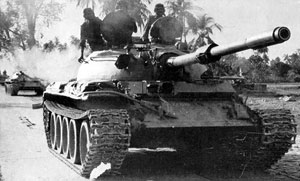
    Indian Tank during the war


    1949 – The Awami League is established to campaign for East Pakistan’s autonomy from West Pakistan.

    1970 – The Awami League, under Sheikh Mujibur Rahman, wins an overwhelming election victory in East Pakistan. The government in West Pakistan refuses to recognise the results, leading to rioting. Cyclone hits East Pakistan – up to 500,000 people are killed.

    Independence
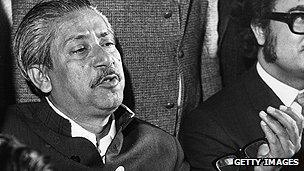
     

    Bangladeshi premier Sheikh Mujibur Rahman pictured in 1972
    source

    1971 – Sheikh Mujib arrested and taken to West Pakistan. In exile, Awami League leaders proclaim the independence of the province of East Pakistan on 26th March. The new country is called Bangladesh. Just under 10 million Bangladeshis flee to India as troops from West Pakistan are defeated with Indian assistance.

    1972 – Sheikh Mujib returns, becomes prime minister. He begins a programme of nationalising key industries in an attempt to improve living standards, but with little success.

    1974 – Severe floods devastate much of the grain crop, leading to an estimated 28,000 deaths. A national state of emergency is declared as political unrest grows.
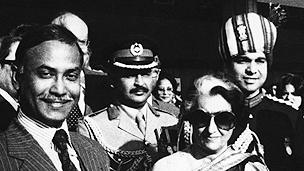
    Bangladeshi leader Ziaur Rahman pictured in 1980
    source

    1975 – Sheikh Mujib becomes president of Bangladesh. The political situation worsens. He is assassinated in a military coup in August. Martial law is imposed.

    1976 – The military ban trade unions.

    1977 – General Ziaur Rahman assumes the presidency. Islam is adopted in the constitution.

    1979 – Martial law is lifted following elections, which Zia’s Bangladesh National Party (BNP) wins.

    1981 – Zia is assassinated during abortive military coup. He is succeeded by Abdus Sattar.

    Ershad era

    1982 – General Ershad assumes power in army coup. He suspends the constitution and political parties.

    1983 – Limited political activity is permitted. Ershad becomes president.

    Bangladeshi leader Hussain Muhammad Ershad
    source

    1986 – Parliamentary and presidential elections. Ershad elected to a five-year term. He lifts martial law and reinstates the constitution.

    1987 – State of emergency declared after opposition demonstrations and strikes.

    1988 – Islam becomes state religion. Floods cover up to three-quarters of the country. Tens of millions are made homeless.

    1990 – Ershad steps down following mass protests.

    1991 – Ershad convicted and jailed for corruption and illegal possession of weapons. Begum Khaleda Zia, widow of President Zia Rahman, becomes prime minister. Constitution is changed to render the position of president ceremonial. The prime minister now has primary executive power. Cyclonic tidal wave kills up to 138,000.

    Awami League returns

    1996 – Two sets of elections eventually see the Awami League win power, with Sheikh Hasina Wajed, the daughter of Sheikh Mujibur Rahman, becoming prime minister.

    1997 – Ershad is released from prison. The opposition BNP begins campaign of strikes against the government.

    1998 – Two-thirds of the country devastated by the worst floods ever. Fifteen former army officers sentenced to death for involvement in assassination of President Mujib in 1975.

    Garment factory in Ashulia, Bangladesh

    2000 September – Sheikh Hasina criticises military regimes in a UN speech, prompting Pakistani leader General Musharraf to cancel talks with her. Relations strained further by row over leaked Pakistani report on 1971 war of independence.

    2000 December – Bangladesh expels Pakistani diplomat for comments on the 1971 war. The diplomat had put the number of dead at 26,000, whereas Bangladesh says nearly three million were killed.

    2001 April – Seven killed in bomb blast at a Bengali New Year concert in Dhaka. Sixteen Indian and three Bangladeshi soldiers killed in their worst border clashes.

    General view of Dhaka, with slum area seen on left

    2001 April – High Court confirms death sentences on 12 ex-army officers for killing Mujib. Only four are in custody.

    2001 July – Hasina steps down, hands power to caretaker authority, becoming the first prime minister in the country’s history to complete a five-year term.

    Coalition government

    2001 September – At least eight people are killed and hundreds injured as two bombs explode at an election rally in south-western Bangladesh.

    2001 October – Hasina loses at polls to Khaleda Zia’s Nationalist Party and its three coalition partners.

    Ramadan prayers outside National Mosque of Bangladesh

    2002 July – Pakistani President Musharraf visits; expresses regret over excesses carried out by Pakistan during 1971 war of independence.

    2004 Opposition calls 21 general strikes over the course of the year as part of a campaign to oust the government.

    2004 May – Parliament amends constitution to reserve 45 seats for female MPs.

    2004 August – Grenade attack on opposition Awami League rally in Dhaka kills 22 people. Awami League leader Sheikh Hasina survives the attack.

    2006 February – Opposition Awami League ends year-long parliamentary boycott.

    Political crisis

    Bangladesh opposition protesters, 2006

    2006 October – Violent protests over government’s choice of a caretaker administration to take over when Premier Zia completes her term at the end of the month. President Ahmed steps in and assumes caretaker role for period leading to elections due in January 2007.

    2006 November – A 14-party opposition alliance led by the Awami League campaigns for controversial election officials to be removed. Chief election commissioner MA Aziz steps aside.

    2006 December – Election date set at 22 January. Awami alliance says it will boycott the polls. Awami leader Sheikh Hasina accuses President Ahmed of favouring her rival. Blockade aimed at derailing parliamentary elections paralyses much of the country.

    2007 January – A state of emergency is declared amid violence in the election run-up. President Ahmed postpones the poll. Fakhruddin Ahmed heads a caretaker administration.

    2007 March – Six Islamist militants convicted of countrywide bomb attacks in 2005 are hanged. They include the leaders of Jagrata Muslim Janata Bangladesh and Jamaat-ul-Mujahideen.

    2007 April – Sheikh Hasina is charged with murder. Begum Khaleda Zia is under virtual house arrest. Several other politicians are held in an anti-corruption drive.

    2007 August – Government imposes a curfew on Dhaka and five other cities amid violent clashes between police and students demanding an end to emergency rule.

    2008 June – Sheikh Hasina is temporarily freed to get medical treatment in the US.

    2008 August – Local elections take place, seen as a big step towards restoring democracy. Candidates backed by the Awami League perform strongly.

    2008 November – The authorities say general elections will be held on 18 December. Sheikh Hasina returns to lead her party in the poll.

    Awami League win

    2008 December – General elections: Awami League captures more than 250 of 300 seats in parliament. Sheikh Hasina is sworn in as prime minister in January.

    2009 February – Around 74 people, mainly army officers, are killed in a mutiny in Dhaka by border guards unhappy with pay and conditions. Police arrest some 700 guards. A further 1,000 guards are detained in May.

    2009 October – The government bans the local branch of the global Islamist organisation Hizb-ut Tahrir, saying it poses a threat to peace.

    2010 January – Five former army officers are executed for the 1975 murder of founding PM Sheikh Mujibur Rahman.

    2012 May-June – Key figures from the main Islamist party Jamaat-e-Islami, including leader Motiur Rahman Nizami, are charged with war crimes by a government tribunal investigating alleged collaboration with Pakistan during the 1971 independence struggle.

    2012 October – Muslim rioters attack Buddhist villages and shrines in south-east Bangladesh after an image said to show a burnt Koran was posted on Facebook. The government denounces the attacks as “premeditated and deliberate acts of communal violence against a minority”.

    2013 January – War crimes tribunal sentences prominent Muslim cleric Abul Kalam Azad to death for crimes against humanity during the 1971 independence war. He was tried in absentia, as he had fled abroad.

    2013 April – Prime Minister Sheikh Hasina vetoes Islamist bill to outlaw criticism of Islam.

    2013 May – European retailers promise to sign an accord to improve safety conditions in factories after a garment factory building collapsed in April, killing more than 1,100 people. Worker protests close hundreds of factories and extract a government pledge to raise the minimum wage and make it easier to form unions.

    Jamaat-e-Islami trials

    2013 July – At least two people are killed as police clash with thousands of protesters after the conviction of Ghulam Azam, leader of the Jamaat-e-Islami party, for war crimes committed during the 1971 war of independence. Ghulam Azam dies in October 2014.

    2013 December – Supreme Court upholds death sentence on Islamist leader Abdul Kader Mullah of the Jamaat-e-Islami party, who was convicted in February of crimes against humanity during the 1971 war of independence.

    2014 January – Opposition BNP boycotts parliamentary elections, Prime Minister Sheikh Hasina returns for third term in office.

    2014 October – Jamaat-e-Islami Leader Motiur Rahman Nizami and another leading figure, Mir Quasem Ali, found guilty of war crimes during independence war in 1971.

    2015 February – Court sentences another senior Jamaat-e-Islami figure, Abdus Subhan, to death for war crimes committed during independence war in 1971.

    2015 May – Bangladesh bans Islamist militant group Ansarullah Bangla Team, which claims responsibility for killing and assaulting several pro-secular public figures.

    2015 November – Threats to Christians and Shia Muslims challenge government view that two years of attacks on pro-secular public figures are the work of a violent faction of the opposition Jaamat-e-Islami party, after the Islamic State armed group claims responsibility for attack on Shia mosque. Jamaat-e-Islami senior figures Ali Ahsan Mohammad Mujahid and Salahuddin Quader Chowdhury executed on war crimes charges dating back to 1971.

    2016 July – The Islamic State group claims an attack on a cafe in Dhaka’s diplomatic quarter in which 20 hostages, including 18 foreigners, are killed but the government rejects the claim saying the militant group Jamaat-ul-Mujahideen was responsible.

    2016 September – Business tycoon and senior leader of Bangladesh’s largest Islamist party Jamaat-e-Islami, Mir Quasem Ali, is executed for war crimes committed during the 1971 war of independence.

    Why Bangladesh is important to India’s north east?

      • Bangala

    Ports – The nearest port for the Northeast is Kolkata. Kolkata is 1500 km from Aizawl and Agartala. Not just the distance, the route passes through multiple states and through a lot of mountains. Imagine dragging a heavy machinery through this long, narrow road. This makes trade and manufacturing very hard in the Northeast. Every product that is either produced in Northeast or needed in northeast has to be carried through that one road through Siliguri. On the other hand, Chittagong port is only 200km from Tripura and passes through the mostly flat land. A major Bangladeshi railway junction Akhaura is just 10 km from Agartala.

    Migration – Major cities in India’s northeast are quite close to the rural hinterland of Bangladesh. For many rural Banglas, it is easy to find jobs in these cities than in Dhaka or Chittagong. Thus, there is a massive migration that is rapidly impacting the demographics of the Northeast. Many tribes feel marginalized in their own territory. India needs Bangladeshi government’s help to arrest the endless flow of migrants.

    Separatism – Tripura alone shares 850km of border with Bangladesh. Other states like Mizoram share long borders too [a total of 4000+ km of shared borders between Northeast India and Bangladesh]. Given the long and unpatrolled borders, the separatists and troublemakers in this region easily escape to Bangladesh. It is hard to fight the separatism as long as the separatists have such an easy escape hatch. India needs Bangladesh’s help in patrolling the borders and also bring the fugitives to justice.

    Food movement – Eastern side of Bangladesh is quite fertile and produces a lot of rice. This can be easily be moved to Tripura, Mizoram and Manipur rather than dragging the food from West Bengal through the Siliguri corridor or air lifting them.

    Risk of Chicken neck – Currently the Siliguri corridor remains the only link between the Northeast and the rest of India. Any problem there – terrorist attacks, natural disasters, etc. – would completely cut off India from the 7 states of North east. Bangaldesh help would reduce that risk substantially

    Major irritants with Bangladesh

    Boundary Dispute

    India’s land border with Bangladesh as per the Ministry of Defence is 4351 km. running through five states, viz., West Bengal (2217kms), Assam (262 kms), Meghalaya (443kms), Tripura (856 kms) and Mizoram (318 kms), including nearly 781 kms of riverine border. The border traverses through 25 districts.

    The border is used as a route for smuggling livestock, food items, medicines and drugs from India to Bangladesh. Moreover, illegal immigrants from Bangladesh cross the border to India in search of improving their lives. Because of a large number of illegal immigrants crossing from Bangladesh into India, a controversial shoot-on-sight policy has been enforced by the Indian border patrols.

    This policy was initiated with reports of violence between the illegal migrants and Indian soldiers. The border has also witnessed occasional skirmishes between the Indian Border Security Force and the Border Guards Bangladesh, most notably in 2001.

    The killing of Bangladeshi nationals by Border Security Force (BSF) has become a major irritant between the two countries in the recent past. It has evoked strong public sentiments in Bangladesh. According to a report of Bangladesh Human Rights Watch organization Odhikar, BSF has, from January 1, 2001 to March 31, 2012, killed 907 Bangladeshis. Bangladesh wants no time lost in stopping these killings.

    Further the Agreement on the demarcation of Land Boundary between Bangladesh and India and related matters had been signed in May 1974 between the two great statesmen, Bangabandhu Sheikh Mujibur Rahman, and Smt. Indira Gandhi. This comprehensive agreement was intended to resolve all lingering and vexing problems that history had bequeathed on the two nations.  But it has not full filled by both Governments.

    During the State visit of the Prime Minister to Bangladesh in September 2011, a “Protocol to the Agreement between the Government of India and the Government of Bangladesh Concerning the Demarcation of the Land Boundary Between India and Bangladesh and Related Matters (LBA)” was signed. It settles the long outstanding land boundary issues related to un-demarcated segment of 6.1 Kms; territories in adverse possession; and exchange of enclaves. The Cabinet has, on 13 February 2013, approved the draft of a Constitution (Amendment) Bill for implementing the India-Bangladesh Land Boundary Agreement (LBA) 1974 and the Protocol to LBA signed in 2011.

    The Protocol envisages that 111 Indian Enclaves in Bangladesh and 51 Bangladesh Enclaves in India, as per the jointly verified cadastral enclave maps, shall be exchanged. As per Article 3 of the LBA 1974, when the Enclaves are transferred, people living in these areas shall be given the right of staying on where they are as nationals of the State to which the areas are transferred.

    Maritime border 

    While  Bangladesh,  having  concave coastlines,  delimits  its  sea  border southward  from  the  edge  of  its  land boundary,  India  stretches  its  claim southeast  wards,  covering  around thousands  of  miles  in  the  Bay  of  Bengal.

    Due  to  competing  claims  of  the  two countries,  delimitation  of  the  sea boundary  and  determining  Bangladesh’s exclusive  economic  zones  have  remained unresolved.  Moreover, in terms  of determining the continental shelf, the presence of the Andamans and Nicobar Islands puts India, in a  favourable position.

    Territorial Waters

    The issue of demarcating territorial waters led to serious differences between the two countries. Questions  of ownership over a new born island known as South Talpatty in Bangladesh and New Moore/ Purbasha in  India  spotted  by  a satellite picture in 1975 in  the estuary of Haribhanga  River  on  the  border  of  the two  countries  has  been  a  source  of contention since its discovery.

    In order to settle the above dispute  Bangladesh proposed sending a joint Indo‐Bangladesh team to determine the flow of channels of the  river  on  the  basis  of  existing International  Law  of  the  Sea.  But  the Indian  counterpart  sent  forces  to establish  claims  by  stationing  naval troops on  the island in 1981. After initial resentment  by  Bangladesh,  India  agreed to resolve the issue through negotiations.

    Illegal Migration

    Illegal migration is one of the bones of the contention of these two countries, Since the 1971 war of independence that created the state of Bangladesh, millions of Bangladeshi immigrants (the vast majority of them illegal) have poured into neighboring India.

    While the Indian government has tried to deport some of these immigrants, the sheer number of them, as well as the porous border between the two countries, has made such an enterprise impossible. It is difficult to assess how many illegal immigrants are currently residing in India. Consider that in 1971, during the civil war in neighboring East Pakistan (the former name of Bangladesh), at least 10-million Bangladeshis poured into West Bengal in India
    Illegal migration appears in the eastern and north-eastern parts of the country from neighbouring Bangladesh, threat to India’s internal security, from Bangladesh is impacted on communal, political, social and economic tensions and conflicts in several areas of the northeast of India.

    The most affected states are West Bengal, Assam, Megalaya, Nagaland, Bihar, and Tripura, although migrants “have spread too far off states like Tamil Nadu, Maharashtra, Gujarat, Rajasthan and Delhi.”  Although the exact figure is not known, it is estimated that there are about 15-20 million Bangladeshis staying illegally in India.

    The National Investigation Agency has found links with Pakistan in rackets engaged in printing and smuggling fake currency into India. NIA sources said fake currency was now being smuggled into the border with Bangladesh has gaps at some points and immigrants cross into India on foot through the breaks in the fence.

    Some also swim across rivers on the border to reach India. The National Investigation Agency has found links with Pakistan in rackets India through its porous border with Bangladesh. Malda district in West Bengal is a key transit point for counterfeiters.

    Once they reach India, immigrants obtain fake documents through local agents.  Political leaders in parts of West Bengal were also involved in endorsing fake documents such as ration cards for illegal immigrants.

    This unfettered illegal migration impacts on national security and socio-economic stability. Intelligence inputs indicate that the Inter Service Intelligence Agency (ISI) of Pakistan is utilizing these migrants as conduits to ferry in terrorists and arms into India. Counterfeit Indian currency with its origins in Bangladesh has flooded border areas, crippling in these parts.

    Vote bank politics in Assam is the one of obstacle to control illegal migration from Bangladesh, led to communal violence between indigenous Bodos and Muslims (migrants from Bangladesh) in 2012.

    The illegal Bangladeshi immigrants have not only changed the demography and disturbed the ecology of the north-east but have also encouraged them to exercise their political rights in India as citizens. It has been one of the key reasons for the rise of insurgent groups in the north-east as some of the insurgent groups like Assam Gana Sangram Parishad started, and got support of the masses, because of the issue of illegal immigration from Bangladesh. At the same time the immigration laws (Illegal Migrants [Determined by Tribunal] (IMDT) Act 1983) followed in Assam has aided illegal immigrants’ settling in the north-east easy.

     Security concerns

    Insurgency has been playing the role in straining relations of India with Bangladesh. Northeast India has been facing insurgency since 1956 due to feelings of ethnic separatism among its inhabitants.

    ISI is operating from Bangladesh, supporting the insurgents in the North east India. National Liberation of Tripura (NLFT), Liberation Front of Assam(ULFA) and National Democratic Front of  Bodoland (NDFM) are major insurgent groups in Northeast India. There are some rumours that ULFA has several lucrative income generating Projects in Bangladesh to sustain its insurgency activities in India.

    Drug Trafficking

    Bangladesh is increasingly being used as a transit point by drug dealers and the drug mafia,  which  dispatches  heroin  and opium  from  Burma,  and  other  countries of  the  golden  triangle,  to  different destinations.

    As  a  result,  Bangladesh’s Department  of  Narcotics  Control  has  come  under  the  scanner  several  times  and  invited  criticism. Bangladesh  has  become the  prime  transit  route  for  trafficking heroin  to  Europe  from  Southeast Asia, according  to  a  report  from  the International  Narcotics  Control  Board  (INCB)  2007  annual  report.

    INCB  notes  that  the  most  common methods and routes for smuggling heroin into  Bangladesh  are  by  courier  from Pakistan,  commercial  vehicles  and  trains from India, and via sea through the Bay of Bengal  or  overland  by  truck  or  public transport from Burma.

    Trade and Investment

    Bangladesh is an important trading partner for India. The two-way trade in FY 2011-2012 was US$5.242 billion with India’s exports to Bangladesh accounting for US$4.743 billion and imports US$0.498 million.

    The trade deficit with India is frequently highlighted by Bangladesh as a major contentious issue. Trade deficit for Bangladesh is more than $4 billion.  For long, Bangladesh has been urging India to reduce this gap by lifting the tariff barriers as they were a major impediment to the growth of Bangladesh’s exports to India. Responding to Bangladesh’s concern, in November 2011, India granted duty free access to all products, except 10 tobacco and liquor items from Bangladesh which amounts 30% of Bangladesh export.

    As much as 98 per cent of Bangladesh products now enjoy zero duty benefits in the Indian market. Bangladesh’s exports to India are expected to cross $1 billion in 2012.

    However, Bangladesh is now urging India to remove all non-tariff barriers (NBTs) as it views NTBs as the major obstacles to its export growth. Some of these barriers are: laboratory test for every consignment of food products, cosmetics, and leather and textile products; delay in getting test results; imposition of state tax; packaging requirement, anti-dumping and countervailing duties; inadequate infrastructure facilities such as warehousing, trans-shipment yard, parking yard and; connecting roads at land customs stations of India.

    To encourage exports from Bangladesh, India must move proactively to provide facilities of customs and testing at the border check posts.
    Besides, removal of non-tariff barriers should be accompanied by tariff reforms since the opportunity cost of non-tariff barriers is very high.

    A Consumer Unity & Trust Society (CUTS) International report says: “In 2010, value of unexplored market was more than 48 per cent of total value of India- Bangladesh trade and potential saving, which is a proxy for cost of non-tariff barriers, is more than seven per cent of total value of Indo-Bangla trade”.

    India is also encouraging investments in Bangladesh. In this regard, a Bilateral Investment Promotion and Protection Agreement have been signed between the two countries. The agreement is expected to increase Indian investment in Bangladesh.
    Transit

    India has been urging Bangladesh to provide rail and road transit to connect with its north-eastern states. Technically speaking, the issue of transit was resolved in 1972 when both sides agreed on a mutually beneficial arrangement for the use of their waterways, railways and roadways for commerce between two countries and for passage of goods to places in one country through the territory of the other. Inland water transit has been functional, but the rail and road transit is still waiting to be operational.

    Bangladesh’s initial reluctance to granting India rail and road transit was on the grounds that transit facility once given was difficult to take back and such a facility may encourage terrorism and insurgency.
    Other concerns included damage to the roads and bridges in Bangladesh by the increased traffic flow from the Indian side.
    The reason for delay was that Bangladesh’s infrastructure was not yet prepared to take the load of the increased traffic that will follow with the granting of transit to India. Addressing Bangladesh’s concern, India provided a credit line of $1billion to Bangladesh for development of infrastructure projects. But the credit line could not be used to its potential because of the strict conditions India imposed, to the effect that 85 per cent of the raw materials for the road projects has to be procured from India, on the ground that it produces all the materials necessary.

    Bangladesh has countered by claiming it too has the necessary raw materials. It could earn $44 million per annum for first five years if it grants transit to India. From the sixth year, earnings would be around $500 million, which could rise to $1 billion.  Transit would not only boost connectivity between the two countries, but also offer opportunities for regional connectivity and help Bangladesh develop Chittagong port into a regional hub.

    The  Chittagong  port  can  become  a modern  busy  port  like  Singapore  and  China  serving  the  SAARC  countries.  Huge  foreign  investment  may  be attracted by Bangladesh and  finally, a throbbing  service  sector like banks, insurance, hotels, rest houses, petrol pumps etc. may develop around the Transcontinental roads and railways.

    There  is  an  estimate  of  direct economic  gain  from  transit  fees.  It ranges from  500  crore  taka  to  4,666 crore taka.  The  mutual  transit will  also give Bangladesh  a  much  shorter  route  to China and an initiative to link Chinese province  of  Yunan with  Seven Sisters of  India,  Myanmar,  Thailand  and Bangladesh.

    Water –sharing:

    We share 54 trans-boundary rivers, big and small.

    Some of the major water sharing disputes

    Ganga river dispute

    In 1996, the sharing of the Ganga waters was successfully agreed upon between the two nations. However, the major area of dispute has been India’s construction and operation of the Farakka Barrage to increase water supply to the river Hooghly.

    Bangladesh complains that it does not get a fair share of the water in the dry season and some of its areas get flooded when India releases excess waters during the monsoons.

    Teesta River dispute

    Teesta originates in Sikkim, flows through West Bengal in India before entering Bangladesh. It merges with the Brahmaputra River (or Jamuna when it enters Bangladesh). The river is important for both Bangladesh and India for its agricultural use.

    Teesta river agreement timeline

    In 1983, India and Bangladesh had agreed into an ad hoc sharing of the water during the dry season (October to April) with an allocation of 36 per cent for Bangladesh and 39 per cent for India, leaving 25 per cent to be decided later. But this deal has remained pending for more than 2 decades.

    As per an agreement of 2011 the two sides had agreed to share the river’s water 50:50, the same as the 1996 Ganges water-sharing pact between the neighbors. This agreement was not signed due to opposition from chief minister of West Bengal.

    Tipaimukh Hydro-Electric power Project

    Bangladesh has been demanding to stop the construction of the Tipaimukh Hydro-Electric Power Project on the Barak River on the eastern edge of Bangladesh.

    Bangladesh says that the massive dam will disrupt the seasonal rhythm of the river and have an Adverse effect on downstream agriculture, fisheries and ecology of the region. Indian government has assured Bangladesh that it will not take any unilateral decision on the Tipaimukh Hydro-Electric Power Project which may adversely affect Bangladesh.

    Chinese Engagement with Bangladesh

    Bangladesh and China has decade-long diplomatic ties. 2015 marked the 40th year of their relationship. China is the largest trading partner of Bangladesh in current times with the two-way trade accounting for about US$12 billion in 2014. China is contributing largely to ongoing infrastructural development in Bangladesh.

    The growing security and military relations between the two countries in recent days is taking place much to the chagrin of New Delhi. Beijing’s current initiative for setting up financial institutions including the Asian Infrastructure Investment Bank (AIIB) is likely to create new opportunities for Bangladesh in accessing funds for infrastructure development.

    Bangladesh’s renewed interest in ocean economy in the Bay of Bengal in the context of UN approved delineation of maritime boundary over the Bay, it needs to engage with technologically and financially sound partners like China, Japan, the United States and South Korea, among others.

    Engagement with China may prove to be most important economic relation for Bangladesh considering China’s growing and developed economy and international clout. However, Dhaka needs to balance its relations between New Delhi and Beijing for its own interest.

    In fine, India in its current focus on neighbourhood prosperity is going to foster an enduring bilateral relationship with Bangladesh, as perceived from the ongoing engagements between New Delhi and Dhaka. Both countries are on the right track for building rapport in spheres of bilateral importance; however, the deep-seated disputes like that of water-sharing needs to be addressed for good for a better tomorrow.

    Recent Developments

    Land Boundary Agreement

    Brief history:

    After the partition of India in 1947, Rangpur was joined to East Pakistan, and Cooch Behar district was merged in 1949 with India. The desire to “de-enclave” most of the enclaves was manifested in a 1958 agreement between Jawaharlal Nehru and Feroz Khan Noon, the respective Prime Ministers, for an exchange between India and Pakistan without considering loss or gain of territory.

    But the matter then worked into a Supreme Court case in India, and the Supreme Court ruled that a constitutional amendment was required to transfer the land. So the ninth amendment was introduced to facilitate the implementation of the agreement.

    The amendment could not be passed because of an objection to transfer of southern Berubari enclave. Because of India’s deteriorated relations with Pakistan, the issue remained unsolved. With that agreement not ratified, negotiations restarted after East Pakistan became independent as Bangladesh in 1971 following the Bangladesh Liberation War

    Attempts have been made to arrive at a comprehensive settlement of the land boundary between India and Bangladesh (the erstwhile East Pakistan) since 1947. The Nehru-Noon Agreement of 1958 and the Agreement Concerning the Demarcation of the Land Boundary between India and Bangladesh and Related Matters of 1974 (referred to as 1974 LBA) sought to find a solution to the complex nature of the border demarcation involved.

    However, three outstanding issues pertaining to an un-demarcated land boundary of approximately 6.1 km, exchange of enclaves and adverse possessions remained unsettled.

    The list of enclaves was prepared in 1997 by both nations. Two Joint Boundary Working Groups was formed to work out the details of enclaves in 2001. The joint census was carried out it May 2007.

    The Protocol (referred to as the 2011 Protocol) to the 1974 LBA, signed on 6th September 2011 during the visit of the Prime Minister to Bangladesh, paves the way for a settlement of the outstanding land boundary issues between the two countries. The both nations announced an intention to swap 162 enclaves, giving residents a choice of nationality.

    Indian Parliament in May 2015 passed the constitutional amendment bill regarding the land boundary agreement with Bangladesh. The Lower House, showing rare unanimity, passed the Constitution (119th Amendment) Bill to allow the operationalisation of the 1974 India-Bangladesh Land Boundary agreement.

    Major features of agreement: 

    A settled boundary is an essential prerequisite for effective cross-border cooperation. It reduces friction, helps neighbours consolidate mutually beneficial exchanges and promotes confidence in building better relations.

    The 2011 Protocol ensures that the India-Bangladesh boundary is permanently settled with no more differences in interpretation, regardless of the government in power.

    • The 2011 Protocol results in a fixed demarcated boundary in all the un-demarcated segments, exchange of 111 Indian enclaves in Bangladesh with 51 Bangladesh enclaves in India and a resolution of all adversely possessed areas.
    • In the exchange of enclaves, India transfers 111 enclaves with a total area of 17,160.63 acres to Bangladesh, while Bangladesh would transfer 51 enclaves with an area of 7,110.02 acres to India.
    • While on paper, the exchange of enclaves between India and Bangladesh may seem like a loss of Indian land to Bangladesh, the actual scenario is quite different as the enclaves are located deep inside the territory of both countries and there has been no physical access to them from either country.
    • Each country will now begin to administer enclaves on its territory and enclave citizens will be able to choose where they want to live and which nationality they would prefer.
    • In reality, the exchange of enclaves denotes only a notional exchange of land as the Protocol converts a de facto reality into a de jure situation.

    The inhabitants in the enclaves could not enjoy full legal rights as citizens of either India or Bangladesh and infrastructure facilities such as electricity, schools and health services were deficient.
    Further, due to lack of access to these areas by the law and order enforcing agencies and weak property rights, certain enclaves became hot beds of criminal activities.

    Major advantages of land boundary agreement: 

     These are as follows:

    The exchange of enclaves will mitigate major humanitarian problems as the residents in the enclaves and others on their behalf had often complained of the absence of basic amenities and facilities the settlement of Adverse Possessions will lead to tranquility and peace along the border it represents a permanent solution to a decades old issue the newly demarcated boundaries are a fixed boundary, thereby adding to certainty regarding the future
    a settled boundary reduces friction, helps neighbours consolidate mutually beneficial exchanges and promotes confidence in building better relations.

    It paves the way for closer engagement and mutually beneficial relations between India and Bangladesh and the region; this also helps on issues of strategic concern, including security cooperation and denial of sanctuary to elements inimical to India. While land will be exchanged, the Protocol does not envisage the displacement of populations; the Protocol ensures that the India-Bangladesh boundary is permanently settled and there should be no more differences in interpretation, regardless of the government in power.

    This deal would also revive the moribund South Asia Growth Quadrangle (SAGQ), comprising India’s north east, Bangladesh, Nepal and Bhutan.

    Indo-Bangladesh Maritime Boundary Dispute

      • [​IMG]


    In a landmark judgment, the Hague-based Permanent Court of Attribution (PCA) has awarded Bangladesh an area of 19,467 sq km, four-fifth of the total area of 25,602 sq km disputed maritime boundary in the Bay of Bengal with India on July 7.

    The UN Tribunal’s award has clearly delineated the course of maritime boundary line between India and Bangladesh in the territorial sea, Exclusive Economic Zone (EEZ) and continental shelf within and beyond 200 nautical miles (nm). Now, Bangladesh’s maritime boundary has been extended by 118,813 sq comprising 12 nm of territorial sea and an EEZ extending up to 200 nm into the high seas.

    In addition, the ruling acknowledged Bangladesh’s sovereign rights of undersea resources in the continental shelf extending as far as 345 nm in the high seas, taking Chittagong coast as the base line. The verdict has been broadly accepted by both the countries as a positive development for further consolidation of friendly relations especially given the geo-strategic/political significance of greater Indian Ocean region and South Asian sub-region.

    Security and Economic implications for India

    • Some are of the scholars’ opinion that the ruling could provide force for the new Indian government to ratify the Land Boundary Agreement and reach an understanding on sharing the waters of the Teesta river with Bangladesh.
    • The verdict would contribute towards establishing strategic partnerships among the nations sharing borders in the Bay.
    • The award is expected to have positive impact on emerging multilateral forum like BIMSTEC. It may be noted that India has already settled its maritime borders with Sri Lanka, Myanmar and Thailand. Similarly, Bangladesh’s maritime issues with Myanmar are resolved.
    • The PCA award assumes strategic significance against the backdrop of China’s close ties with Bangladesh and its growing interests and activities in the Bay region for which India is worried. Now the settlement of maritime disputes between India and Bangladesh may have a restraining influence on the expansionist designs of China.
    • Both the countries have accepted the award as it will open the door for exploration of oil and gas in the Bay—the site of huge energy reserves.
    • The verdict has recognised India’s sovereignty over New Moore island and received nearly 6000 sq km of the contested zone where the island had once existed.
    • India’s discovery of natural gas in 2006 took place in a creek which is situated about 50 km south of the mouth of the Hariabhanga river within the contested zone. The lingering maritime dispute stood in the way of exploration of hydrocarbons in the Bay region. Such as in December, 2013, Australian firm Santos withdrew from two sea-blocks citing security and maritime dispute with Bangladesh.
    • Now India’s policy makers could chalk out a long-term strategy for the economic development of the Bay region. To realise its goals, New Delhi may forge bilateral or multilateral partnerships under the framework of sub-regional grouping like BIMSTEC

    Implication for Bangladesh

    The award has huge economic significance for a small state like Bangladesh. It has cleared the obstacles for Dhaka to open up its waters for foreign firms to explore and exploit hydrocarbons in the Bay. So long, Bangladesh’s maritime dispute with India is believed to have deterred many international petroleum companies to invest in the sea-blocks previously offered by it.

    The United Nations Convention of Law of the Sea (UNCLOS) gives a nation 12 nm of territorial control and ensures sovereign rights to explore, exploit and manage natural resources with 200 nm of EEZ.

    The economic prospects of the Bay region have increased enormously after Myanmar and India discovered huge natural gas deposits beneath the sea. It is reported that Myanmar discovered 7 trillion cubic feet of hydrocarbon deposits in the region. This was followed by India’s discovery of another 100 trillion cubic feet of natural gas. This prompted Bangladesh—a nation with limited resource base and high demand of energy,to search for offshore energy resources.

    In 2008, Bangladesh government divided its claimed territorial sea and EEZ into 28 sea-blocks and leased them to multinational companies to meet its growing energy needs.But Bangladesh was eventually compelled to suspend exploration as both India and Myanmar objected to it.Successive discoveries of massive natural gas have made the delimitation of maritime boundary all the more significant.

    • Economically, Bangladesh is a major gainer. Now, Dhaka is in a position to invite foreign companies to explore oil and gas resources in its maritime zones.
    • It would definitely help Bangladesh to compensate gas shortages in its gas turbine-run industries and plants and contribute to the country’s economic development.
    • India’s ONGC stands a good chance to win lucrative contracts in Bangladeshi offshore gas and oil fields.
    • The verdict is also good news for millions of fishermen in both the countries. The amicable settlement has opened up vast sea areas which were not available to them in the last four decades.
    • Moreover, both the countries could enhance cooperation in the conservation of the rich bio-diversity of the Sunder bans.
    • By clearly delineating the maritime boundary between the two nations, the verdict could help boosting coastal and maritime security in the region. Before the award, both India and Bangladesh could not undertake cooperative measures due to the vexed problem. The verdict has now cleared the hurdles of strengthening security in the maritime front.
    • Furthermore, precise demarcation of maritime boundary would assist in preventing the cases of transgression by fishermen of both countries. The PCA award is really a “win-win” situation for both the countries, as described by the Bangladesh foreign minister, if they follow it up with concrete action.

    3. Growing radicalism in Bangladesh

    Background

    In last 2 years many secularist have been heckled to death in Bangladesh.In 2010, the government of Bangladesh, headed by the secularist Awami League established a war crime tribunal to investigate war crimes perpetrated during Bangladesh’s bloody 1971 Liberation war from Pakistan. In February 2013, Abdul Qadeer Molla, a leader of the Bangladeshi Jamaat-e-Islami party (a small Islamist party within the opposition coalition) was sentenced to life imprisonment by the tribunal.

    The sentence was condemned by Bangladesh’s secularist bloggers and writers, who helped organize the Shahbagh Protest in response, calling for the death penalty for Molla. The protestors quickly expanded their demands to include outlawing the Jamaat-e-Islami party itself for its role in the 1971 war.

    Shortly after the first Shahbag protests, counter-demonstrations, which quickly degenerated into violence, were organized by Islamist groups. Islamist leaders denounced the war crimes tribunal as political and called for an end to the prosecution of Jamaat-e-Islami leaders, instead they demanded the death penalty for secularist bloggers, denouncing them as “atheists” and accusing them of Blasphemy.

    According to many Experts the hostility directed toward Bloggers by Islamists is due primarily to the bloggers’ growing political influence in Bangladesh, which represents a major obstacle to the Islamist goal of a religious state.

    Though there were occasional attacks on secularists prior to the 2013 Shahbag protests, the frequency of attacks has increased since.

    In 2014, a group calling itself “Defenders of Islam” published a “hit list” of 84 Bangladeshis, mostly secularists, of whom nine have already reportedly been killed and others attacked Responsibility for many of the attacks has been claimed by Ansarullah Bangla Team a group which according to police has links with both the youth wing of Jamaat-e-Islami and with Al Qaida. The group has since been banned by the government. Other attacks appear to have been perpetrated by more obscure groups.

    How much is politics responsible for this situation?

    The killing campaign in Bangladesh is fuelled by the bitter war between Prime Minister Sheikh Hasina’s Awami League, and her opponents on the Right — former Prime Minister Khaleda Zia’s BNP, and its sometime ally, the Jamaat.

    Headed into the 2014 elections, the BNP had paralysed the country with weeks of protests, demanding that power be handed over to a neutral caretaker government. The Awami League government, though, held fast, leading the opposition to boycott the elections.

    In 2013, meanwhile, the now-iconic Shahbag protests broke out, with young people demanding the death penalty for Jamaat-e-Islami leaders held guilty of 1971 war crimes. In essence, these twin crises pushed the organised right wing out of the political arena, creating a political vacuum. Though the Bangladeshi police and security services have proved effective at containing terrorism, crushing the once-feared Harkat-ul-Jihad-e-Islami, the fear now is that the political vacuum could be capitalised on by jihadists.

    The best way of preventing that would be to revive competitive political life in Bangladesh, but the political system remains log jammed, with no end in sight to the Awami League-BNP stand-off.

    Significance of these Killing for Bangladesh

    • Bangladesh has always prided itself for its religious tolerance and secularism. In fact, the country is a shining example of Islam and democracy coexisting. However, all that is changing quickly with the rise of religious fundamentalism in the country.
    • The Islamist fundamentalists, apart from targeting minorities, have targeted all those who have commented on religion and who are fighting for their right to the freedom of expression. These Killings are threat to democracy as freedom of expression is one of the very basic tenet of Democracy.
    • The killings Prove that the Islamlist are not just against the minority community but anyone even a Muslim who do not subscribe to their salafist ideology thus most of their victims are liberal Muslims.
    • These killings are leading to  growing sense of fear and insecurity; people in Bangladesh are living under the threat of Terrorism  Moreover, the lukewarm response of the government has only emboldened the radical elements belonging to the Hardline Islamist groups such as ABT and JMB.
    • The persistent failure of the Bangladesh Government and the international community to better protect threatened thinkers has created a climate of fear and direct threat to free thought in the country.
    • The spate of ideological murders is an assault on Bangladesh’s secular principles and ideas.

    Way Forward

    Bangladesh is facing an existential crisis today and unless the government takes steps to launch an all-out attack on the members of AMT and JMB, the situation may spiral out of control. It is also surprising that, except for opprobrium in international newspapers on the growing intolerance in the country, many countries like the United States, the United Kingdom, and even neighboring India have remained silent over the issue.

    It is time that they exert pressure on the Bangladeshi government to act against the perpetrators of these crimes. The government should also realize by not acting against these perpetrators, the groups will be further emboldened to carry out more such attacks against the secular forces. T

    he day is not far when these groups are likely to be exploited by terrorist organizations like al Qaeda and the Islamic State, for not only gaining a toehold in the region, but also an opportunity to radicalize the youth of the country. Before it’s too late, the government must launch an all out attack on these fundamental groups, lest the country fall into an abyss of violence, which would completely destroy the secular character of Bangladesh.

    4. BBIN Motor Vehicle Agreement

    Introduction

    India, Nepal, Bhutan and Bangladesh signed a landmark Motor Vehicles Agreement (MVA) for the Regulation of Passenger, Personnel and Cargo Vehicular Traffic among the four South Asian neighbours in Thimpu, Bhutan. BBIN (Bangladesh, Bhutan, India, Nepal) agreement is a complementary instrument to the existing transport agreements or arrangements at the bilateral levels that the contracting parties will continue to honor.

    What will be the benefits of BBIN?

    • It Will promote safe, economical efficient and environmentally sound road transport in the sub-region
    • Will further help each country in creating an institutional mechanism for regional integration.
    • BBIN countries will be benefited by mutual cross border movement of passenger and goods for overall economic development of the region.
    • Will further promote our cooperation in trade and commerce apart from further cementing our age old cultural ties
    • Enhance regional connectivity.
    • Expand people-to-people contact, trade, and economic exchanges between our countries.
    • Transforming transport corridors into economic corridors could potentially increase intraregional trade within South Asia by almost 60% and with the rest of the world by over 30%
    • A new sub-group in world – BBIN! Regional strength.

    What are the challenges ahead?

    Building and upgrading roads, railways and waterways infrastructure energy Grids, communications and air links to ensure smooth cross border flow of goods, services, capital, technology and people.

    Internal Security concerns

    • Illegal migration
    • Smuggling, etc.
    • Timely implementation of further steps to be taken.
    • Trade facilitation at Land border
    • Multi-modal transport facility
    • Customs system can be shared – this will save time by avoiding duplication

    Bhutan has some reservations related to tourism as they want to strictly maintain culture and everything else of the Himalayas as per their own norms including Gross Happiness Index

    What more can BBIN do?

    Bhutan and Nepal can generate more power and sell to India and Bangladesh

    It is not anymore a socialist hangup of exploitation by one country of other. It is mutual growth through co-operation.

    Is India planning something similar with other countries?

    A major breakthrough has been achieved between India-Myanmar and Thailand. Three nations have agreed to develop a similar framework motor vehicle agreement on the lines of draft SAARC Motor vehicle agreement.

    Secretary level discussions were successfully concluded in Bengaluru this month andconsensus has been reached on the text of Agreement. 

    On conclusion of this Agreement, our sub-region will get access to the larger ASEAN marketthrough seamless passenger and cargo movement.

    Areas of cooperation between India and Bangladesh under Sheika Hasina Government

    • India’s relations with Bangladesh have certainly witnessed a significant upswing over the past decade, some persistent challenges notwithstanding. Bilateral trade has risen to $7 million. Bangladeshi Prime Minister Sheikh Hasina has been cracking down on hardline elements, and has provided India with logistical assistance, for instance in setting up the Paltana plant in Tripura. Sheikh Hasina, after being elected in December 2009 as Prime Minister, used her huge majority in Parliament to launch two initiatives.
    • One was eradication of terrorism from the country, and the other was the trial of the 1971 war criminals for crime against humanity. One Jamaat senior leader has been executed, their mentor Golam Azam has been sentenced to life and cases against others are proceeding. This trial, which was long demanded by the freedom fighters, has set back both the Jamaat and BNP.
    • On the terrorism front Sheikh Hasina has scored unprecedented success. Indian insurgents like the ULFA, NSCN (I/M) and others have been rooted out of this country, and Islamic terrorists and extremists have been hit hard. Apart from Bangladesh India has been the greatest beneficiary of the Sheikh Hasina government’s action against terrorism.
    • From October 2013, India started exporting 500 megawatts of electricity a day to Bangladesh over a period of 35 years
    •  Last year the Indian Parliament, unanimously passed the Land Boundary Agreement (LBA) as its 100th Constitutional amendment, thereby resolving all 68-year old border disputes since the end of the British Raj. The bill was pending ratification since the 1974 Mujib-Indira accords.
    • Resolution of maritime dispute through UNCLOS PCA in favour of Bangladesh and India not re-appealing it.
    • Easing of Visa regime to provide 5 year multiple entry visas to minors below 13 and elderly above 65.
    • Bangladesh allowed India to ferry food and grains to the landlocked North east using its territory and infrastructure.
    •  During the PM modi visit India extended a US$2 billion line of credit to Bangladesh & pledged US$5 billion worth of investments. As per the agreements, India’s Reliance Power agreed to invest US$3 billion to set up a 3,000 MW LNG-based power plant (which is the single largest foreign investment ever made in Bangladesh) & Adani Power will be setting up a 1600 MW coal-fired power plant at a cost of US$1.5 billion.
    • Power agreement and internet service: Prime Ministers of India and Bangladesh commissioned international gateway of internet service in Agartala and supply of 100MW power to Bangladesh from Tripura.

    Under it India will supply 100 megawatt (MW) of electricity in return for 10 Gigabits per second Internet bandwidth.

    100MW power will be supplied from Suryamaninagar grid to the grid in Commilla of southeast Bangladesh.

    India is already supplying 500 MW of power to Bangladesh through the Bahrampur-Bheramara interconnection.

    North eastern region will get benefit of 10GBPS internet bandwidth from Bangladesh’s submarine cable station at Cox Bazar

    • 15-km railway connectivity link between Agartala and Akhaura in Brahmanbaria district of Bangladesh is to be completed in 2017. Akhaura has a rail link to Chittagong too. Once the Agartala-Akhaura railway link is ready, goods brought to Chittagong port can be carried by rail directly to Agartala.
    • Both countries are also implementing BBIN motor vehical agreement which allows vehicles to enter each other’s territory and does away with trans-shipment of goods from one country’s truck to another at the border, a time consuming and costly process.
    • “Agreement on Coastal Shipping”: India and Bangladesh signed the Standard Operating Procedure (SOP), to operationalize the “Agreement on Coastal Shipping” signed between the two countries in June, 2015.

    Salient points about the SOP are

    •  The Standard Operating Procedure will pave the way to promote coastal shipping between India and Bangladesh and would enhance bilateral trade between the two countries by bringing down the cost of transportation of EXIM cargo.
    • The SOP contains provisions which stipulate that India and Bangladesh shall render same treatment to the other country’s vessels as it would have done to its national vessels used in international sea transportation.
    • The two sides have also agreed upon the use of vessels of River Sea Vessel (RSV) category for Indo-Bangladesh coastal shipping.
    • Joint patrolling in Sudarbans and combined military exercise Operation SAMPRITI.
    • The two ways trade is $7 billion. The trade is set to go at $10 billion by 2018 through ports.
    • India is second in import destination for Bangladesh. Bilateral trade between India and Bangladesh stood at USD 6.6 billion in 2013-14 with India’s exports at USD 6.1 billion and imports from Bangladesh at USD 462 million, representing more than double the value of USD 2.7 billion five years ago

    The following steps should be taken to improve relation between India and Bangladesh.

    a) Agreement on water sharing should be given priority. Early resolution of the Teesta issue is necessary.
    b) Security cooperation between the two countries has been good. But there is need for institutionalizing this cooperation so that it does not remain restricted to the tenure of a particular government in either country. In this regard, a beginning could be made by signing the bilateral extradition treaty.
    c) Connectivity should be given top most priority. Both the countries should work together to operationalise it.
    d) There is need for addressing the issue of illegal migration. In this regard innovative measures should be taken to resolve the problem, being extra careful to ensure that illegal migrants do not acquire voting rights and Indian nationality.
    e) People-to-people contact needs to be encouraged; hence liberal visa system should be put in place.
    f) Trade relationship has improved significantly between the two countries. India has provided zero duty access of Bangladeshi products thereby addressing the tariff related issue to a great extent. The two countries should now consider an agreement on non-tariff barriers.
    g) Indian investment should be encouraged in Bangladesh through visits of trade delegations, trade fairs, and bilateral assurances on protection of the interests of potential investors.
    h) Progress can be made by cooperating on common challenges like disaster management, food and energy security.
    i) Greater involvement of people and wider public debate on foreign policy issues will discourage conspiracy theories and distrust.
    j) A greater level of people-to-people contact should be encouraged.
    k) Implement the no-firing policy fully. Ensure accountability to ensure that the image of India as an enemy ceases to exist.
    l) Fencing needs to be completed speedily and monitored effectively.This would create misgivings but also ensure that Bangladesh knows that India means business. The state governments and the Indian border forces seem receptive to such an idea
    m) India and Bangladesh need to strengthen their military ties. They are being revived after a long gap but much more can be done in terms of increasing visits, contacts at various level as well as by selling military hardware. Apart from initiating joint exercises, India should consider the China model of gifting hardware in the initial instance, and offer technical expertise that Bangladeshi military is in need of. They have to be weaned away from Pakistan and China. There can be no overnight successes but sustained efforts are essential.
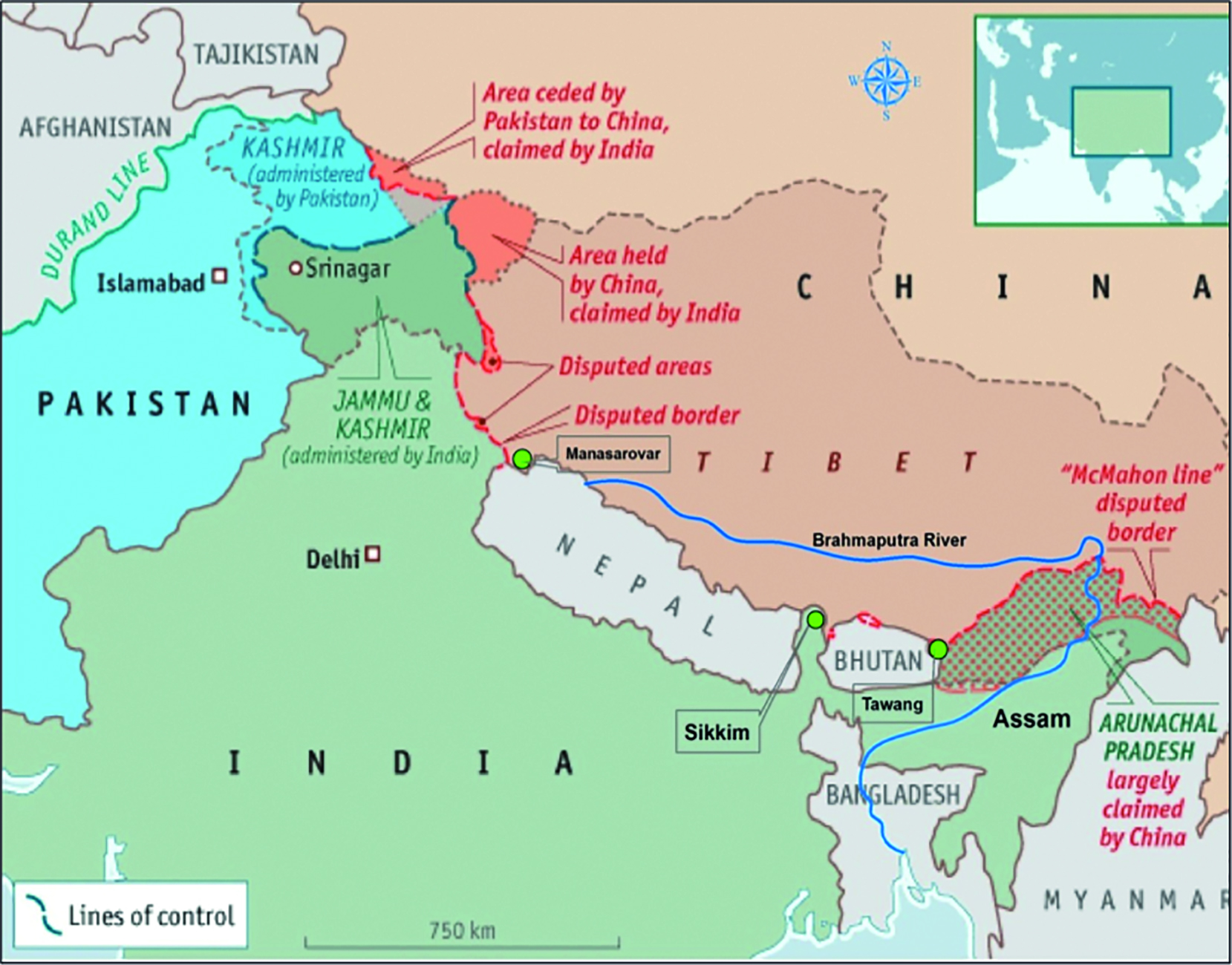
  • India–Nepal Relations


    Brief History of Kingdom Of Nepal

    Gorkha rule

    • After decades of rivalry between the medieval kingdoms, modern Nepal was reunified in the latter half of the 18th century, when Prithvi Narayan Shah, the ruler of the small principality of Gorkha, formed a unified country from a number of independent hill states. Prithvi Narayan Shah dedicated himself at an early age to the conquest of the Kathmandu Valley and the creation of a single state, which he achieved in 1768.
    • The country was frequently called the Gorkha Kingdom. It is a misconception that the Gorkhali took their name from the Gorkha region of Nepal; actually, the region was given its name after the Gorkhali had established their control of these areas.
    • After Shah’s death, the Shah dynasty began to expand their kingdom into much of South Asia. Between 1788 and 1791, during the Sino-Nepalese War, Nepal invaded Tibet and robbed Tashilhunpo Monastery in Shigatse. Alarmed, the Qianlong Emperor of the Chinese Qing Dynasty appointed Fuk’anggan commander-in-chief of the Tibetan campaign; Fuk’anggan defeated the Gorkhali army and halted their northward expansion.
    • After 1800, the heirs of Prithvi Narayan Shah proved unable to maintain firm political control over Nepal. A period of internal turmoil followed.
    • Rivalry between Nepal and the British East India Company over the princely states bordering Nepal and British-India eventually led to the Anglo-Nepalese War (1814–16), in which Nepal suffered a heavy defeat. The Treaty of Sugauli was signed in 1816, ceding large parts of the Nepali territories of Terai, (nearly one-third of the country), to the British.

    Rana rule

    Jung Bahadur Rana was the first ruler from this dynasty. Rana rulers were titled “Shri Teen” and “Maharaja”, whereas Shah Kings were “Shri Panch” and “Maharajdiraj”. Both the Rana dynasty and Shah Dynasty are Rajput caste in the Hindu tradition. Jung Bahadur codified laws and modernized the state’s bureaucracy.

    In the coup d’état of 1885, the nephews of Jung Bahadur and Ranodip Singh (the Shumsher J.B., S.J.B. or Satra Family) murdered Ranodip Singh and the sons of Jung Bahadur, stole the name of Jung Bahadur and took control of Nepal. Nine Rana rulers took the hereditary office of Prime Minister. All were styled (self proclaimed) Maharaja of Lamjung and Kaski.

    20th century

    • In December 1923 Britain and Nepal formally signed a “treaty of perpetual peace and friendship” superseding the Sugauli Treaty of 1816 and upgrading the British resident in Kathmandu to an envoy.
    • Slavery was abolished in Nepal in 1924.

    Revolution of 1951

    The revolution of 1951 started when dissatisfaction against the family rule of the Ranas had started emerging from among the few educated people, who had studied in various South Asian schools and colleges, and also from within the Ranas, many of whom were marginalized within the ruling Rana hierarchy.

    Many of these Nepalese in exile had actively taken part in the Indian Independence struggle and wanted to liberate Nepal as well from the autocratic Rana occupation. The political parties such as The Prajaparishad and Nepali Congress were already formed in exile by leaders such as B. P. Koirala, Ganesh Man Singh, Subarna Shumsher Rana, Krishna Prasad Bhattarai, Girija Prasad Koirala, and many other patriotic-minded Nepalis who urged the military and popular political movement in Nepal to overthrow the autocratic Rana Regime. Thus Nepali congress formed a military wing Nepali Congress’s Liberation Army Among the prominent martyrs to die for the cause, executed at the hands of the Ranas, were Dharma Bhakta Mathema, Shukraraj Shastri, Gangalal Shrestha, and Dasharath Chand.

    This turmoil culminated in King Tribhuvan, a direct descendant of Prithvi Narayan Shah, fleeing from his “palace prison” in 1950, to newly created country called India, touching off an armed revolt against the Rana administration. This eventually ended in the return of the Shah family to power and the appointment of a non-Rana as prime minister.

    A period of quasi-constitutional rule followed, during which the monarch, assisted by the leaders of fledgling political parties, governed the country. During the 1950s, efforts were made to frame a constitution for Nepal that would establish a representative form of government, based on a British model.

    Royal coup by King Mahendra

    • Declaring parliamentary democracy a failure, King Mahendra carried out a royal coup 18 months later, in 1960. He dismissed the elected Koirala government, declared that a “partyless” Panchayat system would govern Nepal, and promulgated another new constitution on December 16, 1960.
    • Subsequently, the elected Prime Minister, Members of Parliament and hundreds of democratic activists were arrested. (In fact, this trend of arrest of political activists and democratic supporters continued for the entire 30-year period of partyless Panchayati System under King Mahendra and then his son, King Birendra).
    • The new constitution established a “partyless” system of panchayats (councils) which King Mahendra considered to be a democratic form of government, closer to Nepalese traditions. As a pyramidal structure, progressing from village assemblies to a Rastriya Panchayat (National Parliament), the Panchayat system constitutionalized the absolute power of the monarchy and kept the King as head of state with sole authority over all governmental institutions, including the Cabinet (Council of Ministers) and the Parliament.
    • One-state-one-language became the national policy in an effort to carry out state unification, uniting various ethnic and regional groups into a singular Nepali nationalist bond. The Back to the Village National Campaign, launched in 1967, was one of the main rural development programs of the Panchayat system.
    • King Mahendra was succeeded by his 27-year-old son, King Birendra, in 1972. Amid student demonstrations and anti-regime activities in 1979, King Birendra called for a national referendum to decide on the nature of Nepal’s government: either the continuation of the panchayat system along with democratic reforms or the establishment of a multiparty system. The referendum was held in May 1980, and the panchayat system won a narrow victory. The king carried out the promised reforms, including selection of the prime minister by the Rastriya Panchayat.

    Multiparty parliament

    People in rural areas had expected that their interests would be better represented after the adoption of parliamentary democracy in 1990. The Nepali Congress with the support of “Alliance of leftist parties” decided to launch a decisive agitation movement, Jana Andolan, which forced the monarchy to accept constitutional reforms and to establish a multiparty parliament. In May 1991, Nepal held its first parliamentary elections in nearly 50 years. The Nepali Congress won 110 of the 205 seats and formed the first elected government in 32 years.

    Civil strike

    • In 1992, in a situation of economic crisis and chaos, with spiraling prices as a result of the implementation of changes in policy of the new Congress government, the radical left stepped up their political agitation. A Joint People’s Agitation Committee was set up by the various groups. A general strike was called for April 6.
    • Violent incidents began to occur on the evening before the strike. The Joint People’s Agitation Committee had called for a 30-minute ‘lights out’ in the capital, and violence erupted outside Bir Hospital when activists tried to enforce the ‘lights out’. At dawn on April 6, clashes between strike activists and police, outside a police station in Pulchok (Patan), left two activists dead.
    • Later in the day, a mass rally of the Agitation Committee at Tundikhel in the capital Kathmandu was attacked by police forces. As a result, riots broke out and the Nepal Telecommunications building was set on fire; police opened fire at the crowd, killing several persons. The Human Rights Organisation of Nepal estimated that 14 persons, including several onlookers, had been killed in police firing.
    • When Promised Land reforms failed to appear, people in some districts started to organize to enact their own land reform and to gain some power over their lives in the face of usurious landlords. However, this movement was repressed by the Nepali government, in “Operation Romeo” and “Operation Kilo Sera II”, which took the lives of many of the leading activists of the struggle. As a result, many witnesses to this repression became radicalized.

    Nepalese Civil War

    In February 1996, the Communist Party of Nepal (Maoist) started a bid to replace the parliamentary monarchy with a people’s new democratic republic, through a Maoist revolutionary strategy known as the people’s war, which led to the Nepalese Civil War. Led by Dr. Baburam Bhattarai and Pushpa Kamal Dahal (also known as “Prachanda”), the insurgency began in five districts in Nepal: Rolpa, Rukum, Jajarkot, Gorkha, and Sindhuli. The Communist Party of Nepal (Maoist) established a provisional “people’s government” at the district level in several locations.

    On June 1, 2001, Prince Dipendra went on a shooting-spree, assassinating 9 members of the royal family, including King Birendra and Queen Aishwarya, before shooting himself. Due to his survival he temporarily became king before dying of his wounds, after which Prince Gyanendra (Birendra’s brother) inherited the throne, according to tradition. Meanwhile, the rebellion escalated, and in October 2002 the king temporarily deposed the government and took complete control of it. A week later he reappointed another government, but the country was still very unstable.

    In the face of unstable governments and a siege on the Kathmandu Valley in August 2004, popular support for the monarchy began to wane. On February 1, 2005, Gyanendra dismissed the entire government and assumed full executive powers, declaring a “state of emergency” to quash the revolution. Politicians were placed under house arrest, phone and internet lines were cut, and freedom of the press was severely curtailed.

    The king’s new regime made little progress in his stated aim to suppress the insurgents. Municipal elections in February 2006 were described by the European Union as “a backward step for democracy”, as the major parties boycotted the election and some candidates were forced to run for office by the army.

    In April 2006 strikes and street protests in Kathmandu forced the king to reinstate the parliament. A seven-party coalition resumed control of the government and stripped the king of most of his powers. As of 15 January 2007, Nepal was governed by an unicameral legislature under an interim constitution. On December 24, 2007, seven parties, including the former Maoist rebels and the ruling party, agreed to abolish the monarchy and declare Nepal a Federal Republic. In the elections held on 10 April 2008, the Maoists secured a simple majority, with the prospect of forming a government to rule the proposed ‘Republic of Nepal’.

    Federal Democratic Republic

    On May 28, 2008, the newly elected Constituent Assembly declared Nepal as Federal Democratic Republic, abolishing the 240-year-old monarchy. The motion for abolition of monarchy was carried by a huge majority; out of 564 members present in the assembly, 560 voted for the motion while 4 members voted against it.

    Finally, on June 11, 2008, King Gyanendra left the palace. Ram Baran Yadav of the Nepali Congress became the first president of the Federal Democratic Republic of Nepal on July 23, 2008. Similarly, Pushpa Kamal Dahal, popularly known as Prachanda, of the Unified Communist Party of Nepal (Maoist) was elected as the first Prime Minister on August 15, 2008, defeating Sher Bahadur Deuba of the Nepali Congress Party.

    After failure to draft a constitution before the deadline, the existing constitution constituent assembly was dissolved and new interim government was formed under prime-minister-ship of Supreme Court judge. The election was held and Nepali Congress won the election largest votes but still failed to get a majority.

    A conclusion was reached to form a coalition government between UML and Nepali Congress and Sushil Koirala of Nepali Congress was elected as Prime-minister with support from UML.

    Importance of Nepal for India

    Nepal importance for India can be classified under following heads:

    POLITICAL

    • Important cog in the pursuit of regional integration & cooperation viz. bay of Bengal initiative for multi-sectoral technical & economic cooperation(BIMSTEC),Bangladesh, Bhutan, India, Nepal(BBIN) initiative.
    • Vindicate the prudence of Gujral doctrine & exhort the continuance of the same vis-à-vis other neighbors.
    • Comprises large sections of Madhesi population which has familial & ethnic ties with states of Bihar, UP. Thus any mishap on either side has significant political repercussions

    SECURITY

    • Both nations share an open & porous border which makes India extremely vulnerable to any major agitations, revolts that can lead to huge influx of people.
    • other threats emanating from open border-insurgency, trafficking, counter-fiet currency flow, drugs smuggling
    • Nepal shares a long open border with India. There is alleged link between Naxalits and Maoist in Nepal thus coordination with Nepal is important to check the spread of naxalism in the red corridor.
    • To counter terrorist activities close to border areas: Many hard core terrorists had been apprehended in Nepal close to India’s border.

    STRATEGIC

    • Nepal is a buffer state between India and china. Buffer state is a small neutral country situated between two larger hostile countries and serving to prevent the outbreak of regional conflict.
    • By virtue of 1950 treaty provisions, India & Nepal jointly man Nepal-Tibet border.
    • Significant Gorkha regiments of Indian army trace their roots to Nepali Gorkha ethnicity.

    ECONOMIC

    • India is the largest exporter of petroleum products, thus Nepal forms one of the reliable export markets
    • India is the largest destination of Nepalese migrant which over a period of time has assimilated in our social milieu & are contributing to the Indian economy
    • Numerous Himalayan rivers flowing into the Nepal presents significant opportunity for joint power project development for hydropower generation. This can bring economic prosperity to border states like Bihar,UP

     CULTURAL

    • Important Landmarks of Buddhism(eg lumbini) is located in Nepal which foregrounds its cultural significance to India.
    • Nepal constitutes a significant pillar in furthering its diplomatic outreach in south Asia by completing Buddhist circuit that covers lumbini-bodh gaya-sarnath-kusinagar In all, Nepal shares a multidimensional relationship with India whose degree of success is significant for India’s rise in the region & large

    Background of Indo-Nepal Relations

    Indian strategists and policy makers consider Nepal as critical to India’s security. The British Indian Empire saw Nepal as the buffer with China and after 1947 India continued with that policy. Any signs of close ties between Nepal and China are anathema to New Delhi.

    While Nepal and India have close historical, religious and cultural ties, Nepal’s strategic ties with India date back to the Treaty of Sugauli of 1816 which was signed between the Nepalese monarch and the British East India Company.

    As per the treaty, large parts of the Nepalese kingdom (including parts of present day Uttaranchal, Himachal Pradesh and Sikkim) were annexed by the British empire, a British resident was stationed at Kathmandu, Nepal agreed to refer to the British with respect to its foreign policy and Gorkhas were recruited in large numbers by the British for military service. Nepal regained some of the lost territory when the monarch helped the British during the 1857 uprising. However, even today Nepal lays claim to certain parts of Indian territory, like Kalapani, along the India-Nepal border.

    1950–1970

    In the 1950s, the Rana rulers of Nepal welcomed close relations with India. Rana rule in Nepal however collapsed within 3 months of signing the PFT. As the number of Indians living and working in Nepal’s Terai region increased and the involvement of India in Nepal’s politics deepened in the 1960s and after, so too did Nepal’s discomfort with the special relationship. India’s influence over Nepal increased throughout the 1950s.

    The Nepalese Citizenship Act of 1952 allowed Indians to immigrate to Nepal and acquire Nepalese citizenship with ease—a source of huge resentment in Nepal (This policy was not changed until 1962 when several restrictive clauses were added to the Nepalese constitution).

    Also in 1952, an Indian military mission was established in Nepal. At the same time, Nepal’s dissatisfaction with India’s growing influence began to emerge, and overtures to China were initiated as a counterweight to India.

    Treaty of Peace and Friendship, 1950:

    Background of the treaty

    The Himalaya Nation of Nepal borders northern India in the south, east and west. During British rule in India, Nepal’s ties with the British Government were governed by the 1816 Treaty of Sugauli that was replaced by the 1923 “Treaty of perpetual peace and friendship”. After the independence of India in 1947, the two nations sought to forge close strategic, commercial and cultural relations.

    The rise of Communist China in 1949 and the subsequent invasion of Tibet heightened security concerns in both India and Nepal — while India had maintained good relations with Tibet, the Rana rulers of Nepal feared that China would support the Communist Party of Nepal and sponsor a communist revolution overthrowing their autocratic regime. With heightening concerns over the security threat to India presented by Communist China, which was seen as seeking to projecting power and influence over Nepal, Sikkim and Bhutan and border disputes with India, the latter sought to strengthen its “Himalayan frontier” by forging an alliance on defense and foreign affairs with the Rana rulers of Nepal

    Key Provisions of the treaty

    The India-Nepal Treaty of Peace and Friendship was signed by the last Rana Prime Minister of Nepal, Mohan Shamsher Jang Bahadur Rana, and the Indian Ambassador to Nepal, Chandreshwor Narayan Singh on 31 July 1950 and came into force the same day. It has ten articles.

    • The treaty provides for everlasting peace and friendship between the two countries and the two governments agree mutually to acknowledge and respect the complete sovereignty, territorial integrity and independence of each other.
    • As per Articles 6 and 7, the two governments agree to grant, on a reciprocal basis, to the nationals of one country in the territories of the other, the same privileges in the matter of residence, ownership of property, participation in trade and commerce, movement and other privileges of a similar nature. This enables Nepali and Indian citizens to move freely across the border without passport or visa, live and work in either country and own property or conduct trade or business in either country. There are a large number of Indians living, owning property and working or doing business in Nepal as a beneficial aspect of the treaty for India. Reciprocally, many Nepalese live, own property and conduct business freely in India.
    • For centuries, Nepal remained in self-imposed isolation. After the 1860 treaty with the East India Company, Prime Minister Jung Bahadur Rana of Nepal allowed Indians to purchase and sell land in Nepal’s Terai. After the ascent of Mt. Everest by Edmund Hillary and Tenzing Norgay, Nepal completely lifted its ban on foreigners.
    • The King of Nepal enacted the Citizenship Act of 1952 that allowed Indians to emigrate to Nepal and acquire Nepalese citizenship. But as more and more Indian immigrants from Bihar started acquiring Nepalese citizenship, most Nepalese became resentful of this provision.
    • It was clearly provided in the Treaty that, “neither government shall tolerate any threat to the security of the other by a foreign aggressor,” and the two countries promised to “consult each other and device effective counter-measures” in case of any threat from a third country. Nepal would ordinarily purchase war equipment from India.
    • The treaty provided that Nepal would consult India before buying war material from any other country. After such consultation Nepal would “import from or through the territory of India, arms, ammunitions, or warlike material and equipment necessary for the security of Nepal.” Indo-Nepalese relations have been based on this treaty.

    Following the 1962 Sino-Indian border war, the relationship between Kathmandu and New Delhi thawed significantly. India suspended its support to India-based Nepalese opposition forces which India had been doing in violation of 1950’s PFT, which clearly stated ‘not to allow any country’s soil to be used against the other’.

    The defeat of Indian forces in 1962 provided Nepal with the breathing space and Nepal extracted several concessions, including transit rights with other countries through India. In exchange, through a secret accord concluded in 1965, similar to an arrangement that had been suspended in 1963, India won a monopoly on arms sales to Nepal.

    In 1969 relations again became stressful as Nepal challenged the existing mutual security arrangement and asked that the Indian security checkposts and liaison group be withdrawn. Resentment also was expressed against the Treaty of Peace and Friendship of 1950. India withdrew its military checkposts and liaison group, although the treaty was not abrogated.

    1970–1980

    Tensions came to a head in the mid-1970s, when Nepal pressed for substantial changes in the trade and transit treaty and openly criticized Sikkim’s 1975 annexation by India. In 1975 King Birendra Bir Bikram Shah Dev against the backdrop of Indian annexation of Nepal’s close neighbor ‘The Kingdom of Sikkim’ proposed Nepal to be recognized internationally as a ‘Zone of Peace’ where military competition would be off limits.

    Nepal’s proposal received support from China and Pakistan but not from India In New Delhi’s view, if the king’s proposal did not contradict the 1950 treaty that the-then Indian government had signed with the Rana rulers of Nepal, it was unnecessary; if it was a repudiation of the special relationship, it represented a possible threat to India’s security and could not be endorsed. In 1984 Nepal repeated the proposal, but there was no reaction from India. Nepal continually promoted the proposal in international forums and by 1990 it had won the support of 112 countries including the USA, the UK, and France.

    In 1978 after the formal acknowledgement of the Himalayan Kingdom of Sikkim being an Indian state by Nepal, India agreed to separate trade and transit treaties, satisfying a long-term Nepalese demand. However, much to the annoyance of Nepalese government and in continued violation of the 1950s PFT, India consistently allowed the opposition parties of Nepal to use Indian soil to launch agitation against the Nepalese government and refused to endorse Nepal as a Zone of Peace.

    In 1987 India urged expulsion of Nepalese settlers from neighboring Indian states that led to expulsion of thousands of Nepali-speaking people from Meghalaya, and Nepal tried to retaliate by introducing a work permit system for Indians working in Nepal but the Nepalese government failed to implement the provision because of the protest from Madheshis.

    In 1988, when two treaties were up for renewal, Nepal refused to accommodate India’s wishes for a single trade and transit treaty stating that it violates the principle of freedom to trade. Thereafter, both India and Nepal took a hard-line position that led to a serious crisis in India–Nepal relations.

    Nepalese leaders asserted the position that as per the UN charter, transit privileges were “a fundamental and a permanent right of a land-locked country” and thus India’s demand for a single treaty was unacceptable. So, after two extensions, the two treaties expired on 23 March 1989, resulting in a virtual Indian economic blockade of Nepal that lasted until late April 1990.

    As time passed Indian economic sanctions over Nepal steadily widened. For example, preferential customs and transit duties on Nepalese goods entering or passing through India (whether imports or exports) were discontinued. Thereafter India let agreements relating to oil processing and warehouse space in Calcutta for goods destined to Nepal expire. Aside from these sanctions, India cancelled all trade credits it had previously extended to Nepal on a routine basis.

    To withstand the renewed Indian pressure, Nepal undertook a major diplomatic initiative to present its case on trade and transit matters to the world community. The relationship with India was further strained in 1989 when Nepal decoupled its rupee from the Indian rupee which previously had circulated freely in Nepal.

    India retaliated by denying port facilities in Calcutta to Nepal, thereby preventing delivery of oil supplies from Singapore and other sources. In historian Enayetur Rahim’s view, “the economic consequences of the dispute… were enormous. Nepal’s GDP growth rate plummeted from 9.7% in 1988 to 1.5% in 1989. This had a lot to do with the decreased availability of goods. Shortly after the imposition of sanctions, Nepal experienced serious deficiencies of important goods such as coal, fuel, oil, medicine and spare parts. Nepal also suffered economically from higher tariffs, the closure of border points and the tense political atmosphere.

    From one of the most thriving economies in Asia, Nepal was now quickly finding itself in the league of World’s poorest nation.” Although economic issues were a major factor in the two countries’ confrontation, Indian dissatisfaction with Nepal’s decision to impose work permits over Indians living in Nepal and Nepal government’s attempt to acquire Chinese weaponry in 1988 played an important role.

    India linked security with economic relations and insisted on reviewing India–Nepal relations as a whole. After failing to receive support from wider international community, Nepalese government backed down from its position to avoid the worsening economic conditions.

    Indian government, with the help of Nepalese opposition parties operating from India, managed to bring a change in Nepal’s political system, in which the king was forced to institute a parliamentary democracy. The new government, led by pro-India parties, sought quick restoration of amicable relations with India.

    1990s

    The special security relationship between New Delhi and Kathmandu was re-established during the June 1990 New Delhi meeting of Nepal’s prime minister Krishna Prasad Bhattarai and Indian prime minister V.P. Singh, after India ended its 13-month-long economic blockade of Nepal. During the December 1991 visit to India by Nepalese prime minister Girija Prasad Koirala, the two countries signed new, separate trade and transit treaties and other economic agreements designed to accord Nepal additional economic benefits.

    Indian-Nepali relations appeared to be undergoing still more reassessment when Nepal’s prime minister Man Mohan Adhikary visited New Delhi in April 1995 and insisted on a major review of the 1950 peace and friendship treaty which Nepal believed was enabling an ongoing demographic shift in Nepal’s Terai region.

    In the face of benign statements by his Indian hosts relating to the treaty, Adhikary sought greater economic independence for his landlocked nation while simultaneously striving to improve ties with China.

    In June 1990, a joint Kathmandu-New Delhi communique was issued pending the finalisation of a comprehensive arrangement covering all aspects of bilateral relations, restoring trade relations, reopening transit routes for Nepal’s imports, and formalising respect of each other’s security concerns.

    Essentially, the communiqué announced the restoration of the status quo ante and the reopening of all border points, and Nepal agreed to various concessions regarding India’s commercial privileges. Kathmandu also announced that lower cost was the decisive factor in its purchasing arms and personnel carriers from China and that Nepal was advising China to withhold delivery of the last shipment.

    21st century

    In 2005, after King Gyanendra took over, Nepalese relations with India soured. However, even after the restoration of democracy, in 2008, Prachanda, the Prime Minister of Nepal, visited India, in September 2008 only after visiting China, breaking the long held tradition of Nepalese PM making India as their first port-of-call. When in India, he spoke about a new dawn, in the bilateral relations, between the two countries. He said, “I am going back to Nepal as a satisfied person. Iwill tell Nepali citizens back home that a new era has dawned. Time has come to effect a revolutionary change in bilateral relations. On behalf of the new government, I assure you that we are committed to make a fresh start.”

    In 2006, the newly formed democratic parliament of Nepal passed the controversial citizenship bill that led to distribution of Nepalese citizenship to nearly 4 million stateless immigrants in Nepal’s Terai by virtue of naturalisation. While the Indian government welcomed the reformed citizenship law, certain section of Nepalese people expressed deep concerns regarding the new citizenship act and feared that the new citizenship law might be a threat to Nepalese sovereignty. The citizenship bill passed by the Nepalese parliament in 2006 was the same bill that was rejected by Late King Birendra in 2000 before he along with his entire family was massacred. Indian government formally expressed sorrow at the death of Late King Birendra of Nepal.

    In 2008, Indo-Nepal ties got a further boost with an agreement to resume water talks after a 4-year hiatus. The Nepalese Water Resources Secretary Shanker Prasad Koirala said the Nepal-India Joint Committee on Water Resources meet decided to start the reconstruction of the breached Koshi embankment after the water level went down. During the Nepal PM’s visit to New Delhi in September the two Prime Ministers expressed satisfaction at the age-old close, cordial and extensive relationships between their states and expressed their support and co-operation to further consolidate the relationship.

    The two issued a 22-point statement highlighting the need to review, adjust and update the 1950 Treaty of Peace and Friendship, amongst other agreements. India would also provide a credit line of up to 150 crore rupees to Nepal to ensure uninterrupted supplies of petroleum products, as well as lift bans on the export of rice, wheat, maize, sugar and sucrose for quantities agreed to with Nepal. India would also provide 20 crore as immediate flood relief.In return, Nepal will take measures for the “promotion of investor friendly, enabling business environment to encourage Indian investments in Nepal.”

    In 2010 India extended a Line of credit worth US$50 million & 80,000 tonnes of foodgrains. Furthermore, a three-tier mechanism at the level of ministerial, secretary and technical levels will be built to push forward discussions on the development of water resources between the two sides. Politically, India acknowledged a willingness to promote efforts towards peace in Nepal. Indian External affairs minister Pranab Mukherjee promised the Nepali Prime Minister Prachanda that he would “extend all possible help for peace and development.”

    Issues and Concerns:

    Political

    • Anti-India feeling in Nepal is largely politically motivated and has been present since the re-installation of monarchy in 1951. The monarchy used anti-Indianism as a rallying point, both to create a popular support-base for itself and to generate a sense of national unity amongst the people. The Nepalese monarchy viewed India’s latent support for democracy with suspicion, even though it benefited immensely from such policies, because they led to removal of the Ranas. In fact, over the years, both the monarch and the democratic forces have looked at India with suspicion, given their own interests. China has been seen as a potential support and as a countervailing force vis-à-vis India.
    • Interestingly, the anti-India feeling among certain ethnic groups in Nepal emanates from the perception that India is still backing the monarchy clandestinely. On several occasions, both the right- and leftwing political forces in Nepal (the royalists, communists and the Maoists) have generated anti-Indian sentiment for their own political benefit.
    • Since the 1990s, these elements have been frequently using the Treaty of Peace and Friendship between India and Nepal signed in 1950, as well as the Kosi, Gandaki and Mahakali Treaties, the alleged border encroachments by India, poor treatment of Nepalese workers in India, and unresolved trade issues to foment anti-India feeling for their political benefit. Even many Kathmandu-based intellectuals and journalists indulge in anti-India rhetoric to get monetary benefits from external agencies known for their adversarial position towards India.
    • Interestingly, this trend has reached new heights since the decline of monarchy in 2006 and emergence of the Communist Party of Nepal- Maoist (CPN-M) as the largest party in the Constituent Assembly (CA) elections in 2008. While this phenomenon was earlier confined to the elites in Kathmandu, it is now also being reflected in rural areas. Some Nepal army officers and the royalists believe that India is responsible for the end of the monarchy and the rise of the Maoists.
    • Senior officers in the Nepal Army point to the fact that India’s refusal to supply arms in 2005 after the royal coup d’état indirectly strengthened the Maoists.
    • On the other hand, the Maoists accuse India of not letting them come to power and also hold it responsible for the political instability in Nepal and delay in the drafting of the Constitution. The most popular narrative in Nepal at present is that Indian bureaucrats, including those from RAW and IB, are responsible for the political instability in Nepal.
    • The treaty of Peace and Friendship is called unequal by most Nepalese as Nepalese law does not permit an open border and Indians, by law, should not be able to buy lands and properties in Nepal or carry out businesses in their names.
    • They claim that the 1950 treaty was signed by undemocratic rulers of Nepal and can be scrapped by a one-year notice. The treaty has been unpopular especially among Pahari segments of Nepal, who often regard it as a breach of its sovereignty.
    • Nepal was a greater sovereign country before the East India Company’s impact on its freedom; the lands which were given to the East India Company according to the Sugauli Treaty must be returned to Nepal, because after the freedom proclamation in India, Nepalese lands should also be handed over Nepali people. Beneath this, agreements were manipulated in the favor of antidemocratic autocratic rule of Nepal where the power of the Nepali people is fragmented


    Economic

    • Economic factors also add to the growing anti-Indianism. This phenomenon is especially noticeable in the rural areas. Every day, thousands of unskilled labourers from mid-western Nepal cross the Indian border in search of jobs and are harassed in various ways (inhuman living conditions, lower wages than their Indian counterparts,ill-treatment by employers, generalization of Nepalese as gatekeepers, and misbehavior by security force [SF] personnel while crossing the border and at airports).
    • When they share these experiences with their fellow villagers, it inevitably gives rise to a negative perception of India. In fact, many retired Gurkha soldiers from rural areas also narrate instances of harassment by Indian officers for retirement benefits. These voices were perhaps muted during the monarchy. However, with the emergence of the Maoists, who are perceived as a strong ‘pro-people’ party with the courage to stand up to India, these views are being expressed more openly. Another factor could be opening up of alternative job markets, other than India, for the Nepalese population.
    • This has, to some extent, emboldened the Nepalese people to express their views openly against India. India’s decision, in March 1989, to close all the border transit points except four in response to Chinese arms supplies is often cited as an example of Indian high-handedness. As far as bilateral economic relations are concerned, firstly, the growing trade imbalance between the two countries has led some political leaders, economists and traders to allege that this is a deliberate strategy by India to keep Nepal poor.
    • Despite a revised trade treaty in 2009 between two countries, Nepalese traders have often complained that India has not complied with the list of Nepali-manufactured goods that were given duty-free access on a non-reciprocal basis in accordance with the trade treaty in 1996. Nepal’s other major concern has been the non-tariff barriers on sanitary and phyto-sanitary measures (SPS) imposed by India.
    • Secondly, Nepal is unable to export pharmaceutical products because these companies are denied registration in India.
    • Thirdly, India does not allow Nepali entrepreneurs to send their machineries for repair and maintenance after three years of their import.
    • Fourthly, Nepalese exporters are concerned about the restrictions on the export of industrial by-products, poor infrastructural facilities at the borders, congestion and delay while importing cargo from Kolkata port, and India’s decision regarding the double seals on Nepali cargo coming via Kolkata port.


    The Issue of Water and Hydropower Cooperation

    Water has been a contentious issue between the two countries because of the controversies surrounding the water treaties on Kosi, Gandak and Mahakali . As a result, Indian investors in the hydropower sector in Nepal face problems on several counts.

    There is a sentiment in Nepal that India has cheated Nepal in those treaties and Nepal’s natural resources have been sold out without taking into account its interests. Deepak Gyawali has observed that in the case of Kosi and Gandak treaties, Nepal can do nothing as all management powers have been retained by the Indian side. Despite the chronic power/electricity shortage, large sections of Nepalese, including Kathmandu-based intellectuals, are not satisfied with the level of investment made by India in the

    hydro-power sector. The Nepalese perceive that the benefits from these investments may not accrue to them.

    Social

    Familiarity breeds contempt. Due to strong cultural linkages, certain sections in Nepal feel insecure about the demand for a separate Madheshi region. The Madheshis are commonly regarded as people of Indian origin and hence regarded as a pro-Indian constituency in Nepal.

    There is a suspicion amongst the Pahadis and major political leaders in Nepal that India is out to balkanise Nepal. Reportedly, during 2002-2004, India attempted to give a political colour to Madheshi grievances which encouraged Madheshis to organise themselves politically.

    As part of this initiative, the Nepal India Friendship Association was reportedly formed with the active support of India and some development projects funded by India were diverted to the Terai region to nurture this constituency. The Madheshis, on the other hand, believe that India’s policy towards Nepal is Kathmandu centric.They accuse India of neglecting the Madheshi movement. Upendra Yadav stated in a published Interview: India, especially South Block and the Indian Embassy, have been against the Madhesh and MJF. They created the TMLP [Tarai-Madhesh Loktantrik Party] to weaken us. In fact, one of the reasons the pre election alliance did not happen was because India was trying to boost up TMLP

    Role of External Forces

    The role of external powers in fomenting anti-India feelings in Nepal has not been investigated so far. There are reports that both China and Pakistan are providing financial support to media houses who add fuel to the anti-India fire in Nepal. Pakistan has made its presence felt in Nepal since the 1960s and its intelligence agencies have used Nepalese territory to export terror to India, taking advantage of the open border between India and Nepal. Therefore, Pakistan’s ability to foment anti-Indianism through sponsorship should not be underestimated. Some Madheshi leaders indicated to the author that due to growing anti-India feelings in the Madheshi region, China, US and other countries have been trying to build their constituencies in the region.

    Some analysts in Nepal admitted that the Nepalese often shared their resentment against India with officials from the Western embassies in Kathmandu.

    There is a common view in Nepal that India’s insensitivity or overreaction to Nepal’s assertions of sovereignty (even when they do not affect legitimate Indian interests) has fuelled anti Indianism over the years.

    Geographical Issues: The Case of Open Borders

    • The 1950 Treaty and the unsettled border disputes at Kalapani and Susta have contributed substantially to the anti-Indian sentiments in Nepal. The issue of open borders has also been a point of debate in Nepal in recent years.
    • A large section of people in Nepal believe that the open border is a historically unique arrangement. It symbolises the deep trust and friendship between the two countries. The livelihood of thousands of economically backward people on both side of border depends on the open border. Contrary to the belief in India, the Nepalese people argue that the India is benefiting more from it than Nepal. The fact remains that the Nepalese farmers benefit from the cheaper agricultural inputs and household products from India while the Indians benefit from better medical facilities and cheaper education in medical colleges across the Nepalese border.
    • Given the socio-cultural linkages, the open border helps in cementing ties between peoples of the two countries. The open border and 26 transit points reduce the time and cost of the transportation of goods from India to Nepal.
    • Thousands of Nepalese workers, who send remittances to Nepal, cross the border without any documents at any point of the border in search of jobs. Quoting a survey report conducted by the World Food Programme (WFP) and the EU, some commentators point out: ‘Thirty nine per cent of Nepal’s total households with one or more migrants have India as their destination.
    • On the Indian side, availability of Nepalese labour takes care of the labour scarcity in different parts of India. Considering these challenge, both the countries have formed a joint Border Monitoring Committee and deployed their security forces along the borders.
    • However, given the political instability in Nepal, these mechanisms are not sufficient. The infrastructure for patrolling and management of the border is very poor. The joint patrolling arrangement is not operational at this moment. Both sides believe that there should be some regulation of the border but there are also other views.
    • One section in Nepal, including the Maoists, argues that the open border has been responsible for the underdevelopment of Nepal and that it should be closed. On the contrary, people living in the border districts of Nepal feel that it should be regulated and kept open.

    Psychological

    There is also a psychological factor at play the asymmetry in size between the two countries. Nepal feels vulnerable and insecure because it is landlocked, and its sense of insecurity is ironically fuelled by the very cultural affinities which are also touted as a great asset in the relationship. Trailokya Raj Aryal argued in an analytical piece in Republica on April 25, 2010: ‘With so many similarities between Nepal and India, naturally, Nepal had no other options but to contrast itself with India.

    Recent development in bilateral relations

    The Recent Visit of Prime Minister Narendra Modi

    • In a first in the last 17 years, Prime Minister Narendra Modi’s two day visit to Nepal, marked a new beginning in Indo-Nepal relations. Publicity of the visit to Nepal was taking a momentum after Sushma Swaraj, the Foreign Minister of India, visited Nepal as a preparation for the schedule.
    • The reception event itself in the international airport could be perceived as a revealing example of how much enthusiastic the Nepalese Parliamentarians and political leaders were towards their guest. Against the international protocol, Sushil Koirala, the Prime Minister of Nepal, came to airport himself to receive his Indian counterpart.
    • The Prime Minister of India expressed his commitment to Nepal’s development and promised to take all necessary steps to take the relations to a new height. Moreover, with repeated emphasis on sovereignty and assurance of non-interference in internal affairs of Nepal, a successful attempt was made to make it clear, both in words and spirit, about India’s intention and dispelling the image of the country as a hegemonic power to a certain extent.
    • The willingness of India to revise the 1950 Treaty of Peace and Friendship was showcased and clearly stated and a statement to this effect was made that India is ready to consider suggestions from government of Nepal, if any, to review the treaty.
    • Nepal considers the treaty, unequal, and in the past, has raised the issue of revision of treaty and tried to place it as a key agenda in bilateral talks, but without any suggestions. Nepal’s reservation to the 1950 Treaty is primarily based on the premise that the treaty weakens its ability to practice, sovereign foreign and security policy. Now it is for Kathmandu, to take up the offer and undertake necessary action to initiate the negotiations for a change.
    • The Prime Minister extended his support to Nepalese constitution makers and political leaders and conveyed best wishes of the government and people of India to the Nepalese leadership and people for their commitment to promulgate the new constitution by early next year. Nepal is facing constitutional crisis since the Constituent Assembly was dissolved without drafting a new constitution in 2012. It was hoped that the Constituent Assembly would draft a constitution to support federal and democratic political structure and promote equality in the country.
    • The address by the Indian Prime Minister to the Constituent Assembly of Nepal was appreciated by Nepalese leaders, across the political spectrum. Interestingly, Pushpa Kumar Dahal alias Prachanda, chairman of the United Communist Party of Nepal-Maoist (UCPNM), who has been a strong critic of India, praised Prime Minister Modi for his touching, inspiring and encouraging speech and expressed confidence that, a new chapter has begun in Indo Nepal relations.
    • A joint statement issued at the end of the visit clearly underlined the need to explore ways to enhance economic and trade cooperation. The Indian Prime Minister outlined the new concept of HIT-to help Nepal through development of Highway, Information technology and Transmission lines for electricity (H. I. T.).
    • The dilapidated condition of roads in Indo-Nepal frontier region, huge gap of demand and supply of electricity in bordering states and poor and pathetic state of communication networks in Nepal and border areas of Indian side need steps to improve the condition of roads, information ways and electricity on a priority basis. Nepal has approximately 83,000 megawatts (MW) of potential hydroelectricity capacity, out of which about 40,000 MW is technically and economically feasible, offering significant export potential and, obviously, a great opportunity to gain huge sum of foreign exchange.
    • Concerned over stalled projects, it was urged by the Indian side that the 5600 MW Pancheswar multipurpose project on Mahakali River should be initiated quickly. According to a joint statement issued at the end of the visit both sides expressed desire for early conclusion of other three Project Development Agreements (PDA), namely Arun III, Upper Marsyangdi and Tamakoshi III.
    • The joint statement reaffirmed the commitment of the respective governments, not to allow their territories to be used against each other. Despite repeated assurances, both sides have not succeeded to reduce the misuse of open border by transnational criminals.
    • To reduce the trans-border crime, both countries need to develop an effective joint border management system. Situation along the border can be improved through constant vigilance, joint patrolling and creation of joint task force to combat the transnational crimes.
    • Aiming to improve cross border trade and transit, both countries are planning to construct border railways along all five agreed border points and the four Integrated Check Posts (ICP’s). According to the Joint statement, two Prime Ministers directed competent officials to expedite construction of cross border railway. This is a welcome step which must be appreciated. Improved infrastructures of roads and railways in Indo-Nepal frontier region would complement India’s vision of greater economic engagement with Nepal.

    Comment

    The visit opened a fresh chapter in Indo-Nepal relations. By endorsing the idea of federal and democratic republic, the Indian Prime Minister dispelled fears in Nepal that the new government in India might work for the restoration of monarchy. His momentous speech in Nepal’s Parliament won the hearts and minds of Nepalese.

    Both countries endorsed new developmental projects, showed their willingness to improve the peace and security at border, promised to improve border infrastructure, and expressed concern over the slow pace of implementation of many projects. In fact, a momentum has already been generated in Indo-Nepal relations and it must be continued with better follow up and implementations

    Nepal Earthquake & India’s assistance

    • When a devastating 7.8 magnitude earthquake struck Nepal, the Government of India swiftly dispatched National Disaster Response Force (NDRF) teams and special aircrafts with rescue and relief materials to Nepal.
    • The total Indian relief assistance to Nepal amounted to approx. US$ 67 million.
    • At an International Donors’ Conference organized by the Government of Nepal in Kathmandu on 25 June 2015 towards post-earthquake reconstruction, India announced Indian assistance of US$ 1 billion to Nepal, one-fourth of which would be as grant.

    Nepal PM visit to India

    Nepal’s Prime Minister K.P. Sharma Oli paid his first state visit to India. In accordance with tradition, Mr. Oli made India his first destination abroad after becoming Prime Minister in October 2015. India and Nepal signed seven agreements.

    List of the agreements

    • MoU on utilisation of USD 250 million grant component of Government of India’s assistance package for post-earthquake reconstruction assistance to Nepal:
    • The MoU includes four sectors — housing, health, education and cultural heritage have been identified. MoU on strengthening of road infrastructure in Tarai area of Nepal:
    • MoU between Nepal Academy of Music and Drama and Sangeet Natak Academy∙ This MoU aims to enhance relations between India and Nepal in the field of performing arts through∙ exchanges of experts, exponents, dancers, scholars and intellectuals.

    Letters of Exchange on Transit Routes:

    • Transit between Nepal and Bangladesh through Kakadbhitta-Banglabandh corridor aims at simplification of modalities for traffic of goods between Nepal and Bangladesh while transiting through India, through the Kakadbhitta (Nepal) and Banglabandha (Bangladesh) corridor.
    • Operationalisation of Vishakhapatnam Port would provide transit facilities for Nepal through the Vishakhapatnam port.
    • Inauguration of Muzaffarpur-Dhalkebar transmission line
    • Establishment of Eminent Persons Group
    • At the third meeting of the India-Nepal Joint Commission held at Kathmandu in July 2014, it was decided to establish an Eminent Persons Group (EPG). Its mandate would be to comprehensively review bilateral relations and recommend measures including institutional frameworks to further enhance bilateral ties.

    Significance of visit

    In August 2015, Nepal adopted new constitution since then there is continuous blocked at the indo-Nepal border by Madhesi. Nepal-India tensions spiked last year with the promulgation of a constitution that was perceived as non-inclusive of ethnic Madhesi and Tharu groups.

    The Nepal government accused India for imposing the blockade that led to a severe humanitarian crisis in Nepal. The Nepali government alleged that the Indian government had encouraged the blockade to apply leverage on Kathmandu to pursue constitutional reform.

    India refuted those allegations, stressing that the border tensions were caused by the Madhesi parties and were the outcome of internal protests in Nepal. India also accused Nepal of stoking ‘anti-India’ sentiment and has been irritated about Nepal’s attempt to use the ‘China card’.

    Nepal PM visit in such circumstance had provided opportunity to both sides to minimize misunderstanding.

    During the visit India conveyed that Kathmandu should urgently resolve the issue to create a sense of “security and harmony” in the Terai region and ensure “uninterrupted commerce.”

    Peace and stability in Nepal is vital for India’s economic development and security. Prolonged conflict in∙ Nepal will have spillover effect especially in Bihar and Uttar Pradesh that share open border with Nepal.

    Anti-India feeling in Nepal may provide opportunity for china to exploit the volatile situation.

    NEPAL: ADOPTION OF NEW CONSTITUTION

    Nepal adopted its first democratic Constitution, a historic step for a nation that has seen war, a palace massacre and devastating earthquakes since a campaign to create a modern state began more than 65 years ago.

    Important features of constitution:

    • The constitution defines Nepal as a secular country, despite widespread protests for it to be declared a Hindu state.
    • Federal system: It creates seven states in a secular, federal system. Nepal’s constitution divided the country into seven provinces. o Kathmandu, the capital district, lies in province No. 2 and except this all other provinces have three geographical divisions, mountain region, hilly region and southern plains.
    • “Nepal’s new constitution has been based on the “entitlement approach” to rights.
    • It guarantees fundamental rights as well as the right to food, right to education and right to protection from environmental degradation. In a move loaded with meaning, the constitution gives right of protection from human trafficking.
    • The needs of marginalised communities, including the Dalits, the disabled and those from the LGBT community, are addressed.
    • Confirming social and economic rights as fundamental
    • Rejecting the death penalty
    • Amendments can be adopted with relative ease over the next two years and four months, as the Constituent Assembly enjoys a kind of afterlife as a Parliament.

    Discontent over the new constitution

    • At a time when Nepal should be celebrating its most awaited Constitution, people in the southern plains (known as Madhesis) who constitute almost half the population, are revolting against it. The Constitution, aimed at establishing lasting peace, has instead triggered fresh conflicts as it is being shunned by the marginalised communities such as Madhesis, Tharus, Janajatis, Dalits and women. The Government of Nepal has mobilised the Army as well as the Armed Police Force and has declared a curfew in several parts of the southern plains as the conflict has escalated and resulted in the tragic death of more than 40 people.

    Madhes and Madhesis

    • Madhes refers to the low-lying land in Nepal bordering India. It consists of about a quarter of the country’s total land area, stretching horizontally for about 885 km from the Mahakali River in the west to the Mechi River in the east, with a width varying from four to 52 km. It also includes the lower reaches of the Himalayas, known as the Siwalik range, with its valleys in certain areas in the north (the inner Madhes).
    • The Madhes region, alternately called the Terai, is now home to half the country’s population, although the Madhesis residing in the region are only one third of the total population.
    • The American scholar Fredrick H. Gaige projects the importance of Madhes thus: it contains 87 per cent of forest resources and generates 75 per cent of land revenue, 93 per cent of excise duty and 70 per cent of customs duty. In effect, Madhes generates about 77 per cent of the public revenue of the state.
    • The Madhesi question underlying the politics of victimhood is complicated: Given the diverse demographics of the Terai, is Madhes a geographical entity or an ethnic entity?
    • The Tharus, the largest group of original settlers, are some 16 lakh in number. Other hill castes who have been living here for several generations are around 60 lakh. Those who are referred to as Madhesis number around 56 lakh (2011 Census). Tharus do not like to be called Madhesis, and those of Hill origin are still identified as Pahadis. The Madhesis have castes and ethnicity similar to Bihar and eastern UP, with frequent inter-marriages between families on either side of the border.
    • The Madhes has historically been part of the larger Mithila region. Most of the affluent of the Terai are educated in India, and the democracy on the other side of the border has kept levels of political awareness high. Most of the 11 Indian ambassadors to Nepal since 1990 have been from Bihar — and about half of them belong to a sizeable caste in Nepal’s Terai. Their interest, and visible concern, in the region’s politics has attracted suspicion in Kathmandu.

    Integration Efforts 

    • Efforts have been made over time to integrate Madhes in processes of policy formulation. In 1947, just before India became independent, Prime Minister Padma Shumsher suggested four representatives from the Terai in the Constitution Reforms Committee. From the 50s onward, some ministerial or key constitutional posts have gone to Madhesis. Bhadrakali Mishra, whose cousin Shyam Nandan Mishra was India’s External Affairs Minister in 1978, was a minister in Nepal in 1951 and, in the early 80s, chief of the King’s advisory body. He was succeeded by Parshunarayan Choudhary, a Tharu.

    Political Struggle

    • The question of Terai rights was raised first by Bedananda Jha in the early 60s, but his movement ended with his co-option in the power centre. He became a Minister and Nepal’s ambassador to India in the late 70s.
    • After the advent of democracy in 1990, leaders like Gajendra Narayan Singh demanded a fair share to Madhes. Since 2007, more regional parties, aggressive and vocal, have come into the picture. The Madhes-centric leaders were discredited after failing to push their agenda during their time in power in 2008. They started to press for greater autonomy as per the March 2007 agreement only after they had fallen out with the major parties over power-sharing in late 2014.

    The Present Crisis 

    • A new Constitution was promulgated in Nepal on 20 September 2015. It has failed to satisfy the Madheshis and Tharus who constitute 70 per cent of the Terai population, who regard the formation of seven federal provinces as per the Constitution as grossly unfair to them.
    • Initially, six provinces were proposed; but later, the number was increased to seven. Yet, such proposals have failed to calm the Tharus and the Madhesis. Rather, they only instigated violent protests around the country and the only Madhesi party that had supported the 16-point agreement, the MJF-D, had to reverse its stance.
    • Unfazed by such opposition, Nepal’s top leadership chose to move ahead with the constitution making process by ignoring the disgruntled forces.
    • The promulgation of the Constitution on September 20 further inflamed the Madhesis and Tharus and their agitation has gathered further momentum since then. The voices for a separate Madhes are now getting stronger by the day and gaining a firm hold among the youth.
    • The new Constitution has a provision for a 165-member Parliament, but the constituencies have been demarcated in such a way that the people of the hill and mountain region would get 100 seats, despite the fact that their share in Nepal’s total population is less than 50 per cent. On the other hand, the Terai region constituting over half of the country’s population has been allocated only 65 seats.
    • Because of the insensitivity shown towards the demands of the Madheshi parties, a call was given by the Unified Democratic Madheshi Front and Tharuhat/Tharuwan Joint Struggle Committee for an indefinite strike in Terai beginning August 8. Security Forces personnel used excessive force to suppress the agitation. Even the army was mobilized for this purpose. But the situation deteriorated fast. During the last month and half of protests, over 46 people, including 10 security personnel, have been killed. Besides, hundreds of protesters have been injured. Almost all the Terai districts have turned into war-like zones.
    • If the Government of Nepal does not make a sincere effort to reach out to the people and the discontented parties and address their genuine demands and resolve the problem amicably, it may lead to disastrous consequences. The implementation of the Constitution can be possible only by generating a consensus to accommodate dissent rather than by shutting out differences through majoritarian bullying.

    Demands of Madhesis

    The major demands that are being raised by the Madhesis that have not been accommodated in the new Constitution are:

    • Group the 20 districts of Madhes in two federal provinces. The present federal structure separates five Madhes districts (Kanchanpur, Kailali, Sunsari, Jhapa and Morang) from Madhesh provinces and merges them with other proposed neighbouring provinces.
    • Delineate electoral constituencies based on population, geography and special characteristics which were accepted by the Interim Constitution after the Madhesh Movement of 2008.
    • Incorporate the right to participate in state structures on the basis of principles of proportional inclusion, which was accepted by the Interim Constitution. Similarly, seats in the national assembly should be allocated on a proportional basis. Since Madhes has 51 per cent of the population, out of the proposed 165 electoral constituencies being proposed for direct elections, 83 should be allocated to the provinces in the Madhes region.
    • Interim Constitution had provided for re-demarcation of electoral constituencies every 10 years, as per the census; the new constitution has increased it to 20 years. The Madhesi parties do not approve of this change.
    • Citizenship should be passed on through the name of the mother as well. There should be no discrimination based on citizenship acquired by descent or naturalisation. The new Constitution states that only citizens by descent will be entitled to hold the posts of President, Vice-President, Prime Minister, Chief Justice, Speaker of Parliament, Chairperson of National Assembly, Head of Province, Chief Minister, Speaker of Provincial Assembly and Chief of Security Bodies.

    India’s Cold Response

    • India neither ‘welcomed’ nor ‘congratulated’ Nepal on this occasion. Rather, there was a press release titled “Statement on the situation in Nepal”, which stated: “We note the promulgation in Nepal today of a Constitution.
    • We are concerned that the situation in several parts of the country bordering India continues to be violent …We urge that issues on which there are differences should be resolved through dialogue in an atmosphere free from violence and intimidation, and institutionalized in a manner that would enable broad-based ownership and acceptance.”India’s cold response indicated that Nepal’s southern and most important neighbour was not happy with the way the Constitution was drafted. India has been following a ‘hands-off’ policy, i.e., not interfering in the Constitution drafting process and encouraging a ‘Nepali grown model’ to generate consensus, ever since the process was set in motion in May 2010.
    • However, in the immediate aftermath of the finalisation of Nepal’s Constitution and especially with the increase in violence and political asylum seekers entering Indian Territory, India has found itself embroiled in Nepal’s domestic issues. As informed observers have noted, Nepal’s political leadership has ignored India’s concerns and suggestions which have been periodically shared ever since Prime Minister Modi visited Nepal in August 2014.
    • In this backdrop, the Indian reaction appears quite natural because prolonged conflict in Nepal is certainly not in India’s interest. Anticipating a Sri Lanka like situation on its northern border and genuinely concerned about the durability of the Constitution which has already become embroiled in controversy, India did not welcome Nepal’s new Constitution.Second, India has felt that it has been let down by Nepal’s leadership. Apparently, top Nepalese leaders — including K. P. OIi, Prime Minister Sushil Koirala, P. K. Dahal (Prachanda) and Sher Bahadur Deuba — had, during private meetings with Modi and other senior Indian officials, assured them that the Constitution would be promulgated on the basis of consensus. In fact, India had all along hoped that Nepalese leaders would keep their promise. When that did not happen, it was but natural for the Indian government to feel betrayed.Thirdly, although many Nepalese commentators linked India’s reactions to its traditional support to the Madhesi cause over the years, the aversion of the present government to the word secularism in Nepal’s constitution and its apprehensions about the spill-over effect of the Terai violence on the upcoming Bihar elections, the fact of the matter is that the Indian foreign office has been particularly worried about the growing ‘united front’ among the left political parties of Nepal — especially between the Maoists and the Communists —against India, backed by external powers opposed to Indian influence in Nepal. India had already apprehended such an alignment of forces against it when it was kept in the dark about the 16-point deal signed in June 2015 among the top four political parties.India had reflexively interpreted this development as a major strategic challenge for it in its Himalayan backyard. Its suspicions were further confirmed when the three-party alliance ignored India’s suggestions about preparing a broad-based document by accommodating the demands of the marginalised groups. Even India’s suggestions during Foreign Secretary Jaishankar’s visit to Nepal on September 18, to delay the Constitution making process by 10 to 15 days and initiate dialogue with the agitating groups, was rejected by the top leaders.Deepening distrust
    • Trust deficit and mutual suspicion between India and Nepal have deepened further after India issued its third note on Nepal on September 21, which said: “We are deeply concerned over the incidents of violence… Our freight companies and transporters have also voiced complaints about the difficulties they are facing in movement within Nepal…” This note gave rise to fears in Nepal that India might resort to an economic blockade like it had done earlier in 1988-89. Anti-India elements took full advantage of the growing fear of Indian retribution in Nepal. Most significantly, India was surprised to see the level of anti-India sentiments posted on Nepalese print, electronic and social media.The Indian reaction has, in the meanwhile, led to notes of caution by some of the major international actors. China, which had welcomed and congratulated Nepal over the new Constitution, has now suggested to Nepalese leaders that they should make the Constitution broad based so as to accommodate the voices of the marginalised groups.
    • A press briefing by the Chinese foreign office on September 21 stated: “China sincerely hopes that all political parties in Nepal can bear in mind the fundamental interests of their country and the people, address the differences through dialogue and consultation, realize enduring development of the country and bring happiness to the people.” The observation by the United States was also along similar lines.
    • Given the fact that India shares an open border with Nepal, the consequences of violence and instability in the Terai would have consequences for India’s security and may threaten the security of Indian businessmen and traders who are engaged in business in Nepal. Moreover, cross border ethnic linkages and familial ties makes India an interested party. While Nepali political leaders blame India and Indian ‘interference’ and try to arouse anti-Indianism, the same political leaders use New Delhi to further their political ambitions and do not hesitate to take New Delhi’s help to entrench themselves in power. If Nepal does not want India’s involvement, it needs to not only ensure that developments in the Terai do not have a spill over effect but also stop courting the Indian establishment to gain political power.

    India Government Response

    According to the government, there are three major problems with the Constitution which prevents India from warmly welcoming the document.

    • The federal-provincial demarcation is perceived to be unfair to the people of the Terai region;
    • Secondly, the constituency delimitation is skewed against the Madhes population as half the population, that is the Pahadi (Hill) community gets 100 seats but the other half consisting of the Madhesi and the Janjatis get only 65 seats. Finally the ‘proportional inclusion’ clause, for reservation includes many forward castes of the Pahadi region, which negates the principle of affirmative action.
    • India also feels let down that many of the commitments given by Nepal during the framing of the 2007∙ interim Constitution have been forgotten.

    Amendment to constitution: Present Situation

    The Constituency Delimitation Commission (Article 286) shall consider population the first priority and geography the second while fixing 165 electoral constituencies (Article 84) as per the federal laws. o It also covers Article 42 to ensure more inclusive social justice.

    However, the amendment process did not include the main demand of the Madhesis for the creation of two separate Madhesi provinces on the plains of Nepal.

    India’s response–

    India has described the first amendment of the Nepali Constitution as welcome development and hoped that other outstanding issues will be similarly addressed in a constructive spirit.

    Madhesi’s View – The United Democratic Madhesi Front rejected a constitutional amendment passed by the Parliament to resolve the ongoing political crisis..

    Growing proximity between Nepal & China: An Analysis

    Nepal has just come out of its two greatest crises namely natural crisis in the form of earthquake & constitutional crisis. Both the events have shaken the roots of Himalayan country.

    However, two events had contrastingly affected the India-Nepal relations. Cooperation & timely support during the earthquake proved India’s worth for Nepal & its irreplaceable geostrategic position. However, forming of new constitution & its implementation created a tense scenario between the two nations & overshadowed the Indian rescue efforts during earthquake.

    In both the events China took advantage to deepen its ties with Nepal & put India on the strategically disadvantageous position, whereas, Nepal also seems to play the China card with India on India’s suggestions for the demands of Terai people and constitutional reforms i.e. for more representation of Terai people in parliament, provincial territory demarcations and issues related to citizenship rights.

    Now it is necessary to analyze the current situation whether growing proximity of China & Nepal is a real threat for India or it’s just an overemphasized perception and if it’s a new reality in triangular relations how India is going to be affected by it.

    Evolution of China Nepal relations:

    For it a brief overview of these triangular relations would help to focus the areas of analysis & discussion. India and Nepal are not only linked due to the proximity of land, but it is the cultural affinity that binds the two nations. The common linguistic and ethnic identities, Hindu religious practices, similar festivals, affinity of food, resemblance of dresses, and the overall way of thinking, all make inseparable ties between India and Nepal.

    While China-Nepal relations dwell into the border conflicts that resulted in Nepal-Tibet-China war (1789-1792) over territorial dispute. Further advancement in time will give even grimmer picture of Nepal-Tibetan war of 1855 that was concluded in 1856 with the Treaty of Thapathali with the special status of China as a mediator.

    Thereafter, by the early 19th century, Nepal broke all relations with China. Can such hostile relations shake the foundation of two thousand year old ties between India and Nepal? Not really, unless we see the developments of Nepal-China relations in the present times and reassess the grounds on which the current relations are established.

    Nepal and China resumed diplomatic relations in the mid 1950s. The basis of signing the Treaty of Peace and Friendship in 1960 was Nepal’s recognition of Tibet as a part of China and a resolution to the long-standing border problem. Thereafter, China has constantly spread its sphere of influence on the Himalayan Kingdom by expanding greater economic linkages and extending substantial military assistance to Nepal. In the 1970s, when King Birendra of Nepal proposed Nepal as a “zone of peace” between India and China, India did not show keen interest, while China was quite supportive. These and many such issues created a rift in Nepal-India ties; while at the same time China has been pro-active to support and aid Nepal.

    Why China is keen to increase the proximity now & its efforts in this direction:

    Although Nepal and India have an open border and free mobility of populace across borders; it is China that is increasingly working to take over India’s position of the largest trading partner of Nepal. As India is largest economy of south Asia & has been emerging as a leader of south Asian countries, China wants to contain the India’s growing power & status which may become a threat to Chinese dream of becoming the superpower.

    • In 2011-2012, India-Nepal trade was USD 3 billion and the total volume of trade between Nepal and China amounted to USD 1.2 billion. To enhance these ties, China has offered zero-tariff treatment to 60 per cent products of Nepal.
    • When there was blockade of fuel & necessary supplies on India-Nepal border due to protest by Madhesi, Beijing gave 1.3 million litres of petrol to Nepal as a grant, with the promise of following up after a commercial arrangement was signed between companies on the two sides.
    • In 2014, China overtook India as the biggest source of Nepal’s foreign investment. Nepalis see Chinese aid as positive because of its focus on infrastructure development, an area in which Chinese seem to have done a good job.
    • China’s open diplomatic policy in Nepal remains to exploit the resources of Nepal and take advantage of Indian market. Hence, it has completed 22-km road in central Nepal connecting its southern plains with Kyirong, county of Tibet, making the shortest motorable overland route between China and India.
    • China also has deeper motives than just business cooperation. The Tibetan community in Nepal is a serious concern for the Chinese authorities. In particular, the clandestine operations that have its roots in Nepal pose greater challenges for the unity of China’s southern periphery. In April 2008, China could use its influence on Nepalese administration to crackdown on Tibetan activities. Hence, it is not wrong to posit that China’s business ties are redefining the power equations with that of Nepal.
    • Simultaneously there is added emphasis on boosting cultural exchanges. There are now almost 19 China Study Centers (CSC) and Confucius Institutes in Nepal to promote Chinese language and culture.
    • Beijing has announced Nepal as an “official destination” for its nationals. The town of Pokhara became a hot attraction after Chinese online guidebooks described it as one of the top ten places “to see before you die”. Signboards in Mandarin are now a common sight in Pokhara. More than a dozen hotels in the town have Chinese owners.
    • The aim now is to have a comprehensive cooperation that serves mutual development and prosperity with the promotion of trade and tourism, joint border management, development of hydropower projects, building infrastructure for greater connectivity, and bringing in overall socio-economic growth of Nepal.

    Why Nepal is increasing its interests in China?

    • For Nepal, China serves as a potential supplier of goods and assistance that it badly needs in order to recover its economy. Almost half the population of Nepal is unemployed and more than half is illiterate. At the same time, more than 30 per cent of the people in Nepal live in abject poverty. To deal with its internal problems, Nepal surely has serious business to engage with China to overcome its poverty & unemployment.
    • Another factor to increase the interest is China card which most of the south Asian counties are playing with India to gain the mileage in negotiations & counter India’s Big Brother approach.

    Why China cannot replace India?

    • Most strong argument in this is the deep linguistic & cultural similarity, religious affinity, historical ties & geographical proximity and family connections between Nepal and India — whose trade or economic ties with China alone cannot entirely overwhelm. People-to-people contacts of India & Nepal is way ahead than contact on Chinese side.
    • China-Nepal relations are also limited as of now by certain practical problems. Even if Nepal Oil Corporation and Petro China Company Ltd. were to sign an agreement, the issue of dual taxation in Tibet which raises the cost of fuel — remains unresolved. While the Indian refinery of Barauni is only 374 km away, the nearest Chinese refinery is more than 2,000 km from Nepal. Assuming China sees no reason for a massive oil subsidy to Nepal, this distance alone will make Chinese fuel more expensive than Indian.
    • Another factor is difficult border terrain between China & Nepal. Routes are frequently obstructed by landslides so keeping the routes open & maintenance of it a difficult & expansive task.

    Areas of Common Interest & Way forward:

    • Both China and India would like Nepal to have a constitution and political stability. China’s security concerns are related to stability in Tibet & India’s security concern include smuggling of fake currency, drugs & terrorism so India and China have realized that only a stable Nepal can take care of their security concerns.
    • China proposed the establishment of an economic corridor among the three countries to promote trilateral cooperation and common prosperity. Nepal can become a stage for mutually beneficial cooperation between China and India, rather than an arena for competition.
    • However, India should take care the special relation that it has with Nepal by focusing on resolving issues through negotiations, development activities & investment in Nepal to reduce the trade distortion for which Nepalese are accusing India.
    • In this direction Nepal and India had agreed to form the Eminent Persons Group (EPG) with four members each from Nepal and India and set up secretariats in respective countries mandated to look into Nepal-India ties in totality and reviewing all bilateral treaties.
    • The panel will also make necessary recommendation to the respective countries about the measures to be taken to review or adjust or replace all bilateral treaties, including the Peace and Friendship Treaty of 1950 and others. The panel will visit both sides for necessary consultations and study.
    • The panel will make specific suggestions to settle the outstanding issues and other concerns of both sides, will give non-government and people’s level perspective to both sides that is required to revisit the bilateral relations. Apart from this India should also refrain from the acts which pose him as a Big Brother in the region & work to resolve the issues through diplomacy & mutual cooperation.

    Recommendations to Improve Relations

    It is obvious that every country has its own interests and it tries to pursue the policy which serves its interests. But, when it comes to the matter of a stable relationship between any two countries, both need to find convergence of interests.

    Some recommendations for improving the relationship, which will also help in addressing the main issues being examined in this chapter, are listed below.

    • India needs to formulate a comprehensive and long-term Nepal policy. Shaping of perceptions should be an integral part of this strategy. Instead of playing favourites amongst the political parties, India should engage with all of them and with other stake India’s Neighbourhood holders like the Army and civil society.
    • It needs to be recognized that Nepal will have to be helped to grow along with India lest it should be a drag on India’s own growth.
    • India has to resist the temptation to micro-manage Nepalese politics. It is too messy to do so and the outcome will be just the opposite of the one that it desires. It will take considerable time for Nepal’s democracy to stabilise and its leaders to start thinking of the country before them. They have to be allowed to make mistakes and learn.
    • Conventional security certainly cannot be the sole basis of India- Nepal relations. Therefore, the 1950 Treaty should be revisited to not only address Nepal’s concerns but also to include India’s concerns about non-conventional threats that have emerged in recent years.
    • One cannot erase the anti-India sentiment in Nepal; however, this can be minimised considerably.
    • Firstly, India has to identify the anti-India forces and engage them. These elements are also present within the Nepal Army.
    • It is perceived in Nepal, as the author gathered from his interlocutors during his fieldtrip, many top officers of Army are, perhaps, not very happy with India’s arms supplies because the arrangement does not allow them to make money. Secondly, India should try to correct the perception through a Track- II dialogue with Nepal, which should extend beyond Kathmandu. India’s 26 pension paying camps across Nepal should be utilised for this purpose. A special emphasis should be given to the Terai region to counter Chinese influence in the region. Thirdly, India should highlight its developmental activities in Nepal.
    • Surveys by academic and non-governmental organisations should be commissioned to identify projects both small and large which most people want to be implemented. Only those projects which find public acceptance must be taken up. New Delhi need to connect to Kathmandu via rail and run special trains till Raxaul or Gorakhpur (Nautanwa-Sunouli) for people visiting Nepal. That will generate goodwill for India and strengthen people-to-people contacts further. The train can be named the ‘Nepal-India Maitri’ train.
    • There is a need to shape the perceptions of the people of Nepal regarding the benefits to be gained by them from joint hydropower projects. Efforts must be made to dispel unreasonable Fears/suspicions about India’s intentions. The welfare and development orientation of the projects need to be highlighted.
    • Transparency levels about project details have to be improved in order to allay peoples’ misconceptions. Last, but not least, keeping Nepalese sensitivities in mind, India must be ready to revise/ modify some of the existing contentious water treaties with Nepal. For future hydro-power treaties, funding from multinational agencies and involvement of companies from third countries as lead developers may help.
    • In case of hydro-cooperation, it should make a beginning with low-risk, quick-yield, less-controversial projects. Gradually, medium-size hydro-electric projects can also be started. Participation of the private sector in hydro-power development and power trading should be encouraged, and finance can be mobilized jointly by involving the private sectors of both countries.
    • Closing the border is an impractical proposition due to the nature of the terrain and the likely, adverse, public reaction on both sides of the border. However, given the emerging security situation, there is a need for regulation of the border due to the prevailing political and economic situation in Nepal and the costs involved. Nepal may not fulfil India’s expectations on the joint-patrolling issue. Therefore, the capacity of the Sashastra Seema Bal (SSB) needs to be enhanced for effective patrolling and regulation. Special attention should be given to the intelligence-gathering capacity related to border issues of security forces in the region.
    • In terms of infrastructure, there is an urgent need for developing motorable border roads in most, if not all sectors, to facilitate bike patrolling by the SSB; India could also reduce the distance between SSB posts (presently there is one post at every 10-15 km), provide lighting facilities in sensitive areas, watch-towers every kilometre, and fencing of some sections of the border which are not being used for cultural, economic and social purposes. An adequate number of border posts with well-regulated markets and public services need to be developed. Given the heavy transaction at Bhairwa, there is an urgent need of a world-class Integrated Check Post (ICP) there and on other important trading routes/ points between both the countries.
    • Many people on both sides of the border do not have proper documents to prove nationality. As is the case on the Nepal-China border, where locals have border passes, a similar system can be introduced on the Indo-Nepal border also.
    • Reciprocity in all matters will not work. Nepal would expect India to be generous while retaining its right to criticize India. Prickliness on our part will have to be replaced by large-heartedness and accommodation.
    • The greatest change has to seen in the behaviour of our diplomats and officials who deal with officials and people of Nepal on a regular basis.
    • India should undertake capacity building programmes— commando training, intelligence gathering, supply of terrorist tracking modern equipments, etc.—with the Nepal armed and civil police for aviation security and for dealing with trans-border criminals.
    • Besides continuing to undertake big projects which are in the pipeline, e.g., hydro-power projects, transmission lines, construction of roads and bridges, etc., there is immediate need to give a fresh look at the likely dividends from cooperation in new sectors. From the business point of view, growth of small and medium enterprises (SMEs) in Nepal has better prospects for balanced growth that can favourably impact on the middle and lower population strata.
    • Extension of educational facilities on the Indian pattern should be considered as a long-term strategy.
    • This will help mould young minds to be inclined towards India in the long run. Both academic and vocational institutions should be facilitated.
    • Despite the Maoists success in 2008, China is yet to take them into confidence due to their long association with India during their armed struggle period. Therefore, India’s engagement with Maoists at this moment will keep them away from China. India must engage all the factions of Maoists at the political level to get them away from China. Along with engaging the Maoists, India should reengage with the Nepal Army.
    • Since 2005, the relationship between India and the Nepal Army has not been warm. India needs to Strengthen its defense cooperation with Nepal and also address the factors responsible for eroding of the relationship.
  • India-China Relations


    Introduction

    • On 1 April, 1950, India became the first non-socialist bloc country to establish diplomatic relations with the People’s Republic of China. Prime Minister Nehru visited China in October 1954. While, the India-  China border conflict in 1962 was a serious setback to ties; Prime Minister Rajiv Gandhi’s landmark visit in 1988 began a phase of improvement in bilateral relations.
    • In 1993, the signing of an Agreement on the  Maintenance of Peace and Tranquility along the Line of Actual Control (LAC) on the India-China Border Areas during Prime Minister Narasimha Rao’s visit reflected the growing stability and substance in bilateral ties.
    • India-China relations, though occasionally showing signs of peace and cooperation, have often been afflicted by tension and mistrust. With the potential to make big contributions to regional peace and development, these two Asian powers have, by design or accident, themselves been the sources of regional tension and insecurity to some extent.
    • Besides their internal dynamics, the interplay of interests and moves of their neigbours, and several external powers would have significant bearing on the equation and relations between them.

    Areas of Conflict

    (a) Tibet & Dalai Lama.

    • This led to the first ever war between these two nations. China is very sensitive about the territorial sovereignty and having Dalai Lama run a shadow government in India has historically been a major irritator for them.  
    • India’s support for the Dharamasala regime is a huge issue for China, but not even headline-worthy for India.

    (b)Two border disputes  

    Two border disputes
    source
    • One in a region called Aksai Chin and another in a region called Arunachal Pradesh. Both nations claim both regions although China controls the former and India the latter.
    • In both these places the geography favors the current arrangement. With both nations nuclear armed, it is inconceivable for any solution other than formalizing the status quo.  
    • When Prime Minister Narendra Modi visited China in May 2015, one of his objectives was to persuade the Chinese leadership to restart discussions on the clarification of the Line of Actual Control (LAC) through the exchange of maps.  
    • The rationale for India’s demand was that, pending a final settlement of the border question, LAC
    • clarification would help ease border tensions. But the Chinese leadership was not enthusiastic about India’s proposal. Instead, China called for a comprehensive ‘code of conduct’ for the forces deployed along the border.
    • Here, it is useful to remember that both LAC clarification and Confidence Building Measures (CBMs) are part of the agreed principles in the 2005 agreement.  This mismatch in desired outcomes was the main obstacle in the recent border talks, and it showed once again India and China’s contrasting approaches to border negotiations at large.  
    • India’s reluctance to consider a ‘code of conduct’ suggests that it entertains reservations about agreeing to restrictions on its plans for infrastructure development in the border region.
    •  Perhaps, this reluctance is because of two inferences. One, that the Chinese proposal is aimed at limiting India’s military and infrastructure modernisation, and thereby enabling China to preserve its military advantage in Tibet. And two, accepting the Chinese proposal could potentially curtail the ability to effectively patrol and intercept PLA movements in territory claimed by India.  
    • The Indian position on the Sino-Pakistan understanding on Chinese activities in PoK has been consistent.
    • There are often debates in India-mostly episodic and lacking vigour-about Sino-Pakistan relations.

    (c)  Domination of Indian Ocean

    Domination of Indian Ocean
    source
    • China has been accused of pursuing strategic maneuvers on a well-thought out route encircling India in the Indian Ocean.  Beijing has been reaching out to India’s neighbors on the premise of development and trade, allegedly recreating the Silk Route.
    • From Nepal in the south east to Myanmar, Bangladesh to Sri Lanka in the south and Pakistan in the west, China plans to choke India diplomatically.  There are diplomatic visits, courtesy calls, exchange of gifts and promises between Mr. Modi and the heads of all of the surrounding countries, to not just counter the Chinese influence but also strengthen the Indian presence.

    Water issue:

    • The dispute between India and china is mainly regarding the Brahmaputra River flowing through the two countries the search for water resources in China and India has persistently been a source of tension between the two countries.
    •  Chinese efforts to divert the water resources of the Brahmaputra River away from India will worsen a situation that has remained tense since the 1962 Indo-China war.
    •  The melting glaciers in the Himalayas as a result of accelerating global climate change will have a dramatic effect on this river’s water supply. This will increase water scarcity as well as the likelihood of floods, impact agrarian livelihoods and strain the fragile equilibrium between the two Asian giants.

    Pakistan factor:  

    • The longtime friendship between China and Pakistan, rooted in a time when both countries were deeply mistrustful of India, has long made New Delhi nervous.  The relationship has mainly gone one way, with China providing economic assistance and political backing to Pakistan.
    •  Islamabad is also anxious for an alliance it can use to balance the growing economic and political clout of India.  But Pakistan also offers China a gateway to South Asia, Iran and the Arabian Sea, one of the economic beltways that President Xi Jinping has sought to build through the region. Earlier this year, during a visit to Islamabad, Chinese Foreign Minister Wang Yi said China and Pakistan have an “all-weather friendship.”

    South China Sea issue and India:

    • China opposes India’s oil exploration in the SCS (which has been undertaken at Vietnam’s request) by calling the area of exploration a ‘disputed’ area and asserting ‘Chinese sovereignty’ over the SCS in the ‘historical’ context.  
    • It has been continuously expressing its reservation in this regard in the last few years, and sometimes quite belligerently at that. India has taken note of the Chinese reservation and has carefully gone ahead in signing a few agreements with Vietnam for oil exploration in the SCS.
    • These exploration fields are very much within the maritime space under the actual control of Vietnam.  But at the same time, China casually shrugs off the issue of India’s ‘sovereignty’ over POK in the ‘historical’ context.
    • China is currently engaged on a variety of investment projects and infrastructural building activities in Gilgit-Baltistan, and these will be expanded under the CPEC project.  
    • China further explains that the Sino-Pak understanding to implement CPEC through POK is based on a range of bilateral agreements and understandings, including their 1963 Border Agreement.

    Trade deficit:

    •  India faces trade imbalance heavily in favour of China. India has a trade deficit with China of nearly $50 billion, its largest with any country. Singapore, with a population about 240 times smaller than India, sells twice as many goods to China each year.

    Reasons for the deficit:

    • China imports raw material from India e.g. iron ore and exports the finished goods as it has got core competency in manufacturing sector and provides huge energy subsidies.
    • Importing finished goods obviously cost more. India also imports power equipments, consumer electronics and telecommunications gear from china. China is dumping manufactured products in India.
    • On the other hand India does not have a large access to Chinese market and with Indian rupee declining while renminbi gaining centre stage the trade deficit is becoming huge.

    Maritime Silk Route project: Impact on India:  

    • Beijing’s plan for a maritime infrastructure corridor in the broader Indo-Pacific region, first proposed by President Xi Jinping’s during his trip to Southeast Asia in October 2013, has attracted attention because of its potential to establish a Chinese foothold in the Indian Ocean. Needless to say, China’s outreach to India – inviting it to join the project – has generated much analytical curiosity.  
    • The first thing of interest about the MSR is that it was initially mooted as an ASEAN-centered project.∙ The intention then was to enhance connectivity and cultural links in China’s strategic backyard-the South China Sea.  
    • Beijing later expanded the scope of the project to include the Indian Ocean, but in reaching out to∙ Colombo and New Delhi, it found a willing partner only in the former. India has been ambivalent about the MSR and is yet to make up its mind on joining the project.  The problem with the MSR, essentially, is the ‘opaque’ nature of its proposal.
    • Outwardly, the project is∙ about the development of massive maritime infrastructure and connectivity in the Indian Ocean and the Western Pacific. Beijing has been careful to project the MSR as an exclusively commercial venture, trying hard to dispel any impressions of it being a cover for maritime military bases.
    • Surprisingly, however, China has released no details about the project, and this makes many countries doubt Beijing’s strategic intentions. The lack of specifics not only makes it hard to decipher the MSR’s real purpose, it gives credence to∙ suspicions of geopolitical game play by China. Indeed, for a project being touted as a critical enabler of regional sea-connectivity, Chinese planners would have spent much time and effort developing the fineprint.
    • The lack of firm plans, proposals and timelines then does lead to a suspicion that there may be something about the MSR that Beijing is hesitant to reveal quickly.  The MSR’s essential∙ rationale is the leveraging of Chinese soft-power.
    • The aim apparently is to shore-up China’s image as a benevolent state. Beijing’s would also conceivably use the project’s commercial investments to establish its legitimate interests in the Indian Ocean. And while China can be expected to do everything in its power to force region states to join the project – including offering economic aid to potential partners – the bottom-line for it will be to make an offer to India that is hard to refuse.
    • For India, it is instructive that the sales pitch of shared economic gains does not conceal the MSR’s real purpose: ensuring the security of sea lines of communications (SLOCs) in the Indian and Pacific oceans. Since African resources are China’s focus right now, the project could well be a surrogate for a giant Chinese SLOC running all the way from the East African coast, to the Southern coast of China – created, maintained and controlled by Beijing.
    • In its ultimate form, therefore, the MSR could end up setting up Chinese logistical hubs in the Indian Ocean, linking up already existing string of pearls.  India’s appreciation of the MSR must be based on an objective appraisal of these new realities. Even assuming the project delivers on its economic promise, it could well turn out to be detrimental to India’s geopolitical interests in the IOR.
    • As Beijing becomes more involved in building infrastructure in the Indian Ocean, it will play a larger part∙ in the security and governance of the IOR, which could pose a challenge to India’s stature as a ‘security provider’ in the region and also adversely affecting New Delhi’s strategic purchase in its primary area of interest.

    China’s Reluctance to Support India’s membership of international bodies

    • China has continuously blocked India’s entry in UNSC. Recently China has blocked India’s entry in NSG. Chinese diplomats say Beijing wants NSG entry to be norm-based — in other words, whatever rules govern Indian entry should apply to others too.
    • Norm-based entry would, presumably, help Pakistan gain entry, something many in the NSG are certain to resist because of the country’s record as a proliferator of nuclear-weapons technology to Iran, Libya and North Korea.

    Areas of Cooperation

    • Despite their rivalries, the two countries have played up their cultural links-such as the importation of Buddhism into China by wandering Chinese monks more than 1,500 years ago-and have found ample room for economic cooperation.
    • Both are members of the BRICS grouping of emerging economies, which is now establishing a formal lending arm, the New Development Bank, to be based in China’s financial hub of Shanghai and to be headed by a senior Indian banker.  
    • India also was a founding member of the China-backed Asian Infrastructure Investment Bank, which plans to be formally established by year’s end and seeks to emulate institutions such as the World Bank and International Monetary Fund.  

    Educational areas:

    India and China signed Education Exchange Programme (EEP) in 2006, which is an umbrella agreement for educational cooperation between the two countries. Under this agreement, government scholarships are awarded to 25 students, by both sides, in recognized institutions of higher learning in each other’s country. The 25 scholarships awarded by India are offered by Indian Council for Cultural Relations (ICCR).

    Trade cooperation:

    India China export & import data
    source
    • Two countries have shown tremendous economic growth. Change in the dynamics of the global economy has provided the opportunity to both countries to cooperate on wider scale.  China and India are the major trading partners in the region. During the last decade, bilateral trade has increased notably. In 2014, the trade between China and India exceeded over $65 billion mark.
    • According to the Trade Map figures, in 2013, China accounted for 11.1 percent of India’s imports, while 4.1 percent of India exports were destined for China. Chinese exports to India are mainly comprised of electric and electronic equipment, organic chemical, fertilizers and furniture. On the other side, China’s imports from India chiefly consist of cotton, pearls, precious stones, copper ores, slag and ash.  
    • Bilateral trade has expanded substantially in recent years. Nevertheless, the balance of trade still remains in China’s favor.
    • Following table summarizes the latest trends in trade between China and India. Source: China India Trade and Investment Center  Though, compared to the past, the economic cooperation between the two countries has accelerated.
    • However, there are still enormous opportunities that have not been exploited in such fields as manufacturing, construction, electricity, gas and water industries, infrastructure (such as, roads, buildings, transportation, storage and communication), hotels and tourism, financial institutions, agriculture, healthcare, education and the various training sectors.  China and India have synergies in many areas.
    • China has wide experience and expertise in the field of construction industry. Due to its international recognition, Chinese firms have been successful in creating infrastructure base for many countries.
    • India could utilize Chinese expertise in the development of its high speed railway network, metro lines and other infrastructure facilities.  While the sides are seeking to expand bilateral trade to $100 billion this year, China exports far more than it imports, something Indian Prime Minister Narendra Modi hopes to alter with increased market access for Indian goods and services.

    Areas of Competition in Africa:

    • The rapid economic growth experienced by China and India has resulted in an increase in competition for∙ global resources and investment opportunities. Unsurprisingly, the abundance of natural resources in Africa has made the continent a hotspot for Chinese and Indian economic activity.  
    • This growing Sino-Indian involvement has been economically beneficial and has resulted in widespread∙ investment and development, with African leaders welcoming the competition.  Africa is now the latest front in an increasingly global competition between India and China for new markets,∙ agricultural land and access to natural resources.  
    • While Western media and politicians have reacted with varying degrees of alarm over the surge of Chinese∙ trade and investment in Africa, Indian companies have been quietly building their presence on the continent.  
    • As China drives deeper into what many Indians consider their sphere of influence in South Asia, Africa offers∙ an ideal opportunity for Indian firms to challenge China’s growing influence in the region.  For many Indians, particularly in certain political circles and on the blogosphere, competition with China is∙ presented in a classical real politik paradigm.
    • The headlines misleadingly frame the issue in terms of win/loss or even as a “race” between the two∙ countries. Although it may be compelling, even somewhat entertaining, to draw on 19th century colonial cliches (e.g. the Scramble for Africa or the Great Game) it is entirely misleading as both the Indians and Chinese are employing radically different strategies in Africa than earlier European powers.
    • Ironically, the enhanced competition among Chinese and Indian companies will most directly affect∙ European and American firms who are rapidly being shut out of Africa’s emerging markets.  While China’s aggressive economic approach has caused it to achieve more influence in Africa than any∙ other country, its dominance is slowly being impeded by India’s growing involvement in the region.
    • India has focussed on emphasising its cultural and historical ties to enhance the development of its trade relations with resource-rich countries like Zimbabwe, Ethiopia and Sudan.  
    • The success of India’s soft power strategy has been evident in countries like Sudan, where Indian∙ corporations have attained near complete control of the local oil and natural gas industry.  The same trend is occurring in Zimbabwe where China’s dominance in the energy and resource sectors is∙ being challenged by private and state-owned Indian enterprises.  

    The US$ 4 billion takeover of Zimbabwean steelmaker Zicosteel, by India’s Essar Group, was hailed by the∙ Zimbabwean Government as the largest foreign direct investment deal in Zimbabwe in recent decades.  Competition for the takeover was intense, as various Chinese corporations challenged the Essar Group’s bid.∙  

    The incident has been viewed by some as a reflection of the intense rivalry developing between China and∙ India, and while China continues to dominate African markets, the success of India’s economic strategies has raised uncertainty towards China’s future economic dominance in the region.

    Competition in foreign policy

    China and India are still strategic rivals despite their increased economic cooperation.∙  

    • Alongside the U.S., Japan, and Australia, India is also seen as one of the major actors that have an interest in offsetting China’s dominance over Asia.  That India and China came to be known as fellow members of the BRICS does not suffice by itself to reverse∙ the two giants’ inherent tendency towards taking sides with rival groupings which are once again beginning to overwhelm Asia’s strategic environment.  
    • Moreover, New Delhi set its permanent membership on the United Nations Security Council (UNSC) as a primary national goal in the name of being recognized as a great power on a global scale. In contrast, China pioneers the opposition bloc which stands firmly against any attempts to reform the UNSC because such would mean including not only India but Japan and several other countries in the Council as well.  
    • The two countries’ strategic interests in South Asia are also mutually exclusive. 
    • China maintains intimate ties with Pakistan, with high-level defense cooperation at the core thereof, a reality that deeply disturbs India as might be expected.  On the other hand, Beijing feels extremely uncomfortable with India’s hosting of the Tibetan opposition.
    • China even fears that India might still be supportive of Tibet’s independence. Likewise, there is a heated rivalry between Beijing and New Delhi for influence over Bangladesh, Myanmar,Sri Lanka, and Nepal.
    • New Delhi shapes its foreign policy in tandem with the West, backing Myanmar’s opening to the rest of the world as well as its related democratization project.
    • However, Beijing believes one of the essential motivations behind such a policy is to detach Myanmar from China’s larger zone of influence.

    PM Modi’s visit to China in 2015  

    • The visit was rich in symbolism and substance and it opened up a new chapter in India-China relations. For the first time, Chinese President Xi Jinping travelled outside Beijing to receive a foreign leader, in Xi’an in his home province of Shaanxi.
    • President Xi also accompanied Prime Minister to the Big Wild Goose Pagoda and organized a grand welcome∙ ceremony at the Xi’an city wall.  
    • There were 24 agreements signed on the government-to-government side, 26 MoUs on the business-tobusiness  side and two joint statements, including one on climate change.
    • The fact that India and China could come up with over 50 outcome documents in just eight months reveals the huge potential that exists between our two countries, as well as the efforts that we have made to elevate our partnership.  
    • They included such diverse fields as space cooperation, earthquake engineering, ocean sciences, mining,railways, skill development, education, culture, Yoga, tourism and many more.
    •  Prime Minister interacted with 21 CEOs of leading Chinese companies and over 40 prominent Indian CEOs attended the Business Forum along with their counterparts from China.
    • The 26 business understandings worth over US$ 22 billion signed at the Forum covered such varied sectors as industrial parks, renewable energy, thermal energy, telecommunication, steel, capital goods, IT and media.  
    • There was, moreover, an action-oriented accord on broad-basing the bilateral partnership, as could be seen from the range of agreements signed and in the establishment of new dialogue mechanisms, such as the one between the DRC and the NITI Aayog and the Think Tanks’ Forum, besides a bilateral consultative mechanism on WTO negotiations.  
    • Three new institutions were launched in partnership, the Centre for Gandhian and Indian Studies in Shanghai, Yoga College in Kunming, and National Institute for Skill Development and Entrepreneurship in Ahmedabad.  Both sides decided to establish new Consulates in each other’s country, in Chengdu and Chennai and to∙ expand our interactions at the sub-national level.
    • Two agreements signed-one on cooperation between the Indian Ministry of External Affairs and the∙ International Department of the Central Committee of the CPC and another on the establishment of a State/Provincial Leaders’ Forum-reflect this understanding.  
    • A number of sister-city and sister-state relations agreements between: Karnataka and Sichuan, Chennai and∙ Chongqing, Hyderabad and Qingdao, Aurangabad and Dunhuang were also signed.  Prime Minister also announced the extension of the e-visa facility to Chinese nationals wishing to travel to India.

    Other Important issues

    (a)ONE BELT

    OBOR
    source

    ONE BELT, ONE ROAD (OBOR)

    The One Belt, One Road (OBOR) initiative is part of China’s major policy framework to boost domestic development and foreign diplomacy. China also wants to ‘reconstruct’ the world order to fulfill its interests and become a dominant world power.

    About OBOR

    The “belt and road” have two components—the Silk Road Economic Belt (SREB) that would be established along the Eurasian land corridor from the Pacific coast to the Baltic Sea, and the 21st century Maritime Silk Road (MSR).

    • The “belt and road” run through the continents of Asia, Europe and Africa, connecting the vibrant East Asia economic circle at one end and developed European economic circle at the other.
    • The SREB focuses on bringing together China, Central Asia, Russia and Europe (the Baltic); linking China with the Persian Gulf and the Mediterranean Sea through Central Asia and West Asia; and connecting China with Southeast Asia, South Asia and the Indian Ocean.
    • On land, the initiative will focus on jointly building a new Eurasian Land Bridge and developing China- Mongolia-Russia, China-Central Asia-West Asia and China-Indochina Peninsula economic corridors.
    • The 21st-Century MSR, in turn is designed to go from China’s coast to Europe through the South China Sea and the Indian Ocean in one route, and from China’s coast through the South China Sea to the South Pacific in the other.
    •  To implement the concept, the Chinese have stressed on joint consultation and joint building. China sees this as the most effective model that can be used to safeguard mutual benefits.

    What China expects from OBOR?

    • Address security threats
    • Achieve long-term economic benefits
    • Reduce America’s threat to trade lifelines

    Analysis

    • Analysts point out that the ‘One Belt One Road’ initiative, backed by a solid financial institutional network, once implemented, is expected to accelerate the shift of geo-economic power away from the United States, towards Eurasia.
    • More than 4.4 billion people, or 63 per cent of the global population countries, are expected to benefit from China’s game-changing plans.
    • Analysts say that the “belt and road” initiative could shift the center of geo-economic power towards Eurasia, and undermine the “Asia Pivot” of the United States and its allies.
    • Chinese President Xi Jinping is hopeful that the mega-trade volumes among the Silk Road economies would touch $ 2.5 trillion over the next 10 years.

    Pros of India joining OBOR  

    The technical know-how the project will bring back could be used to develop or iron out issues facing∙ technical bottlenecks.  

    The OBOR initiative could be icing on the cake for India’s flagship programs like Digital India.

    The “Information Silk Route” has the telecom connectivity between the countries through fiber, trunk line and under-sea cables.  

    This will expand the bandwidth capabilities for India significantly, without which offering e-Governance and∙ delivering public services in an efficient manner will remain a pipe dream and a good marketing campaign.  India will have excellent connectivity of various transport modes, and a great facilitator to Make In India∙ initiative if India joins such global infrastructure project.

    India’s strategy to counter OBOR

    India is not part of OBOR. India reaffirmed its opposition of One-Belt-One-Road initiative of China, with Foreign Secretary stating that New Delhi will join multilateral connectivity initiatives in Asia, only if they were pursued through a consultative process.

    • India has indicated that it sees China’s OBOR as a “national Chinese initiative”.
    • The defence establishment is concerned that the project might not be altogether benevolent and that these corridors in future could be used for military mobilisation.
    • There are concerns in India about being part of a “hegemonic project” that would ensure China led development in the Indian Ocean region.
    • The main point of contention for India is the China-Pakistan Economic Corridor or CPEC, which is also part of OBOR.
    • For New Delhi, OBOR may be a potential economic opportunity but it also threatens India’s interests.

    India’s strategy to counter OBOR

    • India recently proposed the ‘Cotton Route’ (seen by many as its answer to the Silk Route) to strengthen economic ties between countries in the Indian Ocean rim.
    • It has also launched Project Mausam and Spice Route apparently in response to China’s Belt and Road initiative.
    • The ‘Mausam’ project envisages the re-establishment of India’s ancient maritime routes with its traditional trade partners along the Indian Ocean.
    • The ‘Spice Route of India’, visualises the India-centered linkup of historic sea routes in Asia, Europe and Africa.
    • Many people in India perceive the Mausam Project and the Spice Route as rivals to the Maritime SilkRoad.

    (b)SOUTH CHINA SEA (SCS) DISPUTE

    The three million square kilometers South China Sea is the maritime heart of Southeast Asia but also a disputable property. Maritime boundaries in the South China Sea are particularly problematic because they involve six separate claimants in a mostly enclosed body of water with a large number of disputed land features.

    The South China Sea is ringed by Brunei, China, Indonesia, Malaysia, the Philippines, Taiwan, and Vietnam, and dotted with hundreds of small islands, shoals and reefs, many of them occupied by the disputants.

    The fundamental issue in the South China Sea is one of territorial sovereignty, that is, which state has sovereignty over the islands and their adjacent waters.

    UNCLOS has no provisions on how to determine sovereignty over offshore islands. As there is no treaty that governs the issue of sovereignty, states have to look for guidance to the rules of customary international law on the acquisition and loss of territory.

    Main Disputes:

    The Spratly Islands are located in the central part of the South China Sea, north of the island of Borneo (which comprises Brunei Darussalam and the east Malaysian States of Sarawak and Sabah), east of Vietnam, west of the Philippines, and south of the Chinese island of Hainan.

    The Spratly Islands are claimed in their entirety by China, Taiwan, and Vietnam, while some islands and other features are claimed by Malaysia and the Philippines. The Spratly Islands consist of more than 140 islets, rocks, reefs, shoals and sandbanks (some totally or occasionally submerged while others are always dry) spread over an area of more than 410,000 square kilometres.

    The Paracel Islands are located in the northern part of the South China Sea, approximately equidistant from the coastlines of Vietnam and China (Hainan). They are claimed by China, Taiwan and Vietnam. China forcibly ejected South Vietnamese troops from the Paracels in 1974, and they are now occupied exclusively by China.

    China denies the existence of a dispute over these islands, but they are a continual source of tension between China and Vietnam. The Paracels consist of about thirty five islets, shoals, sandbanks and reefs with approximately 15,000 km² of ocean surface.

    Woody Island, the largest island in the Paracels, which is about the same land area as all of the Spratly Islands combined. Woody Island is the location of Sansha City, a prefecture-level city established by China in June 2012 as its administrative centre for its claims in the South China Sea.

    Scarborough Reef is located in the northern part of the South China Sea between the Philippines and the Paracels, and is claimed by China, the Philippines and Taiwan. Scarborough Reef is located about 130 miles from the Philippine island of Luzon. Most of the reef is either completely submerged or above water at low tide, but it contains several small rocks which are above water at high tide. It has been a major source of tension between China and the Philippines since the Philippines attempted arrest of Chinese fishermen in June 2012.

    The Pratas Islands are located just over 200 miles southwest of Hong Kong. They are occupied by Taiwan, and are also claimed by China.

    Macclesfield Bank, a large sunken reef that is completely submerged at low tide, is located between Scarborough Reef and the Paracels. It is claimed by China and Taiwan.

    Resources as a Driver of Competition

    Many analysts feel that resource competition has become one of the key drivers of territorial disputes and tension, particularly in the South China Sea and East China Sea.

    The South China Sea, for example, is a major source of fish resources for each of the nations that borders it, and the largest source of fish for China, the Philippines and Vietnam. The over-fishing in coastal waters has led to depletion of resources thus competition has led fishing boats to work towards offshore.

    Many energy industry observers believe that the sea also has substantial reserves of oil and natural gas. The rising energy demand in countries has encouraged more offshore energy development in their economic planning.

    New technologies are making complicated offshore oil and gas development more feasible, and high energy prices are contributing to the desire to control these resources.

    Energy Resources

    Because much of the South China Sea has never been fully explored, accurate assessments of exploitable oil and gas reserves do not exist. A report by the Department of Energy’s Energy Information Administration (EIA) in 2008 cited some of the most optimistic estimates-Chinese assessments that it could have reserves totaling 213 billion barrels of oil and 900 trillion cubic feet of natural gas. Many analysts argue, however, that because much of the northern part of the South China Sea is deep, energy resources may not be exploitable on this scale.

    In May 2012, the state-owned China National Overseas Oil Corp (CNOOC) unveiled a deep-water drilling rig that could extend its ability to exploit resources into waters deeper than its current capabilities allow. Still, industry analysts believe that international energy companies have considerably more technical ability to develop resources in difficult offshore settings-and thus, much of the sea will likely go undeveloped as long as the disputes continue.

    Offshore energy development is based on assertion of sovereignty over parts of the sea, and because such assertions are still widely overlapping, there are increasing chances for conflict. For example, China warned international oil companies in 2006 that they should not work in regions with unsettled territorial disputes where Vietnam was seeking development partners.

    In 2012, a Chinese state oil company, the Chinese National Overseas Oil Corp. (CNOOC) offered tenders for offshore oil and gas exploration within Vietnam’s EEZ, overlapping with areas Vietnam had already tendered and, in some cases, in which companies were already exploring and drilling. This action prompted angry reactions in Vietnam, which deemed the moves illegal.

    Such disputes have created uncertainties that constrain offshore resource exploration and development, which requires long-term periods of stability.

    There are, however, some examples of exploration and development that have taken place in disputed areas. China, the Philippines, and Vietnam have each undertaken oil-and-gas exploration in disputed parts of the South China Sea, and the Philippines and Vietnam have offered exploration and development contracts to international oil-andgas firms, including American companies.

    Fishery Resources

    Fishing presents another potential source of conflict. The South China Sea is the largest source of fish, an important foodstock, in each of the claimant countries.

    The fishing industries of each of the disputants include large numbers of vessels which travel increasingly farther from their home coasts due to overfishing in coastal waters, bringing them into disputed waters. This has led to frequent incidents of harassment of vessels, confiscation of catches and equipment, and sometimes imprisonment of fishermen.

    A 2012 dispute between the Philippines and China at Scarborough Shoal, an outcropping of rocks within the Philippines’ EEZ and China’s nine-dash line, began when Philippine coast guard officials boarded Chinese fishing vessels and confiscated illegally obtained shark and coral. Some analysts point to joint management of fisheries as a potential path towards lowering tensions and fostering functional cooperation among disputants.

    Attempts for Resolution

    • Currently, states in Southeast Asia are utilizing four different strategies to try to solve the issue.
    • First, states are pushing for bilateral solutions in incremental stages. Beijing has repeatedly stated a preference for this method, but regional states widely regard it as an attempt to freeze resource development, while doing little to actually resolve the various claims. On the other hand, Vietnam and China recently used bilateral diplomacy to reduce tensions.
    • Second, attempts are being made to resolve the issue at the multilateral level, that is utilizing ASEAN. So far it is difficult to achieve much, as only four of ASEAN’s 10 member states are involved in the South China Sea issue, and China has been able to detach the other six members at various times from positions taken by Vietnam, Malaysia, Brunei and the Philippines.
    • Third, fostering closer ties to the US also remains an option, as Washington is still the predominant power in the region. The Philippines and Vietnam in particular have sought strategic reassurance through new or renewed security agreements with the US; and Washington – concerned that China covets such a strategic sea line of communication – has responded warmly.
    • And fourth, Southeast Asian nations are involving non-regional states in the issue. Vietnam’s agreement with India on drilling in contested waters falls into this strategy, and follows a general campaign by Hanoi to engage external states and oil firms – such as Chevron, Exxon Mobil, BP and Zarubezhneft as a form of pressure on Beijing. But these strategies are not making the slightest difference, and serve only to exacerbate tensions.


    India and South China Dispute

    India has a strong interest in keeping sea lanes open in the South China Sea. The South China Sea is not only a strategic maritime link between the Pacific and the Indian Oceans, but also a vital gateway for shipping in East Asia.

    Almost, 55% of India’s trade with the Asia Pacific transits through the South China Sea. Apart from helping secure energy supplies for countries like Japan and Korea, India has the unique distinction of shipping oil from Sakhalin to Mangalore through sea routes of the region. Therefore, it is vital for India to have access to the region.

    If China continues to assert dominance over these waters, it will be difficult for India to continue with its activities through this channel.

    But China’s hard line on the South China Sea has affected India too. New Delhi was a bit taken aback after Beijing denounced plans by an Indian Company to develop oil fields in the region.

    The Chinese objection was to ONGC Videsh’s (OVL) venture for off-shore oil exploration in water’s belonging to Vietnam (not recognized by China), Beijing urged India to refrain from entering into deals with Vietnamese firms exploring oil and gas in the disputed South China Sea over which China enjoys ‘indisputable’ sovereignty.

    India however, in recent years, has been seen as a credible counterweight to China. Southeast Asian countries, wary of continued Chinese aggression in the South China Sea, have encouraged joint maritime exercises with India.

    In February 2010, the Indian Navy concluded its Milan series of maritime exercises in the Andaman and Nicobar Islands and almost all ASEAN countries participated in Milan exercise.

    India, which has helped Malaysia in building up its Coast Guard in the past, must consider assisting other ASEAN countries. India has a strong Navy with technological credibility that can be leveraged by ASEAN. Collaboration on missile technology, radar systems, defence component systems and supporting hardware are again areas where ASEAN countries can work in partnership with India. China, naturally, does not welcome the ASEAN move to interact militarily with India.

    India has also shown keenness to sell Brahmos missiles to friendly countries including the neighboring Southeast Asian countries. Most of the ASEAN countries have been engaged in a defense modernization programme and would like to obtain assistance in weapons up-gradation and systems integration.

    Like India, most of the Southeast Asian countries also rely on Russia for their defence procurements. India with its long experience in using Russian products and developed the technological capabilities for low cost servicing could be a potential ally for ASEAN in this field. Assisting ASEAN will also improve India’s relations with the Southeast Asian countries bilaterally and multilaterally and it will also boost India’s morale in balancing China in the IOR.

    India’s Interests in the SCS

    India has a strong interest in keeping sea lanes open in the SCS.

    • The SCS is not only a strategic maritime link between the Pacific and the Indian Oceans, but also a vital gateway for shipping in East Asia. Almost, 55% of India’s trade with the Asia Pacific transits through the SCS.
    • Apart from helping secure energy supplies for countries like Japan and Korea, India has the unique distinction of shipping oil from Sakhalin to Mangalore through sea routes of the region. Therefore, it is vital for India to have access to the region. If China continues to assert dominance over these waters, it will be difficult for India to continue with its activities through this channel.
    • Presence of India in SCS is not only Counter balance China in South East Asia but it will put pressure on China in South Asia too.
    • Presence in South China Sea will help India to have effective control over Malacca strait.
    • SCS is crucial in India’s Look East Policy-2.
    South china sea dispute
    source

    Recent Ruling of the Tribunal

    The Permanent Court of Arbitration (PCA) in The Hague, Netherlands, has ruled that China’s claims of historical rights over South China Sea (SCS) has no legal basis. The case was brought to the court in 2013 by the Philippines, centring on the Scarborough Shoal, but Beijing chose to boycott the proceedings.

    What did the arbitration panel rule?

    • The court at The Hague ruled that China’s claims to the waters within the so-called “nine-dash line”, with wide-ranging economic interests, was in breach of the UN Convention on the Law of the Sea (UNCLOS).
    • The court slammed China for damaging parts of the ecosystem in the Spratly islands- a contested archipelago– on account of overfishing and development of artificial islands.
    • The Court also said that China violated the Philippines’ sovereign rights. It said China has caused “severe harm to the coral reef environment” by building artificial islands.

    What is the ‘nine-dash’ line?

    The ‘nine-dash line’ stretches hundreds of kilometers south and east of its southerly Hainan Island, covering the strategic Paracel and Spratly island chains. China buttresses its claims by citing 2,000 years of history when the two island chains were regarded as its integral parts.


    Chinese response to ruling of PCA

    • China rejected an international ruling on the South China Sea as “null and void” and devoid of any “binding force”.
    • China is contemplating to establish a military Air Defence Identification Zone (ADIZ) in the South China Sea (SCS). The imposition of an ADIZ would require overflying planes to first notify China.
    • Many Chinese experts stressed that the entire episode was a cover to enforce the US’ “Pivot of Asia” or Rebalance strategy, aimed at the containment of China.

    India’s response

    India has made it clear that it recognised that the tribunal had been set up within the jurisdiction of the UN’s Convention on the Law of the Sea (UNCLOS) that must be given the “utmost respect”.

    Comment

    Despite gloomy predictions about the inevitability of competition between China and India, cooperation between Asia‘s two emerging powers is possible. It, will however, require a much more concerted effort to bridge the gap in socio-cultural understanding that existed between them, there remains a fundamental lack of appreciation on the part of each country of the underlying cultural and societal norms that define the other norms that influence each country‘s perception of its own national interest.

    It is argued that greater appreciation of these elements is critical if China and India are to successfully address issues such as the ongoing border dispute and the mounting trade imbalance.

    In present and future scenarios, strategic and diplomatic relations between China and India are fraught with complication, tensions and misgivings on both sides upon the historical legacies of relations between the two countries. Much of the mistrust and misgivings emanate from the legacy of the 1962 war between the two countries.

    The following five decades have seen generation of Indians growing up with an inherent wariness of China and anything Chinese. The public popular imagination in India was fuelled by the often repeated stories of the great betrayal by the supposed ally nation.

    In recent decades after India gained its independence from Britain in 1947, there was a lot of popular hope for a strong and mutually beneficial partnership between the two nations. This was reflected in the popular phrase that was chanted by Indian children in the 1950s: Hindi-Chini bhai-bhai, the general atmosphere of bonhomie and Friendship was such that most Indians could not imagine the advent of Chinese military aggression on their relative unguarded northeast.


  • Indo-Pak Relationship

    Pakistan profile – Timeline

    A chronology of key events:

    Muhammed Ali Jinnah – founding father of Pakistan
    source

    Muhammed Ali Jinnah – founding father of Pakistan

    • Born in Karachi, 1876
    • Pakistan’s first head of state until his death in 1948

    Screening the life of Jinnah

    1906 – Muslim League founded as forum for Indian Muslim separatism.

    1940 – Muslim League endorses idea of separate nation for India’s Muslims.

    1947 – Muslim state of East and West Pakistan created out of partition of India at the end of British rule. Hundreds of thousands die in widespread communal violence and millions are made homeless.

    1948 – Muhammed Ali Jinnah, founding leader of Pakistan, dies. First war with India over disputed territory of Kashmir.

    Military rule

    1951 – Jinnah’s successor Liaquat Ali Khan is assassinated.

    1956 – Constitution proclaims Pakistan an Islamic republic.

    1958 – Martial law declared and General Ayyub Khan takes over.

    1960 – General Ayyub Khan becomes president.

    War and secession

    1965 – Second war with India over Kashmir.

    1969 – General Ayyub Khan resigns and General Yahya Khan takes over.

    1970 – Victory in general elections in East Pakistan for breakaway Awami League, leading to rising tension with West Pakistan.

    source

    1971 – East Pakistan attempts to secede, leading to civil war. India intervenes in support of East Pakistan which eventually breaks away to become Bangladesh.

    General Zia’s death in 1988 ended 11-year military rule

    Echoes of General Zia

    1972 – Simla peace agreement with India sets new frontline in Kashmir.

    1973 – Zulfiqar Ali Bhutto becomes prime minister.

    Zia takes charge

    1977 – Riots erupt over allegations of vote-rigging by Zulfiqar Ali Bhutto’s Pakistan People’s Party (PPP). General Zia ul-Haq launches military coup.

    1978 – General Zia becomes president, ushers in Islamic legal system.

    1979 – Zulfiqar Ali Bhutto hanged amid international protests.

    1980 – US pledges military assistance to Pakistan following Soviet intervention in Afghanistan.

    1985 – Martial law and political parties ban lifted.

    1986 – Zulfiqar Ali Bhutto’s daughter Benazir returns from exile to lead PPP in campaign for fresh elections.

    1988 August – General Zia, US ambassador, and top army brass die in air crash.

    Benazir Bhutto addressing a rally

    Benazir Bhutto: Twice prime minister of Pakistan

    • Daughter of hanged PM Zulfiqar Ali Bhutto
    • Served as PM 1988-1990 and 1993-1996
    • Died in a bomb blast in 2007, shortly after returning from exile

    Obituary: Benazir Bhutto

    Bhutto comeback

    1988 November – Benazir Bhutto’s PPP wins general election.

    1990 – Benazir Bhutto dismissed as prime minister on charges of incompetence and corruption.

    1991 – Prime Minister Nawaz Sharif begins economic liberalisation programme. Islamic Sharia law formally incorporated into legal code.

    1992 – Government launches campaign to stamp out violence by Urdu-speaking supporters of the Mohajir Quami Movement.

    1993 – Prime Minister Sharif resigns under pressure from military. General election brings Benazir Bhutto back to power.

    Nuclear tests

    1996 – President Leghari dismisses Bhutto government amid corruption allegations.

    1997 – Nawaz Sharif returns as prime minister after Muslim League party wins elections.

    source

    1998 – Pakistan conducts its own nuclear tests after India explodes several nuclear dev

    Nawaz Sharif, ousted in 1999 coup, exiled, back in government in 2008

    Profile: Nawaz Sharif

    1999 April – Benazir Bhutto and husband convicted of corruption and given jail sentences. Ms Bhutto stays out of the country.

    1999 May – Kargil conflict: Pakistan-backed forces clash with the Indian military in the icy heights around Kargil in Indian-held Kashmir. More than 1,000 people are killed on both sides.

    Musharraf coup

    1999 October – General Pervez Musharraf seizes power in coup.

    2000 April – Nawaz Sharif sentenced to life imprisonment on hijacking and terrorism charges over his actions to prevent the 1999 coup.

    2000 December – Nawaz Sharif goes into exile in Saudi Arabia after being pardoned by military authorities.

    2001 June – Gen Pervez Musharraf names himself president while remaining head of the army.

    2001 September – Musharraf swings in behind the US in its fight against terrorism and supports attacks on Afghanistan. US lifts some sanctions imposed after Pakistan’s nuclear tests in 1998.

    Pakistani soldiers build bunkers at Line of Control separating Pakistani- and Indian-held Kashmir
    source

    2001 December – India, Pakistan prompt fears of full-scale war by massing troops along common border amid growing tensions over Kashmir following suicide attack on Indian parliament.

    Tensions with India over Kashmir go back decades

    Q&A: Kashmir dispute

    Kashmir conflict ‘unfinished business’

    The future of Kashmir?

    2002 January – President Musharraf bans two militant groups – Lashkar-e-Toiba and Jaish-e-Mohammad – and takes steps to curb religious extremism.

    2002 April – President Musharraf wins another five years in office in a referendum criticised as unconstitutional and flawed.

    2002 May – Pakistan test fires three medium-range missiles capable of carrying nuclear warheads, amid rumours of impending conflict with India.

    2002 August – President Musharraf grants himself sweeping new powers, including the right to dismiss an elected parliament.

    Thaw with India

    Pervez Musharraf

    2003 November – Pakistan declares a Kashmir ceasefire; India follows suit.

    source

    Military ruler put under pressure by US’s “war on terror”: Pervez Musharraf

    Profile: Pervez Musharraf

    2003 December – Pakistan and India agree to resume direct air links and to allow overflights of each other’s planes from beginning of 2004, after a two-year ban.

    2004 February – Leading nuclear scientist Dr Abdul Qadeer Khan admits to having leaked nuclear weapons secrets, reportedly to Libya, North Korea and Iran.

    2004 June – Pakistan mounts first military offensive against suspected Al-Qaeda militants and their supporters in tribal areas near Afghan border. US begins using drone strikes to target Al-Qaeda leaders in the area.

    2004 April – Parliament approves creation of military-led National Security Council, institutionalising role of armed forces in civilian affairs.

    2004 May – Pakistan readmitted to Commonwealth.

    2005 April – Bus services, the first in 60 years, operate between Muzaffarabad in Pakistani-administered Kashmir and Srinagar in Indian-controlled Kashmir.

    2005 August – Pakistan tests its first nuclear-capable cruise missile.

    Kashmir quake

    2005 October – Earthquake kills tens of thousands of people in Pakistani-administered Kashmir.

    Gunmen defending the Red Mosque, Islamabad, in 2008 Image copyrightAFP

    The 2008 storming of the radical Red Mosque killed more than 100 people.

    Profile: Islamabad’s Red Mosque

    2006 September – Government signs peace accord to end fighting with pro-Al-Qaeda militants in Waziristan tribal areas near Afghan border.

    2007 February – Sixty-eight passengers are killed by bomb blasts and a blaze on a train travelling between the Indian capital New Delhi and the Pakistani city of Lahore.

    Pakistan and India sign an agreement aimed at reducing the risk of accidental nuclear war.

    Musharraf targets judiciary

    2007 March – President Musharraf suspends Chief Justice Iftikhar Mohammed Chaudhry, triggering a wave of protests across the country.

    2007 July – Security forces storm the militant-occupied Red Mosque complex in Islamabad following a week-long siege.

    Supreme Court reinstates Chief Justice Chaudhry.

    Two women mourn assassinated former Pakistani PM Benazir Bhutto Image copyrightAFP

    The assassination of former PM Benazir Bhutto shook Pakistani politics

    Special: Bhutto assassination

    2007 October – Ex-prime minister Benazir Bhutto returns from exile. Dozens of people die in a suicide bomb targeting her homecoming parade in Karachi.

    Army launches offensive against militants in North Waziristan. Nearly 200 people die in the fighting.

    2007 October-November – Musharraf wins presidential election but is challenged by Supreme Court. He declares emergency rule, dismisses Chief Justice Chaudhry and appoints new Supreme Court, which confirms his re-election.

    2007 November – Former PM Nawaz Sharif returns from exile.

    Bhutto killed, Musharraf resigns

    2007 December – State of emergency lifted.

    Benazir Bhutto assassinated at political rally at election campaign rally in Rawalpindi.

    2008 February-March – Pakistan People’s Party (PPP) nominee Yusuf Raza Gilani becomes PM at head of coalition with Nawaz Sharif’s Muslim League party following parliamentary elections in February.

    2008 August – President Musharraf resigns after the two main governing parties agree to launch impeachment proceedings against him.

    Taliban fighters train in South Waziristan tribal area

    Taliban militia expanded their influence in Pakistan’s tribal areas in 2008

    Who are the Taliban?

    Nawaz Sharif pulls his PML-N out of the coalition, accusing the PPP of breaking its promise to reinstate all judges sacked by Mr Musharraf.

    2008 September – MPs elect Pakistan People’s Party’s (PPP) Asif Ali Zardari – the widower of assassinated former PM Benazir Bhutto – president.

    Suicide bombing on Marriott Hotel in Islamabad kills 53 people. Soon after, government launches major offensive in Bajaur tribal area, killing more than 1,000 militants.

    2008 November – The government borrows billions of dollars from the International Monetary Fund to overcome its spiralling debt crisis.

    Tribal areas turmoil

    2008 December – India blames Mumbai attacks in November on Pakistani-based militants and demands Pakistan take action. Islamabad denies involvement but promises to co-operate with the Indian investigation.

    2009 February – Government agrees to implement Sharia law in north-western Swat valley in effort to persuade Islamist militants there to agree to permanent ceasefire.

    2009 March – After days of protests, government yields to demands for reinstatement of judges dismissed by former President Musharraf.

    2009 April – Swat agreement breaks down after Taliban-linked militants seek to extend their control. Government launches offensive to wrest control of Swat from militants.

    A boy makes his way through flood waters in a village south of Muzaffargarh in Punjab, 21 August 2010

    The 2010 monsoon floods were the worst in 80 years

    • At least 1,600 people killed
    • 20 million people affected
    • 4 million lost livelihoods and homes

    2009 August – The leader of Pakistan’s Taliban, Baitullah Mehsud, is killed in US drone attack in South Waziristan. He is succeeded by Hakimullah Mehsud.

    Suicide bombing in northwestern city of Peshawar kills 120 people.

    Reform efforts

    2010 April – Parliament approves package of wide-ranging constitutional reforms. Measures include transferring key powers from office of president to prime minister.

    2010 August – Worst floods in 80 years kill at least 1,600 people and affect more than 20 million. Government response widely criticised.

    Compound where Osama Bin Laden was found and killed on outskirts of Abbottabad, northwest Pakistan Image copyrightBBC

    Al-Qaeda leader Osama Bin Laden was found hiding in a suburban compound in Pakistan

    Ridicule and rage for Pakistan’s army

    BBC News – Death of Bin Laden

    2010 October – Rise in targeted political killings, bombings in commercial hub of Karachi.

    2011 January – A campaign to reform Pakistan’s blasphemy law leads to the killing of two prominent supporters, Punjab Governor Salman Taseer in January, and Minorities Minister Shahbaz Bhatti in March.

    2011 April – The founder of Al-Qaeda, Osama bin Laden, is killed by American special forces in Abbottabad.

    2011 November – Pakistan shuts down Nato supply routes after a Nato attack on military outposts kills 25 Pakistani soldiers, boycotts the Bonn Conference on Afghanistan.

    “Memogate”

    2011 December – Government comes under pressure over a leaked memo alleging senior officials sought US aid against a military coup after the killing of Osama bin Laden in April.

    2012 January – Amid growing tension between government and military over “memogate” scandal, army chief Gen Pervez Kayani warns of “unpredictable consequences” after PM Yousuf Raza Gilani criticises army leaders and sacks top defence official.

    Supreme Court threatens to prosecute Prime Minister Gilani for contempt of court over government’s refusal to reopen corruption cases against President Asif Ali Zardari and other political figures.

    2012 May – A US Senate panel cuts $33m in aid to Pakistan over the jailing of Pakistani doctor Shakil Afridi who helped the CIA find Osama Bin Laden.

    Christians protest against Pakistani blasphemy laws, August 2012

    2012 June – Supreme Court disqualifies Prime Minister Gilani from holding office after he declines to appeal against a token sentence in President Zardari corruption row. Parliament approves Water and Power Minister Raja Pervez Ashraf as his successor.

    2012 July – Pakistan agrees to reopen Nato supply routes to Afghanistan after the US apologises for killing Pakistani soldiers in November.

    Sunni extremist violence increases

    2012 September – Muslim cleric Khalid Chishti is arrested on suspicion of planting burnt pages of the Koran on a Christian girl briefly detained for blasphemy. Amid widespread condemnation of the case against the girl at home and abroad, a court dropped it November.

    2012 October – Taliban gunmen seriously injure 14-year-old campaigner for girls’ rights Malala Yousafzai, whom they accused of “promoting secularism”. The shooting sparked a brief upsurge of anger in Pakistan against the militants.

    2012 November – Taliban suicide bomber kills at least 23 people at a Shia Muslim procession in the Rawalpindi.

    2013 January – Supreme Court orders the arrest of Prime Minister Raja Pervez Ashraf over corruption allegations dating back to his time as a minister in 2010. He denies wrongdoing.

    The government sacks Balochistan chief minister over bomb blasts in the provincial capital Quetta that kill at least 92 Shia Muslims. Sunni extremist group Lashkar-e-Jhangvi claims responsibility.

    Populist cleric and anti-corruption campaigner Tahirul Qadri leads a nationwide march on Islamabad. The government responds by agreeing to dissolve parliament early and to consult Mr Qadri over the formation of a caretaker government.

    2013 February – Bomb attack targeting Shia Muslims in Quetta kills 89 people. Police detain Lashkar-e-Jhangvi militant group founder Malik Ishaq after the group claims responsibility.

    2013 June – Parliament approves Nawaz Sharif as prime minister after his Muslim League-N wins parliamentary elections in May. Taliban conduct systematic campaign of attacks and intimidation, but fail to deter largest turnout of voters since 1970.

    2013 September – More than 80 people are killed in a double suicide bombing at a church in Peshawar. It is the deadliest attack so far against Christians in Pakistan. Taliban-linked Islamists claim responsibility.

    2014 March – Government and Taliban representatives meet in North Waziristan for peace talks, with a cease-fire top of the agenda.

    2014 June – A deadly assault on Karachi’s international airport leaves dozens dead. Uzbek militants fighting with the Pakistani Taliban say they carried out the attack. Peace talks with the Taliban collapse and the army launches a major offensive on Islamist hideouts in north-west Pakistan.

    2014 September – Arrests of opposition activists amid days of violent anti-government protests on the streets of Islamabad. Government and opposition figures hold talks but fail to resolve differences.

    2014 October – Teenager Malala Yousafzai, who was shot in the head by the Taliban but survived to become a campaigner for girls’ education, becomes the youngest person ever to win the Nobel Peace Prize.

    Peshawar school attack

    2014 December – Taliban kills nearly 150 people – mostly children – in an attack on a school in Peshawar.

    Government responds to the massacre by lifting a moratorium on the death penalty and launching round-up of terror suspects, although critics complain major terror organisers are left alone.

    2015 January-February – Taliban attack Shia mosques in Sindh and Peshawar in two incidents, killing nearly 80 people and injuring dozens more.

    2015 April – India protests over Pakistan court release on bail of suspected mastermind of 2008 Mumbai terror attacks, Zakiur Rehman Lakhvi. Human rights activist Sabeen Mehmud shot dead in Karachi.

    2015 June – Pakistan acknowledges that eight out of ten Taliban members allegedly jailed for the gun attack on teenage education activist and Nobel Prize laureate Malala Yousafzai were secretly acquitted at their trial in April.

    2016 January – Islamist extremists attack Bacha Khan University in Charsadda in north-west Pakistan, killing 19 people and injuring 17 others before security forces killed the four suspected assailants.

    2016 March – Taliban offshoot Jamaat-ul-Ahrar says it carried out a suicide attack at a popular park in Lahore on Easter Sunday killing 72 people, saying it had targeted Christians.

    2016 March – Former president Pervez Musharraf leaves the country for Dubai after the Supreme Court lifts a three-year travel ban. His lawyers say he needs urgent spinal treatment and will return to face treason and murder charges against him.

    2016 September – Pakistan’s military acknowledges for the first time the presence of so-called Islamic State militants in the country, but says it has foiled attempts by the group to expand there.

    2016 September – Taliban offshoot Jamaat-ul-Ahrar claims suicide attack on a court in the northern city of Mardan in which 12 people are killed and 50 are injured.

    Pakistan was born by curving out two geographically far flung areas from the earst-while British India. The basis of this division itself was a pseudo sense of difference in identity, which gave rise to instability in government, inefficiency of political parties and a weak political culture leading to the scenario for a politically and socially unstable state.

    The partition of British India led to the creation of two sovereign states ‘The Union of India’ and ‘The Dominion of Pakistan in the August of 1947.

    ‘Partition’ was not only in respect of the division of the Bengal province of British India into East Pakistan and West Bengal (India) and the similar partition of the Punjab province into Punjab of West Pakistan and Punjab of India but also to the respective divisions of other assets, including the British Indian Army, the Indian Civil Service and other administrative services, the Railways and the central treasury.

    Pakistan was virtually divided into two geographically far flung divisions with distinctly separate cultures, never to be assimilated in a single nationhood.

    Major Crisis

    The relationship between the two umbilical twin states got sour from the very beginning. In fact there had been two full scale wars (1965 & 1971), two limited wars (1947 & 1999) and an ongoing proxy war waged by the Pakistani side with the help of various anti-state and terrorist elements. The causes between this enimity are many, which are briefly discussed below:

    The Kashmir Issue

    This northern state was populated predominantly by Muslims and was ruled by a Hindu Maharaja. The Maharaja, Hari Singhji, did not take any decision regarding the state’s accession before, or immediately after, August 15, 1947. Pending final decision, the Maharaja concluded a standstill agreement with Pakistan. India did not accept such a temporary arrangement.

    In the month of October 1947, an attack took place on Kashmir by the so called tribal elements of North West Frontier region of Pakistan. Immediately before the attack by Pakistan-sponsored tribals on Kashmir began, a senior official of Pakistan Foreign Office visited Kashmir and tried to persuade Hari Singh to agree to join Pakistan. Maharaja refused to take any decision in haste.

    Soon thereafter the aggression began. They launched the attack on October 22, 1947 in a number of sectors. They were well-trained and equipped. Within a short period of five days they reached Baramula, just 25 miles away from Srinagar. It was only after the commencement of aggression that a nervous Hari Singh signed the Instrument of Accession in favour of India.

    The accession of Jammu and Kashmir to India was finalized by October 27, and the army was airlifted to clear the aggressions. Pakistan refused to accept the accession. The Prime Minister of Pakistan, Liaquat Ali Khan said that, ‘the accession of Kashmir to India is a fraud perpetrated on the people of Kashmir by its cowardly ruler with the aggressive help of the Government of India.’ In this way started the root cause of enimity between the two neighbours.

    East Pakistan/Bangladesh

    When India was partitioned in 1947, the basis for partition was religion. The Muslim majority areas in the West as well as East constituted the new state of Pakistan. Between the two wings of Pakistan there was about 1200 miles of Indian territory. The majority of Pakistani population lived in the East, but the country’s politics was largely controlled by leadership in the West, particularly Punjab.

    The notion that Islam would unite the two parts and that it was one nation proved to be a myth. Languages and cultural traditions in the two parts of Pakistan were different. Rather than bringing about emotional integration, Pakistan’s bureaucratic-military rulers sought to dominate East Bengal. Imposition of Urdu was totally unacceptable to people of East Pakistan.

    The immediate cause of conflict was denial of the office of Prime Minister of Pakistan to the leader of Awami League, Sheikh Mujibur Rehman, even when his party had won 160 out of 300 seats in Pakistan National Assembly elections held in December 1970.

    Unprecedented violence erupted in East Bengal where Pakistani Security forces let loose a reign of terror. Hundreds of thousands of people were killed and wounded and women in very large numbers were raped. About one crore people arrived in India as refugees.

    This brought India into the picture. Indian Prime Minister Mrs. Gandhi established contacts with all major Powers of the world to pressurize Pakistan to stop massacre of people in East Bengal so that Bangla refugees could be sent back to their homes. Mrs. Gandhi’s visits to western capitals were not fruitful.

    Finally, India had to intervene to provide humanitarian support to the people coming from East Pakistan. Pakistan used it as a pretext and launched air raid on Indian air bases in the western sector. Thus started the war of 1971, which ultimately ended with the liberation of Bangladesh.

    Shimla Accord

    After diplomatic level negotiations for several months, India-Pakistan Summit was held at Shimla at the end of June 1972. Mrs. Indira Gandhi and Mr. Z.A. Bhutto, assisted by their high-level delegations, held complex and extensive discussions on various issues arising out of the war, as well as on general bilateral relations.

    The issues ranged from the repatriation of prisoners of war, the recognition of Bangladesh by Pakistan, normalization of diplomatic relations between India and Pakistan, resumption of trade and fixation of international line of control in Kashmir.

    With these objectives in view Indira Gandhi and Bhutto agreed to (i) seek peaceful solutions to disputes and problems through bilateral negotiations, and neither India nor Pakistan would unilaterally change the existing situation and (ii) not to use force against each other, nor violate the territorial integrity, nor interfere in political freedom of each other.

    Terrorism

    Terrorism remains our core concern in the relationship with Pakistan and has been repeatedly raised with Pakistan, including at the highest level, whereby India has consistently urged Pakistan to fulfill its repeated assurance given to us not to allow the territory under its control to be used for supporting terrorism directed against us or for any other anti-India activity.

    More recently, during the meeting of Indian PM with Pak PM, PM underlined our concerns regarding terrorism and stressed that it was imperative to bring the perpetrators of the Mumbai attack to justice.

    The Siachen Issue

    It is a military conflict between India and Pakistan over the disputed Siachen Glacier region in Kashmir. The conflict began in 1984 with India’s successful Operation Meghdoot during which it wrested control of the Siachen Glacier from Pakistan and forced the Pakistanis to retreat west of the Saltoro Ridge.

    India has established control over all of the 70 kilometres (43 miles) long Siachen Glacier and all of its tributary glaciers, as well as the three main passes of the Saltoro Ridge immediately west of the glacier-Sia La, Bilafond La, and Gyong La.

    The conflict in Siachen stems from the incompletely demarcated territory on the map beyond the map coordinate known as NJ9842. The 1949 Karachi Agreement and 1972 Simla Agreement did not clearly mention who controlled the glacier, merely stating that the Cease Fire Line (CFL) terminated at NJ9842. UN officials presumed there would be no dispute between India and Pakistan over such a cold and barren region.

    • It is not just avalanches; the challenging terrain of the glacier and its surroundings as a whole have been regularly claiming lives.
    • According to reliable estimates, over 2,000 soldiers from both sides have died on the Siachen glacier since 1984, when India beat Pakistan by a few days to occupy many of the strategic locations on the glacier.

    Where is it located?

    Siachen Glacier
    source

    The Siachen Glacier is located in the eastern Karakoram range in the Himalaya Mountains, just northeast of the point NJ9842 where the Line of Control between India and Pakistan ends.

    • At 76 km long, it is the longest glacier in the Karakoram and second-longest in the world’s non-polar areas.
    • It is situated at an average altitude of 5,400 meters above sea level.
    • It lies South of the great watershed that separates Central Asia from the Indian subcontinent, and Pakistan from China in this region. It lies between the Saltoro ridge line to the west and the main Karakoram range to the east.
    • The entire Siachen Glacier, with all major passes, is currently under the administration of India since 1984, while Pakistan controls the region west of Saltoro Ridge.

    Background:

    Ever since the two militaries began a costly engagement on the glacier, there have been numerous efforts by both countries to find a way to demilitarise the glacier. In June 1989, they came very close to clinching a final deal.

    • The two sides had agreed to “work towards a comprehensive settlement, based on redeployment of forces to reduce the chance of conflict, avoidance of the use of force and the determination of future positions on the ground so as to conform with the Shimla Agreement and to ensure durable peace in the Siachen area”.
    • Ever since then, India and Pakistan have tried diplomatically to find a way to demilitarise the region. However, a lack of political will on both sides has meant that the status quo holds, and soldiers continue to pay a very high price in that remote snowy outpost.
    • India has in the past suggested delineation of the Line of Control north of NJ 9842, redeployment of troops on both sides to agreed positions after demarcating their existing positions, a zone of disengagement, and a monitoring mechanism to maintain the peace.
    • Deeply divergent positions held by New Delhi and Islamabad on the dispute is one of the primary reasons why the negotiations on demilitarising the Siachen glacier and the adjoining areas have not progressed much.

    Why India doesn’t want to leave this place?

    The most obvious reason for India’s continuing presence at Siachen is its strategic importance. Military experts also believe that it drives a wedge between Pakistan-occupied Kashmir and China, and is the only tenuous link India has with Central Asia.

    • Other fears include the Chinese presence in the vicinity, concerns about a Pakistani incursion and the difficulty in retaking the glacier once gone.
    • India also insists that the present ground positions on the Saltoro ridge should be demarcated and authenticated on a map before any demilitarisation could be conducted, fearing that once India withdraws from the region, the Pakistan Army could occupy the high ground.
    • Moreover, India does not want a disagreement on the posts and locations to be vacated by the Indian side. This feeling has further strengthened after the Kargil intrusion by Pakistan.
    • India has therefore insisted that joint demarcation of the Actual Ground Position Line (AGPL) on the ground as well as the map should be the first step to be followed by a joint verification agreement and redeployment of forces to mutually agreed positions.

    Pakistan’s arguments:

    • Presently, India is the occupying party in Siachen and hence, it should unconditionally withdraw and the pre-1984 status quo should be maintained.
    • By agreeing to a joint demarcation, Pakistan would be accepting the Indian claims in Siachen, at least theoretically.
    • Pakistan also feels that if it accepts such demarcation, it would amount to endorsing the Indian occupation of 1984.
    • Pakistan has therefore proposed that demilitarisation of the region, withdrawal of forces and authentication proceed simultaneously.

    What can be done?

    • One, both countries can agree to a glacier of peace with neither side occupying it. Then there would be no strategic reason for soldiers to serve in such inhospitable terrain.
    • The second option is mutual withdrawal of forces without delineation and authentication. This is both undesirable and unlikely.
    • The third option is mutual withdrawal after jointly recording current military positions and exchanging them as part of an annexure without prejudice to each other’s stated positions, pending the final settlement of the Line of Control (LoC) and AGPL. This is perhaps the best option and takes on board India’s demand, and may not meet too much resistance from the Pakistani side given that they had agreed to it in 1992.
    • It can also be converted into an international destination for glacial research and other scientific experiments. International scientific presence would act as a deterrent against any potential Pakistani attempts at occupying the territory and it could also check the Chinese activities in the greater Karakoram region. This perhaps is the best option under the circumstances.

    Way ahead:

    Given Prime Minister Narendra Modi’s personal initiative to visit Lahore in December 2015 and to push forward peace with Pakistan, it would only be the next logical step to look at the low-hanging fruits in bilateral issues to build trust.

    • The demilitarisation of Siachen is definitely doable. This is not only because it is diplomatically possible, but also because there is a critical mass of opinion in both India and Pakistan that neither can sacrifice, or put in harm’s way, so many lives on the inhospitable glacier.
    • If the initiative is not seized by both sides now, the vagaries of nature will continue to exact a toll on forces deployed in Siachen, even if peace holds.

    Conclusion:

    It is important to recognise that just because we have militarily and materially invested in the Siachen region over the years or incur lower casualties than Pakistan, it does not provide us with a strategically sound rationale to continue stationing troops there, only to keep losing them year after year.

    The February 3 avalanche on the Siachen glacier that buried 10 Indian Army soldiers is a stark reminder to both India and Pakistan about the cost of military deployment in such inhospitable territory.

    While we as a nation remain indebted to our brave soldiers who laid down their precious lives on the glacier, there is neither valour nor glory in death due to cerebral edema or hypothermia, guarding a few kilometres of ice whose strategic value is ambiguous at best.

    Sir Creek

    The resolution to the Sir Creek dispute has been considered a low-hanging fruit for sometime now. The demarcation of the 96 km strip of water in the Rann of Kutch marshlands was one of the factors that contributed to the 1965 India-Pakistan war.

    • Pertinently, it is tied to the larger issue of delineating maritime boundaries and exclusive economic zones. That the creek has changed its course significantly over the years complicates matters further.

    Background:

    Sir Creek is a strip of area between Pakistan and India in the Rann of Kutch marshlands. It is situated in south east of Karachi, and divides the Kutch region of the Indian state of Gujarat with Sindh province of Pakistan.

    • Both countries have many creeks in the delta region such as Kajhar, Kori, Sir and Pir Sanni creek. The significance of Sir Creek is that it lies between the boundary of India and Pakistan. The far ends starts from Border Pillar (BP) 1175 and other end opens up into the Arabian Sea.
    • A dispute arose on the issue of drawing a dividing line between the two countries. The demarcation becomes significant when the line extends seawards to divide the sea boundary between India and Pakistan. The line then directly affects the division of sea resources including minerals, fish and other marine life between the two countries.
    • Going over to the history of this dispute, it is worth mentioning that the Bombay Presidency, a British Indian Province established in the 17th century, was divided into four commissionerates and twenty-six districts with Bombay city as its capital. The four divisions were Sindh, Gujarat, Deccan and Karnataka.
    • In 1908, the commissioner of Sindh brought to the notice of government, an act of encroachment on the part of Kutch State and Kutch Darbar was asked for an explanation by Government of Bombay. During several sessions and series of meetings, both representatives of Sindh and Kutch states were provided ample opportunity to explain their positions before final decision. In 1914, with Kutch Darbar awarding a triangular area to Sindh state in the north and some area to Kutch state in south, resolved the issue.
    • The boundary demarcation as per 1914 resolution was marked on the map B-44. To demark the boundary on land, 66 pillars were erected vertically and 67 pillars were erected horizontally. Last Border Pillar (BP) 1175 was at the far end of the Sir Creek and a green line was marked on the eastern bank of the Sir Creek.

    During recent past history, the question of boundary in the Sir Creek region came up first time for discussion during 1969, when a delegation from the Government of India visited Islamabad for the purpose of actually settling the question of boundary alignment from BP 1175 to Mouth of Sir Creek opening up into the Arabian Sea. Since then twelve rounds of talks and three technical level meetings have been held in this regard but any success could not be met due to Indian evasive attitude.

    Significance of this region:

    The issue may not have risen, since the creek itself is located in the uninhabited marshlands, has limited military value but holds immense economic gain. The region being rich in oil and gas below the sea bed, control over the creek will add enormously to the energy potential of each nation.

    How Convention of the Laws of the Sea has further increased the tension?

    Initially territorial waters extended only till 12 nautical miles but since the advent of the 1982 UN Convention on the Law of the Sea, a coastal state can now have control over five sea zones: internal water, territorial sea area (12 nautical miles wide), contiguous zone (12 nautical miles wide), the (EEZ) Exclusive Economic Zone (200 nautical miles wide), the continental shelf (from 200 nautical miles up to maximum 350 nautical miles wide).

    The EEZ can thus be exploited commercially both for the undersea energy as well as nutrient sources.

    • The said Convention gives additional rights to both India and Pakistan over sea resources up to 200 nautical miles in the water column and up to 350 nautical miles in the land beneath the water column.
    • It also provides principles on the basis of which sea boundaries have to be drawn between the states adjacent to each other with a concave coastline. In short, the land boundary’s general course of direction on the land leading up to the coast can make a difference of hundreds of square nautical miles of sea when stretched into the sea as a divider between the said two states.
    • With the adaptation of 1982 Law of the Sea Convention by both countries, the governments have suddenly realised the enormous sea resources that can be lost or won on the basis of the land terminal point where the border between India and Pakistan ends. That is why Sir Creek has now become more contentious than ever before.
    • Besides, both countries are bound to protect their sea-lanes of communications and make efforts for increasing the Exclusive Economic Zone (EEZ) area through claiming Continental Shelf by submitting claim to UN Commission on Limits of Continental Shelf (CLCS).
    sir creek

    Pakistan’s arguments:

    Pakistan claims the entire Sir Creek based on a 1914 agreement signed between the government of Sindh and rulers of Kutch.

    India’s arguments:

    India contests Pakistan’s claim, stating that the boundary lies mid-channel of the Creek. In its support, it cites the Thalweg Doctrine in International Maritime Law, which states that river boundaries between two states may be divided by the mid-channel if the water-body is navigable.

    Who is being affected?

    The biggest casualty of not delimiting the Sir Creek is the incarceration of thousands of innocent fishermen from the border region who are routinely arrested and their boats and materials confiscated under the premise of illegal intrusion, even though there is no cognisable territorial and maritime boundary delimitation in the area.

    • These innocent civilians are deprived of their fundamental human rights. They are denied consular assistance; many are allegedly tortured and languish in jails while being subjected to horrible living conditions and without any meaningful access to judicial process.
    • Some prisoners go missing and may even be presumed victims of custodial killings. In goodwill gestures, some prisoners are fortunate enough to be freed, often in swaps.
    • Various studies have also shown that this region has become a safe haven for international drug mafia.

    Why deadlock?

    One of the chief reasons for the deadlock is that India wants the dispute resolved solely through bilateral dealings in the spirit of the Shimla Agreement of 1972, while Pakistan favours third-party involvement and wants to link the resolution of the dispute to contested territories under Indian occupation.

    Options before both the countries:

    • Designating the non-delineated area — Sir Creek and its approaches — as a zone of disengagement or a jointly administered maritime park. Such a joint administration could see licensed fishermen from both countries fish in the area without fear of incarceration.
    • Alternatively, given the creek’s ecological sensitivity, both countries could designate the area a maritime sensitive zone. In fact, given the challenges posed by climate change, environment protection offers a significant opportunity for bilateral cooperation.
    • Another option available is the constitution of an arbitration tribunal under Article 287 (c) of the UN 1982 Convention on the Law of the Sea (Unclos).
    • The solution to the Sir Creek issue also lies in the adoption of the Bombay Government Resolution of 1914, which demarcated the boundaries between the two territories, included the creek as part of Sindh, thus setting the boundary line known as the “Green Line” or the eastern flank of the creek.

    Conclusion:

    Both India and Pakistan are passing through a crucial phase that offers huge potential for collaboration. While issues such as terrorism remain, the youthful demography of both countries holds out significant hope. The post-1971 generation in both countries is increasingly stepping into leadership roles. Unburdened by the baggage of history, and tackling issues on the basis of pragmatism, a paradigm shift in bilateral relations is within grasp

     Indus Water Treaty

    Kashmir and adjoining area is the origin point for many rivers and tributaries of the Indus river basin. They include the Jhelum and Chenab rivers, which primarily flow into Pakistan while other branches-the Ravi, Beas, and the Sutlej- irrigate northern India.

    The Boundary Award of 1947 meant that the headwaters of Pakistani irrigation systems were in Indian territory. Pakistan has been apprehensive that in a dire need, India (under whose portion of Kashmir lies the origins and passage of these rivers) would withhold the flow and thus choke the agrarian economy of Pakistan.

    The Indus Waters Treaty signed in 1960 resolved most of these disputes over water, calling for mutual cooperation in this regard. But the treaty faced issues raised by Pakistan over the construction of dams on the Indian side which limit water flow to the Pakistani side.

    Baglihar Dam

    Baglihar Dam, also known as Baglihar Hydroelectric Power Project, is a run-of-the-river power project on the Chenab River in the southern Doda district of the Indian state of Jammu and Kashmir.

    This project was conceived in 1992, approved in 1996 and construction began in 1999. Pakistan claimed that design parameters of Baglihar project violated the Indus Water Treaty of 1960.

    After failure of talks on January 18, 2005, Pakistan raised six objections to the World Bank, a broker and signatory of Indus Water Treaty.

    In April 2005 the World Bank determined the Pakistani claim as a ‘Difference’, a classification between theless serious ‘Question’ and more serious ‘Dispute’, and in May 2005 appointed Professor Raymond Lafitte, a Swiss civil engineer, to adjudicate the difference. Lafitte declared his final verdict on February 12, 2007, in which he upheld some minor objections of Pakistan, declaring that pondage capacity be reduced by 13.5%, height of dam structure be reduced by 1.5 meter and power intake tunnels be raised by 3 meters, thereby limiting some flow control capabilities of the earlier design.

    However he rejected Pakistani objections on height and gated control of spillway declaring these conformed to engineering norms of the day. India had already offered Pakistan similar minor adjustments for it to drop its objection.

     Kishanganga Project

    The Kishanganga Hydroelectric Project is located on the Kishanganga River and was initially being constructed by the state government of Jammu & Kashmir and was subsequently transferred to NHPC for implementation. Pakistan has articulated its objections in the form of six questions; three are related to the design, two on diversion and one on power house.

    The diversion tunnel would reduce the flow of water by 27%. Besides Pakistan has a plan to construct 969 MW hydropower project on the river Neelam. In fact, they have already spent 71 million rupees on it. Similarly the Indian side has completed 75% tunnel construction work. On May 17, 2010, Pakistan moved for arbitration against India under the provisions of the Indus Waters Treaty. In February 2013, the International Court of Arbitration (ICA), Hague ruled that India could divert a minimum

    of water for their project. In this partial award, the court upheld India’s main contention that it has the right to divert waters of western rivers, in a non-consumptive manner, for optimal generation of power.

     Tulbul Project

    The Tulbul Project is a ‘navigation lock-cum-control structure’ at the mouth of Wular Lake. There has been an ongoing dispute between India and Pakistan over the Tulbul Project since 1987, when Pakistan objected that it violated the 1960 Indus Water Treaty. India stopped work on the project that year, but has since pressed to restart construction.

    The Jhelum River through the Kashmir valley below Wular Lake provides an important means of transport for goods and people. India says suspension of work is harming the interests of people of Jammu and Kashmir and also depriving the people of Pakistan of irrigation and power benefits that may accrue from regulated water releases.

    Cease Fire Violation issue

    line of control

    Introduction

    India desires peaceful, cooperative and friendly relations with Pakistan. This requires an environment free from violence and terrorism, which is difficult to attain. Any dialogue between India and Pakistan is quite often followed by a ceasefire violation along the LOC lines.

    As a result, bilateral engagement is taking two steps back after taking one step forward. This whole process is not something new, owing to a shared disputed and disturbed border since 1947 between them.

    To curb cycle of violence along the 725km long Line of Control (LOC), which divides J&K into two parts, a landmark ceasefire agreement between India and Pakistan was signed in 2003. It included framework of military confidence building∙ measures(CDMs) that kept the artillery pieces at least 20 km away from the LoC non- military CBMs such as a cross-LoC bus service and trade However, the peace didn’t last very long and was hampered by a string of actions by both sides.

    This situation leads to loss of lives of not only army jawans but also innocent people. In a written reply to the Rajya Sabha, defence minister Manohar Parrikar said there were 199 ceasefire violations by Pakistan along the border with India till June this year. In 2014, the number of violations was 583, and in 2013, it was 347.

     Reasons behind ceasefire violations

    • The drastic increase in the ceasefire violations can be termed as a show of power.
    • Both countries vehemently shifts blame on each other for it. Pakistan believes India is taking up border works which in “violation of ceasefire agreement” of 2003.
    • On other occasions, it simply retaliates to open firing from Indian Territory.∙ A thorough analysis from Indian side proves that Pakistan’s deep state is in not in sync with political leadership.∙ It wants to display its ability to start a proxy war.
    • Apart from aiding infiltration, currently violations are used as an instrument of diplomacy to send veiled messages.
    • Pakistan’s internal peace highly depends on proving up India as its external enemy.
    • Pakistan army’s identity and its ideology will get defeated if ever peace is achieved between the two nations.
    • Pakistan’s ISI and army may never let the political leadership override their decision.∙ They want to keep the pot boiling by disrupting any peace process between the two nations. The recent∙ 3 Gurdaspur terror attack, which came ahead of the NSA-level talks, is an example of it. Practice is not new, it is only being used more often now for psychological gains.

    Impact on villagers living near the border

    The borderlands in J&K represent a case of ‘alienated borderlands’. Caught in the hostility between India and Pakistan, the people in border areas of J&K are struck up in the situation of uncertainty.

    It refers to those kind of borders which reflect ‘extremely unfavourable conditions’ defined by warfare, political disputes, intense nationalism, ideological animosity, etc. Such conditions while leading to control over people living in the border areas, impact on their quality of life.

    While multiple wars (1947–48, 1965, 1971, 1999) created havoc in the border areas, even peacetime did not provide any relief to the people there. The situation during last two and a half decades has been more unstable. With the onset of militancy, the border became more active.

    In 2003, a formal ceasefire was declared, which brought the border people some relief. But this ceasefire has often been violated and the uncertainty of the borders has not ended. Continuous volatility of borders has resulted into:

    1. Militarization of the borderlands overwhelming presence of security forces – many towns in the border areas almost seem like military towns.

    2. Life and livelihood loss

    • Huge land area are under the control of the army.
    • It is generally out of bounds for the local residents.
    • There are various kinds of restrictions including restriction of movement. People have become prey to the communalized violence on both the sides of the border.
    • What can be described as normal life – the children attending school, the farmers cultivating the land, or even people living in their own homes – can be disrupted at any moment.

    The situation is worsen due to inadequate or lack of compensation, the conditions in the relief camps, the conditions of schools, college and other education facilities. Partition is not a settled history, but a living problem for tens of thousands of people living along the LoC. Although for a short duration, any ceasefire agreement between two nations comes as a huge relief to them.

    Impact on bilateral ties

    • Ever since the two countries started the peace process, scepticism about the longevity of bilateral dialogue∙ has been a perennial feature of discourse on India-Pakistan relations.
    • Crafting a durable Pakistan policy has been a challenge for every Indian Prime Minister since Independence.
    • Each one of them, from Pandit Jawaharlal Nehru onwards, has tried to put their own individual imprint. Yet, it remains a complex relationship. Even Narendra Modi government, after its initial enthusiasm, couldn’t ensure a lasting breakthrough with Pakistan.
    • It is widely acknowledged on Indian side that elements in Pakistan’s decision-making circles tries to sustain a∙ hostile relationship with India. As long as these elements remain influential, a normal state to state relationship will be very difficult to achieve. Pakistan’s internal politics will need to change before these elements can be neutralized.
    • In India, there is consensus on the need to have normal and peaceful relations with Pakistan. There is also a∙ strong sentiment that Pakistan’s support to terrorism against India prevents normalization. Hence, the peace efforts will take a long time to yield conclusive results.
    • Meanwhile India should continue to expand the range of options in its political tool kit thereby increasing∙ India’s leverage.

     How should the government respond?

    • In a recent interview, India’s foreign secretary has made it clear that any unprovoked firing from the∙ Pakistani side would meet with an effective and forceful response from our forces.
    • While the Pakistani defence minister has lightly warned India that it does not want convert border tension between two nuclear neighbours into confrontation.
    • The response by the Indian army will meet the immediate psychological need of the hour. But this rising tension needs to be cooled down. The response has to be on different fronts – military,∙ political and diplomatic and these cannot be stand alone.
    • The fact remains that both countries have too much at stake in the peace process. For India, it provides an opportunity to rise above the security concern and establish credible relations with Pakistan. For Pakistan, it is a way out of the multiple crises, especially its internal security situation that has worsened over time threatening the stability of the state and the societal structure.

    Conclusion

    There is no alternative to a dialogue to resolve the issues. It is too utopian to think that peace can prevail only after all opposition to the moves aimed at bringing about the peace between both the countries vanishes completely. There are various ways in which the ceasefire agreement can be implemented as long as there is a will to do so from both sides.

    Pakistani Army

     Civil Military relationship

    Healthy civil military relations contribute a lot to enhance the efficiency of a nation. In open societies civil establishment and military institutes work in hand and gloves with political government; where political government is having the final control on national decisions. Although, in developing democracies incidences of military over step their powers is common.

    Ever since its creation, Pakistan has witnessed very dominating military relations with civil government, where the military ‘take over’s were common.

    Since independence in 1947, Pakistan has experienced 30 years of military rule (1958 to 1971, 1977 to 1988 and 1999 to 2008); even when not in government the military has constantly sought to centralise and consolidate political power and the military (notably military intelligence, the Inter-Services Intelligence (ISI)) exerts significant overt and covert control over the civilian authorities in both domestic and foreign affairs.

    Even presently, since Pakistan’s third, disastrous stint of military rule ended in 2008, the generals have tried hard to be seen to be getting out of politics. Behind the scenes the army still wields immense influence. Yet they have tried hard enough to not being seen to boss around civilian governments.

    Army as a driver of foreign policy; especially towards India

    In any democratic country, Foreign Policies are designed by the head of government, normally the democratically elected government, with the aim of achieving complex domestic and international agendas but this is not the case with Pakistan.

    Assessing the role played by core decision-making bodies in Pakistan’s foreign policy is interesting as the National Security Council (NSC) and the Defence Committee of the Cabinet (DCC) reflect the civil-military problematique that affects nearly every aspect of decision making in the country.

    Especially, Indian military superiority, that led to the Pakistani defeat in the 1971 conflict with India, which culminated in the independence of Bangladesh and the Kargil war in 1999, provided more impetus to the overly aggressiverole played by the Army in decision making of the Foreign Policy.

    As the above mentioned background highlights, the lack of institutionalisation of the foreign policy decision making process had immediate consequences in the policy outcomes during those crisis. The unending tensions between the Prime Minister and the Chief of Army Staff (COAS) prevented cohesion and coherence in Pakistan’s foreign policy-making.

    The apparent democratic renaissance that the country witnessed in 2008 and in the wake of the May 2013 elections provides a few tokens that the decision-making mechanism, includingmthe DCC and Parliamentary committees on foreign policy, is starting to work properly under civilian control.

    Current Internal Scenario

    Economic Condition

    Pakistan happens to be world’s 44th largest economy in terms of nominal GDP. After decades of war and social instability, as of 2013, serious deficiencies in basic services such as railway transportation and electric power generation has developed. The economy is semi-industrialized, with centers of growth along the Indus River. Primary export commodities include textiles, leather goods, sports goods, chemicals, carpets and rugs.

    The economy has suffered in the past from internal political disputes, a fast-growing population, mixed levels of foreign investment. Foreign exchange reserves are bolstered by steady worker remittances but a growing current account deficit – driven by a widening trade gap as import growth outstrips export expansion – have draw down reserves and dampened GDP growth in the medium term.

    Given the structural inadequacies of the governance, especially confined revenues and savings coupled with rising expenditures have caused situation of persistent fiscal deficit over the years. One war after another and one coup after another has always kept the coffer empty. Plus came the demand of the military establishment for state of the art weaponry and other means of war, which compounded the impact. One has to admit about the economy being in shambles.

     Political Unrest

    Of late, Pakistan had once again been suffering from another self-induced political crisis. For days, street protests led by opposition politicians Imran Khan and Tahir-ul-Qadri had paralyzed Islamabad and threatened the government of Prime Minister Nawaz Sharif. Although both opposition leaders had been eager to pick fights with the ruling government, they have been equally careful not to clash with the army.

    For the time being, the army’s strength and relative unity limited the prospects for a genuinely revolutionary turn in Pakistan’s political order. But this is also the bad news.

    The repressive, anti-democratic character of a political order in which the military plays a dominant role staves off revolution, but it also stymies healthy reform and progress. As many of political analysts have concluded, the only ‘winner’ in the recent political crisis has been the military and its associated intelligence service, the ISI.

     Pakistani Taliban

    The origin of the Pakistani Taliban can be traced to two significant developments after the United States invaded Afghanistan in October 2001. First, thousands of Pakistani Pakthun tribesmen were mobilized for armed action and crossed the Durand Line into Afghanistan to resist both the American and the NATO forces.

    The second development was the arrival in the tribal areas of the Afghan Taliban’s and Al-Qaeda’s senior leadership, along with hundreds of Afghan, Arab, Chechen, Uzbek, East Asian, and Sudanese fighters.

    Al-Qaeda militants distributed million of dollars among tribal elders in return for shelter. Most of the two groups’ leadership and cadre escaped to South Waziristan, where they were offered protection by the Ahmedzai

    Wazir tribe, who, after two decades of engagement, had become sympathetic toward both groups. Al-Qaeda also began leasing compounds from tribesmen to establish training camps and command and control centers, as well as recruiting local tribesmen. This rekindling of old alliances and forging new ones renewed a culture of militancy that had been cultivated during the Soviet-Afghan War.

    This insurgency, which was initially limited to North and South Waziristan, spread during the next few years throughout FATA. On December 13, 2007, these militant groups formed the Tehrik-e-Taliban Pakistan to coordinate their activities against the American and NATO forces in Afghanistan and against the Pakistan Army in FATA and Khyber-Pakhtunkhwa.

    Impact on India

    India should learn from the past record of Pakistan’s military power take over and try to strengthen the whole system. And cope up the political instability in India, so that political instability do not hinder growth and development of India like Pakistan.

    If Imran Khan and Tahir-ul-Qadri’s politics of disruption ever becomes successful, Taliban’s becomes powerful and gets the center-stage in Pakistani polity. This time in India, with a single party majority government at centre, this may lead to another crisis like situation between the two countries.

    Moreover, in Pakistan, due to political instability, there are less feasibility of inclusive growth and development to take place, which in the long run, will keep on preparing the ground for social-political unrests. Due to lack of proper direction in youth they will be exploited by the terror groups. And this can be used as a strong weapon against India.

    There are already incidents like 26/11, Parliament attack etc., in this backdrop the current scenario is truly explosive. These kinds of activities will hamper Indian economy and society in direct or indirect manner. Consequently social unrest, in Pakistan, will have an altar ego effect over India.

    ISSUE OF BALOCHISTAN

    Balochistan is Pakistan’s largest, but least developed province, which is home to over 13 million people, mostly Balochis.

    • The roots of the conflict go back to the country’s independence. When Pakistan was born in 1947, the rulers of the Khanate of Kalat, which was a princely state under the British and part of today’s Balochistan, refused to join the new nation.
    • Pakistan sent troops in March 1948 to annex the territory. Though Yar Khan, the then ruler of Kalat, later signed a treaty of accession, his brothers and followers continued to fight.

    Insurgency and human rights violations

    • There are several separatist groups in the province.
    • The strongest among them is the Balochistan Liberation Army (BLA), designated as a terrorist group by Pakistan and the U.K.
    • Islamabad has claimed that India is backing the BLA.
    • The Pakistani atrocities in the province had attracted international condemnation.
    • Extra-judicial killings and enforced disappearances are the most common practice.

    Lack of socio-economic development

    • The Balochi nationalists accuse Islamabad of deliberately keeping the mineral-rich province poor, while
    • Pakistan’s rulers say the pace of development is slow due to insurgency.
    • Attempts by Pakistan government to change the demography.
    • Being denied a fair share of the natural gas revenue.
    • The province remains the most backward of Pakistan.

    Big-ticket projects

    The province is now holding greater importance in Pakistan’s grand economic and geopolitical strategies.

    •  CPEC passes through Balochistan. China is building Gwadar port in Balochistan.
    • The Iran-Pakistan gas pipeline is also planned to go through Balochistan.

    GILGIT-BALTISTAN

    Gilgit-Baltistan is a chunk of high-altitude territory at the northwestern corner of Jammu and Kashmir. The region was a part of the erstwhile princely state of Jammu and Kashmir, but has been under Pakistan’s control since November 4, 1947.

    • The region was renamed ‘The Northern Areas of Pakistan’, and put under the direct control of Islamabad. The Northern Areas were distinct from Pakistan-occupied Kashmir (PoK).
    • After the Pakistani government enacted the Gilgit-Baltistan Empowerment and Self-Governance Order in August 2009, the ‘Northern Areas’ came to be known as Gilgit-Baltistan.

    What is Gilgit-Baltistan’s current status?

    • It has an elected Assembly and a Council headed by the Prime Minister of Pakistan. This Council wields all powers, and controls the resources and revenues from the region.
    • Gilgit-Baltistan or Northern Areas do not find any mention in the Pakistani constitution: it is neither independent, nor does it have provincial status. This helps Pakistan maintain ambiguity about the region, in the way it does with PoK.

    What is India’s Stand?

    • India sees Gilgit-Baltistan as part of Indian territory illegally occupied by Pakistan.
    • The unanimous parliamentary resolution of 1994 had reaffirmed that the region is a “part of the State of Jammu and Kashmir, which is an integral part of India by virtue of its accession to it in 1947”.

    China role

    Since the Pakistan-China agreement in 1963 which saw the transfer of the Shaksgam Valley to China, Beijing has been an important player in the region.

    • China constructed the Karakoram Highway linking Kashghar in Xinjiang with Gilgit.
    • China-Pakistan Economic Corridor (CPEC) passes through this region.
    • India has opposed CPEC since it passes through disputed territory of J&K.

    PAKISTAN INVITATION FOR TALK ON KASHMIR

    Pakistan invited India for talks on Kashmir, saying it is the “international obligation” of both the countries to resolve the issue.

    India’s response

    • India rejected Pakistan offer of talk on Kashmir.
    •  India is prepared to talk to Pakistan only about terrorism issues, including the investigation into the

    Pathankot airbase attack in January 2016 and the Mumbai 26/11 attacks in 2008, with the addition of a new demand that Pakistan vacate Pakistan-occupied Kashmir (PoK) immediately.

    Pakistan stands on Kashmir unrest

    • Pakistan sought to escalate tension over Kashmir and called Hizbul Mujahideen militant Burhan Wani, a “Kashmiri leader” and accusing Indian forces of “extrajudicial killings.”
    • Pakistan Prime Minister Nawaz Sharif had praised Wani and called him a martyr. Besides observing July 19 as a ‘Black Day’ to support the people of Kas/”
      {}hmir, Sharif had said Pakistan would “continue to extend moral, political and diplomatic support for Kashmiris”.

    URI ATTACK

    On September 18, a Jaish-e-Mohammad fidayeen group attacked the administrative station of the Indian Army’s 12 Brigade, killing 19 soldiers. Data on GPS sets seized from the slain terrorists suggested Pakistan links.

    Fidayeen militants stormed an Army camp in Uri near the Line of Control (LoC). It was the largest attacks on the Army in Kashmir by militants “belong to Jaish-e-Mohammad tanzeem,’’.

    Investigation

    • The National Investigation Agency (NIA) has started the investigation of the Uri terrorist attack.
    • The NIA would collect DNA samples of the terrorists and look at the commonalities in the Uri and the Pathankot air base attacks in January.

    Vacuum on the intelligence

    • South Kashmir has been simmering with protests since the killing of Burhan Wani,Hizbul Mujahideen’s commander, in an encounter in July.
    • The three-month unrest has left a huge vacuum on the intelligence front as several areas were put under curfew, affecting the movement of informers.
    • The continuing unrest in Kashmir is affecting the Army’s routine movements and operations as well as intelligence gathering.

    Spike in infiltration

    • Not only violent protests, the Valley has also witnessed an unprecedented spike in infiltration bids since the killing of Hizbul Mujahideen commander Burhan Wani
    • Infiltrating LeT militants were trying to rope in local boys to emerge as the most influential militant group in the Valley, capitalising on the rising anger and desperation among the youth.

    India’s response to Uri attack

     Diplomatic

    • In the wake of the Uri attack, Indian government has launched diplomatic offensive to isolate Pakistan internationally and in its neighbourhood.
    • India has decided to pull out of the SAARC summit in Islamabad this November, with Afghanistan, Bhutan and Bangladesh deciding to follow suit.

    India Summons Pak Envoy: India’s foreign secretary summoned Pakistan High Commissioner and shared evidence of Pakistani involvement in the Uri attack, which Islamabad rejected.

    India has decided to review Indus Water Treaty (IWT). Officials made it clear that the IWT will hold, at least for the moment. Instead, the Centre drew up a list of measures to optimise use of the Indus waters that India has so far failed to do.

    Review of the Most Favoured Nation (MFN) provisions further indicates that government is determined to demonstrate that it is not business as usual.

    In her address at the United Nations General Assembly, foreign minister took on Pakistan on the issue of terrorism. She told the world’s nations that all India has got in response for its peace overtures were cross border attacks. She also took up the issue of human rights violations in Balochistan.

    Military response

    • India has carried out surgical strikes targeting “launch pads” for terrorists across the Line of Control (LoC). It is first time India has openly declared that it had carried out surgical strike in side LoC. Similar strike was carried out along Indo-Myanmar border by Indian army against NSCN (K) militants in 2015.
    • Indian commandos entered three kilometres across the Line of Control and conducted the ‘surgical strikes’in Bhimber, Hotspring, Kel & Lipa sectors. The location was 500 meters-2 Km across LoC
    • 7 terror launch pads were destroyed during the surgical strike .
    • The strike across the LoC was reportedly carried out by Para Commandos and Ghatak platoons of the Indian Army

    Before we go further deep into the news, let us decode surgical strike for you in quick points:

    1. A surgical strike is a military attack which is intended to demolish something specific or specific target to neutralise it.
    2. It is done with an intention to not harm the surroundings.
    3. No damage is intended to any structure, building etc.
    4. An example of surgical strike is precision bombing which is conducted systematically and with much coordination.
    5. These are methodically planned and coordinated on various levels.
    6. Surgical strike also needs Command, Control, Communications, Computers, Intelligence, Surveillance and Reconnaissance (C4ISR) support from the commanders.

    What are the wrong lessons to draw from the surgical strike?

    • It does not show that India has “called Pakistan’s nuclear bluff”.
    • No serious analyst, scholar, or military officer ever argued that the threat of nuclear use against Indian forces was salient, or even possible, for operations across the LoC.
    • It is only operations across the international border — and more likely in the desert sector where India’s 21 Corps has a quantitative and manoeuvre advantage over Pakistan’s forces — which present possible targets for tactical nuclear use (such as logistics, bridgeheads, or concentrated armoured forces) where the threat of Pakistani nuclear use becomes salient.
    • The strike does not mean that India can now conduct operations that significantly attrite the Pakistan military or seize valuable territory across the international border.
    • The surgical strike does not herald a new era of conventional retaliatory options for India. This was not evidence that India has a proactive strategy (popularly known as Cold Start) option available for deeper punitive strikes — either on the ground or with air and stand-off capabilities.
    • The Narendra Modi government was very careful not to use helicopters across the LoC, and even the drone that recorded the strike could have easily loitered over Indian territory to do so.
    • This strike should therefore not be read as evidence that India has advanced its so-called Cold Start options.
    • The strike in no way suggests that the government has abandoned strategic restraint as a general grand strategy towards Pakistan.

    There is a lot of confusion about what strategic restraint means. Most precisely, it means avoiding operations that risk major conventional escalation: attriting the Pakistan military or seizing valuable territory across the international border.

    Strategic restraint does not mean “do nothing”. It means responding in a way that does not potentially become strategically costly for India by risking a broader conventional war, which carries with it not only human and economic costs, but also the risk of nuclear use if the war spills across the international border.

    So what, then, are the major implications of the surgical strike?

    Although the surgical strike demonstrated immense strategic restraint, it suggests that visibly “doing nothing” militarily may no longer be domestically politically tenable.

    • Although the Indian national security establishment is often given a lot of grief — for one, was there adequate force protection at Uri, and why were the jawans not in fire-retardant tents? — it deserves a lot of credit for how this finely calibrated operation was conceived, planned, executed, and managed.
    • The surgical strike shows Pakistan that it must now consider potential Indian responses in the future. And the nature of those responses may be unpredictable.

    Why Pakistan downplayed this attack?

    • Pakistan has denied this operation as a surgical strike because they don’t want it to be full blown crisis. They realize that the international opinion understands the justification that India has in order to carry out such a strike.
    • Pakistan cannot open its nuclear umbrella every time to launch cross border attacks and international opinion needs to understand this. This is a part of overall package of steps that India has taken to examine the premises of its policies towards Pakistan. If Pakistan acknowledges that this was a surgical strike, the army leadership there will be under tremendous pressure to act and it would confirm that Pakistan is a safe haven for terrorists.
    • On the diplomatic front, this operation was fairly organized by Indian Government in order to stop any blow back that India was aggressive, it violated LoC ceasefire etc. This can be said because Indian DGMO conveyed the details of the strike to its Pakistani counterpart thus differentiating Pakistani military from the terrorists.
    • There was also a connection between India and US before the strike regarding exchange of information. Earlier also, such strikes have been carried out but in a covert manner. This time it has taken the limelight because of the outrage that was within India after Uri incident.

    Was India’s surgical strike across LoC a strategic mistake?

    From military point of view, the surgical strike was limited and was carefully calibrated. Pakistani military installations were not targeted.

    The operation was against the terror camps and not against Pakistani army. (Director General of Military Operations (DGMO) telephoned his Pakistani counterpart after the operations ended and conveyed the counter-terrorist intent behind the strike).

    However, some quarters have criticized India’s post-strike triumphalism, as it had a negative reputational impact on Pakistani army and for the Pakistan government. Also, such strikes, based on the assumption of Pakistani indulgence is rife with multiple challenges:

    • It would be difficult to fix the degree of complicity of state in an attack within the limited time frame for any retaliatory operation.
    • The local commanders along the LoC on the Pakistani side could misread the assumption and act differently than expected when attacked.
    • Indian side could exaggerate the success of the retaliatory strike. Pakistan could, on the other hand, deny the operation altogether. Trying to exploit a fine balance between the two positions may be setting out on a dangerous course of action.
    • Pakistan’s response: though Pakistan did not acknowledge any strike from Indian side, it is responding by firing on the border and organizing coordinated attacks on Indian Army bases/convoys through its proxies such as the Jaish-e-Mohammed and Lashkar-e-Taiba. The LoC and the IB have become the new battlefield
    • Vertical military escalation: While border firing might seem less escalatory than cross-border raids, ceasefire violations are a slow killer: as ceasefire violation-related casualties continue to rise, they could lead to political and diplomatic escalation. Such sustained violations could lead to vertical military escalation.
    • Attacks on army camps: While border firing hurts both parties, low-intensity strikes (for example, Nagrota and Pampore) hurt only India since it loses soldiers in such raids, whereas Pakistan only loses proxies. Some argue that precious lives of soldiers could have been saved if India had not followed an aggressive policy towards Pakistan.
    • Kashmir uprising: Pakistan may continue to fan the Kashmir uprising with even more vigor. This will keep Kashmir on the boil. Pakistan may internationalize Kashmir issue.
    • Collateral damage: lives and livelihood of people living across the border is lost. The year-long violations in 2014, for instance, had displaced them for several months. This is a collateral damage that goes unsung and unacknowledged.
    • Loss of moral high ground: India now enjoys a moral high ground in the international community. Such surgical strikes could hit a blow to this advantageous position.

    The strike, however is justified on following grounds:

    • Failure of talks: the diplomatic channels failed to yield results. NSA level talks, foreign secretary level talks did not lead to any stringent action on part of Pakistan to contain any terror attacks on India and to bring terror suspects to books
    • National morale: after the Uri attack, morale of the army and the nation in general had fallen. This will create insecurities and is antithetical to national security and development.

    China Pakistan Economic corridor

    China Pakistan Economic Corridor, popularly known as CPEC, is an ambitious infrastructure development project of Pakistan in partnership with China. It is a part of Chinese One-Belt-One-Road initiative. It includes country-wide rail-road and gas-pipeline network and development of other transit corridor facilities. The project includes development of a port in Gwadar region, known as Gwadar port; construction of power plants which will generate 4500 MW of electric power.

    China Pakistan Economic Corridor Finances

    China has included CPEC into its 13th Five Year Plan which proves its importance for China. China has invested a huge sum of 46 billion dollars in Pakistan.

    The investment is made in the form of highly subsidized interest loan to Pakistan. Out of this, $ 11 billion of this investment will be dedicated to development of countrywide rail-road transit network connecting Chinese Xinjiang city Kashgar to port city Gwadar.

    A loan of $33 billion will be provided to private consortium under the aegis of China Pakistan Economic Corridor for development of energy generation capacity in Pakistan.

    CPEC China Pakistan Economic Corridor Project

    Gwadar Port and Gwadar City

    The construction of a deep sea port in Gwadar region of Balochistan province started in 2002 and and initial infrastructure construction finished by 2006. Now upgrade and expansion of Port is going on under CPEC agreement. Apart from port China has also granted $230 billion build Gwadar International Airport. Apart from this China is also going to invest $4.5 billion on roads, power, hotels and other infrastructure for the industrial zone as well as other projects in Gwadar city.

    Gwadar port is connecting point of Chinese ambitious One Belt One Road project and Maritime Silk Route Project.

    Economic Impact on Pakistan

    Pakistan views the economic corridor as a game changer in Pakistani economic development. It will generate huge revenue for government, boast private sector and industry, build world class infrastructure, attract foreign direct investment, minimize electricity deficiency to zero, supply of enough gas and oil through proposed pipe lines, create better opportunities of employment,

    Pakistan has a chronic energy shortage issue and it requires 4500 MW of electricity to alleviate this crisis. Even best of its cities suffering from long power cuts. Under CPEC has private consortium will develop 10,400 MW energy generating capacity by 2020. Most of these plants are coal based but

    Pakistan is critically dependent on CPEC and cannot afford losing it in any case. All government machinery, state functionaries, special agencies, media and even military all are unanimously supporting and focused on guaranteeing the success of this China Pakistan Economic Corridor.

    Employment Opportunities in CPEC

    The CPEC is considered to generate 7,00,000 new jobs in Pakistan, which is essential for Pakistan today in order to bring their young generation in mainstream.

    String of Pearls Policy of China

    Gwadar port is also seen as a part of China’s strategic policy to contain India in Indian Ocean known as String of Pearls Policy. U.S. consulting firm Booz Allen Hamilton was first to mention about this geopolitical theory.

    China is building naval bases in the form of various ports in Indian Ocean. China has been denying about any such strategic interest and claiming it as pure economic projects but facts are contrary to Chinese claim.

    According to theory, China has been establishing a network of ports, dubbed the 21st Century Maritime Silk Road, extending from their own coastlines through Southeast Asia, the Indian Ocean, the east coast of Africa, and up through the Mediterranean to Greece.

    China has been working on building 15 ports from Hong Kong to Sudan including Sittwe in Myanmar, Hambantota in Sri Lanka and a Port in Maldives.

    string of pearls china cpec

    The security concern of India proved to be true when Chinese navy ships came to its Sri Lankan Port, India registered a strong protest against this activity of China in Indian region. With China already building ports in Sri Lanka, Pakistan, the Maldives, and Myanmar, Bangladesh was the last remaining link on a chain that would leave India completely surrounded.

    Indian Concern

    India has raised its concern to Chinese authorities over construction in Gilgit-Baltistan region of Pakistan occupied Kashmir which is a disputed area between India and Pakistan. Under the aegis of CPEC the Karakoram Highway will be reconstructed and developed to connect China to Pakistan passes through the disputed region.

    India was never against CPEC, until Chinese state media started calling Gilgit-Baltistan a Pakistani territory, which is actually a disputed region between India and Pakistan. India believes that a such development projects may address many problems in Pakistan and may bring stability there which is beneficial for the region.

    Balochistan Issue and CPEC

    Balochistan is least developed province of Pakistan and epicenter of China Pakistan Economic Corridor. Pakistani government has been ignoring the Baloch region since its incorporation into Pakistan. At the time of independence Balochistan was an independent princely state but later Pakistan annexed it.

    Since its annexation the demand and struggle for independence is going on which is being suppressed from time to time by excessive use of force by Pakistani military by killing thousands. As Balochistan’s Gwadar city is crux of CPEC but people are raising voice against this project. Pakistan need to build install confidence in Baloch people instead of killing them.

  • Modified Target Mains Answer Writing Programme | Starts 27th August

    After a very good initial response to this initiative and a few dedicated aspirants writing answers now, we thought of revamping our Mains answer review programme in order to give more time to aspirants for preparation and better competition with many more people participating in the initiative.

    Core Objective?

    Give you few but high quality questions backed up with practical and actionable insights so that you retain the information right till you write your IAS Mains

    What is the change?

    • 10 +2 Questions Test (Every Sunday)
    • Model Answers to be Published (Next Sunday)
    • Best answers (plural) will be reviewed by our mentors. This means you will have to be good with your attempt and keep improving on them
    • Time Duration (1.5 hours)
    • Focus of the programme will not be on the quantity but quality of questions and model answers

    From when do we change the structure of the programme?

    Starting 27th August

    Structure of 10 Questions

    • 10 Questions on Weekly Current affairs (most important themes of the week) ( Hindu, IE, PIB, EPW, Livemint, Economic Times)
    • 2 Ethics Questions ( 1 case study + 1 theory question)

    Additional Components

    • Weekly Video lecture (How to approach the Questions) To be uploaded on next Sunday
    • The video lecture will also contain in-depth analysis of issues/themes on which questions were asked in the test (Current affairs part).
    • Our mentor will explain how to approach the questions asked in the test.
    • We will also share the best answer and explain how that answer can be improved further.

    Why are we moving towards weekly test series?

    -To focus on Quality rather than Quantity.
    -Every Week we only have 10-12 important themes which are relevant to UPSC. When we give you a daily test there are 2 consequences in long run:

    (1) The quality of question/theme and model answer is diluted because of lack of time and lack of themes. As it is impossible to get 3-4 UPSC mains relevant themes every day.

    (2) Questions on repetitive themes are asked coz everyday

    For example, on a well known website, 11 times question has been asked on farm loan waiver in last 2 months. While 9 times Question has been asked on No detention policy in last 1.5 months. We want to avoid that as if we will continue with daily answer writing programme this thing will bound to happen in future.

    Let us further illustrate our point on NDP with an example:

    1. When did this news break out?

    The cabinet took decision to scrap No detention policy on 3rd August

    http://www.hindustantimes.com/education/failing-in-class-5-and-8-could-be-back-as-cabinet-agrees-to-scrap-no-detention-policy/story-opE0qzA3M7wDpL3FG9wOAO.html

    Op-eds we curated on this issue

    http://indianexpress.com/article/opinion/editorials/right-to-education-act-no-detention-policy-ndp-school-students-4785429/

    http://www.livemint.com/Opinion/mVZ1aJ6jGe3zUTHa8gND6O/RTEs-heart-is-in-the-right-placebut-not-its-head.html

    Op-eds we ignored

    http://www.thehindu.com/opinion/editorial/skill-dont-detain-on-scrapping-no-detention-policy/article19439937.ece

    http://www.financialexpress.com/opinion/government-does-well-to-repeal-the-no-detention-policy-for-school-students/793380/

    Reason? Both op-eds did not have any major new angle on the NDP

    Superfluous Questions from a well known website

    Q.) Considering socioeconomic factors and the state’s limitations in providing education, especially for the weaker sections, do you think government’s decision to scrap no-detention policy under RTE is warranted? Critically comment.

    Q. Critically comment on the decision of the Union Cabinet to scrap the no-detention policy at the elementary level, and introduce detention of students who fail a designated test in Class 5 or 6.

    Q.) In the light of government’s decision to scrap no-detention policy, critically analyse success and failures of the Right of Children to Free and Compulsory Education Act or the Right to Education Act (RTE).

    Our Selected Question?

    Q.) The government move to scrap no-detention policy shows inability to analyse what went wrong. In the light of above statement critically discuss whether no detention policy should be scrapped?

    Why is the transition from everyday question to weekly tests better?

    Generally, whenever an important (UPSC relevant) event takes place, there is no point on asking question on it on the same day because we have lack of content (Since no op-eds have been written on it).

    However when we will conduct a test weekly it will give us ample content on the question so that we can frame a quality question on it and since lot of content is available for aspirants it will easier for them to write quality answer.

    If we will continue this exercise till the next mains than most likely we would have covered almost all-important themes relevant for mains 2018.

    You would have written answers on most important themes (Feeling super-confident for mains 2018) and plus you will have model answers on almost all-important mains relevant themes of the year (feeling super-super confident for mains 2018).

    What will you gain From this exercise?

    If you will continuously attempt our weekly current affairs and ethics test for the whole year than by the next mains You would have written answers on almost all important UPSC relevant themes/issues + you would also have model answers on all the themes.

    Thus by September 2018, you will feel damn confident and with continuous mentoring, your answer writing skills would have reached to a next level.

    How do you register for it?

    • This is a free initiative to begin with and you are all registered by default
    • As per the announcement, questions will be up every Sunday (starting 27th) and will be available on the front page of CD. Archives can be found by clicking here
    • We will be maintaining an internal record of students who are sincere/ frequency of attempts/ quality of attempts etc. and we will take selected few for a PAID course so that they have more 1 on 1 overlaps with our mentors. Details later.

    Wish you best of luck.

  • 24 August 2017 | Pub Ad | Daily Answer Writing Session

    Attempt the questions by posting your answers in comments below.

    Q1. Organization and Methods is the systematic examination of activities to improve the effective use of human and other material resources. Explain the functions of O&M. Critically analyse O&M.

    Approach:

    1. Introduction on O&M
    2. Functions of O&M
    3. Positive aspects of O&M
    4. Negative aspects of O& M
    5. Conclude appropriately


  • 24 Aug 2017 | GS 4 | Explain how ethics contributes to social and human well-being.

    GS paper 4: Ethics and Integrity

    Q.4) Explain how ethics contributes to social and human well-being.

More posts