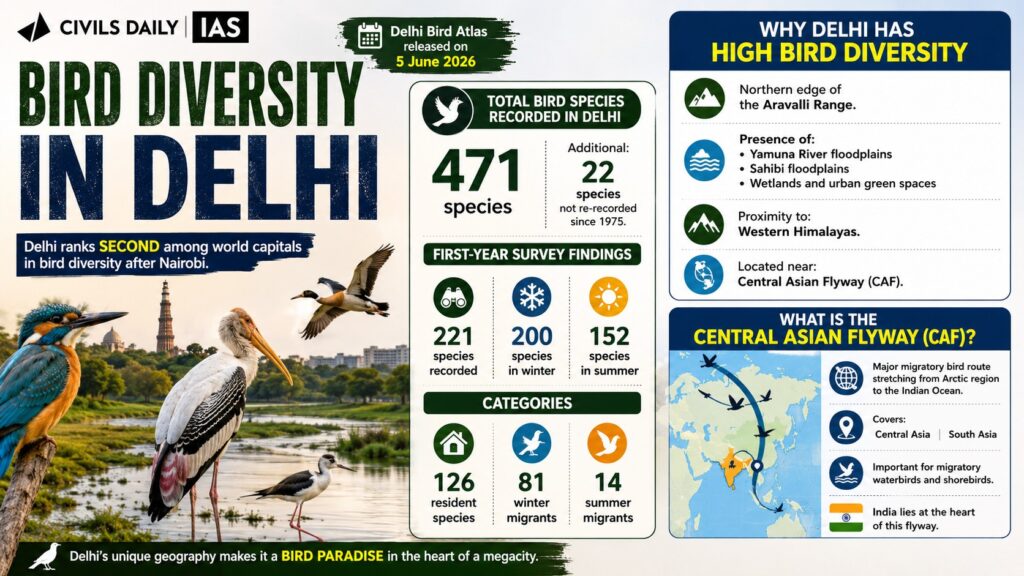
The Delhi Bird Atlas released on 5 June 2026 documented bird distribution and abundance across Delhi for the first time and stated that Delhi ranks second among world capitals in bird diversity after Nairobi.
Bird Diversity in Delhi
Total bird species recorded in Delhi: 471 species.
Additional: 22 species not re-recorded since 1975.
First-year survey findings:
221 species recorded.
200 species in winter.
152 species in summer.
Categories
126 resident species.
81 winter migrants.
14 summer migrants.
Why Delhi Has High Bird Diversity
Northern edge of the Aravalli Range.
Presence of:
Yamuna River floodplains.
Sahibi floodplains.
Wetlands and urban green spaces.
Proximity to: Western Himalayas.
Located near: Central Asian Flyway (CAF).
What is the Central Asian Flyway (CAF)?
Major migratory bird route stretching from the Arctic region to the Indian Ocean.
Covers: Central Asia and South Asia.
Important for migratory waterbirds and shorebirds.
India lies at the heart of this flyway.
[2011] The Himalayan Range is very rich in species diversity. Which one among the following is the most appropriate reason for this phenomenon?
(a) It has a high rainfall that supports luxuriant vegetative growth.
(b) It is a confluence of different biogeographical zones.
(c) Exotic and invasive species have not been invasive species and have not been introduced in this region.
PYQ Relevance[UPSC 2022] What is the basic principle behind vaccine development? How do vaccines work? What approaches were adopted by the Indian vaccine manufacturers to produce COVID-19 vaccines?Linkage: The PYQ tests understanding of vaccine science, indigenous vaccine development, and the role of biotechnology in addressing public health challenges. The PreVenTB Trial evaluates indigenous vaccines (VPM1002 and Immuvac) for TB prevention, highlighting India’s growing capabilities in vaccine research and the use of biotechnology to combat infectious diseases.
Mentor’s Comment
India’s fight against tuberculosis (TB) has received a major boost with the publication of the ICMR-led PreVenTB Trial. The trial found that the indigenous vaccine candidates VPM1002 and Immuvac provide protection against both pulmonary TB and the difficult-to-diagnose extrapulmonary TB (EPTB). The findings are significant as they offer new evidence from a large real-world Indian population at a time when India continues to bear one of the world’s highest TB burdens. They also strengthen hopes for achieving TB elimination, even as TB remains the leading infectious disease killer globally.
Why has a “one-size-fits-all” vaccine approach failed in TB control?
Diverse Disease Pathways: TB infection can remain latent for years, progress to subclinical disease, or develop into active pulmonary or extrapulmonary TB.
Biological Complexity: Individuals differ in infection status, age, comorbidities, and immune responses.
Vaccine Limitations: Previous TB vaccine development largely focused on preventing pulmonary TB.
Unrealistic Expectations: Search for a single vaccine capable of preventing all forms of TB has repeatedly disappointed global TB control efforts.
How severe is the TB burden and why does it demand urgent action?
Global Mortality: TB continues to kill more people annually than any other infectious disease.
Burden in LMICs: Incidence in many low- and middle-income countries remains between 200-300 cases per 100,000 population.
Elimination Threshold: TB incidence must decline to 10-20 cases per 100,000 population to approach elimination.
Indian Context: India carries one of the world’s highest TB burdens, requiring sustained public health investments.
Long-Term Challenge: Elimination demands decades of coordinated interventions rather than a single technological solution.
What are the key pillars of a layered TB elimination strategy?
Better Detection
Advanced Diagnostics: Enables identification of subclinical TB before progression to active disease.
Risk-Based Screening: Supports early detection among vulnerable populations.
Public Health Impact: Reduces transmission and disease progression.
Preventive Therapy
Latent TB Treatment: Prevents inactive infection from progressing to active disease.
Targeted Intervention: Particularly relevant for household contacts and high-risk populations.
Vaccination
Critical Tool: Complements diagnostics and preventive therapy.
Population Protection: Reduces progression from infection to disease.
Integrated Strategy: Most effective when combined with nutrition and case management.
What are the major findings of the PreVenTB Trial?
Institution: Conducted by the Indian Council of Medical Research (ICMR).
Scale: Conducted at multiple sites across India.
Participants: More than 12,700 household contacts of TB patients.
Target Group: Individuals aged six years and above, including those with comorbidities and varying infection status.
Vaccines Evaluated: VPM1002 and Immuvac.
Efficacy of VPM1002
Extrapulmonary TB Protection:50.4% efficacy against EPTB.
Pulmonary TB Protection:21.4% efficacy against pulmonary TB overall.
Efficacy of Immuvac
Overall Protection:64.6% efficacy against all forms of TB.
Children Protection: More than 60% efficacy among children aged 6–10 years.
Progression Prevention: More than 60% efficacy against progression to disease among individuals with latent infection.
Significance
First-of-Its-Kind Evidence: Demonstrates efficacy against both pulmonary and extrapulmonary TB.
Real-World Conditions: Large Phase III trial conducted in an Indian population.
Broad Coverage: Includes multiple age groups and disease forms.
Why is extrapulmonary TB an important policy concern?
Extrapulmonary tuberculosis (TB) is an active Mycobacterium tuberculosis infection occurring in organs other than the lungs. It accounts for 15% to 40% of all TB cases and primarily affects lymph nodes, pleura, the spine, and the central nervous system.
Hidden Burden: Harder to diagnose than pulmonary TB.
Missed Cases: Frequently underreported and undetected.
Higher Morbidity: Associated with severe complications and mortality.
Clinical Impact: A reduction of over 50% in EPTB cases would significantly lower patient suffering and healthcare costs.
Novel Evidence: Current findings provide rare vaccine efficacy data against EPTB.
What opportunities do the findings create for children and adolescents?
Strong Signal: Vaccine efficacy exceeded 60% among school-age children and adolescents.
Policy Gap: India currently lacks a structured TB vaccination strategy beyond infancy.
Booster Potential: Findings may support future booster-dose vaccination programmes.
Disease Prevention: Offers protection before transition to adulthood, when disease burden increases.
Why is nutrition emerging as a critical component of TB control?
Low BMI Impact: Reduced vaccine efficacy observed among individuals with low Body Mass Index.
Immune Function: Nutritional status influences vaccine effectiveness and disease resistance.
Integrated Approach: Vaccination must be aligned with nutritional interventions.
Modified BCG Platform: Uses an established vaccine platform.
Manufacturing Ease: Can be produced at scale.
Cost Effectiveness: Suitable for large population programmes.
LMIC Relevance: Practical for resource-constrained settings.
What lessons can India draw from previous vaccine decisions?
TrueNat Example: Indigenous molecular test adopted by the National TB Elimination Programme before WHO qualification.
COVID-19 Response: Covaxin received approval under a “clinical trial mode” during the pandemic to accelerate access while evidence accumulated.
Rotavirus Vaccine: Indigenous vaccines were introduced despite early uncertainty and later demonstrated significant reductions in severe disease and child mortality.
Policy Lesson: Timely deployment based on credible evidence can yield substantial public health gains.
What should India’s future TB strategy look like?
Targeted Vaccination: Deployment of VPM1002 and Immuvac among household contacts and high-risk groups.
School-Based Vaccination: Focus on adolescents and school-going children.
Preventive Therapy: Integration with latent TB treatment programmes.
Nutritional Support: Strengthening nutrition interventions for vulnerable populations.
Case-Based Management: Improved diagnosis and treatment adherence.
Public Health Investment: Sustained funding and surveillance systems.
Combination Approach: Multiple interventions rather than reliance on a single vaccine breakthrough.
Conclusion
The PreVenTB Trial offers a promising pathway for strengthening India’s TB elimination efforts through indigenous vaccines and targeted interventions. Achieving the goal of a TB-Mukt Bharat by 2025 and contributing to SDG 3’s target of ending the TB epidemic by 2030 will require a combination of vaccination, nutrition, early detection, and sustained public health action.
Value Addition
Tuberculosis (TB): Key Facts
Causative Agent:Mycobacterium tuberculosis
Transmission: Airborne droplets
Types: Pulmonary TB and Extrapulmonary TB
Latent TB: Infection without symptoms; can later progress to active disease
SDG Target: End TB epidemic by 2030
National TB Elimination Programme (NTEP)
Formerly Revised National TB Control Programme (RNTCP)
Based on National Strategic Plan for TB Elimination
Uses molecular diagnostics and universal drug susceptibility testing
Provides free diagnosis and treatment
Major Government Initiatives
Ni-kshay Portal: Facilitates digital tracking of TB patients.
Ni-kshay Poshan Yojana: Provides nutritional support to TB patients.
TB Mukt Bharat Abhiyan: Supports community participation in TB elimination.
PM TB Mukt Bharat Abhiyan: Encourages adoption of TB patients through Ni-kshay Mitras.
The Union Government promulgated the Income-tax (Amendment) Ordinance, 2026, which received President Droupadi Murmu’s assent on June 5, 2026. The ordinance completely exempts Foreign Institutional Investors (FIIs) from capital gains tax and withholding tax on interest income earned from Indian government securities, effective from April 1, 2026. The move seeks to attract large foreign debt inflows, address a projected $50-60 billion Balance of Payments (BoP) gap, and support rupee stability amid weak portfolio and FDI inflows.
How Has The Tax Treatment Of Foreign Investors Changed?
Previous Tax Regime
Long-Term Capital Gains Tax (LTCG): FIIs paid 12.5% tax on gains from bonds held for more than 12 months.
Short-Term Capital Gains Tax (STCG): FIIs paid 30% tax on short-term gains.
Withholding Tax: Foreign investors paid nearly 20% tax on interest income from government bonds.
Global Comparison: India’s withholding tax was among the highest globally after the concessional 5% rate expired in 2023.
Gross Taxation: Non-resident investors paid withholding tax on gross interest income and could not offset losses against past gains.
New Tax Regime
Capital Gains Exemption: The government has completely scrapped both Long-Term Capital Gains (LTCG) and Short-Term Capital Gains (STCG) taxes on investments made by FIIs in government bonds.
Interest Income Exemption: The government has also scrapped the withholding tax (Tax Deducted at Source) that FIIs were required to pay on their interest income derived from government debt instruments/bonds.
Coverage: Applies to investments through the General Route and Fully Accessible Route (FAR).
Effective Date: Changes become effective from April 1, 2026 following Presidential assent to the ordinance amending the Income Tax Act, 2025.
Institutional Coverage: Benefits extend to FIIs and the Bank for International Settlements (BIS).
Why Is India Seeking Greater Foreign Debt Inflows?
Balance of Payments Pressure
BoP Deficit: India may face a $50-60 billion BoP deficit in FY27.
External Financing Need: Sustained capital inflows are necessary to finance the deficit without exerting pressure on foreign exchange reserves.
Rupee Stability
Exchange Rate Stress: The rupee had nearly breached the ₹97 per US dollar level recently.
Recent Recovery: Rupee strengthened from ₹95.79/$ on Thursday to ₹94.94/$ on Friday.
Currency Support: Higher debt inflows increase foreign exchange supply and support currency stability.
Weak Portfolio and FDI Flows
Equity Outflows: FPIs have withdrawn approximately $28 billion from Indian equities in FY26.
FDI Moderation: Net FDI inflows have weakened, increasing reliance on alternative capital sources.
How Large Could The Potential Foreign Inflows Be?
Expected Debt Inflows
Axis Bank Estimate: Tax exemptions could attract $45-50 billion into government debt markets over the next two years.
BoP Gap Financing: Such inflows could bridge a major portion of the projected external financing requirement.
Untapped Market Potential
Current Holdings: FIIs hold only ₹3.75 lakh crore.
Total Market Size: Government securities outstanding amount to ₹112.42 lakh crore.
Foreign Share: Foreign participation remains limited at 3.34%.
Global Investor Appeal
Tax Neutrality: Aligns India more closely with major sovereign bond markets.
Yield Attraction: Indian government bonds offer relatively attractive yields compared to many developed markets.
What Additional Measures Have Been Taken To Liberalize Government Bond Investments?
Expansion Of Fully Accessible Route (FAR) Securities
Coverage Expansion: RBI is considering inclusion of all new issuances of 15-year, 30-year and 40-year government bonds under FAR.
Accessibility: Ensures unrestricted foreign investment in a larger segment of sovereign debt.
Removal Of Investment Restrictions
Short-Term Investment Limits: Proposed removal of caps on short-duration investments.
Concentration Limits: Removal of concentration restrictions on FII investments.
Individual Security Limits: Greater flexibility for investors across government securities.
Complementary RBI Measures
Overseas Borrowing: RBI eased norms for state-owned enterprises to borrow abroad.
Objective: Strengthens overall foreign capital inflow architecture.
How Can Greater Debt Inflows Benefit The Indian Economy?
External Sector Stability
BoP Financing: Ensures financing of current account and capital account gaps.
Reserve Protection: Reduces pressure on foreign exchange reserves.
Rupee Appreciation
Forex Supply: Higher inflows increase dollar availability.
Exchange Rate Support: Reduces depreciation pressures on the rupee.
Bond Market Development
Market Depth: Broadens investor base in government securities.
Liquidity: Enhances trading activity and price discovery.
Lower Borrowing Costs
Demand Expansion: Increased demand for government bonds may lower yields over time.
Fiscal Benefit: Reduces government borrowing costs.
Global Financial Integration
Market Confidence: Signals policy commitment to capital market reforms.
International Participation: Improves India’s standing in global bond markets.
What Risks And Concerns Remain?
Dependence On Portfolio Flows
Volatility Risk: Debt inflows can reverse quickly during global financial stress.
External Vulnerability: Excessive reliance on foreign capital may increase exposure to global shocks.
Revenue Implications
Tax Foregone: Government sacrifices tax revenues to attract foreign investment.
Cost-Benefit Question: Actual inflows must justify revenue losses.
Monetary Management Challenges
Liquidity Effects: Large inflows may complicate liquidity and exchange-rate management.
Sterilization Costs: RBI may need intervention to manage excess forex inflows.
Structural Constraints
Investment Decisions: Tax incentives alone may not overcome concerns relating to regulations, global risk appetite, and geopolitical uncertainties.
Conclusion
Amid global economic uncertainty and pressure on India’s external sector, the reform seeks to attract foreign capital, support the rupee, and deepen the sovereign debt market. It aligns with India’s broader aspiration of becoming a $5 trillion economy and a globally integrated financial powerhouse while ensuring macroeconomic stability.
PYQ Relevance
[UPSC 2016] Justify the need for FDI for the development of the Indian economy. Why is there a gap between MOUs signed and actual FDIs? Suggest remedial steps for increasing actual FDIs in India
Linkage: The PYQ examines policy measures undertaken by the government to attract foreign capital and strengthen investment inflows. The reform uses tax incentives to attract foreign capital and deepen India’s debt market.
The Union Cabinet has approved a two-year Clean Mobility Scheme aimed at replacing older trucks and buses in Delhi-NCR with BS-VI-compliant vehicles. The move is significant because heavy commercial vehicles constitute only a small fraction of the vehicle fleet but contribute disproportionately to particulate and nitrogen oxide emissions.
What is the Clean Mobility Scheme for Delhi-NCR?
Approval: Approved by the Union Cabinet for a two-year period to reduce air pollution and promote clean mobility in Delhi-NCR.
Objective: Accelerates replacement of BS-IV and older trucks and buses with BS-VI-compliant or electric vehicles (EVs).
Funding Mechanism: Financed through the National Capital Region Planning Board (NCRPB) under the Ministry of Housing and Urban Affairs (MoHUA).
Implementing Agencies: Implemented by the Ministry of Road Transport and Highways (MoRTH) and the Ministry of Petroleum and Natural Gas (MoPNG) in collaboration with Delhi, Haryana, Rajasthan and Uttar Pradesh.
Financial Outlay: Provides a total package of ₹9,585 crore, including ₹5,041 crore Central assistance and ₹1,601 crore estimated State tax concessions.
Coverage: Targets nearly 2.07 lakh vehicle owners, including 1.91 lakh trucks and 16,329 buses across Delhi-NCR.
Vehicle Replacement Norms: Mandates scrapping of BS-III and older vehicles at Registered Vehicle Scrapping Facilities; BS-IV vehicles may be scrapped or sold outside NCR in non-NCAP cities/towns.
Delhi-Specific Provision: Requires electric Light Goods Vehicles (LGVs) and permits only BS-VI CNG or electric buses under the scheme.
Exclusion: Government-owned vehicles are not eligible for scheme benefits.
What Incentives Does the Scheme Provide?
Central Government Support
Interest Subvention: Provides 5% interest subsidy on vehicle loans for five years.
Fuel Support: Provides monthly fuel vouchers of up to ₹4,800, depending on vehicle category.
EV Incentives: Offers lump-sum benefits for electric vehicle purchases or Certificate of Deposit trading.
State Government Support
Registration Fee Waiver: Exempts eligible new vehicles from registration charges.
Motor Vehicle Tax Relief: Provides up to 100% tax concession for new vehicles and 50% concession for used vehicles for 10 years.
Liability Waiver: Waives pending liabilities on old vehicles participating in the scheme.
Industry Support
OEM Contribution: Participating automobile manufacturers provide 8% discount on ex-showroom prices.
How Will the Scheme Be Implemented and Monitored?
Digital Platform: Uses an integrated portal for real-time eligibility verification, automated claims processing and fuel voucher disbursement.
Outcome Monitoring: Tracks pollution-reduction outcomes and scheme performance digitally.
Long-Term Support: Central benefits continue for five years from registration of the new vehicle, extending beyond the two-year enrolment period.
Empowered Committee: Monitored by a high-level committee chaired by the Cabinet Secretary, with representation from NITI Aayog, MoHUA, MoRTH, MoPNG, DFS and NCR States.
District-Level Oversight: District Collectors/District Magistrates will supervise implementation and monitoring at the local level.
Can the Replacement of Old Trucks and Buses Significantly Improve Delhi-NCR Air Quality?
Disproportionate Emission Burden: Old trucks and buses contribute significantly higher emissions despite constituting a small share of the total fleet.
PM2.5 Contribution: Trucks and buses account for 36% of transport-sector PM2.5 emissions, directly affecting respiratory and cardiovascular health.
Diagnostic Systems: Uses advanced on-board diagnostic (OBD) systems for emission monitoring.
BS-IV Gap:BS-IV vehicles emit 2.7 times more pollution than comparable BS-VI vehicles.
Technology Transition: Aligns Indian emission standards with advanced global regulatory practices.
What Is the Current Composition of Delhi-NCR’s Commercial Vehicle Fleet?
Goods Vehicles: Account for 4.1% (11.80 lakh) of Delhi-NCR’s 2.88 crore vehicle fleet.
Bus Share: Buses constitute only 0.6% of the total vehicle fleet.
BS-VI Buses:34,449 buses are BS-VI compliant.
Older Buses:1,26,549 buses fall within the pre-BS to BS-IV categories.
Pollution Concentration: A relatively small commercial fleet contributes disproportionately to emissions.
Why Is Delhi-NCR Particularly Vulnerable to Air Pollution?
Multiple Sources: Pollution arises from transport, dust, industrial emissions and biomass burning.
Meteorological Factors: Weather conditions influence pollutant accumulation and dispersion.
Regional Nature: Pollution originates from both local and regional sources.
Winter Inversion: Seasonal atmospheric conditions trap pollutants closer to the ground.
Population Exposure: High population density magnifies health impacts.
What Are the Potential Benefits and Limitations of the Scheme?
Benefits
Emission Reduction: Accelerates removal of highly polluting vehicles.
Fleet Modernisation: Promotes adoption of cleaner commercial transport.
Health Gains: Reduces exposure to PM2.5 and NOx.
Regulatory Compliance: Supports implementation of CAQM directives.
Climate Co-benefits: Improves fuel efficiency and lowers emission intensity.
Limitations
High Replacement Cost: Fleet owners may face financial constraints.
Enforcement Challenges: Effective scrappage and replacement monitoring remain critical.
Partial Solution: Transport is only one component of Delhi-NCR’s pollution problem.
Regional Coordination: Requires cooperation among multiple NCR states.
Conclusion
The Clean Mobility Scheme aligns with India’s commitment to achieve Net Zero by 2070, reduce the emissions intensity of GDP by 45% by 2030, and promote sustainable urban transport. By targeting a small fleet responsible for a disproportionately large share of vehicular pollution, the scheme can complement the National Clean Air Programme (NCAP) target of reducing particulate pollution in non-attainment cities while advancing SDG 3 (Good Health), SDG 11 (Sustainable Cities) and SDG 13 (Climate Action).
PYQ Relevance
[UPSC 2020] What are the key features of the National Clean Air Programme (NCAP) initiated by the Government of India?
Linkage: The PYQ focuses on policy measures and institutional interventions for tackling air pollution in India.The Clean Mobility Scheme complements NCAP by targeting vehicular emissions, a major source of PM2.5 and NOx pollution in Delhi-NCR, through fleet modernisation and BS-VI transition.
Scientists from Indian Institute of Astrophysics used over 100 years of observations from Kodaikanal Solar Observatory to study how convection patterns on the Sun are linked to the 11-year solar activity cycle.
Key Highlights
Study based on: More than 34,000 Ca II K solar images.
Published in: Astrophysical Journal Letters.
Researchers examined:
Lane widths
Intensities
Their relation with sunspot numbers and solar cycles.
Note: The 34,000 Ca II K solar images mean a historic, 100-year-old archive of solar photographs from India’s Kodaikanal Solar Observatory that scientists recently digitized and used to solve mysteries about the Sun’s 11-year magnetic cycle.
What are Supergranulations?
Large-scale convection patterns on the Sun’s surface.
Form network-like structures on the solar surface.
Features
Average lifetime: Around 24 hours.
Average size: About 30,000 km.
Cooler intergranular lane width: Around 6,000 km.
Note: An intergranular lane is the darker, cooler region found between bright granules (bright cellular structures visible on the Sun’s surface) on the Sun’s surface.
Major Findings
Correlation with Solar Cycle
Lane widths and intensities strongly correlate with Sunspot activity.
Latitude Dependence
Strongest correlations observed around ±11° to ±22° latitudes.
Peak lane-width correlation 18°N and 20°S.
Peak intensity correlation 13°N and 14°S.
Time Lag
Lane width correlations peak:
During solar maximum.
Intensity correlations peak:
1.25 to 1.5 years after solar maximum.
Lag varies with latitude:
Near zero around ±20°.
Increases toward equator.
Significance of Study
Helps understand:
Solar dynamics
Magnetic flux transport
Solar irradiance variations.
Important for:
Future solar cycle prediction.
Understanding UV radiation changes from the Sun.
Confirms:
Supergranular properties are influenced by solar magnetic activity.
About Kodaikanal Solar Observatory
Located in: Kodaikanal.
Known for: One of the world’s longest continuous solar observation datasets.
Operated by: Indian Institute of Astrophysics.
About Solar Cycle
The Sun undergoes an approximately: 11-year cycle of magnetic activity.
Characterized by variation in:
Sunspots
Solar flares
Solar radiation.
Solar maximum: Period of highest solar activity.
Solar minimum: Period of lowest solar activity.
[2022] If a major solar storm (solar flare) reaches the Earth, which of the following are the possible effects on the Earth?: 1. GPS and navigation systems could fail. 2. Tsunamis could occur at equatorial regions. 3. Power grids could be damaged. 4. Intense auroras could occur over much of the Earth. 5. Forest fires could take place over much of the planet. 6. Orbits of the satellites could be disturbed 7. Shortwave radio communication of the aircraft flying over polar regions could be interrupted. Select the correct answer using the code given below;
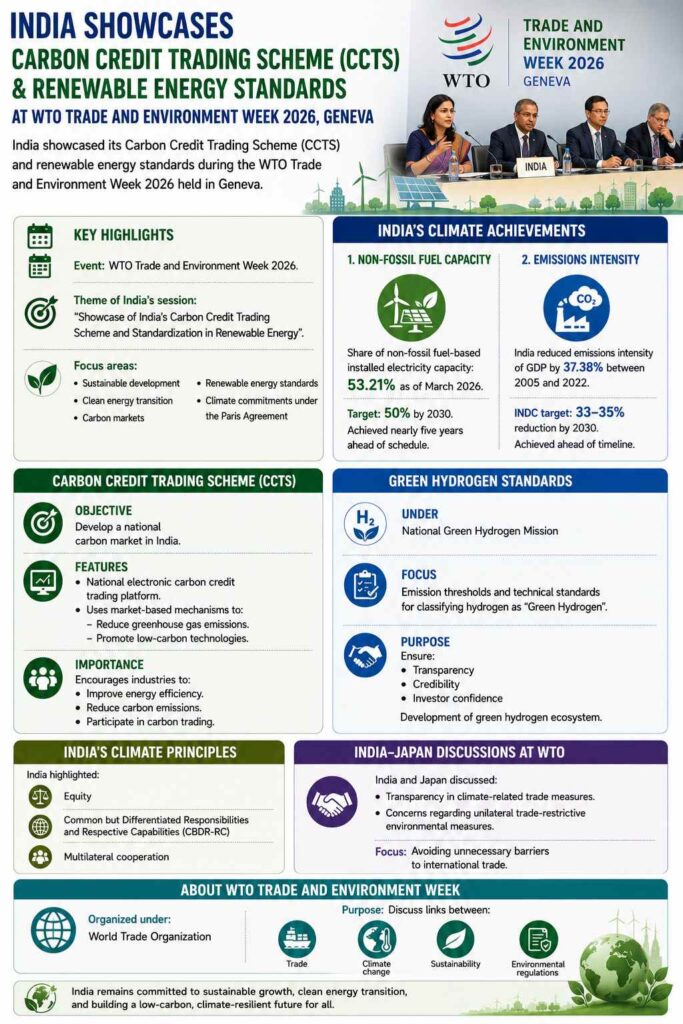
Focus: Avoiding unnecessary barriers to international trade.
About WTO Trade and Environment Week
Organized under: World Trade Organization
Purpose: Discuss links between Trade, Climate change, Sustainability, and Environmental regulations.
[2025] Consider the following statements: Statement I: Article 6 of the Paris Agreement on climate change is frequently discussed in global discussions on sustainable development and climate change. Statement II: Article 6 of the Paris Agreement on climate change sets out the principles of carbon markets. Statement III: Article 6 of the Paris Agreement on climate change intends to promote inter-country non-market strategies to reach their climate targets. Which one of the following is correct in respect of the above statements?
[A] Both Statement II and Statement III are correct and both of them explain Statement I
[B] Both Statement II and Statement III are correct but only one of them explains Statement I
[C] Only one of the Statements II and III is correct and that explains Statement I
[D] Neither Statement II nor Statement III is correct
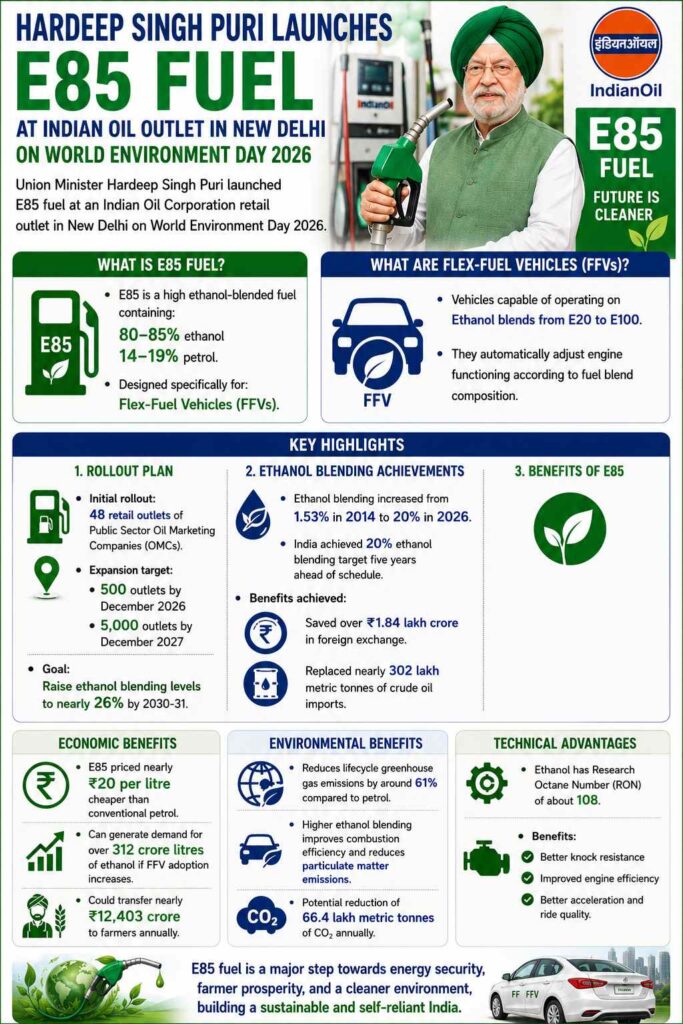
Potential reduction: 66.4 lakh metric tonnes of CO₂ annually.
[2025] Consider the following statements: Statement I: Of the two major ethanol producers in the world, i.e., Brazil and the United States of America, the former produces more ethanol than the latter. Statement II: Unlike in the United States of America where corn is the principal feedstock for ethanol production, sugarcane is the principal feedstock for ethanol production in Brazil. Which one of the following is correct in respect of the above statements?
[A] Both Statement I and Statement II are correct and Statement II explains Statement I
[B] Both Statement I and Statement II are correct but Statement II does not explain Statement I
[C] Statement I is correct but Statement II is not correct
[D] Statement I is not correct but Statement II is correct
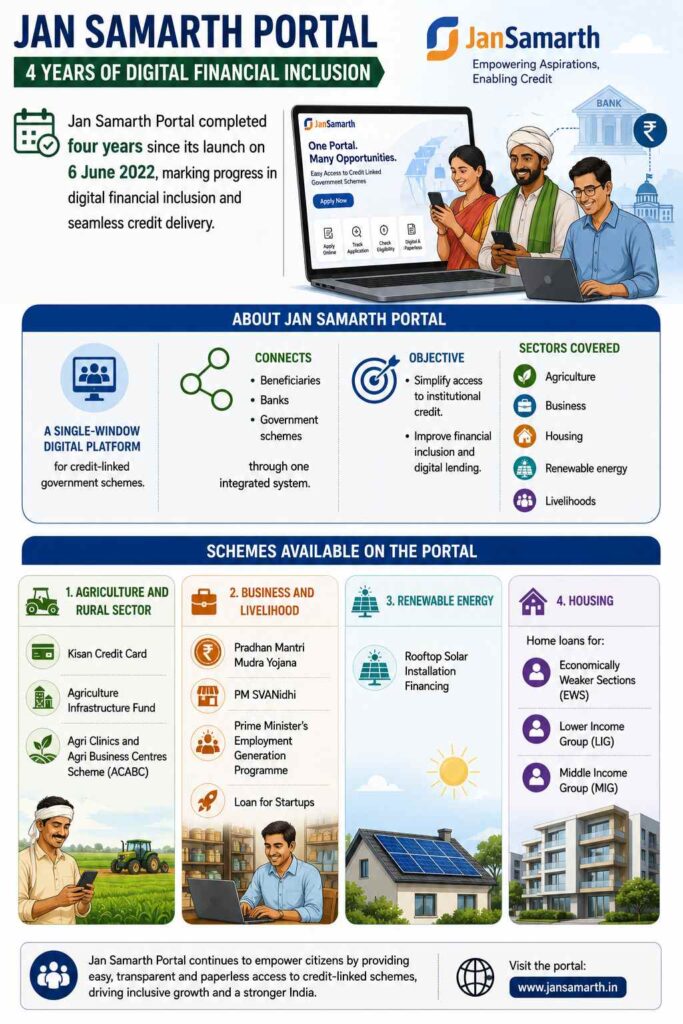
Jan Samarth Portal has completed four years since its launch on 6 June 2022, marking progress in digital financial inclusion and seamless credit delivery.
About Jan Samarth Portal
A single-window digital platform for credit-linked government schemes.
Connects:
Beneficiaries
Banks
Government schemes through one integrated system.
Objective:
Simplify access to institutional credit.
Improve financial inclusion and digital lending.
Sectors covered:
Agriculture
Business
Housing
Renewable energy
Livelihoods.
Schemes Available on the Portal
Agriculture and Rural Sector
Kisan Credit Card
Agriculture Infrastructure Fund
Agri Clinics and Agri Business Centres Scheme (ACABC)
Loan Value ₹3,00,951 crore applications processed through the portal.
Digital Approvals
49.55 lakh beneficiaries approved.
₹2,76,493.78 crore sanctioned digitally.
[2020] Under the Kisan Credit Card scheme, short-term credit support is given to farmers for which of the following purposes? 1.Working capital for maintenance of farm assets 2.Purchase of combine harvesters, tractors and mini trucks 3.Consumption requirements of farm households 4.Post-harvest expenses 5.Construction of family house and setting up of village cold storage facility Select the correct answer using the code given below:
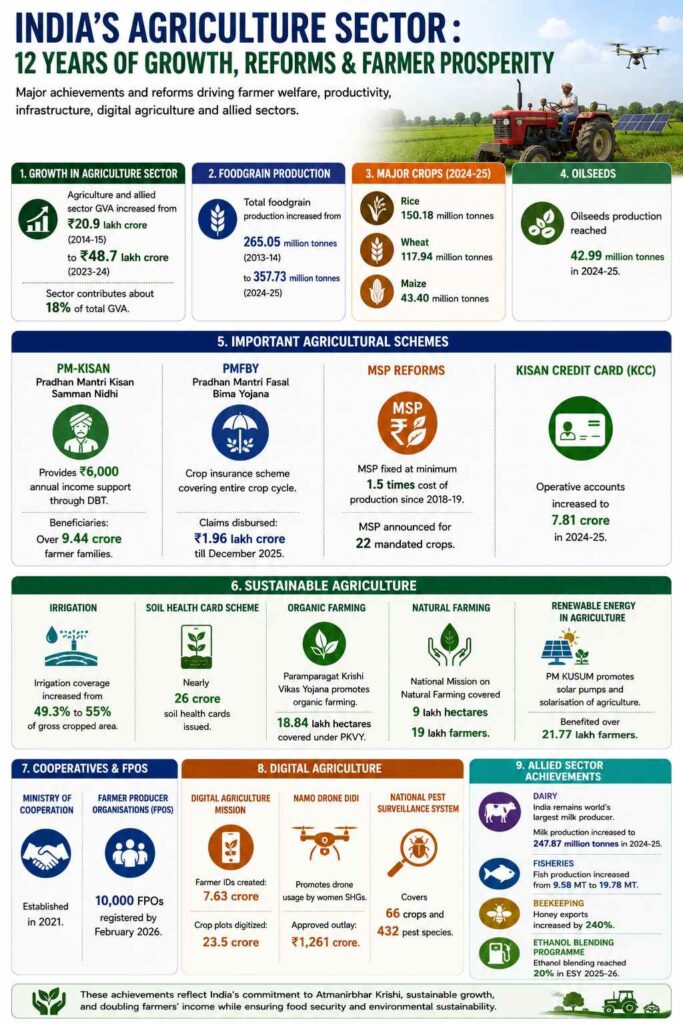
The Government of India highlighted major achievements and reforms in the agriculture sector over the past 12 years, focusing on farmer welfare, productivity, infrastructure, digital agriculture, and allied sectors.
Growth in the Agriculture Sector
Agriculture and allied sector GVA increased from:
₹20.9 lakh crore (2014-15)
to ₹48.7 lakh crore (2023-24).
Sector contributes:
About 18% of total Gross Value Added (GVA).
Foodgrain Production
Total foodgrain production increased from:
265.05 million tonnes (2013-14)
to 357.73 million tonnes (2024-25).
Major Crops
Rice production: 150.18 million tonnes in 2024-25.
Wheat production: 117.94 million tonnes.
Maize production: 43.40 million tonnes.
Oilseeds
Production reached: 42.99 million tonnes in 2024-25.
Important Agricultural Schemes
Pradhan Mantri Kisan Samman Nidhi (PM-KISAN)
Provides: ₹6,000 annual income support through DBT.
Promotes solar pumps and solarisation of agriculture.
Benefited: Over 21.77 lakh farmers.
Cooperatives and FPOs
Ministry of Cooperation
Established in: 2021.
Farmer Producer Organisations (FPOs)
10,000 FPOs registered by February 2026.
Digital Agriculture
Digital Agriculture Mission
Farmer IDs created: 7.63 crore.
Crop plots digitized: 23.5 crore.
Namo Drone Didi
Promotes drone usage by women SHGs.
Approved outlay: ₹1,261 crore.
National Pest Surveillance System
Covers:
66 crops and 432 pest species.
Allied Sector Achievements
Dairy
India remains: World’s largest milk producer.
Milk production: Increased to 247.87 million tonnes in 2024-25.
Fisheries
Fish production: Increased from 9.58 MT to 19.78 MT.
Beekeeping
Honey exports increased by: 240%.
Ethanol Blending Programme
Ethanol blending reached: 20% in ESY 2025-26.
[2016] With reference to ‘Pradhan Mantri Fasal Bima Yojana’, consider the following statements: 1. Under this scheme, farmers will have to pay a uniform premium of two percent for any crop they cultivate in any season of the year. 2. This scheme covers post-harvest losses arising out of cyclones and unseasonal rains. Which of the statements given above is/are correct?
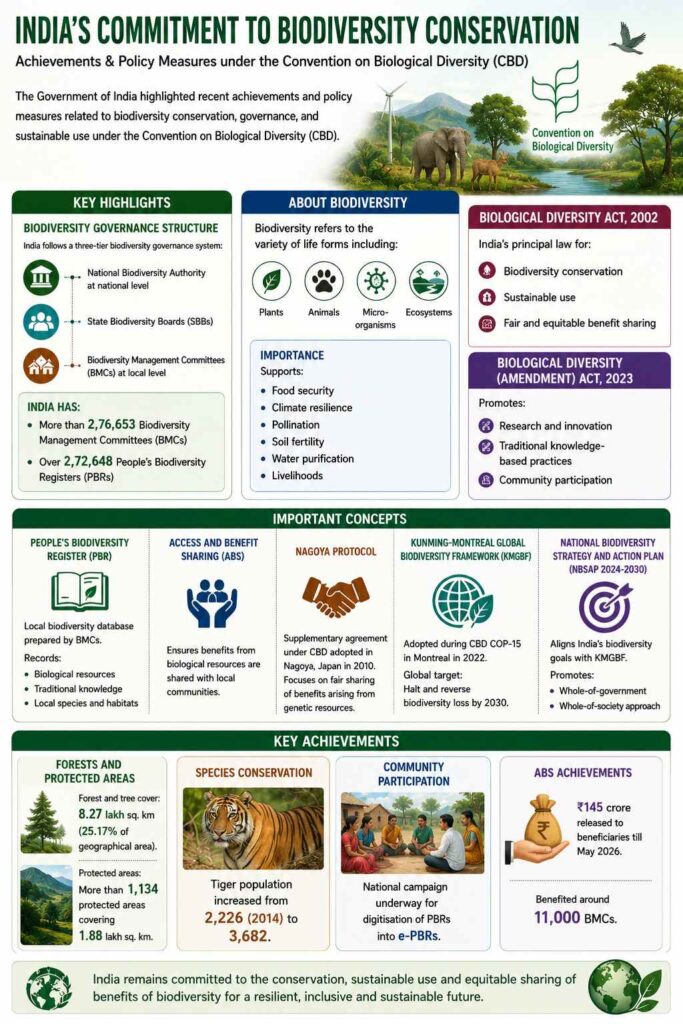
The Government of India highlighted recent achievements and policy measures related to biodiversity conservation, governance, and sustainable use under the Convention on Biological Diversity (CBD).
Biodiversity Governance Structure
India follows a three-tier biodiversity governance system:
National Biodiversity Authority at national level
State Biodiversity Boards (SBBs)
Biodiversity Management Committees (BMCs) at local level.
India has:
More than 2,76,653 Biodiversity Management Committees (BMCs)
Over 2,72,648 People’s Biodiversity Registers (PBRs).
Note: Biodiversity Management Committees (BMCs) are local-level statutory bodies in India, mandated by the Biological Diversity Act of 2002.
About Biodiversity
Biodiversity refers to the variety of life forms including:
Plants
Animals
Microorganisms
Ecosystems.
Biological Diversity Act, 2002
India’s principal law for:
Biodiversity conservation
Sustainable use
Fair and equitable benefit sharing.
Biological Diversity (Amendment) Act, 2023
Promotes:
Research and innovation
Traditional knowledge-based practices
Community participation.
Important Concepts
People’s Biodiversity Register (PBR)
Local biodiversity database prepared by BMCs.
Records:
Biological resources
Traditional knowledge
Local species and habitats.
Access and Benefit Sharing (ABS)
Ensures benefits from biological resources are shared with local communities.
Nagoya Protocol
Supplementary agreement under CBD adopted in Nagoya, Japan in 2010.
Focuses on fair sharing of benefits arising from genetic resources.
Kunming-Montreal Global Biodiversity Framework (KMGBF)
Adopted during CBD COP-15 in Montreal in 2022.
Global target:
Halt and reverse biodiversity loss by 2030.
National Biodiversity Strategy and Action Plan (NBSAP 2024-2030)
Aligns India’s biodiversity goals with KMGBF.
Promotes:
Whole-of-government
Whole-of-society approach.
Key Achievements
Forests and Protected Areas
Forest and tree cover: 8.27 lakh sq. km (25.17% of geographical area).
Protected areas: More than 1,134 protected areas covering 1.88 lakh sq. km.
Species Conservation
Tiger population increased from: 2,226 (2014) to 3,682.
Community Participation
National campaign underway for digitisation of PBRs into e-PBRs.
ABS Achievements
₹145 crore released to beneficiaries till May 2026.
Benefited around 11,000 BMCs (Biodiversity Management Committees).
[2023] Consider the following statements: 1. In Biodiversity the India, Management Committees are key to the realization of the objectives of the Nagoya Protocol. 2. The Biodiversity Management Committees have important functions in determining access and benefit sharing, including the power to levy collection fees on the access of biological resources within its jurisdiction. Which of the statements given above is/are correct?