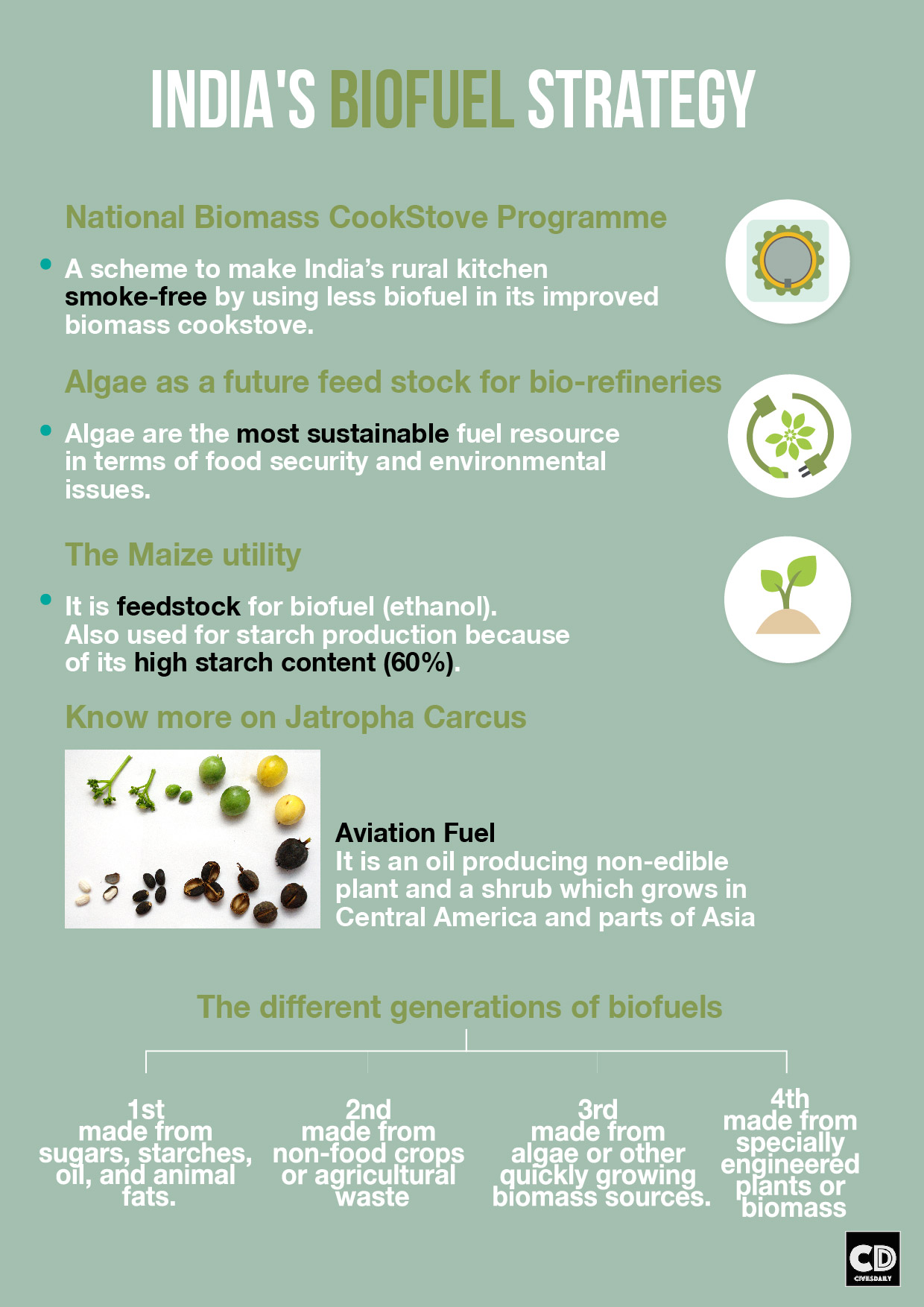
India is set to announce a policy on flexible-fuel cars, cars that can run on bio-ethanol and petrol, or a blend of both.
Biofuel production would help farmers by supporting the diversification of agriculture into energy, power and bio-plastics.
What are Biofuels?
Simply put, fuels produced directly/indirectly from organic material i.e. biomass including plant materials and animal waste.
Biofuels can be solid, liquid or gaseous.
Primary Biofuels
Those organic materials which are used in an unprocessed form such as fuel wood, wood chips and pellets, primarily for heating, cooking, electricity production.
Secondary Biofuels
Those materials which result from processing of biomass.
Example: Liquid fuels such as ethanol and biodiesel
What are different generations of Biofuels?
First Generation
The first generation fuels are conventional biofuels made from sugar, starch or vegetable.
Issue: They come from a biomass that is also a food source, so it requires a lot of land to grow at a time when there is food shortage in the world.
Let’s learn about some of the famous examples in this category.
Ethanol – It is a type of alcohol which can be produced by any feedstock containing significant amount of sugar. It can be blended with petrol or burned in nearly pure form in slightly modified spark-ignition engines.
1 litre of ethanol produces energy equivalent to two-third of energy produced by 1 litre of petrol.
Is there any benefit of blending except providing an alternative to sugar industry? Of course, it improves combustion performance and lowers the emissions of Carbon Mono-oxide and Sulfur Di-oxide.
Biodiesel – It is produced by combining vegetable oil or animal fat with alcohol. It can be blended with traditional diesel fuel or burned in its pure form in compression ignition engines.
Source – rapeseed, soyabeen, palm, coconut or jatropha oils.
Energy content is 88-95 % of diesel
Second Generation
They come from non-food biomass such as wood, organic waste, food waste, specific biomass crops.
Issue: The second-generation fuel sources compete with food production for land.
Third Generation
They are specifically engineered crops such as algae as the energy source. These algae are grown and harvested to extract oil within them.
Fourth Generation
They are aimed at not only producing sustainable energy but also a way of capturing and storing carbon-dioxide. They are carbon-negative i.e. it takes away more carbon-dioxide than it produces.
National Policy on Biofuels 2015
The Policy endeavors to facilitate and bring about optimal development and utilization of indigenous biomass feedstocks for production of bio-fuels.
- It envisages that biofuels will be produced using non-food feedstock on waste lands
- Encouraged the use of renewable energy resources as alternate fuels to supplement transport fuels
- Proposed an indicative target of 20% biofuel blending by 2017
- Major thrust for development of second generation biofuels
- A Biofuel Steering Committee will be set up to oversee implementation of the Policy
Criticism – Govt launched National Biodiesel Mission identifying Jatropha as the most suitable tree-borne oilseed for bio-diesel production, which failed miserably. The policy is also criticized for being largely sugarcane centric.
What is the proposal under flex-fuel policy?
It aims at decreasing pollution by adopting cleaner alternatives against fossil fuels. It encourages a diversion in the sugar industry’s output away from sugar towards ethanol.
Sugar industry has an excess supply problem and it helps farmers because of diversification of agriculture into energy, power and bio-plastics.
What are the challenges to implement this policy?
- Additional sugarcane cultivation or it can be met by improved farm practices/HYV canes
- Installing special dispensing units at petrol pumps across the country
- Automakers need to be given adequate time to comply
- Oil marketing companies will have to augment storage capacity for ethanol
- Reforming tax structure so that transport of ethanol across state boundaries is not expensive
Published with inputs from Pushpendra