The article the need for liberal and realistic definition of the ‘urban’ area in the next Census and mention the implications of such change.
2 ways to define urban areas
1) Statutory town
These towns are defined by state governments and place India’s urbanisation rate at 26.7%.
A statutory town includes all places with a municipality, corporation, cantonment board or notified town area committee.
2) Census-based criteria
Census adopts three criteria to define what is urban.
The three criteria are:
i) a minimum population of 5,000;
ii) at least 75% of the male main working population engaged in non-agricultural pursuits, and
iii) a density of population of at least 400 persons per sq km
This, coupled with statutory towns, pegs India’s urbanisation rate at 31%.
Total number of towns (state and census) stands at 7,933, together constituting a 377-mn population.
Why there is a need for changing the definition of ‘urban’
There is growing evidence—mostly from satellite imagery—that India is way more urban than the 2011 Census estimate.
This is quite plausible because there is a large sum of money allocated for rural development, and it is in the interest of state governments to under-represent urbanisation.
Besides, the Census’s stringent definition was first carved out in 1961 which do not reflect the realities of the 21st century.
India won’t be alone in changing these definitions for Census 2021.
Many countries, such as China, Iran, the UK, among others, have changed the definition of ‘urban’ from one census to another.
Getting the right picture of urbanisation
A more liberal and realistic definition in the upcoming census will present the actual picture of urbanisation.
For instance, if we just use the population density criteria like 37 other countries, with the 400 people per sq km threshold, we will add around 500 mn people to the urban share of the population.
This pegs the urbanisation rate at over 70%!
What will be its implications?
First, the budgetary allocation will reflect the reality and scales will balance between rural and urban areas.
Second, the urban areas will not be governed through rural governance structures of Panchayati Raj Institutions.
Third basic urban infrastructure like sewerage networks, fire services, building regulations, high-density housing, transit-oriented development, piped drinking water supply.
Fourth, these newly defined urban areas could act as a new source of revenue for funding local infrastructure development.
This would ease pressure on state finances.
Lastly, the rethink of urban definition would have an impact on the regional and national economy.
These newly defined urban areas will open them to new infrastructure such as railway lines, discom services, highway connectivity, creation of higher education institutes which will together increase the connectivity and resource capability at the local level.
This will not only boost the local economy but also ease pressure on bigger cities and help in cluster level development.
Conclusion
A rethink of urban definition in Census 2021, particularly with some degrowth in urban areas due to Covid, will bode well for India for coming decades in more ways than one.
The Parliament has passed new versions of three labour codes — Industrial Relations Code Bill, 2020, Code on Social Security Bill, 2020 and Occupational Safety, Health and Working Conditions Code Bill, 2020.
The Code on Social Security 2020, which received the Presidential Assent on 28 September 2020, subsumes major regulations relating to social security, retirement and employee benefits.
What is Social Security?
Social security is “any government system that provides monetary assistance to people with an inadequate or no income”.
It refers to the action programs of an organization intended:
to promote the welfare of the population through assistance measures guaranteeing access to sufficient resources for food and shelter and
to promote health and well-being for the population at large and potentially vulnerable segments such as children, the elderly, the sick and the unemployed
Why need Social Security?
India has a very basic social security system catering to a fairly small percentage of the country’s workforce.
Traditionally, Indians relied on their extended families for support in the event of illness or other misfortunes.
However, due to migration, urbanization, and higher social mobility, family bonds are less tight and family units much smaller than they used to be.
Social Security System in India
India’s social security system is composed of a number of schemes and programs spread throughout a variety of laws and regulations.
Keeping in mind, however, that the government-controlled social security system in India applies to only a small portion of the population.
Furthermore, the social security system in India includes not just an insurance payment of premiums into government funds (like in China), but also lump sum employer obligations.
Generally, India’s social security schemes cover the following types of social insurances:
Pension
Health Insurance and Medical Benefit
Disability Benefit
Maternity Benefit
Gratuity
While a great deal of the Indian population is in the unorganized sector and may not have an opportunity to participate in each of these schemes, Indian citizens in the organized sector (which include those employed by foreign investors) and their employers are entitled to coverage under the above schemes.
Code on Social Security 2020
The 3 bills which were passed are
Industrial Relations Code, 2020
Code on Occupational Safety, Health & Working Conditions Code, 2020 &
Social Security Code, 2020
All the labour laws (29 in number) being amalgamated into 4 labour codes are :
Name of the Code
Amalgamated laws
Wage Code
4 laws – The Payment of Wages Act, 1936 The Minimum Wages Act, 1948 The Payment of Bonus Act, 1965 The Equal Remuneration Act, 1976
IR Code
3 laws – The Trade Unions Act, 1926 The Industrial Employment (Standing orders) Act, 1946 The Industrial Disputes Act, 1947
OS Code
13 laws – The Factories Act, 1948 The Plantations Labour Act, 1951 The Mines Act, 1952 The Working Journalists and other Newspaper Employees (Conditions of Service) and Miscellaneous Provisions Act, 1955 The Working Journalists (Fixation of Rates of Wages) Act, 1958 The Motor Transport Workers Act, 1961 The Beedi and Cigar Workers (Conditions of Employment) Act, 1966 The Contract Labour (Regulation and Abolition) Act, 1970 The Sales Promotion Employees (Conditions of Service) Act, 1976 The Inter-State Migrant Workmen (Regulation of Employment and Conditions of Service) Act, 1979 The Cine-Workers and Cinema Theatre Workers (Regulation of Employment) Act, 1981 The Dock Workers (Safety, Health and Welfare) Act, 1986 The Building and Other Construction Workers (Regulation of Employment and Conditions of Service) Act, 1996
Social Security Code
9 laws – The Employees’ Compensation Act, 1923 The Employees’ State Insurance Act, 1948 The Employees Provident Fund and Miscellaneous Provisions Act, 1952 The Employment Exchanges (Compulsory Notification of Vacancies) Act, 1959 The Maternity Benefit Act, 1961 The Payment of Gratuity Act, 1972 The Cine Workers Welfare Fund Act, 1981 The Building and Other Construction Workers Welfare Cess Act, 1996 The Unorganised Workers’ Social Security Act, 2008
Here are the key features of these bills:
(A) Social Security Code, 2020
The facility of ESIC would now be provided in all 740 districts. At present, this facility is being given in 566 districts only.
EPFO’s coverage would be applicable to all establishments having 20 workers. At present, it was applicable only on establishments included in the Schedule.
Provision has been made to formulate various schemes for providing comprehensive social security to workers in the unorganised sector.
A “Social Security Fund” will be created on the financial side in order to implement these schemes.
Work to bring newer forms of employment created with the changing technology like “platform worker or gig worker” into the ambit of social security has been done in the Social Security Code.
Provision for Gratuity has been made for Fixed Term Employee and there would not be any condition for minimum service period for this.
With the aim of making a national database for unorganised sector workers, registration of all these workers would be done on an online portal and this registration would be done on the basis of Self Certification through a simple procedure.
(B) Occupational Safety, Health & Working Conditions Code, 2020
Free health checkup once a year by the employer for workers which are more than a certain age.
A legal right for getting Appointment Letter given to workers for the first time.
Cine Workers have been designated as Audio Visual Worker so that more and more workers get covered under the OSH code. Earlier, this security was being given to artists working in films only.
(C) Industrial Relations Code, 2020
Efforts made by the Government for quickly resolving disputes of the workers include:
Compulsory facility for Helpline for redressal of problems of migrant workers.
Making a national database of migrant workers.
Provision for the accumulation of one day leave for every 20 days worked when work has been done for 180 days instead of 240 days.
Equality for women in every sphere: Women have to be permitted to work in every sector at night, but it has to be ensured that provision for their security is made by the employer and consent of women is taken before they work at night.
In the event of the death of a worker or injury to a worker due to an accident at his workplace, atleast 50 % share of the penalty would be given. This amount would be in addition to Employees Compensation.
Provision of “Social Security Fund” for 40 Crore unorganized workers alongwith GIG and platform workers and will help Universal Social Security coverage
Occupational Safety & Health Code to also can now over cover workers from IT and Service Sector.
14 days notice for Strike so that in this period amicable solution comes out.
Now let’s look up at the various loopholes of these Bills one by one:
A. The Code on Social Security, 2020
No robust entitlements:
To begin, the Code does not emphasise social security as a right, nor does it make reference to its provision as stipulated by the Constitution.
In addition, it does not stipulate a clear date for enforcement, which will leave millions of workers vulnerable without clear social protections.
2. No universalization
A model scheme covering the issues such as education, health, social security, pensions and other benefits which can assure a dignified life for workers.
It is essential that social security protections be made universal for the entire Indian workforce, i.e. that such protections be universal.
Instead of this, the Code makes arbitrary categorizations that will leave millions of working poor out of its protections. While the Code defines multiple categories, most definitions are ambiguous.
3. Migrant workers find NO special mention
Interstate migrant workers should have been mentioned as a separate category with the establishment of a sizable Welfare Fund with contributions by sending and receiving states and employers.
Given the particular distress faced by such workers in the last few months, there are no provisions established for migrant workers who face very specific vulnerabilities.
There is not even a provision for the portability of social security which takes into account their continuous movement within the country.
There is no consideration for unemployment protection for unorganised workers, which is particularly important at times of great recession and crisis.
4. Pro-employer
Finally, the Code makes it easier for employers to flout legally required social protection for workers.
For instance, there is no stringent penalty for non-contribution of Provident Fund dues by employer/contractor.
As an effective deterrent and policy tool to ensure timely payment of dues, penal provisions should be incorporated for large employers who have the capacity to pay regular Provident Fund contributions.
B. The Occupational Safety, Health and Working Conditions Code, 2020
Ignores key economic activities
The Code excludes many branches of economic activities, most notably, the agriculture sector which employs more than 50% of total working population of India.
Further, the employees in other unorganised sectors such as small mines, hotels & eating places, machinery repairs, construction, brick kilns, etc find no mention.
Also those employed as informal workers in organized sectors, including new and emerging sectors such as IT and IT enabled services, digital platforms, e-commerce, have also not found coverage under the Code.
2. Ambiguous occupational safety
It is appalling that the Code has got away by not fixing any responsibility on employers with respect to safety and health.
It does not specify even minimum standards for Occupation Safety and Health, or daily and weekly working hours and everything has been delegated to the Central government to be stipulated through notification.
A minimum Occupation Safety and Health standard should have been specified in the Code itself.
3. Issue of fair treatment
The Code does not contain any provisions for equal treatment for contract labour that perform work of a similar nature as that of permanent workers in the same establishment.
Contract labour that is engaged in similar work in the same establishment should have been treated on par with permanent workers in the matter of wages and other conditions of employment.
C. The Industrial Relations Code, 2020
Restrictions on ‘Freedom of Association’
The definition of strike has been broadened to include “the concerted casual leave on a given day by fifty percent or more workers employed in an industry”.
This constrains workers’ ability to participate in collective bargaining processes and demonstrations.
Beside this, there are several restrictions made on right to strike – workers will be subject to penal sanctions for the mere fact of organizing or participating in a peaceful strike.
Imposing such sanctions on strikes that are justified amounts to a grave violation of the principles of freedom of association.
2. Definitional issues
The definition of “industry” includes terms like “charitable”, “philanthropic”, “social”, etc. which are undefined and can be misused.
A manufacturer of sanitary pads or toilet paper, for instance, may claim to be a social activity and therefore not an industry.
The change in the definition of “wage” is either the result of muddled thinking or made with malicious intent.
It will have the effect of reducing retrenchment compensation, subsistence allowance etc., which is deplorable.
3. Fixed-term contracts
There is an institutionalization of “fixed term contracts” as tenure of employment.
Workers employed on a fixed term basis may be terminated on the completion of their contract, even while there is an actual need for their services.
In other words, they may be terminated from service without any just and reasonable cause. This will further create instability and massive labour market unrest.
The fixed term employment does not guarantee the right to receive notice or wages in lieu of notice prior to the termination of services.
Conclusion
The government needs to work more to recognise that focusing on economic growth without redistribution of wealth leads to jobless growth and socially unaccountable prosperity.
Every law has to aim to maintain the best possible balance between competing interests and should try to give as much comfort to the weaker of the two sides, as much possible in the larger interest of our nation.
Ultimately these laws will be as good as their implementation, mere letters of law have no meaning.
The government has to ensure that they are implemented with honesty and integrity, then only the country will be able to achieve the desired goal of speeding up economic growth and unleashing the untapped potential of thousands and thousands of our industries, businesses and entrepreneurs to take the nation to new heights.
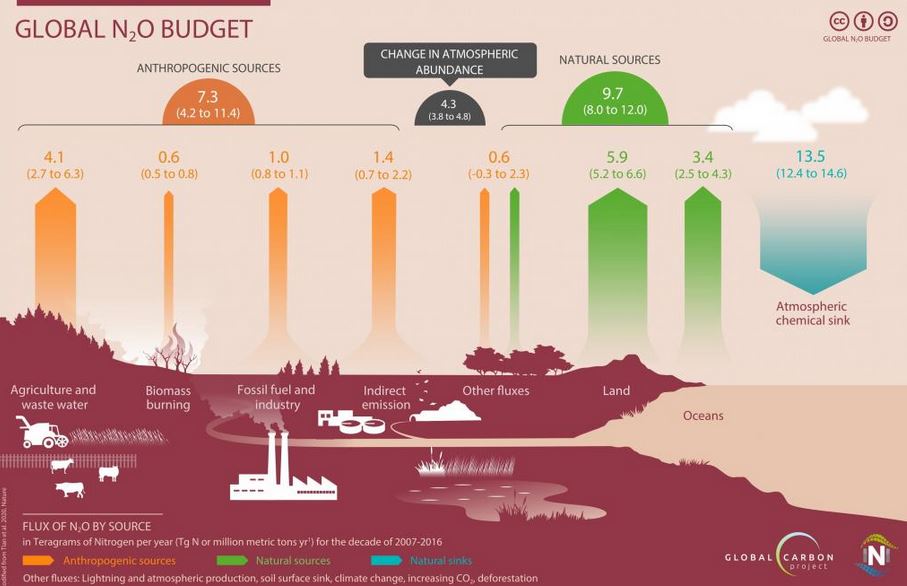
Human emissions of nitrous oxide (N2O) — a greenhouse gas 300 times more potent than carbon dioxide (CO2) — increased by 30 per cent between 1980 and 2016.
Observe the above image carefully and try to find out the major contributor of nitrous oxide emission in the Global N2O Budget.
What is Nitrous oxide?
Nitrous oxide is a dangerous gas for the sustainable existence of humans on Earth.
It has the third-highest concentration — after CO2 and methane — in our atmosphere among greenhouse gases responsible for global warming.
N2O can live in the atmosphere for up to 125 years.
Most N2O emissions have come from emerging countries like India, China and Brazil.
About the research
Nitrous oxide global concentration levels have increased from 270 parts per billion (ppb) in 1750 to 331 ppb in 2018 — a jump of 20 per cent.
The growth has been the quickest in the past five decades because of human emissions.
The research was conducted through an international collaboration between the International Nitrogen Initiative (INI) and the Global Carbon Project of Future Earth, a partner of the World Climate Research Programme.
Why N2O matters?
N2O is also the only remaining threat to the ozone layer, for it accumulates in the atmosphere over a long period of time, just like CO2.
The increase in its emissions means that the climatic burden on the atmosphere is increasing from non-carbon sources as well, while the major focus of global climate change negotiations is currently centred on carbon.
A major proportion of the N2O emissions in the last four decades came from the agricultural sector, mainly because of the use of nitrogen-based fertilizers.
The growing demand for food and feed for animals will further increase global nitrous oxide emissions.
Our PM has launched the physical distribution of Property Cards under the SVAMITVA Scheme.
Try this MCQ:
Q.The SVAMITVA Scheme sometimes seen in news is related to:
Urban Employment/ Land records management/ Child Adoption/ None of these
About SVAMITVA
SVAMITVA stands for Survey of Villages and Mapping with Improvised Technology in Village Areas.
Under the scheme, the latest surveying technology such as drones will be used for measuring the inhabited land in villages and rural areas.
The mapping and survey will be conducted in collaboration with the Survey of India, State Revenue Department and State Panchayati Raj Department under the Ministry of Panchayati Raj.
The drones will draw the digital map of every property falling in the geographical limit of each Indian village.
Property Cards will be prepared and given to the respective owners.
Significance of the scheme
The scheme paves the way for using the property as a financial asset by villagers for taking loans and other financial benefits.
Also, this is the first time ever that such a large-scale exercise involving the most modern means of technology is being carried out to benefit millions of rural property owners.
Various benefits
The scheme will create records of land ownership in villages and these records will further facilitate tax collection, new building plan and issuance of permits.
It will enable the government to effectively plan for the infrastructural programs in villages.
It would help in reducing the disputes over property.
Back2Basics: E-Gramswaraj Portal
E Gram Swaraj portal is the official portal of central govt for the implementation of Swamitva scheme.
By visiting this portal people can check their Panchayat profile easily. It will also contain the details of ongoing development works and the fund allocated for them.
Any citizen can create his or her account on the portal and can know about the developmental works of villages.
The user of E Gram Swaraj portal can also access all work of the Ministry of Panchayati Raj.
This single interface will help speed-up the implementation of projects in rural areas from planning to completion.
Union Ministry of Chemicals & Fertilizers has launched an indigenous variety of fertilizers- ‘Calcium Nitrate’ & ‘Boronated Calcium Nitrate’.
Try this PYQ:
Why does the Government of India promote the use of ‘Neem-coated Urea’ in agriculture?
(a) Release of Neem oil in the soil increases nitrogen fixation by the soil microorganisms
(b) Neem coating slows down the rate of dissolution of urea in the soil
(c) Nitrous oxide, which is a greenhouse gas, is not at all released into atmosphere by crop fields
(d) It is a combination of a weedicide and a fertilizer for particular crops
What is Calcium Nitrate?
Calcium nitrate is used as a water-soluble fertilizer in agriculture. In addition, this product is also used in wastewater treatment and to increase the strength of cement concrete.
Last year, around 1.25 lakh metric tons (1,23,000 tons) of Calcium Nitrate was imported in the country.
Of this, 76% was imported from China and the rest from other countries like Norway and Israel.
These indigenous varieties will provide a quality product at a cheaper rate to the farmer community in the country than imported ones.
Uses of Calcium nitrate
The fertilizer grade calcium nitrate is popular in the greenhouse and hydroponics. It is also used to control certain plant diseases.
Calcium nitrate is also used in wastewater pre-conditioning for odour emission prevention.
Indian researchers have successfully developed new Aqueous Suspension formulation technology of bio-pesticide based on entomopathogenic fungus Verticillium lecanii.
Try this PYQ:
Q.Recently, there was a growing awareness in our country about the importance of Himalayan nettle (Girardinia diversifolia) because it is found to be a sustainable source of
(a) anti-malarial drug
(b) biodiesel
(c) pulp for paper industry
(d) textile fibre
Verticillium lecanii
This bio-pesticide formulation has been found very effective in controlling various insects in seed spice crops (fenugreek, cumin, and coriander).
It has a good shelf life, safe to user & environment and it may be effectively used for controlling different agricultural insects especially in seed spice crops.
This bio-pesticide may be used as a safer alternative to chemical pesticides to minimize pesticide residue problem.
Besides, it may be used as a key input for crop protection from insects pest in organic agriculture and Integrated Pest Management.
RudraM-I is an anti-radiation missile can locate and target any radiation-emitting source like enemy radars, communication sites and other Radio Frequency (RF) emitting targets.
It is being developed by Defence Research Development Laboratory (DRDL), Hyderabad, as the nodal agency.
It is a joint effort involving several DRDO labs, the IAF, the Hindustan Aeronautics Limited (HAL) and several public and private sector enterprises.
This is the first indigenous anti-radiation missile of the country. It has a range of up to 200 km depending upon the launch conditions.
It can be launched from altitudes of 500 m to 15 km and speeds of 0.6 to 2 mach.
It can play a key role in neutralizing any jamming platforms of the enemy or take out radar stations thereby clearing a path for own fighters to carry out an offensive and also prevent own systems from being jammed.
How does it work?
Anti-radiation missiles are designed to detect, track and neutralize the adversary’s radar, communication assets and other radio frequency sources, which are generally part of their air defence systems.
Such a missile’s navigation mechanism comprises an inertial navigation system — a computerised mechanism that uses changes in the object’s own position — coupled with GPS, which is satellite-based.
For guidance, it has a “passive homing head” — a system that can detect, classify and engage targets (radio frequency sources in this case) over a wide band of frequencies as programmed.
Once the RudraM missile locks on the target, it is capable of striking accurately even if the radiation source switches off in between.
The Nobel Peace Prize was awarded to the World Food Programme (WFP) for feeding millions of people from Yemen to North Korea, with the coronavirus pandemic seen pushing millions more into hunger.
The WFP is the food-assistance branch of the United Nations and the world’s largest humanitarian organization focused on hunger and food security.
Founded in 1961, it is headquartered in Rome and has offices in 80 countries.
In addition to emergency food aid, WFP focuses on relief and rehabilitation, development aid, and special operations, such as making food systems more resilient against climate change and political instability.
It is an executive member of the United Nations Development Group, which collectively aims to fulfil the 17 Sustainable Development Goals (SDG), and has prioritized achieving SDG 2 for “zero hunger” by 2030.
Blessed with a vibrant colour pattern, including vermilion (Haldi – kumkum), the Indian Jezebel (or Common Jezebel) is known to deter its predators with its flashy wing colours.
Regarded as soldiers of farmers, they also prey on parasites that infest fruit-bearing plants.
Widely distributed, the species can be spotted in gardens and other lightly wooded areas.
(2) Krishna Peacock
It is a flagship species for biodiversity and conservation, generally found in large numbers in the Himalayas.
Possessing a peculiarly large swallowtail, its iridescent green scales diffract light to coat itself in radiance.
(3) Orange Oakleaf
It is commonly known as ‘dead leaf’ for its ability to camouflage as a dry autumn leaf while striking a stationary pose with its wings closed.
The masquerade enables the species to prevent it from being devoured by birds in the moist forests of the northern Western Ghats, central, northern and northeastern parts of India where they are generally found.
Besides, the Oakleaf is also known to exhibit polyphenism as it assumes specific colour and size during dry and wet seasons.
The article highlights the importance of CAG in times of disasters to ensure check and balances.
Context
With the nation spending substantial resources to manage the pandemic, the role of Comptroller and Auditor General (CAG) of India has come into prominence.
Opportunity for corruption in pandemic
Allegations of siphoning off of funds to purchase the inferior quality at prices higher than those prevailing in the market are made.
The opportunity to indulge in corruption exists in disaster management.
Emergency procurement to save lives and reduce sufferings are a chance to obfuscate rules and procedures and can happen in all three tiers of governance.
Role of the CAG
If all the major purchases by governments are audited by the CAG, there can be substantial improvement in disaster management.
It will usher in better transparency, integrity, honesty, effective service delivery and compliance with rules and procedures and governance.
The CAG has issued an order creating a new vertical — health, welfare and rural development, restructuring the office of the Director General of Audit, Central Expenditure.
It is necessary that the CAG undertakes performance audits of COVID-19 related procurements, the Central Government Health Scheme (CGHS) and Employee State Insurance (ESI) hospitals.
A beneficiary survey will become part of the audit process to bring out efficacy of service delivery and the availability and quality of drugs.
Audit recommendations can contribute improvements in various aspects of disaster preparedness, management and mitigation.
Benefits of audit
The statutory responsibility of CAG includes appraising disaster preparedness, ensuring that management, mitigation operations, procedures are complied with, and proper internal controls are in place.
Ensuring that there are proper records, documentation, authentic, accurate, reliable and complete information and data.
Providing assurance to people’s representatives, tax payers and the public at large that government resources are being used prudentially as per the law and regulations and safeguarded.
Providing assurance that risks are assessed, identified and minimised with established disaster management process and procedures.
Offering assurance that resources are being used economically efficiently and effectively for achieving the planned objectives and that benefits have gone to the targeted beneficiaries.
Conclusion
All public entities management must be accountable and ensure that resources are managed properly and used in compliance with laws and regulations; programmes are achieving their objectives; and services are being provided efficiently, effectively, and economically.