The Bangladesh Nationalist Party secured a landslide victory in Bangladesh’s parliamentary elections held on February 12. Party chief Tarique Rahman is set to form the next government, with transfer of power likely by February 17 or 18.
Key Election Results
BNP led alliance won 212 seats, securing a two thirds majority in the Jatiyo Sangsad
11 party alliance led by Jamaat-e-Islami won 77 seats
The Prime Minister inaugurated the new Prime Minister’s Office complex named Seva Teerth and two Central Secretariat buildings called Kartavya Bhavan 1 and 2 in New Delhi. A commemorative stamp and coin were also released on the occasion.
Key Highlights
New PMO named Seva Teerth
Two new Secretariat buildings named Kartavya Bhavan 1 and 2
Aim to reflect citizen centric governance and Viksit Bharat vision
Replaces space constrained functioning from North Block and South Block
About the Architectural Context
Colonial Era Buildings: North Block and South Block.
Built during the British era when the capital shifted from Kolkata to Delhi in 1912. Designed to represent imperial authority.
Features of the New Complex
Built using white and red sandstone inspired by Indian civic traditions
Domes inspired by Buddhist Stupa architecture
Entrance design draws from Chalukyan temple stone screen work
Plinth band inspired by the 12th century Chennakeshava Temple
[2023] With reference to ancient India, consider the following statements: 1. The concept of Stupa is Buddhist in origin.
2. Stupa was generally a repository of relics.
3. Stupa was a votive and commemorative structure in Buddhist tradition.
How many of the statements given above are correct?
The Union Home Ministry has proposed compiling a standard English medical dictionary titled Medical Shabd Sindhu, which will be translated into 15 Indian languages to support medical education in regional languages under the National Education Policy 2020.
About the Initiative
Led by the Department of Official Language under the Ministry of Home Affairs
Compilation of a standard English medical dictionary
At least 1,00,000 unique medical terms with explanations
Commission for Scientific and Technical Terminology under the Education Ministry has translated around 60,000 medical terms into Hindi so far
Madhya Pradesh became the first State to offer MBBS in Hindi in 2022
Initially, transliterated textbooks were provided in subjects such as anatomy, physiology and biochemistry
Objectives
Promote medical education in mother tongue
Remove language barriers in professional courses
Strengthen regional language knowledge systems
Support NEP 2020 emphasis on multilingual education
[2024] The Constitution (71st Amendment) Act, 1992 amends the Eighth Schedule to the Constitution to include which of the following languages? 1. Konkani
2. Manipuri
3. Nepali
4. Maithili
Select the correct answer using the code given below:
(a) 1, 2 and 3 (b) 1, 2 and 4 (c) 1, 3 and 4 (d) 2, 3 and 4
The Chairperson of the Pension Fund Regulatory and Development Authority announced that the National Pension System (NPS) will raise its equity exposure to 25 percent by FY2027, and that pension funds may begin investing in Alternative Investment Funds (AIFs) by March 2026.
About the National Pension System
Launched in 2004 for government employees and extended to all citizens in 2009
Regulated by PFRDA
Defined contribution pension scheme
Market-linked returns
Two types:
Tier I: Mandatory retirement account
Tier II: Voluntary savings account
Key Announcements
Increase in Equity Exposure
Equity cap in the Government Composite Scheme raised from 15 percent to 25 percent
Current equity exposure around 19 percent
Corporate bond exposure has reduced slightly
G Sec share remains largely stable
Objective: Improve long term returns while maintaining prudent risk levels.
Investment in AIFs: NPS to allow exposure to Alternative Investment Funds (AIFs) by March 2026
MARS Committee
PFRDA has constituted the Minimum Assured Return Scheme (MARS) committee
Exploring a pension product offering a guaranteed minimum return
[2017] Who among the following can join the National Pension System (NPS)? (a) Resident Indian citizens only
(b) Persons of age from 21 to 55 only
(c) All State Government employees joining the services after the date of notification by the respective State Governments
(d) All Central Government Employees including those of Armed Forces joining the services on or after 1st April, 2004
The African Union (AU) held its annual summit in Addis Ababa, Ethiopia, amid rising conflicts, military coups, and governance crises across Africa, raising concerns about its effectiveness and enforcement capacity.
About the African Union
Established in 2002, replacing the Organization of African Unity
Headquarters: Addis Ababa, Ethiopia
Members: 55 African countries
Objective: Promote unity, peace, security, democracy, and economic integration in Africa
Key Institutional Features
Peace and Security Council (PSC): Conflict prevention and peacekeeping
African Charter on Democracy, Elections and Governance: Opposes unconstitutional changes of government
Provision to suspend members after military coups
Current Challenges
10 military coups since 2020 across Africa. AU has struggled to enforce its rule barring coup leaders from contesting elections. Ongoing conflicts in: Sudan, Democratic Republic of the Congo, and Sahel region insurgencies
Weak response to controversial elections in: Tanzania and Burundi
Financial constraints:
Missed self funding targets (2020, 2025)
Around 64 percent funding from external partners such as the US and EU
Why is the AU Considered Weak?
Member states reluctant to grant strong enforcement powers
Dependence on external funding limits autonomy
Political divisions among members
Limited ability to intervene in internal conflicts
[2023] In the recent years Chad, Guinea, Mali and Sudan caught the international attention for which one of the following reasons common to all of them?
(a) Discovery of rich deposits of rare earth elements
Most aspirants don’t fail Mains because they lack knowledge. They fail because they start too late.
They wait for Prelims results. They wait to feel ready. They wait for the perfect plan.
And in that waiting, they lose the biggest advantage, time.
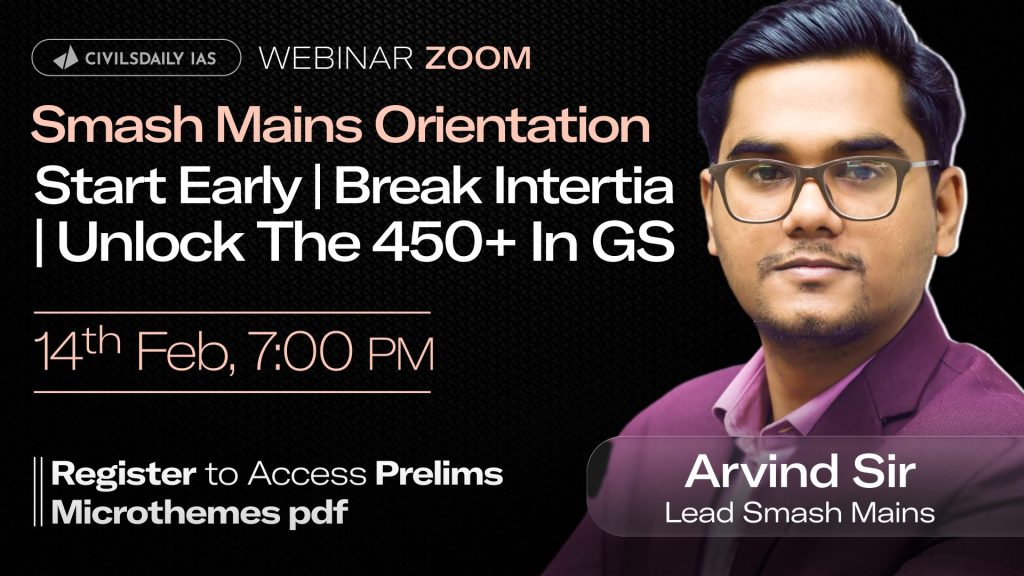
In this special Smash Mains 2027 Orientation, Arvind Sir will show you why starting early is not optional, it’s decisive.
Arvind Sir, Civilsdaily IAS
What I’ll cover in this session:
1. Why most aspirants remain stuck in Mains inertia • The psychology of delay in UPSC preparation. • Why “I’ll start after Prelims” becomes a costly mistake. • How late starters remain trapped in the 90–100 marks range despite effort. • Why inertia, not lack of content, is the real problem.
2. What it actually takes to cross 450+ in GS • Depth vs Width, what truly matters. • Content vs Structure vs Execution, what evaluators reward. • Why writing answers without direction does not improve scores. • The difference between writing regularly and writing strategically.
3. When to start answer writing (and what to write first) • How to build answer writing stamina gradually. • How microthemes improve clarity, structure & recall. • How to avoid burnout while staying consistent. • How to build a system, not just practice randomly.
4. How starting early strengthens content retention • How it improves articulation under time pressure. • How it reduces post Prelims panic. • How it leads to a real score jump, not cosmetic improvement. • Early starters don’t just feel prepared • They perform differently in the exam hall
Who should attend: 1. Serious UPSC 2027 aspirants.
2. 2025/2026 candidates who don’t want to repeat mistakes.
It will be a 45 minute session, post which we will open up the floor for all kinds of queries which a beginner must have. No questions are taboo and Arvind sir is known to be patiently solving all your doubts.
Join us for a Zoom session on 14th Feb at 7 PM. This session is a must attend for you If you are attempting UPSC for the first time or have attempted earlier and now preparing for 2027, then it is going to be a valuable session for you too.
See you in the session”
Register for the session for a complete in-depth UPSC Prep
(Don’t wait—the next webinar/session won’t be until End Feb’26)
These masterclasses are packed with value. They are conducted in private with a closed community. We rarely open these webinars for everyone for free. This time we are keeping it for 300 seats only.
[UPSC 2017] Mention the advantages of the cultivation of pulses because of which the year 2016 was declared as the International year of Pulses by the United Nations.
Linkage: It links to the pulses debate as it highlights their nutritional, ecological, and income-support role, strengthening arguments for procurement reform and crop diversification.
Mentor’s Comment
Pulses policy reflects a structural tension between consumer price stabilization and farmer income security. Weak procurement architecture, import dependence, and trade commitments intersect with federal politics and food security imperatives.
Why in the News?
India’s pulses policy is back in focus after reports of possible import commitments under a trade deal with the United States. This appears to clash with the government’s Mission for Aatmanirbharta in Pulses, raising fresh concerns among farmers about the gap between self-reliance goals and trade decisions.
Why Are Pulses Crucial to India’s Food and Farm Economy?
Protein Dependence: Pulses supply nearly 25% of non-cereal protein intake.
Livelihood Base: Around five crore farmers depend on pulse cultivation.
Persistent Demand Gap: Production ~2.5 crore tonnes; demand ~3 crore tonnes; imports fill deficit.
Food Security Linkage: Dependence on imports exposes vulnerability to global price fluctuations.
How Do Imports Create Immediate Market Distortions?
Centralized Decision Impact: A single central decision to import can immediately lower domestic prices.
Household Spending Relief: Imports reduce consumer expenditure when supply is tight.
Farmer Income Shock: Price depression directly hurts domestic producers.
Food Security Vulnerability: Continued import dependence sustains long-term strategic risk.
Way Forward
Stronger Procurement: Expand procurement centres in pulse-growing areas to ensure MSP reaches farmers and reduce distress sales.
MSP Credibility: Ensure timely and predictable procurement to build farmer confidence and encourage investment.
Stable Import Policy: Align imports with domestic production cycles to prevent sudden price crashes.
Higher Productivity: Promote improved seeds, irrigation support, and climate-resilient varieties to raise yields.
Crop Diversification: Reduce policy bias toward rice and wheat and incentivise pulses through procurement and subsidies.
Conclusion
Pulses policy reflects the tension between consumer price stability and farmer income security. Import dependence without strong procurement weakens domestic incentives and deepens vulnerability. Long-term food security requires credible MSP implementation, higher productivity, and a trade policy aligned with self-reliance goals.
India’s life insurance industry paid ₹60,799 crore in commissions in FY2025, yet premium growth stood at only 6.7% while commission payouts increased by 18%. This divergence signals a structural imbalance between distribution costs and value creation. The Life Insurance Corporation (LIC) reduced its commission ratio from 5.45% to 5.17% despite premium growth of 2.8%, whereas private insurers increased commission ratios sharply to 7.21%-8.95%, leading to a 38.8% surge in commission payouts to ₹35,491 crore. Insurance penetration declined from 4% of GDP in FY2020 to 3.7% in FY2024. The issue marks a shift from episodic compliance concerns to a structural distribution faultline affecting financial stability and consumer welfare.
Public-Private Structure of India’s Insurance Sector
Life Insurance Composition: LIC, the sole public-sector life insurer, contributes 57.07% of total new business premiums (FY2024-25). The sector comprises 27 life insurers, including 26 private companies.
General (Non-Life) Market Distribution: Private insurers hold approximately 64-66% market share, while Public Sector General Insurance Companies (PSGICs) account for 31-32%. The industry includes 34 non-life insurers, 6 public and 28 private (including standalone health and specialised insurers).
Health Segment Significance: Health insurance constitutes 41.42% of gross direct premiums in FY2024-25, emerging as the largest non-life segment. Public sector general insurers’ premiums increased from ₹80,000 crore (2019) to approximately ₹1.06 lakh crore (early 2025).
What Is the Structural Difference Between Public and Private Insurers?
Channel Composition: LIC derives 95% of business from agency channels, enabling tighter commission control.
Agency channels are individual agents appointed by an insurance company to sell its policies directly to customers.
Commission Ratio Reduction: LIC reduced commission ratio from 5.45% to 5.17% despite 2.8% premium growth.
Alternate Channel Dependence:Private insurers rely heavily on bancassurance, brokers, and marketing firms.
Bancassurance is a distribution model where banks sell insurance products to their existing customers.
Sharp Commission Escalation: Private commission ratios rose from 7.21% to 8.95% (174 basis points increase).
Commission Outgo Surge: Private insurer commission payouts increased 38.8% to ₹35,491 crore from ₹25,564 crore.
Why Does Distribution Cost Escalation Reflect Structural Market Imbalance?
Bargaining Concentration: Twenty-six life insurers compete for access to banks operating over 4,00,000 branches, strengthening distributor leverage.
High Switching Power: Banks and brokers control infrastructure and customer base, increasing negotiation power over insurers.
Product-Wise Caps: IRDAI introduced product-level commission ceilings to contain rising distribution payouts.
Expense of Management (EOM) Consolidation: The regulatory framework later shifted to a unified Expense of Management structure, embedding commissions within overall expense limits.
Competitive Structuring: Marketing tie-ups, infrastructure arrangements, and distribution negotiations limited the restraining effect of reforms.
Rising distribution costs signal a structural imbalance in India’s insurance ecosystem rather than a temporary market distortion. Regulatory recalibration under the amended IRDAI framework must prioritise cost efficiency, persistence-based incentives, and balanced public-private participation. Sustainable insurance penetration depends on correcting bargaining asymmetries while safeguarding financial stability and consumer interest.
Value Addition
Insurance Density
Key Figures & Trends:
Recent Density: Around $97 per person for 2024-25.
Life Density: Increased to $72 in 2024-25.
Non-Life Density: Stable at $25 in 2024-25.
Growth: Gradual, steady increase observed since 2016-17.
Comparison with Global Averages (Approximate): India’s density ($97) is a fraction of the global average (around $874 in 2021-22).
Insurance penetration
It in India stood at approximately 3.7% in FY25, remaining relatively stagnant and well below the global average of 7.3%.
Life insurance penetration dipped to 2.7%, while non-life insurance remained flat at 1.0%.
PYQ Relevance
[UPSC 2013] The product diversification of financial institutions and insurance companies, resulting in overlapping of products and services strengthens the case for the merger of the two regulatory agencies, namely SEBI and IRDA. Justify.
Linkage: Recent amendments to the Insurance Regulatory and Development Authority Act have renewed focus on insurance sector reforms, making regulatory architecture and governance in insurance a high-priority area for GS II and GS III. The article’s discussion on distribution costs and bargaining asymmetry highlights why regulatory design under the revised IRDAI framework remains central to sectoral stability.
Global institutions are weakening as U.S.-China rivalry intensifies and countries increasingly take unilateral trade and security actions. The U.S. has bypassed WTO dispute systems and imposed tariffs, while China has expanded trade ties and is now the top trading partner for over 120 countries. The North Atlantic Treaty Organization’s (NATO) role is questioned, and the United Nations (UN) faces decision-making paralysis. Despite tensions, India remains heavily dependent on Chinese imports. The post-1991 liberal global order is fragmenting, forcing India to rethink strategic autonomy, diversify trade, and build domestic capacity. These shifts directly affect India’s trade, security, and diplomatic space.
Introduction
India’s foreign policy evolved from Non-Alignment to strategic autonomy within a multilateral, rule-based global order. The emerging order is increasingly transactional, alliance-driven, and technology-centric. This requires recalibration of India’s external engagement strategy.
Why is Multilateralism Eroding?
Institutional Paralysis: Multilateral institutions such as the UN and World Trade Organisation (WTO) face decision-making deadlocks, reducing enforceability of global norms. The WTO dispute settlement mechanism remains dysfunctional.
Power Politics: Major powers prioritise bilateral leverage over multilateral commitments. The U.S. imposed unilateral tariffs despite WTO membership.
Economic Nationalism: Countries increasingly adopt protectionist measures. The U.S.-China trade war reflects departure from liberal trade principles.
Decline of Global Consensus: Consensus-based diplomacy gives way to issue-based coalitions and minilateral frameworks.
Is Strategic Autonomy Still Viable?
Cold War Origins: Strategic autonomy emerged through the Non-Aligned Movement to preserve decision-making independence amid U.S.-Soviet bipolarity.
Post-1991 Evolution: India retained autonomy while integrating into the liberal economic order, engaging the U.S., Russia, EU, BRICS, and Quad simultaneously.
Operational Example: India purchased the Russian S-400 system despite U.S. CAATSA pressure and did not choose the U.S. Patriot system, demonstrating independent security choices.
Multi-Alignment: Simultaneous engagement in Quad, BRICS, SCO, and continued defence ties with Russia reflect flexible alignment.
Shrinking Multilateral Space: WTO paralysis and UN gridlock reduce institutional protection for balanced positioning.
Capability Imperative: Autonomy is sustainable only if backed by manufacturing strength, technological capacity, and diversified trade. Strategic autonomy now requires material capability, not only diplomatic positioning.
How Is Power Politics Reshaping Global Relations?
U.S.-China Rivalry: The U.S. CHIPS and Science Act (2022) restricts semiconductor exports to China; China advances “Made in China 2025” for tech self-reliance.
Economic Coercion: The U.S. imposed Section 301 tariffs on China; Russia was excluded from SWIFT after the Ukraine war, showing finance as a strategic tool.
Supply Chain Shift: The Indo-Pacific Economic Framework (IPEF) and “friend-shoring” aim to reduce dependence on China; Japan subsidised firms relocating from China.
Minilateralism: The Quad and AUKUS operate outside universal platforms like the UN, focusing on strategic coordination.
WTO Paralysis: The U.S. blocked Appellate Body appointments, disabling dispute settlement since 2019.
What Challenges Does This Create for India?
Trade Dependence: India remains significantly dependent on Chinese imports despite geopolitical tensions.
Development Linkage: External volatility directly affects growth ambitions.
India must therefore shift from reactive diplomacy to structured strategic positioning.
How Should India Reframe Its Foreign Policy?
Endogenous Capacity: Strengthens domestic manufacturing and technological capability.
Trade Diversification: Expands FTAs with EU, Africa, and emerging markets.
Technology Partnerships: Deepens cooperation in AI, digital infrastructure, and cybersecurity.
Pragmatic Regional Engagement: Stabilises neighbourhood relations through economic instruments.
BRICS Repositioning: Aligns BRICS toward economic coordination rather than political bloc identity.
Digital Currency Cooperation: Integrates official digital currencies to facilitate cross-border trade.
Viksit Bharat 2047 Alignment: Links foreign policy with development milestones and economic transformation.
Conclusion
The erosion of multilateralism reflects structural transformation in global power distribution. India must recalibrate foreign policy toward endogenous capacity, diversified trade, and technology-driven growth. Strategic autonomy remains relevant but requires economic and technological foundations to remain credible.
PYQ Relevance
[UPSC 2019] “The long-sustained image of India as a leader of the oppressed and marginalised Nations has disappeared on account of its new found role in the emerging global order”. Elaborate.
Linkage: It examines the evolution of India’s foreign policy from moral leadership of the Global South to pragmatic strategic positioning. It directly links to themes of eroding multilateralism and the shift from traditional strategic autonomy to interest-driven engagement in the emerging global order.
The Defence Acquisition Council chaired by Rajnath Singh has granted Acceptance of Necessity for defence procurement proposals worth about ₹3.6 lakh crore, including 114 Rafale fighter jets and six P-8I aircraft.
About Defence Acquisition Council
Apex decision making body for capital procurement in the Ministry of Defence after the Kargil War of 1999.
Headed by the Defence Minister
Grants Acceptance of Necessity, which is the first formal step in defence procurement
Functions under the framework of the Defence Acquisition Procedure 2020
Composition
The council is chaired by the Defence Minister (Raksha Mantri). Key members include the Chief of Defence Staff, the three Service Chiefs (Army, Navy, Air Force), and the Defence Secretary, with the Deputy Chief of Defence Staff (Planning & Procurement) as Member Secretary.
Key Points: Recent procurement proposals:
Acceptance of Necessity (AoN): First stage of capital procurement approval under Defence Acquisition Procedure 2020.
Indian Air Force: 114 Rafale Multi Role Fighter Aircraft, combat missiles, and High Altitude Pseudo Satellite for ISR and ELINT roles.
Indian Navy: Six P-8I long range maritime reconnaissance aircraft for anti submarine warfare and maritime strike capability.
Indian Army: Procurement of Vibhav anti tank mines and overhaul of T-72, BMP II and armoured recovery vehicles.
[2024] Consider the following aircraft: 1. Rafael
2. MiG-29
3. Tejas MK-1
How many of the above are considered fifth generation fighter aircraft?
![🔴[UPSC Webinar for 2027] By Arvind Sir, Lead Smash Mains, Civilsdaily IAS | Start Early. Break Inertia. Unlock 450+ in GS. | Smash Mains Orientation Session | Join on 14th Feb at 7PM](https://d18x2uyjeekruj.cloudfront.net/wp-content/uploads/2026/02/Arvind-thumb3-1-1568x882.jpg)