For the first time, the National Council of Educational Research and Training (NCERT) has introduced Indian classical music, dance, theatre, and visual arts into primary and middle school textbooks (Classes 3 to 8).
About Classical Arts in School Textbooks
For the first time, NCERT has integrated Indian classical arts (music, dance, theatre, and visual arts) into textbooks for Classes 3 to 8.
The reform aligns with the National Education Policy (NEP) 2020, which mandates rooting education in India’s ethos and cultural heritage.
Music content includes swar, laya, shabd, Sanskrit shloka recitations, folk songs, ragas from Hindustani & Carnatic music.
Dance content covers 8 classical dance forms — Bharatnatyam, Kathak, Kathakali, Kuchipudi, Manipuri, Mohiniyattam, Odissi, and Sattriya.
Draws from ancient texts like Natyashastra, Brihaddeshi, Sangita Damodara, Abhinaya Darpanam.
Pedagogy: Emphasis on exposure, appreciation, and creativity rather than mastery. Includes storytelling, abhinaya (expressions), theatre, group performances.
Classical Dance Forms Mentioned:
Dance Form
Details
Bharatnatyam (Tamil Nadu)
Oldest dance form; temple origins; fixed torso, bent legs, intricate footwork; emphasis on abhinaya and mudras; devotional themes (Bhakti rasa).
Kathak (North India)
Storytelling tradition (katha = story); features fast spins (chakkars) and rhythmic footwork; evolved in temples & Mughal courts; uses ghungroo.
Kathakali (Kerala)
Dance-drama with elaborate costumes, makeup, masks; based on Ramayana, Mahabharata, Puranas; strong gestures, expressions (navarasas).
Kuchipudi (Andhra Pradesh)
Blend of dance & drama with dialogue; famous Tarangam item (dance on brass plate); Vaishnav themes (Krishna stories); brisk, graceful movements.
Manipuri (Manipur)
Graceful, devotional form linked to Ras Lila of Krishna; lyrical movements, cylindrical skirt for women; avoids forceful footwork; spiritual style.
Mohiniyattam (Kerala)
“Dance of the enchantress”; soft, feminine style; gentle swaying movements; solo, mostly by women; white-golden costume; mood of lasya (grace).
Odissi (Odisha)
Temple dance linked to Jagannath worship; tribhangi posture and chauka stance; sculptural quality like temple carvings; strong Vaishnava themes.
Sattriya (Assam)
Introduced by Srimanta Sankardev in monasteries (sattras); devotional Vaishnava themes; combines dance, drama, music; recognised as classical in 2000.
[UPSC 2012] How do you distinguish between Kuchipudi and Bharatanatyam dances?
1. Dancers occasionally speaking dialogues is found in Kuchipudi dance but not in Bharatanatyam.
2. Dancing on the brass plate by keeping the feet on its edges is a feature of Bharatanatyam but Kuchipudi dance does not have such a form of movements.
India is looking to ease its liability laws to limit supplier liability and attract foreign investment for reviving nuclear energy projects and meeting clean energy goals.
UPSC frames broad, issue-based questions linking nuclear energy to climate goals, energy security, and public safety – like the 2018 GS3 question on expanding India’s nuclear programme. Most aspirants focus only on technical or legal specifics, missing deeper themes like foreign investment, private sector entry, and clean energy targets.
This article addresses that gap by offering conceptual clarity through well-structured sub-sections. It connects legal reform to strategic goals – for instance, “Challenges in Amending Nuclear Laws” discusses political and ethical hurdles, while “Why Is India Considering Amending Its Nuclear Laws?” ties the changes to India’s 100 GW nuclear energy target by 2047.
PYQ ANCHORING
GS 3: With growing energy needs should India keep on expanding its nuclear energy programme? Discuss the facts and fears associated with nuclear energy. [2018]
MICROTHEMES: Renewable Energy
India is considering easing Civil Liability for Nuclear Damage Act, 2010 (CLNDA 2010) to reduce accident-related penalties on suppliers, addressing foreign firms’ concerns over unlimited liability. The step aims to revive stalled nuclear projects and advance India’s clean energy targets.
About the Civil Liability for Nuclear Damage Act, 2010 (CLNDA)
The CLNDA is India’s law that deals with compensation and responsibility in case of a nuclear accident. It ensures that people affected by such accidents are compensated quickly and fairly.
It is based on global rules like the Convention on Supplementary Compensation (CSC, 1997), made after the Chernobyl disaster. India joined this agreement in 2016.
The law follows international principles from earlier nuclear safety agreements (Vienna, Paris, and Brussels Conventions).
Key Features:
Strict Liability: The company running the nuclear plant is always responsible for any damage, even if it wasn’t their fault.
Compensation Cap: The operator has to pay up to ₹1,500 crore.
Government Support: If damages go beyond that, the Indian government steps in and pays up to around ₹2,100–₹2,300 crore.
Claims and Disputes:
A special Nuclear Damage Claims Commission is set up to handle compensation claims and solve disputes.
Unique Point – Supplier Liability:
Unlike other countries, India’s law holds suppliers (those who provide parts, materials, or services) also responsible.
If a nuclear accident happens due to faulty equipment or poor-quality services, the plant operator can make the supplier pay—this is allowed under Section 17(b).
Key Concerns regarding CLNDA,2010
Concern
Description
Examples
Supplier Liability and Legal Ambiguities
The inclusion of Section 17(b) allows operators to seek recourse against suppliers for defective equipment or wilful misconduct. This, along with Section 46, raises the possibility of multiple civil claims.
Raises apprehensions among suppliers (domestic and foreign) due to fear of unlimited or prolonged liability.
Insurance and Definition Gaps
Unclear insurance mechanisms and a broad, ambiguous definition of “nuclear damage” complicate liability coverage.
Results in limited availability of insurance and reluctance of suppliers to engage in the sector.
Deterrent to Foreign Investment
India’s liability framework diverges from international norms like the CSC, where liability rests solely with the operator.
Acts as a barrier to nuclear deals and collaborations, notably with countries such as the United States.
Impact on Nuclear Sector Growth
Investor uncertainty stemming from liability provisions has slowed project implementation and financing.
Projects like Jaitapur Nuclear Power Plant (9.6 GW) have seen delays, affecting energy security.
Challenges to Clean Energy Targets
Delayed nuclear expansion undermines India’s commitment to its 500 GW non-fossil fuel target by 2030.
With nuclear power contributing only ~3% to the total energy mix, decarbonization is significantly hampered.
Need for Nuclear Liability Reforms
Attract foreign nuclear suppliers India’s Civil Liability for Nuclear Damage Act (CLNDA), 2010 holds suppliers liable for unlimited accident damages, discouraging companies like GE and Westinghouse. Amending the law to cap supplier liability would encourage their participation. Example: Reuters reports a draft amendment to cap liability at contract value. Business Standard notes supplier reluctance due to existing rules.
Achieve ambitious nuclear targets India aims to scale up nuclear power from ~8 GW to 100 GW by 2047 to meet energy demand and climate goals. This requires large investments and global partnerships, which current laws hinder. Example: Budget 2024 set a 100 GW nuclear goal. India currently operates 24 reactors (~8,180 MW); aims for ~40 GW by 2035.
Encourage private sector investment The Atomic Energy Act (1962) and CLNDA (2010) restrict private ownership of nuclear facilities. Amendments could allow firms like Reliance, Adani, or NTPC to build and operate reactors. Example: Parliament (April 2025) formed committees to study changes. NTPC invited bids to indigenize 15 GW nuclear capacity.
Align liability rules with global norms Internationally, liability for accidents usually rests with plant operators, not equipment suppliers. India plans to adopt this model by capping supplier liability and making operators primarily responsible. Example: Deloitte India says a liability cap will ease supplier fears. Draft law proposes limiting supplier liability to contract value.
Balance reforms with safety concerns The 2010 CLNDA was shaped by the Bhopal gas tragedy, emphasizing supplier accountability. Any changes must balance investment needs with public trust in safety and compensation mechanisms. Example: Business Standard notes the law’s roots in Bhopal. Critics continue to invoke the tragedy when opposing liability dilution.
Address political and legislative hurdles Amending nuclear laws requires parliamentary approval and faces political resistance. Opposition parties criticize the proposed reforms and cite past government positions against amendments. Example: Budget 2024 announced planned reforms. Congress recalled the 2015 MEA statement opposing changes. Minister Jitendra Singh confirmed committees are reviewing with no set timeline.
Strengthen regulatory oversight Greater private and foreign participation demands stricter safety regulations. India plans to enhance monitoring of nuclear fuel use, reactor design, and waste disposal through updated frameworks. Example: Business Standard reports on a proposed new authority for nuclear fuel and waste. All reactor designs will require AERB approval.
Types of Liability
Term: What It Means
Operator LiabilityThis means the company that runs the nuclear plant (like NPCIL in India) is fully responsible if something goes wrong—like a radiation leak or accident.
Supplier LiabilityThis means the company that supplied the parts or technology (like Westinghouse or GE) can also be held legally responsible if their component caused the problem.
Key Difference:
Operator liability is the default model worldwide – only the operator (plant owner) pays compensation. Supplier liability, which India added in 2010 (CLNDA), says the operator can also sue the supplier if a defect in their equipment caused the accident.
Why is this controversial? Foreign companies don’t want supplier liability. They fear being sued for billions if something goes wrong years later.India added it because of public concerns after the 1984 Bhopal gas disaster, where the supplier (Union Carbide) avoided full accountability.
Evolution of Nuclear Liability Laws in India
Time Period
Event / Development
Details and Impact
1962
Atomic Energy Act, 1962 enacted
Established the foundation for India’s nuclear energy program, regulating nuclear materials and facilities. Focus was on development and safety, but did not clearly define liability for nuclear accidents. The government held full control over nuclear activities.
1998
India conducts nuclear tests (Pokhran-II)
Boosted India’s nuclear program but increased global focus on nuclear safety and liability. Highlighted the need for clear liability rules as nuclear energy expanded.
2008
India-US Civil Nuclear Agreement
Opened doors for foreign nuclear technology and fuel imports, but liability concerns remained a sticking point. Foreign suppliers hesitated due to India’s unclear liability rules.
2010
Civil Liability for Nuclear Damage Act (CLNDA), 2010 enacted
India’s first dedicated nuclear liability law. Made the plant operator strictly liable for accidents, but controversially included clauses allowing operator to sue suppliers for defective equipment causing damage (supplier liability). This worried foreign companies.
2013
Supreme Court Judgment on Nuclear Liability
The SC upheld key provisions of the CLNDA, including supplier liability clauses, reinforcing the operator’s right to seek recourse against suppliers. The court stressed the importance of victim compensation but also confirmed government’s position on supplier liability.
2014
Political Opposition and Debate
The opposition and some industry voices demanded changes to reduce supplier liability to attract foreign investment. The government faced pressure balancing public safety concerns and industry interests.
2015-2020
Government reviews amendment proposals
To attract foreign companies like Westinghouse (US) and EDF (France), the government considered amending laws to align with international standards like the Convention on Supplementary Compensation (CSC). Discussions focused on limiting supplier liability to build confidence for technology transfer and investment.
2022
Rising push for private sector involvement
India set ambitious targets to increase nuclear power capacity to 100 GW by 2047. Legal reforms discussed to allow private companies to build and operate nuclear plants, requiring clarity and fair liability provisions to de-risk investments.
2023 onwards
Ongoing legal and policy reforms
Draft amendments and policy frameworks aim to balance strict operator liability (to protect public safety) with limited supplier liability (to attract foreign and private investors). The Supreme Court continues to emphasize victim rights while acknowledging the need for a sustainable investment climate.
Challenges in amending Nuclear Liability Laws
Amending nuclear laws in India – especially the Atomic Energy Act, 1962 and the Civil Liability for Nuclear Damage Act (CLNDA), 2010 – faces several complex challenges across political, legal, public, and strategic domains. These include:
1. Political Sensitivity and Opposition Resistance
Amendments to nuclear laws are politically contentious, especially those seen as diluting liability provisions.
Opposition parties (like Congress and Left) often invoke the legacy of the 1984 Bhopal gas tragedy, accusing the government of compromising victim rights and accountability.
Any shift perceived as favoring foreign suppliers may trigger public and parliamentary backlash.
2. Public Sentiment and Safety Concerns
The CLNDA 2010 was enacted amid strong public demand for corporate accountability.
Reducing supplier liability could be seen as prioritizing business interests over citizen safety and victims’ compensation.
Civil society and activists continue to raise concerns about weakening safeguards.
3. Legal and Constitutional Complexity
Changes to the liability regime may involve constitutional interpretation, especially related to Right to Life (Article 21) and environmental safety.
Any amendment reducing accountability could face judicial review or Public Interest Litigations (PILs).
4. International Commitments vs. Domestic Law
India must balance its commitments to international nuclear conventions (e.g. CSC – Convention on Supplementary Compensation) with its domestic liability framework.
While global norms place liability primarily on the operator, India’s current law uniquely allows operator recourse against suppliers (Section 17(b) of CLNDA).
5. Multi-Ministry Coordination and Bureaucratic Delay
Amendments require consensus among multiple agencies: Department of Atomic Energy (DAE), Ministry of External Affairs, AERB, NITI Aayog, Law Ministry, etc.
Internal differences and risk-averse bureaucracy slow down the reform process.
As of 2025, no fixed timeline exists for proposed amendments.
6. Strategic Autonomy and Technology Dependence
While reforms may attract foreign suppliers and investments, critics argue this could increase dependence on U.S./Western tech firms.
Strategic concerns include protecting India’s autonomy in nuclear fuel cycles, reactor design, and waste management.
7. Absence of a Strong Regulatory Framework
Bringing in private and foreign players demands robust safety, monitoring, and liability enforcement mechanisms, which need to be developed alongside legal changes.
Without strong regulation, trust in safety may erode—especially in the event of an incident.
Way Forward
1. Legislative Reforms
Amend Section 17(b): Limit supplier liability to intentional wrongdoing or gross negligence, in line with global norms.
Amend Atomic Energy Act: Allow private firms to participate, especially in Small Modular Reactors (SMRs).
2. Financial Safeguards
Insurance Consortium: Create an international pool to cover supplier liability risks.
Risk-Sharing Fund: Establish a domestic fund to reduce taxpayer burden and support accident compensation.
3. Diplomatic & Bilateral Solutions
Sign IGAs: Partner with countries like the U.S., France, and Japan to clarify liability terms and set up dispute resolution.
Revive Projects: Use diplomatic assurances to restart stalled projects like Jaitapur and Kovvada.
4. Strengthen Regulation & Safety
Empower AERB: Ensure independent, strong oversight of safety and operations.
Third-Party Audits: Mandate external safety checks for all reactors.
Disaster Protocols: Fast-track nuclear emergency response systems to build public trust.
5. Investment Incentives
Tax Breaks & Subsidies: Encourage private investment in nuclear energy.
Low-Interest Loans/Grants: Offset high costs of insurance and safety compliance.
#BACK2BASICS: ATOMIC ENERGY REGULATION FRAMEWORK
A. ACTS AND RULES
Name of Act/Rule
Purpose
Key Provisions/Notes
Atomic Energy Act, 1962
Principal legislation for atomic energy regulation in India
Empowers Central Government for control and development of atomic energy.Regulates mining, production, and use of nuclear materials- Establishes plants and institutions.Authorizes licensing and prohibits unauthorized use
Civil Liability for Nuclear Damage Act, 2010
Establishes liability for nuclear accidents
Operator’s liability capped at ₹1,500 crore.Right of recourse against suppliers (Section 17(b))Enables Nuclear Liability Fund.Aligns with CSC treaty
Atomic Energy (Safe Disposal of Radioactive Waste) Rules, 1987
Governs disposal of radioactive waste
– Approval from AERB required for disposal methods- Focus on health and environmental protection
B. REGULATORY BODIES
Name
Established
Functions
Department of Atomic Energy (DAE)
1954 (under PMO)
– Develops policies for nuclear energy- Oversees research and development- Coordinates nuclear power programs
Atomic Energy Regulatory Board (AERB)
1983
– Independent regulator for radiation and nuclear safety- Issues licenses, guidelines, and safety inspections- Ensures compliance with radiation protection norms
C. INTERNATIONAL COMMITMENTS
Treaty/Agreement
India’s Position
Key Features
Nuclear Non-Proliferation Treaty (NPT)
Not a signatory
India maintains sovereign control over nuclear arsenal and civilian use
Convention on Nuclear Safety (CNS)
Signatory
Promotes safety of nuclear power plants through peer review and reporting
Convention on Supplementary Compensation for Nuclear Damage (CSC)
Signatory
Provides global legal framework for nuclear liability and compensation
IAEA Safeguards Agreement (as part of Indo-U.S. deal)
Signatory (2009)
Applies IAEA safeguards to civilian nuclear facilities for transparency and non-diversion
Why Is India Considering Amending Its Nuclear Laws?
Objective
Explanation
Examples
To Attract Private and Foreign Participation
The Civil Liability for Nuclear Damage Act (CLNDA), 2010 imposes strict liability on operators and allows right of recourse against suppliers. This discourages global companies from participating.
Firms like Westinghouse (USA) and EDF (France) have stayed away due to fear of unlimited liability.
To Meet Clean Energy Targets
India aims to expand nuclear power capacity from 8 GW to 100 GW by 2047 as part of its energy transition plan. Private and foreign capital is essential for achieving this goal.
The current public sector capacity alone is insufficient to meet this target.
Concerns Over Foreign Investment and Liability
Issue
Concern
Example
Fear of Legal Responsibility
Foreign firms are concerned they’ll be held liable for accidents even if their equipment fails.
Westinghouse and Areva avoided Indian markets for this reason.
Exclusive Operator Liability
Under Indian law, NPCIL (public operator) bears full liability even when fault lies with the supplier.
Suppliers are not directly accountable.
Legacy of Industrial Accidents
Memories of the Bhopal Gas Tragedy make both public and political leadership cautious about reducing liability for foreign companies.
In 2012, the NDA opposed dilution of liability citing past industrial disasters.
How Will Legal Amendments Help Achieve the 100 GW Goal?
Change
Expected Impact
Examples
Foreign Participation
Aligning liability provisions with global norms will open the door for foreign investment and technology.
Westinghouse and EDF have expressed interest, contingent on liability changes.
Domestic Private Sector Involvement
Amending the Atomic Energy Act, 1962 could allow Indian private companies to construct and run nuclear plants.
Firms like L&T and BHEL could contribute infrastructure and components.
Investment in SMRs
Legal certainty may attract investment in Small Modular Reactors (SMRs)—a scalable and future-ready technology.
SMRs are suitable for remote areas and industrial use, and can complement renewables.
What Are Small Modular Reactors (SMRs)?
Feature
Details
Definition
Compact nuclear reactors with capacity up to 300 MW, factory-built for easier transport and quicker installation.
Advantages
Use passive safety features, suitable for remote regions, industrial power, and grid integration with renewables.
Global Trend
Being explored by countries like the USA, UK, Russia, and now India for decentralized nuclear expansion.
Challenges in Technology Transfer of SMRs
Challenge
Explanation
Examples
Profit-Driven Sharing
Private foreign firms are unlikely to share SMR tech unless it guarantees high returns.
US firms may restrict tech transfer without IP safeguards.
Export Controls
National governments may block tech transfer citing national security.
The US government regulates exports strictly—learning from past issues with China.
Partial Transfers Only
Even friendly countries often withhold core technology.
Russia’s Rosatom allowed India to build subcomponents of VVER reactors but retained control over hot sections.
SMASH MAINS MOCK DROP
India’s nuclear liability regime, while rooted in justice and accountability, has become a major roadblock to the country’s clean energy transition. Critically examine the need for reforming the Civil Liability for Nuclear Damage Act, 2010, in the context of India’s energy security and climate commitments.
On 23rd August 2025, UPSC conducted the UPSC Mains GS Paper 1 Exam 2025 and the PDF for the same is available here to download. Rest of the UPSC Mains Question Paper 2025 will be available here in PDF format for aspirants once the exam is over. The UPSC Mains 2025 is scheduled to be held from August 22 to 31, 2025.
Artificial Intelligence (AI) is steadily entering the Indian judiciary, promising efficiency in a system burdened with nearly five crore pending cases. However, without proper guardrails, it risks undermining the very foundation of justice. The recent Kerala High Court guidelines mark India’s first attempt at framing policy around AI use in judicial processes. This is a critical juncture where technology and justice intersect demanding careful balance between innovation and accountability.
Introduction
The integration of Artificial Intelligence into courts represents a paradigm shift in India’s judicial landscape. While AI tools such as transcription, translation, and defect detection offer solutions to systemic inefficiencies, their unregulated use could lead to serious ethical and legal risks. From mistranslations of legal terminology to hallucinations in Large Language Models (LLMs), the challenges are real. The need of the hour is a structured framework that ensures AI strengthens, rather than weakens, the judiciary’s integrity and human-centric decision-making.
The Growing Relevance of AI in Courts
First policy initiative: In July 2025, the Kerala High Court released the “Policy Regarding Use of Artificial Intelligence Tools in District Judiciary,” the first of its kind in India.
Case Management & Reducing Pendency: AI can assist in case listing, tracking, and prioritization to improve efficiency. Eg: The Supreme Court Portal for Assistance in Court’s Efficiency (SUPACE) developed by the Supreme Court helps judges analyze case facts quickly.
Enhancing Transparency & Access to Justice: AI chatbots and online portals assist litigants in understanding procedures, filing cases, and accessing justice without middlemen. Eg: The Supreme Court’s AI-driven translation project ‘SUVAS’ (Supreme Court Vidhik Anuvaad Software) translates judgments into regional languages to empower citizens.
Why are AI-enabled court processes risky?
Mistranslation risks: In India, the Supreme Court’s AI-based translation initiative SUVAS once mistranslated “leave granted” as “chhutti manzoor” (holiday approved) in Hind
Hallucinations in AI: LLMs such as Whisper generate fictitious phrases when encountering pauses, leading to unreliable records.
Bias in legal research: AI search results may amplify user patterns, invisibilising relevant precedents, impacting fair adjudication.
Reductionist adjudication: AI risks turning nuanced judicial reasoning into mere rule-based inference, undermining human judgment.
How is AI being used in courts today?
Pilot tools: Market tools are in test use for transcription of oral arguments and witness depositions, though without timelines or safeguards.
Manual checks: Current safeguards include retired judges and translators manually vetting AI-generated judgments.
Risk of dependency: Courts adopting AI pilots without frameworks risk becoming dependent on vendors without sustainable adoption plans.
What are the guardrails necessary for responsible AI use?
Critical AI literacy: Judges, lawyers and staff need capacity-building to understand both potential and limitations of AI.
Transparency rights: Litigants should be informed if AI is used in research or judgment-writing; they should also have the right to opt out.
Procurement standards: Courts need standardised procurement guidelines to assess reliability, explainability, data handling, and vendor compliance.
Dedicated tech offices: The Vision Document for Phase III of the eCourts Project suggests creating technology offices to guide courts in evaluating and adopting AI tools.
The way forward for AI in judiciary
Balanced adoption: AI must serve the ends of justice, not replace human reasoning.
Infrastructure readiness: Reliable internet and hardware are prerequisites before full-scale deployment.
Oversight and accountability: Independent monitoring systems and ethical review frameworks must be built into adoption.
Conclusion
AI can be a transformative force in India’s judiciary, addressing inefficiencies in a system struggling under massive case pendency. But technology without guardrails risks introducing new layers of error, bias, and opacity. The ultimate purpose of judicial reform must remain the same, to deliver fair, timely, and human-centred justice. Clear guidelines, transparency, and ethical oversight will determine whether AI strengthens or weakens the rule of law in India.
Value Addition
AI is already being deployed in judicial systems worldwide to improve efficiency, accessibility, and decision-making.
Legal Interpretation Aid: Judges in the U.S. used AI to clarify the meaning of complex legal terms during sentencing appeals.
Victim Impact Statement: Arizona courts allowed AI to recreate a victim’s voice for delivering impact statements.
Affordable Legal Services: Garfield AI in the UK provides cheap legal documents, reducing case backlog.
Responsible AI Use Rules: California courts framed formal guidelines for safe AI adoption in judicial work.
Transcription & Translation (India): Supreme Court uses AI for live transcription and translation of hearings.
Case Summarization (India): Nyay-Darpan delivers summaries and similar case retrieval in consumer law disputes.
Case Classification (Brazil): AI model routes Supreme Court cases, cutting delays in document handling.
AI Judge for Small Claims (China): Smart Courts handle repetitive small cases via AI systems.
Judicial Summaries (Brazil): AI tools assist in generating summaries, easing court management.
Access to Justice (Canada): Botler AI chatbot helps citizens understand rights in harassment cases.
PYQ Relevance
[UPSC 2018] E-Governance is not only about utilization of technology but also about the ‘use value’ of information. Explain.
Linkage: The 2018 UPSC question on E-Governance and ‘use value’ of information directly links to AI in judiciary: while AI can speed up translations, research, and transcription, its real worth lies in enhancing accessibility, transparency, and fairness in justice delivery—not just technological adoption.
Independence Day speeches are often symbolic, but in 2025 the Prime Minister shifted focus to frontier technologies, semiconductors, clean energy, AI, quantum computing, and defence indigenisation. Unlike earlier years, this vision was paired with the acknowledgment that bureaucratic inertia and regulatory red tape remain India’s toughest hurdles. The central challenge is whether India’s governance structures can keep pace with its technological ambitions.
Significance of the 2025 Speech by the Prime Minister
Future focus: Strong emphasis on frontier areas like semiconductors, EVs, and jet engines.
Symbolic push: The PM asked if fighter jet engines should not be Indian-made.
Bold promise: India will shed dependency in two decades.
Data milestone: India is the largest per capita data consumer (32 GB), ahead of China and the US.
India’s current position in technology and self-reliance
Strength in mid-tech: Success in fintech, data access, and digitisation
Import dependency: India depends heavily on imports in semiconductors, defence hardware, AI hardware, and clean energy technologies.
Global presence: Firms like Nvidia and IBM rely on India’s talent pool, but domestic ecosystems remain thin.
Bureaucratic Challenges that obstruct deep-tech ambition
Colonial bureaucratic legacy: The Westminster model prioritised control over innovation and accountability.
Rigid steel frame: The “steel frame” of the civil services designed to ensure subservience to colonial administrators remains rigid even a century after the Public Service Commission’s creation in 1926.
Unrealised reforms: The Veerappa Moily Committee (2005) suggested domain experts and ethics codes-still pending.
Lateral entry limits: Attempts at inducting experts face systemic resistance.
Why are regulatory and judicial reforms critical?
Persistent red tape: The Deregulation Commission (2025) was set up to identify redundant compliance norms, but structural bottlenecks persist.
Judicial backlog: Slow dispute resolution and investment climate, affectshigh-tech sectors.
Comparative lessons:
US & China: Despite different models, both empower political leadership over bureaucracy to push national interests.
UK: Even Britain debates its bureaucratic model, Dominic Cummings under Boris Johnson pushed for external competition and greater ministerial control.
How does this link to Viksit Bharat@2047?
Ambition vs. architecture: India’s goal of becoming a deep-tech powerhouse is contingent not just on financial investment but on restructuring governance.
Symbolic timing: The UPSC centenary in 2026 is a historic chance for overhaul.
Future-readiness: Without structural reform, Atmanirbhar Bharat may remain aspirational.
Conclusion
India’s ambition to lead in deep-tech must be matched with institutional reform. The PM’s 2025 speech acknowledged that Atmanirbharta is as much about fixing bureaucratic bottlenecks as building jet engines or quantum labs. The centenary of UPSC offers an opportune moment to align India’s governance with its 2047 goals.
Value Addition
Committees on Civil Service Reforms
1. Santhanam Committee (1964)
Focus: Preventive corruption measures.
Key suggestion: Creation of the Central Vigilance Commission (CVC).
2. Kothari Committee (1976)
Focus: Recruitment and exam structure of Civil Services.
Key suggestion: Recommended 3-stage exam (Prelims, Mains, Interview), which is still followed today.
3. Satish Chandra Committee (1989)
Focus: Review of recruitment and selection.
Key suggestion: Increased emphasis on aptitude and ethics in recruitment.
4. Hota Committee (2004)
Focus: Ethics, transparency, and performance.
Key suggestion: Right to Information, performance-linked incentives, citizen charters.
5. Second Administrative Reforms Commission (ARC) – Veerappa Moily (2005–2009)
Most comprehensive civil service reform report (15 volumes). Key suggestions:
Lateral entry of domain experts.
Code of Ethics & Code of Conduct.
Citizen-centric administration
Performance-based appraisal system.
Training in e-governance and modern management practices
6. Punchhi Commission (2010) – on Centre-State relations
Relevant link: Stressed need for civil service neutrality in federal governance.
7. Baswan Committee (2016)
Focus: UPSC exam age and attempts.
Key suggestion: Reduce maximum age for UPSC CSE (though not implemented).
8. Current initiatives
Lateral entry into Joint Secretary and Director-level posts.
Mission Karmayogi (2020): National Programme for Civil Services Capacity Building (NPCSCB) to train officers with competency-based framework.
Deregulation Commission (2025): Identifying and scrapping redundant compliances.
Mapping Microthemes
GS Paper-II: Civil Service Reform, Regulation, Judiciary
GS Paper -III: Tech missions, Defence Indigenisation, Atmanirbhar Bharat
GS Paper -IV: Accountability, Ethics in governance
PYQ Relevance
[UPSC 2016] Civil Services “Traditional bureaucratic structure and culture have hampered the process of socio-economic development in India.” Comment.
Linkage: PM Modi’s Independence Day 2025 address highlighted that despite India’s technological advances, the colonial-era bureaucratic “steel frame” continues to obstruct innovation, investment, and governance reforms. The traditional bureaucratic structure—designed for control rather than development—remains a bottleneck in achieving Atmanirbhar Bharat. Thus, the speech directly echoes the UPSC 2016 theme that outdated bureaucratic culture hampers socio-economic transformation.
Canada has decided to drop retaliatory tariffs and mirror the U.S. exemptions on goods covered under the United States-Mexico-Canada Agreement (USMCA). This represents a success in preserving tariff-free trade for over 85% of Canada-U.S. commerce. But sector-specific tariffs like the 50% duties on steel and aluminium continue to hurt Canadian industries. The development is crucial, given Canada’s heavy reliance on the U.S. market, with more than 75% of its exports heading south.
Significance of the News
Tariff Alignment: Canada has chosen to align its tariff exemptions with those of the U.S., signaling a conciliatory move in contrast with earlier retaliatory tariffs.
First-time Reset: For the first time since retaliatory duties were announced, Canada is rolling them back to match U.S. exemptions under USMCA, a notable policy reversal.
Trade Dependence: With over 75% of Canadian exports going to the U.S., the stakes are extremely high, making tariff negotiations critical for economic stability.
Striking Data: 85% of Canada-U.S. trade is still tariff-free, reflecting both success in negotiations and risks if the pact weakens.
What is USMCA?
USMCA Pact: Signed in 2020, it replaced NAFTA and provides preferential treatment for Canadian and Mexican goods entering the U.S.
Carve-out Mechanism: Goods shielded under the agreement are protected from punitive tariffs, preserving market access.
Upcoming Review : The pact is up for review in 2026, adding urgency to Canada’s attempt to preserve smooth trade relations.
How does Canada benefit from this carve-out?
Preferential Access: Canadian goods remain shielded from most punitive duties.
Export Stability: With 75% of exports going to the U.S., the pact secures critical market access.
Low Tariff Burden: U.S. average tariffs on Canadian goods remain among the lowest globally.
What are the challenges despite tariff exemptions?
232 Tariffs: The U.S. has imposed sector-specific duties, including 50% tariffs on steel and aluminium, straining Canadian industries.
Renegotiation Risk: U.S. Commerce Secretary Howard Lutnick has hinted at reopening USMCA talks, creating uncertainty.
Dependence Dilemma: Canada retains some retaliatory tariffs, but its heavy reliance on U.S. markets weakens bargaining power.
Why is this crucial for North American trade stability
Export Dependence: More than 75% of Canada’s exports and 80% of Mexico’s exports head to the U.S., underlining their vulnerability.
Regional Integration: The USMCA has reestablished tariff-free trade for the majority of goods, preventing economic disruption in North America.
Geopolitical Context: At a time of growing global protectionism, North America’s internal trade pact provides a stabilising force, but also exposes Canada and Mexico to unilateral U.S. decisions.
Conclusion
Canada’s decision to align its tariffs with U.S. exemptions under USMCA reflects both pragmatism and vulnerability. While the pact secures tariff-free trade for the majority of goods, sector-specific tariffs and the looming threat of renegotiation highlight the fragile foundation of North American trade integration. For Canada, the challenge lies in balancing sovereignty with economic dependence, a dilemma increasingly relevant in today’s protectionist world.
Value Addition
United States–Mexico–Canada Agreement (USMCA)
Key Features (vs. NAFTA)
Rules of Origin – Higher thresholds for auto production (75% North American content vs. 62.5% under NAFTA).
Labour Provisions – Stronger labour standards; Mexico required to reform labour laws.
Digital Trade – New rules on data flows, e-commerce, and IP rights absent in NAFTA.
Sunset Clause – Agreement reviewed every 6 years; expires after 16 years unless renewed.
Agriculture – U.S. gained greater access to Canadian dairy market.
PYQ Relevance
[UPSC 2018] How would the recent phenomena of protectionism and currency manipulations in world trade affect macroeconomic stability of India?
Linkage: The USMCA episode shows how U.S. protectionism through sectoral tariffs (like 50% on steel/aluminium) can destabilize even close trade partners like Canada. Such measures reflect the larger global trend of tariff wars and currency leverage, which disrupt supply chains and investment flows. For India, this highlights risks to macroeconomic stability via trade deficits, inflationary pressures, and exchange rate volatility.
The Indian Space Research Organisation (ISRO) is developing its heaviest-ever rocket, the Lunar Module Launch Vehicle (LMLV).
About Lunar Module Launch Vehicle (LMLV):
Overview: India’s heaviest rocket under development by the Indian Space Research Organisation (ISRO).
Purpose: Designed mainly for lunar exploration, including India’s first human mission to the Moon by 2040.
Strategic Role: Replaces the Next Generation Launch Vehicle (NGLV) plan and will support India’s space station programme.
Scale: As tall as a 40-storey building, far larger than the current LVM-3.
Key Features:
Payload Capacity: Can carry 80 tonnes to Low Earth Orbit (LEO) and 27 tonnes to the Moon, suitable for human-rated spacecraft.
Three-stage: Partially reusable super heavy-lift vehicle with:
First two stages using liquid propellants.
Third stage using cryogenic propellant.
Strap-on boosters taller than the entire LVM-3 rocket.
27 engines in the first stage (core + boosters).
Timeline: Expected completion by 2035.
Indigenous Development: Conceived by ISRO within months; aligned with India’s long-term space exploration goals.
Future Missions based on LMLV:
Human Lunar Mission (2040 target): Capable of carrying 18–20 tonne crew modules for India’s first astronaut landing on the Moon.
Bharatiya Antariksh Station (BAS): Will deploy heavy modules for India’s planned five-module space station by 2035.
Lunar Cargo Missions: Can transport ~27 tonnes to the Moon, supporting logistics and lunar infrastructure.
Deep Space Exploration: Its heavy-lift capacity could enable interplanetary missions in the 2040s, extending beyond lunar exploration.
[UPSC 2018] With reference to India’s satellite launch vehicles, consider the following statements:
1.PSLVs launch the satellites useful for Earth resources monitoring whereas GSLVs are designed mainly to launch communication satellites.
2.Satellites launched by PSLV appear to remain permanently fixed in the same position in the sky, as viewed from a particular location on Earth.
3.GSLV Mk III is a four-stage launch vehicle with the first and third stages using solid rocket motors, and the second and fourth stages using liquid rocket engines.
Which of the statements given above is/are correct?
Options: (a) 1 only* (b) 2 and 3 (c) 1 and 2 (d) 3 only
The United Nations has officially declared a famine in Gaza based on an Integrated Food Security Phase Classification (IPC) panel assessment.
About Integrated Food Security Phase Classification (IPC):
What It Is: A global standard tool to assess and classify the severity of food insecurity.
Established: In 2004 during the Somalia food crisis by FEWS NET (Famine Early Warning Systems Network) and partners.
Coordination: Led by the UN Food and Agriculture Organization (FAO).
Purpose: Supports early warning, evidence-based decision-making, and coordinated response by governments, UN agencies, NGOs, and donors.
Partnership Model: Combines efforts of UN bodies, NGOs, academic institutions, and national governments.
Key Features of the IPC:
Five-Phase Classification System:
Phase 1: Minimal
Phase 2: Stressed
Phase 3: Crisis
Phase 4: Emergency
Phase 5: Catastrophe/Famine
Methodology:
Uses convergence of evidence from food access, livelihoods, nutrition, and mortality.
Requires technical consensus among analysts for transparency and accuracy.
Allows real-time assessments and 6-month forecasts to support timely action.
What is Famine and How is it Declared?
Definition: IPC Phase 5 – the most extreme level of food insecurity.
Criteria (All Must Be Met):
At least 20% of households face extreme food gaps.
At least 30% of children under five suffer acute malnutrition (wasting).
Death rate: 2 adults or 4 children per 10,000 people per day.
Declaration: Made by UN agencies, national governments, or authorized global bodies.
Purpose of Declaration:
Mobilize international aid and emergency operations.
Trigger food, health, and logistics support.
Raise global awareness and funding for urgent interventions.
Past Declarations: Somalia (2011), South Sudan (2017, 2020), Darfur, Sudan (2024)
[UPSC 2023] Which of the following countries has been suffering from decades of civil strife and food shortages and was in news in the recent past for its very severe famine?
Options: (a) Angola (b) Costa Rica (c) Ecuador (d) Somalia*
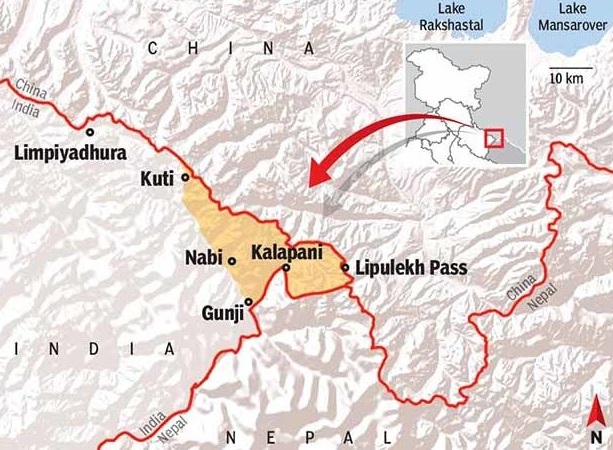
India has rejected Nepal’s objection to resumption of India–China border trade through the Lipulekh Pass in Uttarakhand.
About Lipulekh Pass:
Location: High-altitude Himalayan pass (~17,000 ft) near the trijunction of India, Nepal, and China (Tibet).
Connectivity: Links Uttarakhand’s Kumaonregion with Taklakot in Tibet.
Cultural Role: Serves as the shortest route for the Kailash Mansarovar Yatra.
Trade Importance: Historic India–China trade route since 1954; disrupted during COVID-19 but later resumed.
Strategic Significance: Crucial for India due to its proximity to the India–China–Nepal border.
What is Limpiyadhura–Lipulekh–Kalapani Dispute?
Origin: Rooted in the 1815 Treaty of Sugauli (Nepal–British East India Company), fixing Nepal’s western boundary at the Kali (Mahakali) River.
India’s Position: Claims Kali River originates near Lipulekh, placing Lipulekh and Kalapani within India.
Nepal’s Position: Claims Kali River originates at Limpiyadhura, extending Nepal’s boundary east to include Lipulekh and Kalapani.
Disputed Area: About 370 sq. km., under Indian administration since the 19th century.
Recent Development: In 2020, Nepal issued a new map showing Limpiyadhura, Lipulekh, and Kalapani as its territory; India rejected the claim citing lack of historical basis.
Back2Basics: India–Nepal Border Disputes
Border Length: India and Nepal share a 1,770 km long open border across five Indian states – Uttarakhand, Uttar Pradesh, Bihar, West Bengal, and Sikkim.
Susta (Uttar Pradesh–Nepal border): Caused by Gandak River’s shifting course, leading to encroachments and overlapping claims.
Tensions: Despite close ties, disputes often cause diplomatic strains.
Positions: India relies on historical treaties and long-standing administration, while Nepal asserts sovereignty and constitutional recognition of disputed territories.
[UPSC 2007] Which one of the following Himalayan passes was reopened around in the middle of the year 2006 to facilitate trade between India and China?
Options : (a) Chang La (b) Jara La (c) Nathu La* (d) Shipki La
A recent movie depicted the 1946 “Great Calcutta Killing” — four days of communal riots on Direct Action Day (August 16, 1946), spotlighting Gopal Patha’s role in mobilising Hindu youth.
About Direct Action Day:
Declaration: Called by the All-India Muslim League to press for Partition and creation of Pakistan.
Bengal Role: Muslim League’s H. S. Suhrawardy (then Bengal Premier) declared 16 August a public holiday.
Mass Rally: Nearly 1,00,000 gathered at the Maidan, Calcutta; addressed by Suhrawardy and Khwaja Nazimuddin.
Violence: Immediate communal clashes broke out, remembered as the Great Calcutta Killing.
Casualties: 5,000–10,000 killed; ~15,000 injured.
Spread: Violence lasted four days (16–19 August), army intervention required; later spread to Bombay, Noakhali, Bihar, Punjab.
Who was Gopal Patha (Gopal Mukherjee)?
Background: Born 1916 in Bowbazar, Calcutta; nicknamed Patha (goat) since family ran a College Street mutton shop.
Gang Leader: Headed a street group of ~800 men; mobilized masses for defense during riots.
Approach: Declared aim was to retaliate against rioters but forbade harm to women, children, or ordinary people.
Links: Associated with revolutionary groups like Atma Unnati Samiti; influenced by Subhas Chandra Bose.
[UPSC 2002] The last opportunity to avoid the partition of India was lost with the rejection of:
Options: (a) Cripps Mission (b) Rajagopalachari Formula (c) Cabinet Mission* (d) Wavell Plan