💥Join UPSC 2027,2028 Mentorship (August Batch) + XFactor Notes & Microthemes PDF

Search results for: “”

  • [31st October 2024] The Hindu Op-ed: Importing a toxic work culture into India

    PYQ Relevance:

    Q) What are the continued challenges for Women in India against time and space? (UPSC CSE 2019)
    Q) Are we losing our local identity for the global identity? Discuss. (UPSC CSE 2019)
    Q) “Though women in post-independent India have excelled in various fields, the social attitude towards women and the feminist movement has been patriarchal.” Apart from women’s education and women empowerment schemes, what interventions can help change this milieu? (UPSC CSE 2021)
    Q) Explain why suicide among young women is increasing in Indian society. (UPSC CSE 2023)

    Mentor’s Comment:

    The tragic death of Anna Sebastian Perayil, a 26-year-old chartered accountant, underscores the human cost of a relentless work culture that often glorifies long hours and high productivity, leading to Mental health crises among young professionals.

    The World Health Organization (WHO) states that 20% of Indians are expected to experience mental health disorders by the end of the year, with 5.6 crore suffering from depression and 3.8 crore from anxiety disorders

    Most of the world’s largest multinationals are American, which shapes their work culture. Western work culture is not just about productivity; it’s deeply rooted in historical and religious contexts.

    Today’s editorial addresses the alarming trend of adopting detrimental workplace practices from abroad, particularly from high-pressure environments in developed countries. It highlights the severe implications of such practices on mental health and overall employee well-being.

    _

    Let’s learn!

    Why in the News?

    The tragic death of a 26-year-old Chartered Accountant has brought attention to the severe pressures faced by employees in high-stress environments.

    • The Lancet found a 35% increase in mental health disorders in India, reflecting the growing crisis 

    What are the characteristics of toxic work cultures imported from Western countries?

    • Historical Insights: After the USSR fell, the U.S. gained significant influence over global affairs, and its economic practices became the standard for success.
      • The idea of “the American way” (long hours and high productivity/Capitalist perspective) became synonymous with corporate culture, influencing companies worldwide.
      • Karl Marx pointed out over a century ago, longer working days can lead to higher profits if labor costs are kept low.
      • German sociologist Max Weber explored that Protestantism changed its attitudes toward work in Northern Europe.
    • American Influence on Work Culture: The term ‘Multinational Corporations’ is misleading because, despite their global operations, these companies are often closely tied to their home countries.
      • Max Weber cited American thinker Benjamin Franklin to illustrate this connection, suggesting that the work culture in MNCs is deeply rooted in historical religious values (cultural glorification of hard work) rather than modern management theories.
    What is the actual scenario?

    Data from the International Labour Organisation (ILO) shows that while hard work has helped the U.S. economy grow, it doesn’t guarantee the highest living standards. In 2023, the U.S. ranked 12th globally in terms of per capita income, falling behind countries like Austria, Belgium, and Denmark.
    The U.S. has improved only slightly compared to Switzerland. Interestingly, workers in most other countries listed worked fewer hours than those in the U.S. This shows that achieving greater wealth while working less is possible.

    How does this imported ‘Capitalist perspective’ affect Indian professionals and their work culture?

    • High-Pressure Work Environment: American companies often expect long hours, leading to stress and burnout among Indian workers. The expectations set by American firms often clash with Indian cultural norms.
      • Indian work culture traditionally values relationships and teamwork, the imported capitalist model tends to prioritize efficiency and individual performance. 
      • Indian professionals may struggle with the more egalitarian approach of American firms, which encourages open communication.
    • Hierarchical Structures Vs. Equality: Indian workplaces are typically hierarchical, with a strong emphasis on respect for authority and seniority. In Indian organizations, decision-making is often top-down, whereas American firms favor collaborative approaches.
      • This difference can make it challenging for Indian professionals to adapt, as they may feel uncomfortable speaking up or challenging their superiors even when encouraged to do so.
    • Work-Life Balance Challenges: Long hours and blur boundaries like working late or during weekends, make it hard for the employees to relax or find the space between work and personal life.
      • Rising stress levels contribute to mental health problems, including anxiety and burnout.
      • Women face additional pressures in balancing work demands with traditional family roles.

    What steps can organizations take to mitigate these effects?

    • Employee Wellbeing Programs: Create wellness initiatives that include flexible work hours, mental health days, and access to counseling. These programs help reduce stress and improve morale.
    • Promote Work-Life Balance: Encourage flexible schedules and remote work options. This helps employees manage personal and professional commitments, reducing burnout.
    • Foster Open Communication: Build a culture where employees can discuss their workloads and mental health openly. Regular check-ins can help managers support their teams effectively.
    • Train Managers: Provide training for managers to be supportive leaders. Good management practices can enhance employee satisfaction and create a positive work environment.

    https://www.thehindu.com/opinion/lead/importing-a-toxic-work-culture-into-india/article68815685.ece

  • Bulldozer Justice: Balancing Legal Principles and the Quest for Justice

    Bulldozer Justice: Balancing Legal Principles and the Quest for Justice

    Why this? SC called to address extra-legal demolitions like ‘Bulldozer justice’ at a pan-India level. We have drawn a chronology of SC judgments from 1978 to 2024 so you get comfortable with legal concerns. However, the quick revision table for Legal Principles & Bulldozer violations is the most important takeaway. You can use it for any other form of ‘extra-legal’ justice.

    —-

    UPSC Syllabus Anchoring:

    1.⁠ ⁠GS1: Indian Society: Communalism, Urbanization, their problems, and remedies

    Note4Students: Understand “Bulldozer Justice” and analyse societal inequalities and communal conflicts in urban contexts. Make value added notes on social challenges and remedies.

    Microtheme: Emerging Urban Issues

    2.⁠ ⁠GS2: Polity, Governance, Constitution, and Social Justice: Separation of Powers, Fundamental Rights, Issues related to Poverty and Hunger

    Note4Students: Link governance actions to constitutional safeguards, addressing state overreach and rights violations. Strengthen arguments on constitutional rights, governance, and judicial checks.

    Microtheme: Local Self-government, Government Schemes and Policies

    3.⁠ ⁠GS3: Economy, Development, Security: Government Policies and Interventions

    Note4Students: Enhance your critique of urban developmental interventions and their socio-economic consequences.

    Microtheme: Climate Change Impact, Disaster Risk Reduction, Disaster Preparedness

    4.⁠ ⁠GS4: Ethics, Integrity, and Aptitude: Ethics in Public Administration, Conflict of Interest, Transparency, and Accountability, Case Studies

    Note4Students: Build your practical, ethical reasoning in governance-related case studies and dilemmas. Explore ethical dilemmas in public administration, focusing on fairness, accountability, and integrity in governance decisions.

    Microtheme: Social influence and persuasion, Attitude for Individuals, Probity in Governance

    —-

    What is bulldozer justice?

    The practice where authorities demolish properties, often bypassing due process and legal procedures. While it is used to curb illegal constructions or encroachments, it raises concerns about constitutional rights, fairness, and the rule of law. The lack of judicial oversight in such actions undermines principles like due process, natural justice, and equal protection under the law.

    Critics argue that bulldozer justice disproportionately impacts marginalized communities and violates Article 14 (equality before the law) and Article 21 (right to life and personal liberty) of the Indian Constitution. On the other hand, supporters see it as a swift and effective response to lawlessness and encroachments.

    Opinions of Supreme Court:

    1. Maneka Gandhi vs Union of India (1978): SC ruled that executive actions must be fair, just, and reasonable.
    2. Municipal Corporation of Ludhiana vs Inderjit Singh (2008): SC held that no demolition can occur without notice and a hearing to the occupant, even in cases of illegal construction.
    3. Olga Tellis vs Bombay Municipal Corporation (1985): SC stated that eviction without due process violates the right to livelihood under Article 21.
    4. Punjab and Haryana HC on Nuh Demolitions (2023): The HC stopped the demolitions citing lack of due process and concerns of ethnic targeting.
    5. Supreme Court bench comprising Justices Bhushan R Gavai and KV Viswanathan (2024):
      1. Condemned the practice of demolishing properties based solely on accusations or convictions of individuals, stressing the importance of due process and natural justice.
      2. Emphasized that even in cases of unauthorized construction, demolitions must follow proper legal procedures, underscoring the need for fairness and lawful action.
      3. Called for the formulation of nationwide guidelines to ensure uniformity in demolition practices across all states, preventing arbitrary actions by authorities.

    Legal Principles violated by Bulldozer Justice:

    Legal PrinciplesQuick ExplanationViolation by Bulldozer Justice
    Due Process of LawLaw requires fair treatment and legal procedures before action.Demolitions without legal procedure.No judicial oversight or recourse.
    Right to PropertyIndividuals have the right to own and protect property under the law.Properties demolished without notice.No legal backing for actions taken.
    Equality Before Law (Article 14)All individuals must be treated equally by the law.Marginalized groups targeted.Inconsistent application of law.
    Rule of LawLaw must govern the actions of both citizens and authorities.Arbitrary state actions.Legal frameworks bypassed by local authorities.
    Right to ShelterEvery person has the right to adequate housing and protection.People left homeless.No rehabilitation or alternative shelter provided.
    Natural JusticeFairness in legal processes with an opportunity to be heard.No fair hearings before demolition.No opportunity to defend or appeal.
    Separation of PowersClear division between judicial, executive, and legislative powers.Municipal authorities exceed powers.Judiciary’s role in oversight bypassed.
    Proportionality PrincipleGovernment actions must be proportionate to the offense committed.Collective punishments via demolitions.Excessive response to minor or alleged offenses.

    What should be done?

    1. UN Guidelines: The United Nations Basic Principles and Guidelines on Development-based Evictions and Displacement (2019) provide humanitarian directives, yet court rulings have been inconsistent and piecemeal which needs a comprehensive approach.
    2. Exceptional Circumstances: Demolitions should only occur in exceptional cases and must adhere strictly to established legal processes.
    3. Need for Proposed Phased Procedures:
      1. Pre-Demolition Phase: Provide a reasoned notice with details on land records and resettlement plans, allowing adequate time for responses.
      2. During Demolition Phase: Requires the presence of neutral government officials during demolitions.
      3. Rehabilitation Phase: Need to establish a swift mechanism for affected persons to challenge demolition decisions and seek remedies such as compensation and restitution.

    Back2Basics

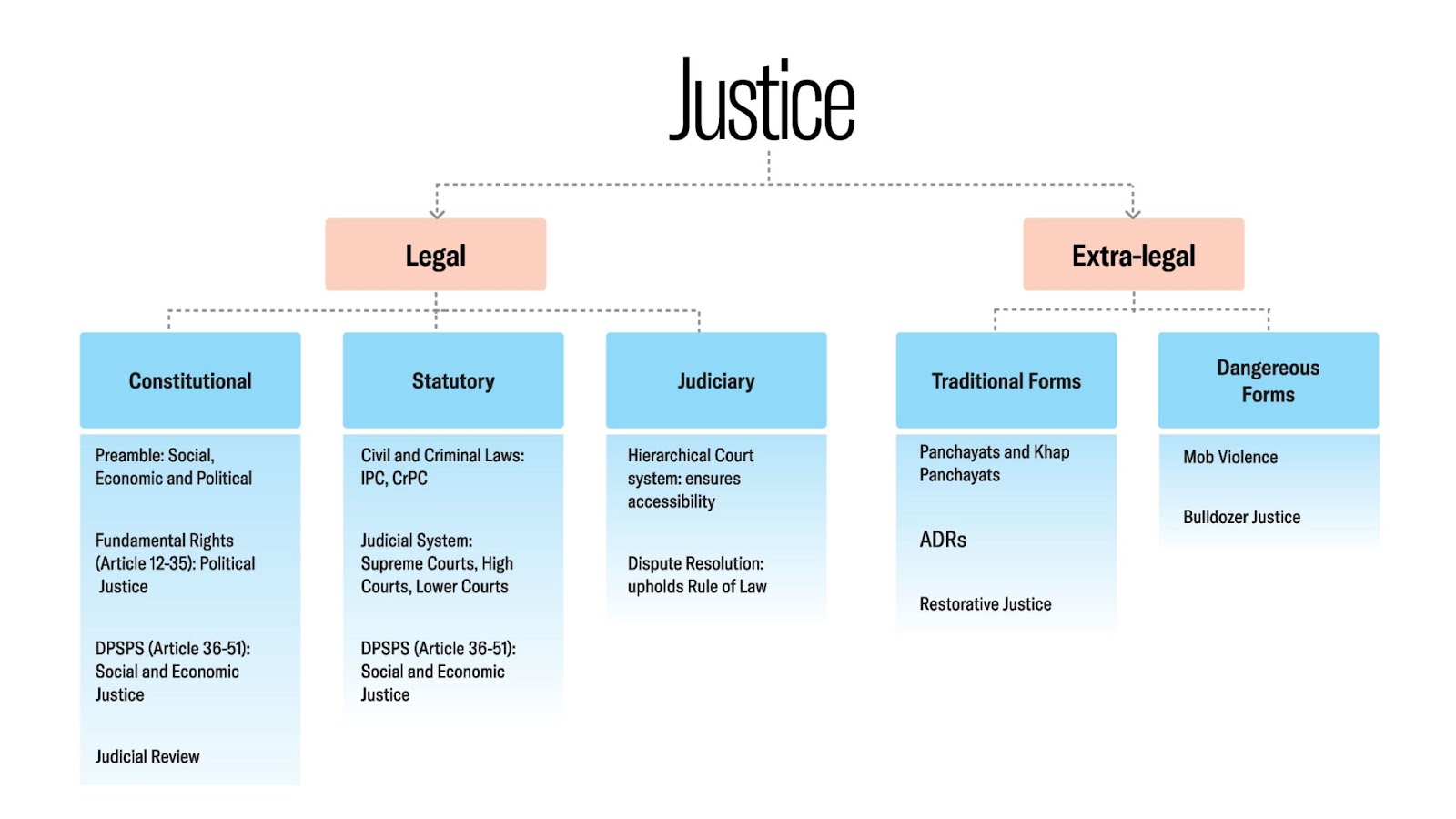
    Justice

    Justice is the maintenance of what is just and fair. In the modern state, justice implies ensuring and protecting minimum rights and entitlement for all.

    “Injustice anywhere is a threat to justice everywhere.” – Martin Luther King Jr.

    “A democracy cannot thrive where power remains unchecked and justice is reserved for a select few. Ignoring these cries and failing to respond to this movement is simply not an option — for peace cannot exist where justice is not served.” – John Lewis

    Types of Justice:

    Hello,

    We have a confession: we’re here to compete with your notes! Burning Issues magazine is your go-to resource as your exam approaches, designed to help you through the anxiety and overwhelm of preparing for the Civil Services Examination.

    Many aspirants struggle despite reading current affairs for a year. This often happens because they interpret current affairs as merely news. As a UPSC aspirant, it’s essential to analyze these topics from the perspectives of General Studies 1, 2, 3, and 4, and that’s exactly what Elevate does.

    This magazine features two sections: Burning Issues and Prelims Tidbits. Burning Issues covers current affairs that may appear in your Mains papers and teaches you how to think about these topics from different GS perspectives in just two pages.

    Prelims Tidbits simplifies your Prelims preparation by distilling key facts, data, and concepts into easy-to-recall points framed around basic questions: What? Who? How? When?

    So, dive in! Every page is crafted to enhance your UPSC prep. With consistency and this magazine, you’re not just preparing; you’re mastering the exam. The journey is about understanding and applying your knowledge effectively.

  • A collective effort towards peace in Myanmar

    Why in the News?

    The 44th ASEAN Summit in Vientiane highlighted growing regional issues, especially Myanmar’s crisis. Despite ASEAN’s peace efforts, Myanmar’s turmoil persists, testing the group’s commitment to stability.

    What are the key challenges facing ASEAN and India in their efforts to stabilize Myanmar?

    • Lack of Consensus within ASEAN: ASEAN’s principle of consensus-based decision-making complicates strong, unified responses.
      • Nations like Indonesia and Malaysia advocate for firm action, while others, including Thailand and Laos, maintain closer ties with Myanmar’s military government, slowing decisive actions.
    • Failure of the Five-Point Consensus: Despite ASEAN’s efforts to enforce the 2021 Five-Point Consensus, which mandates an end to violence and inclusive dialogue, Myanmar’s military has shown little interest in cooperating, undermining ASEAN’s credibility.
    • Exclusion of Key Groups: ASEAN’s initiatives mainly engage the junta without including the National Unity Government (NUG) or Ethnic Armed Organizations (EAOs), limiting the inclusiveness and effectiveness of peace efforts.
    • Worsening Humanitarian Crisis: Myanmar’s civil war has led to massive displacement and humanitarian needs, with over 18.6 million people requiring aid.
      • This poses logistical and diplomatic challenges for ASEAN and complicates India’s border security and refugee policies.
    • Balancing Regional and Security Concerns for India: India faces a dilemma balancing its Act East Policy objectives and the need for stability on its Myanmar border.
      • Issues such as cross-border militancy, illegal activities, and the refugee crisis strain India’s relations with the junta and impact regional connectivity projects.

    How can Inclusive dialogue be achieved among all stakeholders in Myanmar?

    • ASEAN must involve non-state actors like the NUG, EAOs, and the People’s Defense Forces (PDFs) in dialogue efforts to ensure all key groups have a stake in Myanmar’s peace process.
    • Thailand’s recent ‘Troika’ proposal to host talks with ASEAN chairs (current, past, and future) and possibly other stakeholders indicates a potential pathway for more flexible discussions, albeit with the need for junta cooperation and broader participant involvement.
    • Establishing humanitarian corridors that operate beyond junta-controlled areas, with the cooperation of EAOs, could lay the groundwork for inclusive engagement and build trust among conflicting parties.

    What role does India’s Foreign Policy play in addressing the Myanmar crisis? (Way forward)

    • Strategic Engagement and Regional Connectivity: Under its Act East Policy, India invests in key infrastructure projects like the Kaladan Multi-Modal Transit Transport Project, linking Myanmar and ASEAN.
    • Balanced Relations with Junta and Democracy Advocates: Need to principles of non-interference, India maintains ties with Myanmar’s military and democratic groups, addressing security needs while ethically supporting democratic aspirations.
    • As per Gujral Doctrine: India should engage constructively with Myanmar, respecting its sovereignty, promoting regional connectivity, and fostering dialogue among all stakeholders to enhance stability and mutual prosperity.

    Mains PYQ:

    Q Evaluate the economic and strategic dimensions of India’s Look East Policy in the context of the post-Cold War international scenario. (UPSC IAS/2016)

  • Delimitation, women’s quota

    Why in the News?

    The Centre has hinted that the delayed Census might begin next year and finish by 2026, which would play a key role in redrawing constituencies and starting women’s reservations in elected bodies.

    What are the implications of the Women’s Reservation Bill for women’s political representation in India?

    • Increased Representation: The bill, once implemented, will reserve 33% of seats in the Lok Sabha and state legislative assemblies for women, marking a significant increase in women’s representation and fostering a more inclusive legislative environment.
    • Long-Term Social Change: With more women in legislative positions, issues relevant to women’s rights, safety, and empowerment could receive greater legislative focus, driving long-term societal shifts toward gender equality.
    • Gradual Integration: By mandating women’s reservation for 15 years post-implementation, the bill allows time for systemic integration of women into Indian politics, potentially encouraging more women to enter politics.

    Key features of the Women’s Reservation Bill: 

    • Reservation of Seats: The bill reserves one-third of all seats in the Lok Sabha and state assemblies for women, including those seats already reserved for Scheduled Castes (SCs) and Scheduled Tribes (STs).
    • Implementation Timeline: The reservation will come into effect after the next census is conducted and published, which has not yet been scheduled. The law is set to remain in place for 15 years, with provisions for extension.
    • Rotating Constituencies: Reserved seats will be rotated after each delimitation exercise to ensure fair representation across different regions.

    How does the delimitation process affect the implementation of the Women’s Reservation Bill?

    • Dependency on Delimitation: The reservation will only be implemented following a census-based delimitation exercise, making the timeline for reservation contingent on the next Census, expected to conclude in 2026.
      • Thus, the reservation may only be actionable around the 2029 general elections.
    • Impact on Seat Allocation: The delimitation exercise will likely increase the total seats in the Lok Sabha, which could make implementing the 33% reservation less disruptive.
      • For example, if Lok Sabha seats rise to around 770, this will allow for a more balanced accommodation of both male and female representatives without substantial loss of seats for male incumbents.

    Challenges and Criticisms Surrounding the Women’s Reservation Bill and Its Implementation:

    • Delay in Implementation: As the reservation is contingent on delimitation, the immediate impact of the bill remains deferred.
      • Critics argue that the reservation could be enacted sooner if it did not depend on the Census and delimitation.
    • Intra-Party Resistance: Male incumbents might resist the bill due to concerns over losing their seats, and political parties might face difficulties balancing this resistance with the need for compliance, despite an increase in overall seats.
    • Exclusion of Other Marginalized Women: The bill lacks sub-quotas for women from marginalized communities, such as SC/ST/OBCs, sparking criticism that it may predominantly benefit women from privileged backgrounds rather than addressing the political representation gap for all women.
    • Dependence on Census Accuracy: Any delays or inaccuracies in Census data could delay the bill’s impact or result in skewed representation due to reliance on outdated demographic data.

    Way forward: 

    • Expedite Delimitation and Census: Streamline Census and delimitation processes to ensure timely data collection and boundary adjustments, enabling earlier implementation of the reservation without prolonged delays.
    • Include Sub-Quotas for Marginalized Women: Introduce provisions for SC/ST/OBC sub-quotas within the reservation to ensure fair representation of women from diverse social backgrounds, addressing inclusivity concerns in political representation.

    Mains PYQ:

    Q “The reservation of seats for women in the institutions of local self-government has had a limited impact on the patriarchal character of the Indian Political Process.” Comment. (UPSC IAS/2019)

  • Why India is at risk of becoming a ‘diminishing democracy’

    Why in the News?

    In her book “Democracy on Trial: Majoritarianism and Dissent in India”, Zoya Hasan points out that, though India’s democracy is strong in elections, it has struggled with fairness and freedoms due to growing majoritarianism since 2014.

    What factors contribute to the erosion of civil liberties in India?

    • Majoritarian Politics: Since a decade ago, India’s democracy has seen a shift toward majoritarianism, with the rights of minorities, particularly Muslims, facing marginalization.
      • This tilt toward majoritarian views fosters unequal treatment, weakening the universal protection of civil liberties and undermining the democratic principles of inclusion and equality.
    • Compromised Media Landscape: Traditionally, media acted as a watchdog on power, but now it frequently functions as a government advocate.
      • This shift has narrowed public discourse on civil rights and accountability, reducing the media’s role in preserving civil liberties.
    • Legislation Targeting Minorities: Laws such as the Citizenship (Amendment) Act (CAA) are seen as religiously discriminatory, especially when considered with the National Register of Citizens (NRC).
      • Such laws challenge the Constitution’s guarantee of equal rights for all citizens, placing undue pressure on certain communities and further eroding civil liberties.

    Role of Political Institutions in Undermining Democracy:

    • Judicial Autonomy and its Challenges: While the judiciary has traditionally been a pillar of democracy, recent trends indicate compromised judicial independence.
      • There are instances where courts appear reluctant to challenge the executive because political pressure may be impacting judicial autonomy, thereby diminishing an essential check on power.
    • Media’s Decline as a Check on Power: Media independence has weakened as corporate and political influences have taken root, limiting its role in holding power to account.
    • Legislative and Executive Power Dynamics: The increasing concentration of power within the executive, combined with a legislative body that often aligns with the ruling agenda, limits checks and balances.

    Impact of Political Polarization on Democratic Processes:

    • Divisive Identity Politics: Identity-based polarization is intensifying, with significant events such as the Ayodhya dispute and the Shaheen Bagh protests illustrating how political narratives can frame majority identities against minority rights.
    • Silencing of Dissent: Governmental responses to protests, like those against the CAA, often include the use of force, indicating reduced tolerance for opposition.

    Steps taken by the Election Commission of India:

    • Voter Education and Awareness Campaigns: The ECI has launched extensive voter education campaigns to promote awareness about the electoral process, emphasizing the importance of informed voting.
    • Monitoring and Regulation of Political Parties: The ECI has increased scrutiny over political parties’ funding and activities to ensure transparency.
    • Strengthening Electoral Laws: Recent amendments to electoral laws have been made to enhance the integrity of elections.
    • Use of Technology: The ECI has implemented technology-driven solutions such as Electronic Voting Machines (EVMs) and Voter Verified Paper Audit Trails (VVPATs) to ensure transparency and reliability in the voting process.

    Way forward: 

    • Strengthening Institutional Independence: Reinforce the autonomy of key institutions like the judiciary, media, and law enforcement through stricter legal safeguards and transparent appointment processes.
    • Promoting Inclusive and Balanced Governance: Establish mechanisms to ensure equal representation and protection for all communities, addressing grievances through impartial review processes. Implementing inclusive governance policies can help counter majoritarian biases and foster a more cohesive democratic environment.

    Mains PYQ:

    Q To enhance the quality of democracy in India the Election Commission of India has proposed electoral reforms in 2016. What are the suggested reforms and how far are they significant to make democracy successful? (UPSC IAS/2017)

  • [pib] Four replicas of Konark Wheels at Rashtrapati Bhavan

    konark
    PC: konark.in

    Why in the News?

    Four replicas of the Konark wheels, made of sandstone, have been installed at Rashtrapati Bhavan Cultural Centre and Amrit Udyan. 

    About Konark Wheels

    Details
    Design The temple is designed in the shape of a huge chariot drawn by 7 horses and features 24 wheels.
    Dimensions of Wheels Each wheel has a diameter of 9 feet 9 inches with 8 wider spokes and 8 thinner spokes.
    Symbolism of Wheels The wheels represent various time-related aspects:
    • 7 horses symbolize the days of the week.
    • 12 pairs of wheels signify 12 months.
    • 24 wheels represent 24 hours in a day.
    • 8 spokes symbolize prahars (three-hour periods).
    Architectural Features • The wheels are intricately carved, showcasing designs of foliage, animals, and figures of women in various poses.
    • Rims of the wheels have decorative carvings.
    Sun Dial Functionality Two of the wheels function as a sundial, accurately indicating time from sunrise to sunset using the shadow cast by the axel.
    Modern Representation
    • Featured in Indian currency, specifically in the old Rs. 20 and new Rs. 10 notes, representing Odisha’s rich cultural heritage.
    • Rs. 10 note released by the RBI on January 5, 2018, features the Konark Wheel on its reverse side.

    Its significance

    • The Konark Wheel, serving as an ancient sundial, symbolizes the advanced understanding of timekeeping and astronomy in 13th-century India.
    • Its intricate carvings reflect exceptional craftsmanship and cultural significance, embodying the cycle of life and the worship of Surya, the Sun God.
    • Its depiction on Indian currency highlights its enduring legacy and significance in promoting national identity and tourism in Odisha.

    Back2Basics: Konark Sun Temple

    konark

    • Approximately 64 km from Bhubaneswar.
    • Built in the 13th century (around 1250 CE) during the reign of King Narasimhadeva I of the Eastern Ganga Dynasty.
    • Dedicated to Surya, the Sun God.
    • Exemplifies Kalinga architecture, known for its intricate stone carvings and elaborate sculptures.
    • Constructed from Khondalite stone, which is durable and intricately carved.
    • Designed as a chariot with 7 horses and 24 wheels.
    • Structure originally included a sanctum (deul) and a jagamohan (assembly hall) that have largely collapsed but were once adorned with exquisite carvings.


    PYQ:

    [2017] Which of the following is/are famous for Sun temples?

    1. Arasavalli

    2. Amarakantak

    3. Omkareshwar

    Select the correct answer using the codes given below:

    (a) 1 only

    (b) 2 and 3 only

    (c) 1 and 3 only

    (d) 1, 2 and 3

  • Maithili missed out on Classical Status

    Why in the News?

    While five languages were granted classical status earlier this month, Maithili was not considered as the Bihar government had not officially forwarded the proposal, despite ongoing demands for its inclusion.

    Maithili missed out on Classical Status

    About Maithili Language

    • Maithili belongs to the eastern sub-group of the Indo-Aryan branch of languages.
      • It is believed to have evolved from Magadhan Prakrit.
      • The poet Vidyapati (14th century) popularized Maithili, establishing its importance in literature and folk culture.
    • It was added to the Eighth Schedule of the Indian Constitution in 2003, making it one of the 22 officially recognized languages of India.
      • It is an optional subject in the UPSC exams, providing an opportunity for candidates to take it as a paper.
      • It was granted second official language status in Jharkhand in 2018.
    • It is spoken primarily in Bihar and Jharkhand in India, with a significant presence in Nepal.
      • According to the 2011 Census, there are around 12 million Maithili speakers in India.
      • It is the second most spoken language in Nepal, especially in the Terai region.
    • Mithilakshar, also known as Tirhuta, is the original script used for writing Maithili.
      • It belongs to the same family as Bangla, Assamese, Odia, Tibetan, and Nepali scripts.
      • The script’s oldest records date back to 950 AD, found in Sahodara stone inscriptions.

    About Eighth Schedule:

    Details
    Purpose Lists the official languages of India as recognized by the Constitution.
    Relevant Articles Part XVII (Articles 343 to 351) of the Constitution outlines provisions for official languages.
    Key Constitutional Provisions Article 344(1): Mandates the formation of a Commission by the President to recommend steps to promote Hindi after five years of the Constitution’s commencement.
    Article 351: Promotes the development of Hindi as a medium to represent India’s composite culture.
    Languages in the Eighth Schedule Currently includes 22 languages:
    Initially Included (14 languages): Assamese, Bengali, Gujarati, Hindi, Kannada, Kashmiri, Konkani, Malayalam, Manipuri, Marathi, Nepali, Oriya, Punjabi, Sanskrit, Sindhi, Tamil, Telugu, and Urdu.
    Later Additions: Sindhi (21st Amendment, 1967), Konkani, Manipuri, Nepali (71st Amendment, 1992), Bodo, Dogri, Maithili, Santhali (92nd Amendment, 2003).
    Official Language Status Hindi (in Devanagari script) is the official language of India, with English as an additional official language for administrative purposes.


    PYQ:

    [2014] Consider the following languages:

    1. Gujarati
    2. Kannada
    3. Telugu

    Which of the above has/have been declared as ‘Classical Language/Languages’ by the Government?

    (a) 1 and 2 only

    (b) 3 only

    (c) 2 and 3 only

    (d) 1, 2 and 3

  • United Nations Relief and Works Agency (UNRWA)

    Why in the News?

    Israel’s Knesset has banned the United Nations Relief and Works Agency (UNRWA) from operating within its borders, citing alleged ties between UNRWA staff and Hamas.

    What is Israel’s Knesset?

    • The Knesset is Israel’s unicameral parliament, established in 1949.
    • It consists of 120 members, elected every four years through proportional representation, and is responsible for legislation, government oversight, and electing the president.

    About UNRWA:

    Details
    Full Name United Nations Relief and Works Agency for Palestine Refugees in the Near East (UNRWA)
    Establishment Established by the UN General Assembly in 1949.
    Primary Purpose To provide relief, healthcare, and education for Palestinian refugees displaced after the 1948 Arab-Israeli war.
    Headquarters Originally in Beirut, moved to Vienna in 1978, and relocated to Gaza in 1996.
    Mandate Renewal The mandate has been renewed repeatedly, currently extended until June 30, 2026.
    Fields of Operation Operates in Jordan, Lebanon, Syria, Gaza, and the West Bank, including East Jerusalem.
    Beneficiaries Supports over five million Palestinian refugees and their descendants displaced in 1948 and 1967.
    Services Provided • Education
    • Healthcare
    • Social services
    • Infrastructure improvement
    • Microfinance
    • Emergency assistance
    Funding Sources Primarily funded by voluntary contributions from UN member states, with limited funding from the UN Regular Budget for staffing costs.
    Leadership Led by a Commissioner-General, appointed by the UN Secretary-General with General Assembly approval.
    Controversies • Disputed mandate regarding descendants of original refugees.
    • Allegations of staff affiliations with militant groups.
    Global Response Condemned by the international community regarding bans and criticisms, with calls to support UNRWA’s humanitarian role.

    Its role and significance:

    • Humanitarian Aid: UNRWA provides essential support, including food, shelter, healthcare, and education to over five million Palestinian refugees.
    • Education and Empowerment: Operates schools for 500,000 children and supports microfinance programs to promote economic self-sufficiency.
    • Crisis Response: Plays a vital role in emergency situations and advocates for the rights of Palestinian refugees on an international level.

    PYQ:

    [2015] Amnesty International is:

    (a) an agency of the United Nations to help refugees of civil wars

    (b) a global Human Rights Movement

    (c) a non-governmental voluntary organization to help very poor people

    (d) an inter-governmental agency to cater to medical emergencies in war-ravaged regions

  • TN declares Heatwaves a State-specific Disaster

    Why in the News?

    • The Tamil Nadu government has officially declared heatwaves a State-specific disaster.
      • It announced an ex-gratia payment of ₹4 lakh for families of individuals who die from heat-related causes, including those involved in relief operations.

    Key Details of the Declaration

    • Purpose: This declaration allows the government to provide immediate relief to those affected by extreme heat, especially during the severe temperatures of April and May 2024.
    • Funding: Relief efforts will be supported by the State Disaster Response Fund.
    • Other State-specific disasters in TN: Sea erosion, lightning, thunder, whirlwinds, and gale winds as State-specific disasters to ensure relief assistance for those impacted by these events.

    Note: 

    • Kerala in March this year, declared man-animal conflict as a state-specific disaster, becoming the first state in the country to do so.
    • Once an issue is declared a state-specific disaster, the onus to deal with it shifts to the state disaster management authority, which, powered by the Disaster Management Act, can take quicker and more decisive action.
    • Also, district collectors can directly intervene in their capacity as the chairman of the district disaster body.


    heatwave

    About Heatwaves:

    Details
    Definition A heatwave is a prolonged period of excessively hot weather, relative to the usual climate of a region.
    Occurrence Typically occurs in India between March and June.
    Declaration by IMD
    • Plains: The maximum temperature is at least 45°C
    • Hills: The maximum temperature is at least 30°C
    • Coastal regions: The maximum temperature is at least 37°C and the departure from normal is at least 4.5°C
    Formation High-Pressure Systems: Develop when high pressure settles over a region for days or weeks.
    Air Sinking: Forces air to sink, warming and drying it.
    Increased Radiation: Fewer clouds lead to higher surface temperatures.
    Surface Winds: Warm air from lower latitudes or continental winds intensify heat.
    Criteria for Declaring a Heatwave At least two stations in a meteorological subdivision must meet one of the following criteria for two consecutive days (declared on the second day):
    Based on Departure from Normal:
    – Heat Wave: Temperature departure of 4.5°C to 6.4°C above normal.
    – Severe Heat Wave: Temperature departure of >6.4°C above normal.
    Based on Actual Maximum Temperature (plains only):
    – Heat Wave: Maximum temperature reaches 45°C or higher.
    – Severe Heat Wave: Maximum temperature reaches 47°C or higher.
    Duration Typically lasts a minimum of four days but can extend to seven or ten days.
    Longest Recorded Spell: May 2015, lasting from 18 to 31 May.
    Impact of Heatwaves Heat Strokes: Increased risk, especially for the elderly and those with chronic illnesses.
    Increased Healthcare Costs: Higher hospital visits and death rates from related illnesses.
    Reduced Productivity: Extreme heat affects the output of over 1 billion workers.
    Risk of Wildfires: Heat domes can lead to wildfires.
    Effect on Vegetation: Prolonged heat damages crops and leads to droughts.
    Increased Energy Demands: Higher electricity usage for cooling, driving up rates.


    PYQ:

    [2013] Bring out the causes for the formation of heat islands in the urban habitat of the world.

    [2013] The annual range of temperature in the interior of the continents is high as compared to coastal areas. What is / are the reason / reasons?

    1. Thermal difference between land and water

    2. Variation in altitude between continents and oceans

    3. Presence of strong winds in the interior

    4. Heavy rains in the interior as compared to coasts

    Select the correct answer using the codes given below.

    (a) 1 only

    (b) 1 and 2 only

    (c) 2 and 3 only

    (d) 1, 2, 3 and 4

  • [pib] Pradhan Mantri Mudra Yojana (PMMY)

    mudra

    Why in the News?

    • The Centre has doubled the limit of Mudra loan amount under the PMMY to Rs 20 lakh from Rs 10 lakh under a new ‘Tarun Plus’ category to promote entrepreneurship in the country.
      • This higher loan limit is available to entrepreneurs who have previously taken and successfully repaid loans under the existing ‘Tarun’ category.

    About Pradhan Mantri Mudra Yojana (PMMY):

    Details
    Launch  Launched on April 8, 2015, by Prime Minister.
    Objective
    • To provide financial assistance and support to non-corporate, non-farm small and micro-entrepreneurs through collateral-free loans.
    • Non-corporate, non-farm small and micro-entrepreneurs are individuals or entities that operate small-scale businesses outside the corporate and agricultural sectors. 
    • These include self-employed workers, small retail shops, artisans, repair services, and other informal sector businesses, often with limited capital and workforce.
    Recent Update Loan limit increased from Rs 10 lakh to Rs 20 lakh under the new Tarun Plus category, announced in July 2024.
    Loan Categories Shishu: Loans up to Rs 50,000
    Kishore: Loans between Rs 50,000 and Rs 5 lakh
    Tarun: Loans between Rs 5 lakh and Rs 10 lakh
    Tarun Plus: Loans between Rs 10 lakh and Rs 20 lakh
    Loan Performance (2023-24) 66.8 million Loans sanctioned totaling Rs 5.4 trillion.
    • Over 487.8 million loans worth Rs 29.79 trillion sanctioned since launch.
    NPA Statistics • NPA of public sector banks under Mudra loans decreased to 3.4% in FY24, down from 4.77% in 2020-21.
    • Gross NPA for scheduled commercial banks at 2.8% as of March 2024.
    Target Beneficiaries Aims to empower women, minorities, and marginalized communities by facilitating easy access to credit.
    Technological Intervention
    • MUDRA Card: An innovative credit product that offers an overdraft facility and can be used like a debit card for transactions.
    • MUDRA MITRA App: A mobile application providing information about MUDRA and its schemes, guiding loan seekers to approach banks for availing loans.


    PYQ:

    [2016] Pradhan Mantri MUDRA Yojana is aimed at:

    (a) Bringing the small entrepreneurs into formal financial system.

    (b) Providing loans to poor farmers for cultivating particular crops.

    (c) Providing pension to old and destitute persons.

    (d) Funding the voluntary organizations involved in the promotion of skill development and employment generation.