💥UPSC 2026, 2027, 2028 UAP Mentorship (March Batch) + Access XFactor Notes & Microthemes PDF

Search results for: “”

  • 🔴[UPSC Webinar for 2027] By Arvind Sir, Lead Smash Mains, Civilsdaily IAS | Learn to Decode Your UPSC Marksheet | Smash Mains Batch Launch | Join on 19th March at 7PM

    🔴[UPSC Webinar for 2027] By Arvind Sir, Lead Smash Mains, Civilsdaily IAS | Learn to Decode Your UPSC Marksheet | Smash Mains Batch Launch | Join on 19th March at 7PM

    Register for the session


    Read about Webinar


    Most aspirants look at their marksheet only once, to feel happy, disappointed, or confused.

    But a UPSC marksheet is not just a result sheet. It is a diagnostic report.

    In this session, I will show you how to properly read your marksheet, identify where you actually lost marks, and understand what it reveals about your preparation strategy.

    Arvind Sir, Civilsdaily IAS

    What I’ll cover in this session:

    1. How to read your marksheet beyond the total score
    You’ll learn how to break your performance into meaningful parts instead of seeing it as one final number.

    2. What your marksheet reveals about your strengths and weak zones
    Whether your issue is content depth, answer structure, speed, consistency, or paper wise balance, your marksheet leaves clues.

    3. Why many aspirants misdiagnose their failure or underperformance
    Sometimes the real problem is not optional, not GS, and not even knowledge, but poor interpretation of performance.

    4. How to use your marksheet to rebuild your Mains strategy
    Arvind Sir will explain how to convert marksheet insights into clear next steps for improvement.

    5. How serious aspirants should respond to low, average, or uneven scores
    You’ll understand how to stop reacting emotionally and start responding strategically.


    Who should attend:

    1. Aspirants who have written Mains and want to understand their score better

    2. Candidates who feel confused about where they actually went wrong

    3. Anyone preparing for the next attempt and wanting a smarter improvement plan

    Join us, for a 45 minute live Zoom session on 19th March at 7PM.

    See you in masterclass.


    It will be a 45 minute session, post which we will open up the floor for all kinds of queries which a beginner must have. No questions are taboo and Arvind sir is known to be patiently solving all your doubts.

    Join us for a Zoom session on 19th March at 7 PM. This session is a must attend for you If you are attempting UPSC for the first time or have attempted earlier and now preparing for 2027, then it is going to be a valuable session for you too.

    See you in the session”

    Register for the session for a complete in-depth UPSC Prep


    In this Civilsdaily masterclass, you will get:

    1. A 45-minute deep dive on how to plan your UPSC strategy from the start to the end.
    2. How do first-attempt IAS Rankers get the most out of their one year prep?
    3. Insider tips that only the top IAS and IPS rankers know and apply to get rank.

    By the end, you’ll have razor-sharp clarity and a clear path to crack UPSC with confidence and near-perfect certainty. 

    Join UPSC session on 19th March, at 7 PM

    (Don’t wait—the next webinar/session won’t be until End March’26)



    These masterclasses are packed with value. They are conducted in private with a closed community. We rarely open these webinars for everyone for free. This time we are keeping it for 300 seats only.

    Ready to attend the UPSC Webinar?


    Not sure yet?

    We recommend you register here. It takes less than 10 seconds to register.

    • No spam! Once in a while, we’ll only send you high-quality exam-related content. 
    • We will inform you about the upcoming Masterclasses that might benefit you.
    • You can demand one free mentorship call from verified Civilsdaily mentors. 
    • You can always choose to unsubscribe. 
  • Wild Buffalo Translocation: Kaziranga to Kanha Initiative

    Why in the News

    Authorities have planned to translocate ~50 Asiatic wild water buffaloes from Kaziranga National Park to Kanha Tiger Reserve in a phased manner, starting with a smaller group.

    About the Species

    • Asiatic Wild Water Buffalo
      • Scientific name: Bubalus arnee
      • Status: Endangered (IUCN)
      • India holds major global population

    Key Details of the Plan

    • Total planned: ~50 buffaloes
    • Initial phase: 5–15 individuals
    • Method:
      • Tranquilization and capture
      • Gradual relocation after feasibility checks

    Why Translocation is Being Done?

    • Species Conservation: Avoids over-concentration in one area
      • Reduces risk from: Disease outbreaks and Natural disasters.
    • Kanha Tiger Reserve historically had wild buffaloes
      • Aim: restore lost populations
    • Genetic Diversity: Helps maintain: Healthy breeding populations and Reduced inbreeding.

    Why Kaziranga?

    • Hosts 1000+ wild buffaloes
    • One of the strongest populations globally
    • Suitable as a source population

    Why Kanha?

    • Suitable: Habitat (grasslands + water sources)
    • Part of central Indian landscape restoration
    [2017] According to the Wildlife (Protection) Act, 1972, which of the following animals cannot be hunted by any person except under some provisions provided by law? 
    1. Gharial Indian 
    2. Wild ass 
    3. Wild buffalo 
    Select the correct answer using the code given below: 
    (a) 1 only (b) 2 and 3 only (c) 1 and 3 only (d) 1, 2 and 3
  • India Submits First National Report on Nagoya Protocol (ABS)

    Why in the News?

    India has submitted its First National Report (NR1) on the implementation of the Nagoya Protocol (ABS) to the Convention on Biological Diversity (CBD) on 27 February 2026, fulfilling obligations under Article 29.

    Key Highlights of the Report

    1. Reporting Period

    • Covers 1 November 2017 to 31 December 2025
    • Earlier Interim Report submitted in 2017

    2. Legal & Institutional Framework

    • Based on: Biological Diversity Act, 2002, Biological Diversity Rules, 2024 and ABS Regulations, 2025. 
    • Three-tier structure:
      • National Biodiversity Authority (NBA)
      • State Biodiversity Boards (SBBs) / UT Biodiversity Councils
      • Biodiversity Management Committees (BMCs)
    • 2,76,653 BMCs established → strong grassroots participation

    3. Access and Benefit Sharing (ABS) Performance

    • Total approvals (2017–2025): 12,830
      • NBA: 5,913 approvals (research, IPR, commercial use, etc.)
      • SBBs/UTBCs: 6,917 approvals (commercial utilization)

    4. Global Leadership in Compliance

    • 3,556 IRCCs (Internationally Recognised Certificates of Compliance) published
    • Accounts for over 60% of global total
    • Shows leadership in transparency under Nagoya Protocol

    5. Financial Benefits Generated

    • ₹216.31 crore mobilised through NBA approvals
      • ₹139.69 crore disbursed to: Local communities, Farmers, and Traditional knowledge holders
    • ₹51.96 crore generated via SBBs/UTBCs

    6. Non-Monetary Benefits

    • 395 approvals included: Capacity building, Technology transfer, Training and Collaborative research. 

    7. Monitoring of Foreign Biological Resources

    • 41 declarations received for use of foreign bioresources
    • Ensures compliance with international ABS norms

    8. Capacity Building & Awareness

    • 2,56,393 individuals trained
    • Through: 3,724 workshops and 600+ capacity-building initiatives

    9. Strategic Contribution

    • Supports Target 13 of India’s NBSAP (National Biodiversity Strategy and Action Plan)
    • Strengthens: Biodiversity conservation, Livelihood security, and Community participation
    [2025] Consider the following statements: 
    1. In India, the Biodiversity Management Committees are key to the realisation of the objectives of the Nagoya Protocol. 
    2. The Biodiversity Management Committees have important functions in determining access and benefit sharing, including the power to levy collection fees on the access of biological resources within its jurisdiction. 
    Which of the statements given above is/are correct? 
    (a) 1 only (b) 2 only (c) Both 1 and 2 (d) Neither 1 nor 2
  • New Fish Species Discovered: Butis bargabhimae in West Bengal

    Why in the News

    Scientists have discovered a new estuarine fish species, named Butis bargabhimae, in the Rupnarayan River near Tamluk.

    About the Species

    1. Classification

    • Family: Butidae (gudgeon gobies)
    • Habitat: Brackish water (estuaries)
    • Found where rivers meet the sea

    2. Discovery Process

    • Time: 2022–2024
    • Institutions: Tamralipta Mahavidyalaya and Vidyasagar University.
    • Method:
      • Field collection by local fishermen
      • Morphological + DNA analysis

    Unique Features

    • Presence of interorbital scales (between eyes)
    • Additional auxiliary body scales
    • Distinct light and dark bands on pectoral fins
    • DNA similarity only ~86% with closest relatives
    • Confirms it as a new species

    Naming Significance

    • Named after Bargabhima, a local deity of Tamluk
    • Reflects link between biodiversity and cultural heritage

    Scientific Importance

    • Taxonomic Clarity: Helped correct misidentification of similar species in:
      • India
      • Bangladesh
    • Role of DNA Barcoding: Shows importance of genetic tools in species identification
    • Hidden Biodiversity: Suggests many undiscovered species in Indian rivers and estuaries
    [2022] DNA Barcoding can be a tool to: 
    1. Assess the age of a plant or animal. 
    2. Distinguish among species that look alike. 
    3. Identify undesirable animal or plant materials in processed foods. 
    Select the correct answer using the code given below: 
    (a) 1 only (b) 3 only (c) 1 and 2 (d) 2 and 3
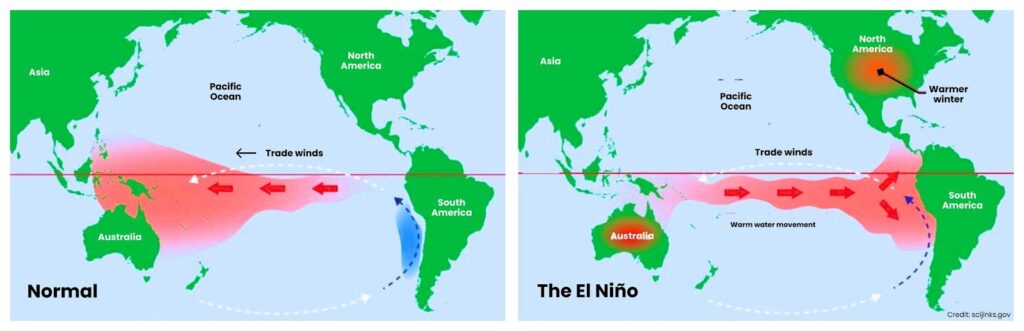
  • ‘Super El Niño’ Alert: Risk of Record Global Heat

    Why in the News

    Forecasters, including NOAA Climate Prediction Center, warn of a possible El Niño in 2026, with chances it could intensify into a “super El Niño”, potentially pushing global temperatures to new highs.

    What is El Niño?

    • A warm phase of the El Niño–Southern Oscillation (ENSO)
    • Occurs when Pacific Ocean surface waters become warmer than normal

    What is a “Super El Niño”?

    • When sea surface temperature rises ≥ 2°C above average
    • Much stronger than normal El Niño
    • Rare events: Last major one: 2015–16

    Current Situation

    • Present phase: La Niña (cool phase) is ending
    • Forecast: ~62% chance of El Niño by mid-2026 and ~15% chance of super El Niño

    How El Niño Works

    • Warm water shifts toward eastern Pacific
    • Weakens trade winds
    • Alters global weather systems
    [2011] La Niña is suspected to have caused recent floods in Australia. How is La Niña different from El Niño? 
    1. La Niña is characterized by unusually cold ocean temperature in the equatorial Indian Ocean whereas El Niño is characterized by unusually warm ocean temperature in the equatorial Pacific Ocean. 
    2. El Niño has an adverse effect on the southwest monsoon of India, but La Niña has no effect on monsoon climate. 
    Select the correct answer: 
    (a) 1 only (b) 2 only (c) Both 1 and 2 (d) Neither 1 nor 2
  • Biopharma SHAKTI Scheme: Boosting India’s Biologics & Biosimilars Sector

    Why in the News

    The Government has announced the Biopharma SHAKTI Scheme with an outlay of ₹10,000 crore (5 years) to strengthen India’s biopharmaceutical ecosystem and enhance global competitiveness.

    What is Biopharma SHAKTI?

    • A flagship initiative to:
      • Promote biologics and biosimilars manufacturing
      • Support R&D, clinical trials, and innovation
    • Goal: Make India a global biopharma hub and ensure affordable healthcare

    Key Objectives

    • Build a self-reliant biopharma ecosystem
    • Reduce import dependence
    • Improve global competitiveness
    • Promote innovation-driven manufacturing

    Major Components of the Scheme

    • Funding Support: Discovery Grant Fund and Equity Fund for drug development
    • R&D Ecosystem
      • Strengthening: National Institute of Pharmaceutical Education and Research (NIPER)
      • Creation of a National Biopharma R&D Network
    • Clinical Trials Expansion
      • 1,000 accredited trial sites across India
      • Led by Indian Council of Medical Research (ICMR)
    • Manufacturing Boost
      • Incentives for: Fermentation-based bulk drugs and Biopharma manufacturing inputs
    • Devices & Packaging
      • Develop ecosystem for: Drug delivery devices and Advanced packaging. 
    • Biosimilars & Biologics Production: Biosimilars (cost-effective versions of biologics) and Emerging biologics like gene therapies.
    • Regulatory Strengthening: Strengthen Central Drugs Standard Control Organisation (CDSCO)
      • Create scientific review cadre
      • Faster and globally credible approvals

    What are Biologics & Biosimilars?

    • Biologics: Medicines derived from living organisms (e.g., vaccines, monoclonal antibodies)
    • Biosimilars: Cheaper versions of biologics with similar efficacy
    • Not identical (due to complexity of biologics)
    • Must show no clinically meaningful differences in safety, purity, and effectiveness
    [2025] With reference to monoclonal antibodies, consider the following: 
    1. They are man-made proteins. 
    2. They stimulate the patient’s immune system to fight the specific disease. 
    3. They are produced using animal cells only. 
    Select the correct answer using the code given below: 
    (a) I and II only (b) II and III only (c) I and III only (d) All the three
  • Impact of China’s Lithium Policy on India’s EV Sector

    Why in the News

    China has imposed export controls and licensing requirements on key lithium-ion battery components and technology, raising concerns for India’s electric vehicle (EV) sector, which is highly import-dependent.

    What are China’s Policy Changes?

    China has restricted exports of:

    • High-performance lithium-ion batteries (≥300 Wh/kg)
    • Cathode materials
    • Artificial graphite anodes
    • Battery manufacturing technology
      • China dominates the midstream processing stage of EV battery supply chains.

    Impact on India’s EV Sector

    1. Supply Chain Vulnerability

    • India depends almost entirely on imports for lithium
    • Heavy reliance on Chinese processing → risk of disruptions

    2. Rising Battery Costs

    • Restrictions may increase prices of: Lithium, Cobalt, and Nickel.
      • Leads to higher EV prices

    3. Slower EV Adoption

    • Increased costs → reduced affordability
    • Could delay India’s EV transition targets

    Government Response (India)

    • National Critical Mineral Mission: Ensures long-term supply security
      • Covers full value chain: Exploration → Mining → Processing → Recycling
    • Domestic Mining & Auctions: 46 critical mineral blocks auctioned
    • Overseas Acquisition: Khanij Bidesh India Limited (KABIL)
      • Lithium exploration in Catamarca
    • Recycling Push: ₹1,500 crore incentive scheme for: Battery recycling and Recovery from waste (fly ash, tailings, etc.).
    [2025] In the context of electric vehicle batteries, consider the following elements: 
    1. Cobalt 
    2. Graphite 
    3. Lithium 
    4. Nickel 
    How many of the above usually make up battery cathodes? 
    (a) Only one (b) Only two (c) Only three (d) All the four
  • [17th March 2026] The Hindu OpED: Belem as a test of new model of forest finance

    PYQ Relevance[UPSC 2021] Describe the major outcomes of the 26th session of the Conference of the Parties (COP) to the UNFCCC. What are the commitments made by India in this conference?Linkage: TFFF emerges from COP30 processes, reflecting evolving climate finance architecture under UNFCCC, especially beyond traditional commitments like REDD+ and Glasgow pledges.

    Mentor’s Comment

    The Tropical Forest Forever Facility (TFFF) represents a paradigm shift in climate finance architecture by institutionalizing payments for forest conservation. However, it raises fundamental questions about governance, equity, and the role of indigenous communities. The Belém model provides critical insights into future global climate financing frameworks.

    What is Tropical Forest Forever Facility (TFFF)?

    The Tropical Forest Forever Facility (TFFF) is a Brazil-led global initiative designed to reward countries for maintaining standing tropical forests. Set to launch at COP30, this multi-billion-dollar fund seeks to raise $125 billion (25% public, 75% private) to generate annual returns that provide continuous financial incentives for forest conservation, aiming to make standing forests more valuable than felled ones. 

    Key Aspects of the TFFF:

    1. Funding Goal: $125 billion, with early contributions exceeding $5.5 billion from countries like Brazil, Indonesia, Norway, and Colombia.
    2. Mechanism: The initiative combines public and private investment, investing in a portfolio of bonds. The annual profits are then paid out to countries that effectively protect their forests, verified by satellite data.
    3. Indigenous Support: The facility mandates that at least 20% of the funds must go to Indigenous Peoples and Local Communities (IPLCs).
    4. Focus: It focuses on rewarding nations with existing low deforestation rates to keep forests standing, rather than only rewarding reduction. 

    Objectives:

    1. Permanent Conservation: Creating a self-sustaining financial model for long-term conservation rather than temporary projects.
    2. Economic Value: Assigning value to the standing forest ecosystem.
    3. Climate Action: Contributing to a 1.5°C goal by halting tropical deforestation.

    What distinguishes TFFF from earlier forest finance models?

    1. Shift in Approach: Rewards standing forests, not just avoided deforestation.
    2. Financial Structure: Ensures returns on investments, unlike donation-based REDD+ mechanisms.
    3. Scale of Funding: Mobilizes $5.5 billion initial commitments, including $3 billion from Norway.
    4. Performance Incentives: Mandates 20% of payments for indigenous and local communities.
    5. Participatory Design: Incorporates inputs from 400+ community leaders globally.

    Does the TFFF ensure inclusive and equitable governance?

    1. Governance Gap: Indigenous groups lack voting rights in core decision-making bodies.
    2. Power Asymmetry: Central governments retain control over fund allocation.
    3. Equity Concerns: Raises questions on true decentralization of financial authority.
    4. Institutional Risk: Weak local accountability may lead to elite capture of funds.
    5. Structural Inclusion Limits: Participation remains consultative, not decision-binding.

    Why is the TFFF being criticized as “colonial” in design?

    1. Intermediary Dominance: Benefits financial intermediaries over forest-dependent communities.
    2. Return-Oriented Model: Prioritizes financial returns over ecological outcomes.
    3. Structural Drivers Ignored: Fails to address agribusiness expansion, mining, oil extraction.
    4. Superficial Conservation: Risks rewarding preservation without reducing exploitation pressures.
    5. Narrative Control: Reinforces global North-South financial dependency patterns.

    Can financial mechanisms alone address forest degradation?

    1. Systemic Pressures: Infrastructure, extractive industries, and agriculture drive deforestation.
    2. Insufficient Funding: $4 per hectare (earlier proposals) inadequate for ecosystem services.
    3. Policy Disconnect: Financial flows do not align with land-use regulation reforms.
    4. Local Impact Risk: Funds may bypass communities without strong governance structures.
    5. Economic Trade-offs: Conservation competes with high-revenue extractive activities.

    How central are indigenous land rights to forest conservation?

    1. Land Rights Assertion: Indigenous communities demand recognition of territorial sovereignty.
    2. Exclusion Concerns: Many feel excluded from decision-making affecting their lands.
    3. Survival Linkage: Forest protection is tied to livelihoods and cultural identity.
    4. Global Advocacy: Calls for long-term funding supporting community governance models.
    5. Risk of Displacement: Weak safeguards may lead to land alienation and displacement.

    What institutional innovations accompany the TFFF?

    1. Digital Platform: Facilitates TFFF eligibility assessment and transparency mechanisms.
    2. Global Partnerships: Collaborates with UNDP, FAO, WWF, and GATC.
    3. Capacity Building: Supports technical assistance and peer collaboration.
    4. Conflict Safeguards: Ensures independence from governing structures to avoid conflicts of interest.
    5. Inclusion Framework: Promotes knowledge-sharing and participatory governance models.

    What determines the success of the Belém model?

    1. Delivery Mechanisms: Strong institutions ensure efficient and transparent fund utilization.
    2. Local Accountability: Strengthens community-level governance structures.
    3. Rights Integration: Secures indigenous land rights alongside financial flows.
    4. Structural Reform: Aligns conservation with broader economic and land-use policies.
    5. Outcome Orientation: Ensures funds translate into measurable ecological protection.

    Conclusion

    The TFFF represents a transition toward investment-based conservation finance, but its credibility depends on equity, governance, and structural reforms. Without integrating indigenous rights and accountability mechanisms, financial innovation alone cannot ensure sustainable forest conservation.

  • The dual impact of Artificial Intelligence on the finance industry

    Why in the News?

    AI is rapidly becoming central to financial systems, marking a shift from human-driven processes to algorithm-based decision-making. Nearly 75-97% of financial leaders report active AI adoption, while fraud risks are also scaling, AI-enabled financial fraud losses in the U.S. could reach $40 billion by 2027.

    How is AI transforming operational efficiency in finance?

    1. Automation of Processes: Ensures faster data processing and decision-making; example, credit scoring, portfolio management, algorithmic trading.
    2. Cost Reduction: Reduces operational expenses through automation of repetitive tasks such as data entry and routine analysis.
    3. Real-time Analytics: Enables processing of vast datasets instantly, improving accuracy in financial decisions.

    How has AI improved risk management and fraud detection?

    1. Predictive Analytics: Identifies anomalies and potential threats before materialization.
    2. Fraud Detection Efficiency: Reduces investigation time by 70% in major U.S. banks.
    3. Loss Reduction: Decreases fraud losses by 54% in organizations adopting AI-based systems.
    4. High-volume Monitoring: Analyses millions of transactions per second, improving detection accuracy over traditional systems.

    How is AI reshaping customer experience and financial services delivery?

    1. Personalization: Enables tailored financial services based on individual behavior and preferences.
    2. 24/7 Support Systems: Chatbots and virtual assistants ensure continuous customer engagement.
    3. Client Retention: Improves satisfaction and loyalty through data-driven recommendations.

    What are the employment implications of AI adoption in finance?

    1. Job Displacement: Automates repetitive roles such as data entry and customer service; up to 800,000 jobs in the U.S. could be automated by 2030.
    2. Job Creation: Generates new roles in digital risk analysis, compliance, and AI system management; 1.3 million jobs expected globally.
    3. Net Impact: Anticipates both displacement (1.1 million jobs) and creation, indicating structural workforce transition.
    4. Skill Shift: Requires analytical thinking, digital literacy, and AI management capabilities.

    What ethical and security challenges arise from AI in finance?

    1. Algorithmic Bias: Perpetuates biases present in training data, leading to discriminatory outcomes in lending decisions.
    2. Cybersecurity Risks: Increases vulnerability as AI systems become targets of sophisticated cyberattacks.
    3. Governance Deficit: Necessitates regulatory oversight to ensure market integrity and consumer protection.

    How is the financial workforce adapting to AI-driven transformation?

    1. Reskilling Imperative: Requires continuous learning and workforce adaptation to new roles.
    2. Institutional Partnerships: Promotes collaboration with educational institutions to bridge skill gaps.
    3. Employment Growth: Projects 16% growth in financial analyst and data science roles (2024-2030).

    What do market trends and projections indicate about AI in finance?

    1. Adoption Rate: 60% of U.S. financial firms have implemented or plan to implement AI solutions.
    2. Market Expansion: Global AI in finance market projected to reach $64.03 billion by 2030.
    3. Growth Rate: Expands at a CAGR of 23.7%, indicating rapid technological penetration.

    Conclusion

    AI in finance represents a dual-edged transformation, enhancing efficiency, accuracy, and innovation while introducing risks related to employment, ethics, and security. Sustainable integration depends on balancing technological advancement with governance, transparency, and workforce adaptation.

    PYQ Relevance

    [UPSC 2023] Introduce the concept of Artificial Intelligence (AI). How does AI help clinical diagnosis? Do you perceive any threat to privacy of the individual in the use of AI in healthcare?

    Linkage: AI in finance and healthcare reflects the broader theme of technology-driven transformation of critical sectors, relevant to GS-III (S&T and Economy). Issues of data privacy, algorithmic bias, and regulation directly link to ethical governance and cybersecurity concerns in AI-enabled systems.

  • The discrepancies in India’s new GDP data

    Why in the News?

    India’s newly revised GDP series has again brought the issue of ‘discrepancies’ into focus, with their share in GDP rising sharply to ~1.5% in 2025-26, compared to 0.4% in 2022-23, a nearly 4-fold increase. This is significant because discrepancies directly affect the credibility of GDP estimates, and their resurgence contrasts with expectations that improved data systems would reduce them.

    What is the New Revised GDP Series?

    Base Year Revision: Reflects Current Economic Structure

    1. Updated Base Year (2011-12): Aligns GDP calculation with a more recent economic structure, replacing older bases like 2004-05 and 1999-2000.
    2. Better Representation: Captures changes such as rise of services, digital economy, and consumption patterns.
    3. Purpose: Ensures GDP estimates remain relevant and comparable over time.

    Methodological & Data Improvements: Expands Coverage

    1. Wider Data Sources: Incorporates GST data, corporate filings (MCA-21), digital transactions.
    2. Improved Measurement: Better estimation of private consumption, corporate sector output, and formal economy activities.
    3. Enhanced Deflators: Uses 600+ price indices (earlier ~180) for more accurate real GDP calculation.

    Reasons for Revision: Improves Accuracy and Credibility

    1. Structural Changes: Accounts for shift from agriculture to services and formalisation of economy.
    2. Data Availability: Utilises new datasets and improved statistical systems.
    3. Global Alignment: Brings methodology closer to international standards (UN System of National Accounts).

    What was the controversy in the old GDP series?

    1. Overstatement of GDP Growth: The new GDP series (base year 2011-12) indicated average GDP growth of ~7.5% (2012-16), while many macro indicators did not support such high growth, raising concerns of overestimation.
    2. Nominal vs Real Growth Inconsistency: The article highlights that nominal GDP grew at ~8%, while real GDP growth was estimated at 7.4%, implying an inflation (deflator) of only ~0.6%. This is highly unrealistic in the Indian context.
    3. Inflation Measurement Issue: An implied inflation of ~0.6% was far lower than actual price trends, suggesting deflators were underestimated, which in turn artificially inflated real GDP growth figures.

    What are ‘discrepancies’ in GDP estimation and why do they arise?

    1. Definition of Discrepancy: Represents the gap between GDP estimates derived from production (GVA) and expenditure methods (GDP).
      1. Nature of Discrepancy: In practice, these two estimates do not match exactly, creating a residual called ‘discrepancy’, which is added to reconcile the accounts.
      2. Accounting Identity: GDP = GVA + Taxes – Subsidies + Discrepancy; Discrepancy ensures the final GDP number balances despite differences in estimation.
    2. Statistical Residual: Acts as a balancing figure when both methods do not match exactly due to data gaps or estimation issues.
    3. Theoretical Expectation: Ideally, discrepancies should be minimal or near zero, indicating robust statistical systems.
    4. Practical Reality: Occurs due to timing differences, incomplete data, and proxy-based estimation, especially in informal sectors.

    What explains GDP growth and where does the mismatch arise?

    The main components of GDP from the expenditure side are: 

    1. Private Final Consumption Expenditure (PFCE):
      1. Represents money spent by individuals/households on goods and services.
      2. Includes food, clothes, rent, services etc.
      3. Largest contributor (~60% of GDP)
    2. Gross Fixed Capital Formation (GFCF):
      1. Represents investment by businesses and government in creating assets.
      2. Includes factories, machinery, equipment, infrastructure
      3. Contributes ~30% of GDP
    3. Government Final Consumption Expenditure (GFCE):
      1. Represents government spending on day-to-day functioning
      2. Salaries, pensions, fuel, administration
      3. Contributes ~10% of GDP
    4. Other Components:
      1. Net Exports (X-M)
      2. Change in Stocks (Inventory changes)

    If these explain GDP, then where is the problem?

    1. Coverage of Components:
      PFCE + GFCF + GFCE together account for ~98% of GDP
    2. Growth Reality:
      1. GDP Growth = 7.2% (FY24)
      2. But these 3 components grew only = 5.7%
    3. Logical Contradiction:
      1. If 98% of the economy grows at 5.7%, then the question arises as to how is GDP growing at 7.2%?

    What fills this unexplained gap?

    1. Discrepancy as Residual:
      1. The gap between 5.7% and 7.2% is captured as “discrepancy”
      2. Magnitude:
        1. ₹0 (FY23) to ₹1 lakh crore+ (FY24)
        2. +230% increase in FY25 (~₹3.5 lakh crore)
        3. ~₹4.9 lakh crore (FY26)
      3. Additional Factor: Change in stocks increased by 116%, adding to statistical distortion

    Why is the rise in discrepancies in the new GDP series significant?

    1. Sharp Increase: Discrepancies rose from 0.4% (FY23) to 1.2% (FY24) to 1.5% (FY26).
    2. Growth Contribution: Accounted for ~23% of GDP growth in FY25, indicating disproportionate influence.
    3. Credibility Concerns: High discrepancies weaken confidence in headline GDP numbers.
    4. Historical Contrast: Earlier expectation with improved data systems was declining discrepancies, but trend has reversed.

    What structural changes in the new GDP series influence discrepancies?

    1. Base Year Revision: Shift from 2011-12 base year, incorporating updated economic structure.
    2. Data Source Expansion: Increased reliance on digital transactions, GST data, and corporate filings.
    3. Measurement Complexity: Larger informal sector and evolving consumption patterns complicate estimation.
    4. Deflator Issues: Use of 600+ deflators (earlier ~180) affects real GDP calculation accuracy.

    How do discrepancies reflect underlying economic trends?

    1. Consumption Weakness Signal: Positive discrepancies imply actual consumption weaker than production estimates.
    2. Statistical Overestimation Risk: Negative discrepancies suggest consumption stronger than production estimates.
    3. Recent Trend Insight: Rising discrepancies indicate growth not fully supported by core demand components.
    4. Component Imbalance: Real GDP growth (~7.2%) exceeds sum of major components (~6.1%), gap filled by discrepancies.

    What are the implications for policy and economic analysis?

    1. Policy Uncertainty: Weakens reliability of GDP as a basis for monetary and fiscal decisions.
    2. Investment Signals: Distorts perception of economic momentum for investors.
    3. Credibility Risk: Raises questions on statistical integrity and transparency.
    4. Need for Reform: Calls for strengthening data collection, methodology, and reconciliation processes.

    Why is India’s GDP estimation particularly prone to discrepancies?

    1. Informal Sector Dominance: Large share of economic activity lacks real-time measurable data.
    2. Proxy-based Estimation: Use of indicators like corporate data to estimate informal output.
    3. Diverse Economy: Wide variation across sectors complicates uniform data capture.
    4. Data Lag: Delays in availability of high-frequency, reliable datasets.

    Conclusion

    The rising discrepancies in India’s GDP estimates highlight a structural statistical challenge rather than a mere technical issue. While GDP growth remains robust on paper, the increasing reliance on discrepancies signals data inconsistencies and potential overestimation risks, necessitating urgent improvements in statistical systems to maintain credibility.

    PYQ Relevance

    [UPSC 2021] Explain the difference between computing methodology of India’s Gross Domestic Product (GDP) before the year 2015 and after the year 2015.

    Linkage: This question tests understanding of GDP methodology changes, including base year, data sources, and deflators in GS-3. It links to current concerns on GDP credibility and discrepancies, especially mismatch in PFCE, GFCF, and growth.

More posts