Why in the News
Madhya Pradesh has raised its guaranteed procurement of summer moong at Minimum Support Price (MSP) from 25% to 60% of estimated yield, after farmers demanded the state’s declared MSP be honoured in practice, not left on paper. The concession exposes the deeper conflict between expanding price-support procurement, which is fiscally unsustainable for any state, and shifting toward direct income support that does not distort what farmers choose to grow.
What is driving Madhya Pradesh’s decision to raise the procurement threshold?
- Price gap: Moong is wholesaling in mandis at about Rs 7,000 a quintal, well below the MSP of Rs 8,768 a quintal.
- Prior cap: The state had earlier guaranteed MSP procurement only for up to 1.2 quintals of yield per acre, since raised to 3 quintals.
- Unequal benefit: Farmers harvesting 6 to 8 quintals an acre, twice the state’s assessed average yield, still stand to lose the most on the extra output sold below MSP.
- Broader demand: The demand for MSP as a guaranteed entitlement is no longer confined to Punjab and Haryana’s wheat and rice growers. It now extends to pulses and oilseed farmers in states like Madhya Pradesh.
Why is expanded physical procurement not a sustainable solution?
- Fiscal capacity: No state government, including Madhya Pradesh, has the resources to procure and stock all the moong or soyabean farmers bring for MSP sale.
- Existing surplus problem: Even in wheat and rice, where government agencies already hold stocks beyond the requirements of the public distribution system and welfare schemes, continued procurement adds to storage costs without matching need.
- Best available alternative still costly: Paying only the price difference between MSP and the market rate, rather than physically procuring the crop, is a cheaper alternative but still not a long-term sustainable solution.
What alternative does the case for reform point to?
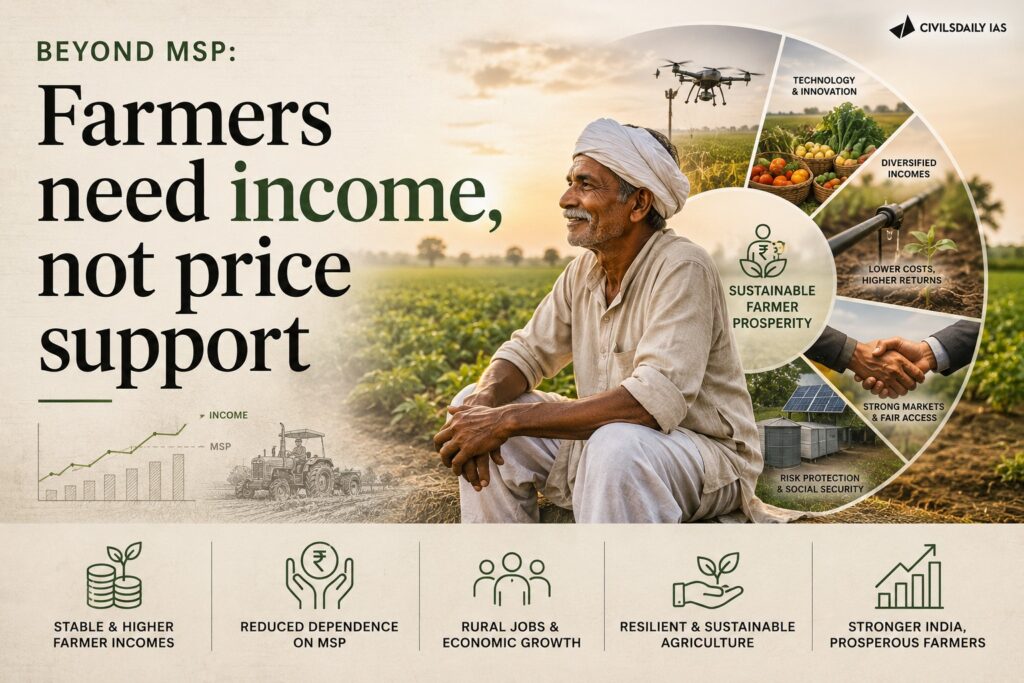
- Minimum Income Support (MIP): A per-acre direct cash transfer, described as Minimum Income Support (MIP), would guarantee farmers income without requiring the state to procure or store any crop.
- Market-aligned incentive: Once assured of an MIP, farmers would have the freedom to grow crops the market actually wants, rather than crops guaranteed a price floor.
- Complementary measures: Crop insurance and greater public investment in agricultural research and rural infrastructure are identified as the support structures that should accompany an MIP.
- Policy stance: Agricultural policy should complement markets rather than displace or distort them, an approach both MSP-based procurement and open-ended input subsidies have failed to deliver.
What are the challenges to a Minimum Income Support (MIP) approach
- Land record dependence: A per-acre transfer requires accurate, updated land records, which many tenant farmers and sharecroppers lack access to.
- Moral hazard risk: A flat per-acre payment could be gamed through short-term land leasing arrangements designed solely to capture the transfer.
- State fiscal capacity still tested: An MIP still requires sustained budgetary commitment from state or central governments. Its affordability has not been demonstrated at the scale MSP procurement currently operates.
- Loss of price floor: Removing procurement-based price support exposes farmers fully to market price volatility, without the safety net an assured MSP purchase currently provides.
- Political resistance: Farmer groups that have organised around MSP as an entitlement may resist a transition away from procurement guarantees they have fought to expand.
Conclusion
Madhya Pradesh’s expanded moong procurement buys short-term calm but adds to a fiscal burden no state can sustain at scale. The alternative on the table, a per-acre Minimum Income Support transfer paired with crop insurance and rural investment, would let farmers respond to market signals instead of price guarantees, though its own implementation challenges remain unresolved.
Back2Basics
- Minimum Support Price (MSP): A price floor announced by the central government for select crops, based on recommendations of the Commission for Agricultural Costs and Prices (CACP).
- Coverage: MSP currently covers 22 crops, but assured physical procurement at scale is concentrated overwhelmingly in wheat and rice through the Food Corporation of India (FCI) and state procurement agencies.
- Pulses and oilseeds: Procurement of pulses and oilseeds like moong at MSP has historically been far more limited than for cereals, leaving a wider gap between announced MSP and actual market realisation for these crops.
Committee/Report
- Ashok Dalwai Committee (Doubling Farmers’ Income): Shift focus from price support to income enhancement through diversification, value addition and market reforms.
- Shanta Kumar Committee (2015): Recommended restricting MSP procurement and replacing it with Direct Benefit Transfers (DBTs) where feasible.
Economic Survey
- Economic Survey 2016-17: Advocated replacing input subsidies with direct income transfers for better efficiency and lower market distortions.
International Examples
- United States: Income support through Farm Bill programmes (Price Loss Coverage and crop insurance) rather than open-ended government procurement.
- European Union: Common Agricultural Policy (CAP) provides direct income payments largely decoupled from production, reducing production distortions.
PYQ Relevance
[UPSC 2018] What do you mean by Minimum Support Price (MSP)? How will MSP rescue the farmers from the low-income trap?
Linkage: The PYQ tests the role of MSP in ensuring remunerative prices and improving farmers’ incomes. The article examines the limitations of MSP-based procurement and the case for Minimum Income Support (MIP) as an alternative.