💥Join UPSC 2027,2028 Mentorship (July Batch) + XFactor Notes & Microthemes PDF

Subject: AirportsXInfrastructure

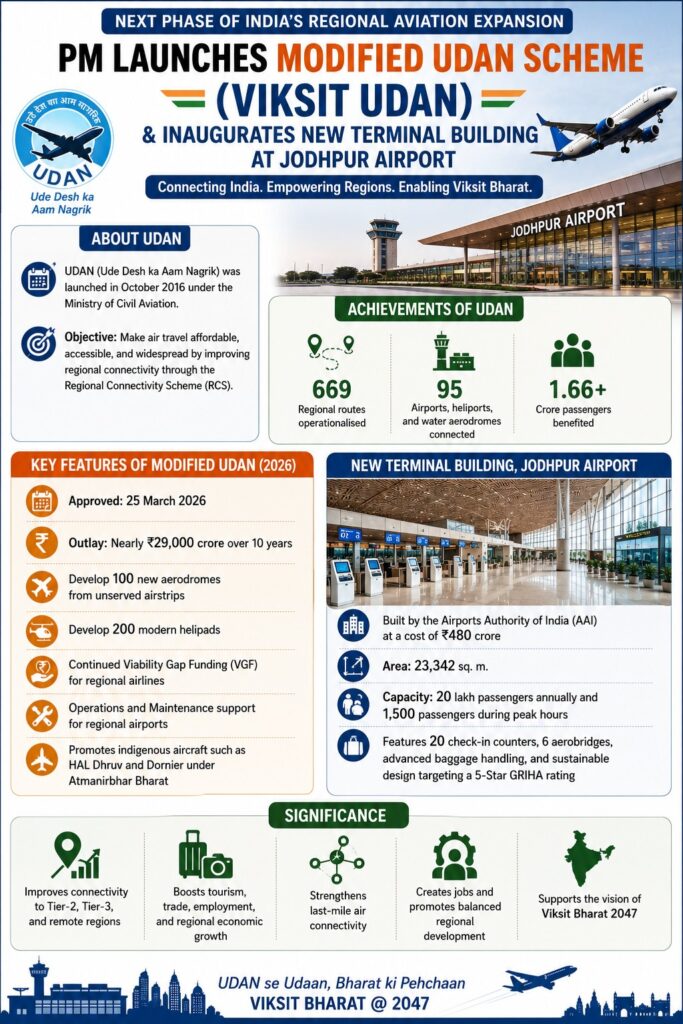
  • Modified UDAN Scheme (Viksit UDAN)

    Why in News?

    The Prime Minister launched the Modified UDAN Scheme (Viksit UDAN) and inaugurated the New Terminal Building at Jodhpur Airport, marking the next phase of India’s regional aviation expansion.

    About UDAN

    • UDAN (Ude Desh ka Aam Nagrik) was launched in October 2016 under the Ministry of Civil Aviation.
    • Objective: Make air travel affordable, accessible, and widespread by improving regional connectivity through the Regional Connectivity Scheme (RCS).

    Achievements of UDAN

    • 669 regional routes operationalised.
    • 95 airports, heliports, and water aerodromes connected.
    • Over 1.66 crore passengers benefited.

    Key Features of Modified UDAN (2026)

    • Approved: 25 March 2026.
    • Outlay: Nearly ₹29,000 crore over 10 years.
    • Develop 100 new aerodromes from unserved airstrips.
      • Note: An aerodrome is any defined location on land or water used for the arrival, departure, and movement of aircraft
    • Develop 200 modern helipads.
    • Continued Viability Gap Funding (VGF) for regional airlines.
    • Operations and Maintenance support for regional airports.
    • Promotes indigenous aircraft such as HAL Dhruv and Dornier under Atmanirbhar Bharat.

    New Terminal Building, Jodhpur Airport

    • Built by the Airports Authority of India (AAI) at a cost of ₹480 crore.
    • Area: 23,342 sq. m.
    • Capacity: 20 lakh passengers annually and 1,500 passengers during peak hours.
    • Features 20 check-in counters, 6 aerobridges, advanced baggage handling, and sustainable design targeting a 5-Star GRIHA rating.

    Significance

    • Improves connectivity to Tier-2, Tier-3, and remote regions.
    • Boosts tourism, trade, employment, and regional economic growth.
    • Strengthens last-mile air connectivity.
    • Supports the vision of Viksit Bharat 2047.

    [2024] Consider the following airports:
    1. Donyi Polo Airport
    2. Kushinagar International Airport
    3. Vijayawada International Airport In the recent past,
    which of the above have been constructed as Greenfield project?

    [A] 1 and 2 only

    [B] 2 and 3 only

    [C] 1 and 3 only

    [D] 1, 2 and 3

  • What is the need for expanding the regional air connectivity in India? In this context, discuss the government’s UDAN Scheme and its achievements.

    UDAN (Ude Desh ka Aam Naagrik) scheme was launched in 2017 to enhance regional air connectivity and make air travel accessible to all.

    Need for Expanding Regional Air Connectivity in India

    Bridging Regional Imbalances and connecting Tier-2 and Tier-3 cities. Boosts economic activity and market integration.

    Enhancing Mobility for Remote Areas such as the Northeast, Himalayan states, and island regions

    Boosting Tourism and Local Economies in places like Rajasthan, Uttarakhand, Northeast India, and coastal regions.

    Reducing Travel Time & improving convenience for business, medical, and administrative travel.

    Air connectivity enhances ease of doing business by stimulating Trade and Investment

    National Integration & Security- strengthen connectivity in strategic border regions

    Employment generation at airlines, airports, air navigation sector

    Environment benefit with “green airports” minimising carbon footprint. Eg- Kochi Airport

    UDAN Scheme (Ude Desh Ka Aam Nagrik): Key Features

    Objective- Make air travel affordable and accessible, especially in underserved and unserved airports.

    Regional Connectivity Scheme provides viability gap funding (VGF) to airlines to operate flights on low-demand routes.

    Revives/operationalises existing airstrips, heliports to reduce infrastructure barriers.

    affordable.

    Focus on Remote Areas in the Northeast, hill states, islands, tribal districts to ensure last-mile connectivity.

    Encourages Public-Private Partnership (PPP) in regional airport infrastructure.

    Achievements of the UDAN Scheme

    India emerged as 3rd largest aviation market in the world

    Expansion of Airports- Over 70+ airports, heliports, and water aerodromes have been operationalised

    More than 1,000 UDAN routes have been awarded, connecting Tier-2 and Tier-3 cities to major metros.

    Improved Connectivity in the Northeast & Himalayas – Routes like Shillong-Agartala, Pasighat-Guwahati, Kullu-Shimla

    Enhanced Tourism & Local Economies in destinations such as Shirdi, Darbhanga, Jharsuguda, Kishangarh, and Hubballi

    Growth of Regional Airlines due to VGF-supported routes. Eg- Star Air, TruJet

    Operationalisation of Water Aerodromes in places like Sabarmati-Kevadia, creating new mobility options.

    Faster air access in remote regions supports emergency evacuation and medical services. Eg- during Kerala Floods

    Issues in Expanding Regional Air Connectivity / UDAN Implementation

    Low Route Viability- Many Tier-2 and Tier-3 routes have low passenger demand

    Smaller regional airlines (e.g., TruJet) have struggled due to high operational costs, fuel prices, and limited fleet capacity.

    Several UDAN airports lack proper runways, night-landing facilities, ATC systems, firefighting equipment

    Slow land acquisition, tendering, and regulatory clearances delay operationalisation

    Volatility in Fuel Prices- ATF constitutes 35-40% of airline cost

    Limited Last-Mile Connectivity as .any UDAN airports are far from city centres

    Way Forward

    Adopt flexible revenue-share + viability funding to ensure long-term route sustainability.

    Fast-track DGCA clearances, land acquisition, environmental approvals

    Leverage Technology – Integrate AI, ML, automation, digital ATC towers, and predictive maintenance

    Boost Multimodal Integration- Ensure UDAN airports are linked to rail, buses, waterways

    With improved PPP models and technology adoptionUDAN can act as a true catalyst for inclusive growth and balanced regional development.