💥Join UPSC 2027,2028 Mentorship (July Batch) + XFactor Notes & Microthemes PDF

Subject: Economics

  • [pib] Remission of Duties and Taxes on Exported Products (RoDTEP) Scheme

    The Union govt. has decided to extend the benefit of the Scheme for Remission of Duties and Taxes on Exported Products (RoDTEP) to all export goods with effect from 1st January 2021.

    Try this PYQ:

    Q.Among the following, which one is the largest exporter of rice in the world in the last five years? (CSP 2019)

    (a) China

    (b) India

    (c) Myanmar

    (d) Vietnam

    RoDTEP Scheme

    • RoDTEP is a scheme for the Exporters to make Indian products cost-competitive and create a level playing field for them in the Global Market.
    • It has replaced the current Merchandise Exports from India Scheme, which is not in compliance with WTO norms and rules.
    • The new RoDTEP Scheme is a fully WTO compliant scheme.
    • It will reimburse all the taxes/duties/levies being charged at the Central/State/Local level which are not currently refunded under any of the existing schemes but are incurred at the manufacturing and distribution process.

    Why need such a scheme?

    • The scheme was announced last year as a replacement for the Merchandise Export from India Scheme (MEIS), which was not found not to be compliant with the rules of the World Trade Organisation.
    • Following a complaint by the US, a dispute settlement panel had ruled against India’s use of MEIS as it had found the duty credit scrips awarded under the scheme to be inconsistent with WTO norms.

    Back2Basics: Merchandise Exports from India Scheme (MEIS)

    • MEIS was launched with an objective to enhance the export of notified goods manufactured in a country.
    • This scheme came into effect on 1 April 2015 through the Foreign Trade Policy and will be in existence till 2020.
    • MEIS intended to incentivize exports of goods manufactured in India or produced in India.
    • The incentives were for goods widely exported from India, industries producing or manufacturing such goods with a view to making Indian exports competitive.
    • The MEIS covered almost 5000 goods notified for the purpose of the scheme.
  • The growth India deserve

    The Indian economy has been showing the green shoots in the results of the third quarter. However, the recovery is far from complete. The article suggests the strategy to get to the 5 per cent trend line.

    Divergent performance after lockdown

    • At the end of the third quarter, the economy is showing a hugely divergent performance.
    • Pharmaceuticals and chemicals are showing growth on their Year-To-Date numbers.
    • FMCG reached last year’s level in the second quarter.
    •  Construction equipment are showing a huge recovery, with record sales numbers in the last three months, driven by rural demand from sales to individuals.
    • Capital goods are still sluggish with YTD numbers well down on last year, but are now showing some signs of life.
    • In contrast, travel and tourism, real-estate and construction, and retail, are all still at under half last year.
    • These are high employment sectors, and salaried employment has correspondingly taken a big hit, with potentially longer term effects.

    How to achieve ‘full recovery’

    • Full recovery means getting back to the trend line of growth where we would have been pre-COVID.
    • We need to aspire to grow 9 per cent for three years, which is what will get us back to our 5 per cent trend line of growth by 2024.
    • The recovery underway is solid, but we need measures to sustain and deepen it.
    • The government can do three things.

    3 suggestions to sustain the recovery

    1) Stimulate the economy

    • The most immediate fiscal stimulus possible is to put cash into the economy.
    • Distribute the pending tax refunds, pay the bills of all companies, pay off the arbitration awards pending where the government has lost cases, and pay state governments their pending GST dues.
    • All this will run into a few trillion rupees, and it will be cash that immediately stimulates the economy.

    2) Invest in public health infrastructure

    • Some preparation is underway to distribute vaccines, but there is need to go much further.
    • Centre should finance state government efforts to build an extensive public health network so we are equipped to handle a possible second wave of the virus.
    • If we demonstrate that we are much more prepared in February and March 2021 than we were in April and May 2020, we will spread confidence.
    • Government should work in partnership with private sector hospitals.

    3) Invest in inftrstructure

    • There are dozens of projects stuck as funds are not available.
    • The 20 trillion infrastructure pipeline needs to have some cash flow in it.
    • The COVID crisis revealed awful things about living conditions in slums across our cities.
    • We can put in place the right public-private programme to provide decent, accessible housing, with quick and cheap connectivity into our cities.
    • This could trigger a building boom that would stimulate demand like nothing else.

    How to finance the spending: Privatisation program

    • Government can manage the resource for spending through privatisation program.
    • Our current stock market boom says that buyers are ready to invest. But public-sector stock values are still depressed.
    • The best way to see them take off is to announce that the government intends to reduce its share-holding to 26 per cent across public-sector banks, steel companies, oil companies, and every manufacturing company and hotel it currently owns.
    • To avoid opposition to such reforms, we must operate consistent with our democratic institutions.
    • We need discussion papers for public comment, the debate in Parliament, hearing out stakeholders, and compromise with the interests of state governments.

    Consider the question “What are the measures India needs to take to achieve the complete recovery of the Indian economy disrupted in the wake of the pandemic.”

    Conclusion

    Unless we act now we will have a stunted recovery. We must use our economic crisis to set some bigger things right. 2021 will be a year to welcome if it returns us to the growth trajectory we deserve.

  • Need for comprehensive agri policy

    The article examines the reasons for declining farm incomes and the contribution of farm subsidies.

    Contribution of agriculture

    • India’s agriculture, which also supports the rural workforce, was, forever, living beyond its means.
    • In 1950-51, agriculture’s share in the country’s GDP was 45%, the share of the workforce dependent on it was close to 70%.
    • Today, agriculture’s share in GDP is below 16%, but almost 50% of the country’s workforce depends on this sector.
    • The squeeze on the agricultural sector becomes even more evident from its terms of trade vis-à-vis the non-agricultural sectors.
    • Agriculture has been facing adverse terms of trade over extended periods since the 1980s, and even during the phases when the terms of trade have moved in its favour, for instance in the 1990s and again since 2012-13, there was no distinct upward trend.

    Reason for fall in farm incomes: falling investment

    • The decline in farm incomes was triggered by growing inefficiencies.
    • This decline, in turn, was caused by a lack of meaningful investment in agriculture.
    • The share of this sector in the total investment undertaken in the country consistently fell from about 18% in the 1950s to just above 11% in the 1980s.
    • In the most recent quinquennium for which data are available (2014-15 to 2018-19), the average share of agriculture was 7.6%.

    India’s dismal performance in term of yields of major crops

    • If one ranks countries in terms of their yields in wheat and rice — India’s two major crops — the country’s ranks were 45 and 59, respectively, in 2019.
    • This ranking would go down sharply if the areas recording high yields, such as Punjab and Haryana, are excluded.
    • In other words, for farmers in most regions of the country, it is an uphill battle for survival amid low yields.

    Need for coherent policy for agriculture

    • The lack of a coherent policy for agriculture must surely be regarded among the most remarkable failures of the governments in post-Independence India.
    • Compare this failure with the United States, with less than 2% of its workforce engaged in agriculture, has been enacting farm legislations every four years since the Agricultural Adjustment Act was enacted in 1933.
    • These policies comprehensively address the needs of the farm sector through proactive support from the respective governments.

    Issue of the farm subsidies in India

    • The subsidies are the price that the country pays for the failure of the policymakers to comprehensively address the problems of the farm sector.
    • Wanton distribution of subsidies without a proper policy framework has distorted the structure of production and, consequently, undesirable outcomes in terms of excessive food stockpiling.
    • And, yet, the fundamental ills of Indian agriculture are not adequately addressed.
    • Members of the World Trade Organization (WTO) are expected to notify their agricultural subsidies as a part of their commitment under the Agreement on Agriculture (AoA).
    • India’s latest notification, for 2018-19, shows that the subsidies provided were slightly more than $56 billion.
    • In most of the recent years, the largest component of India’s subsidies ($24.2 billion, or 43% of the total) is provided to “low income or resource-poor farmers”, a terminology that the AoA uses.
    • However, the designation of this category of farmers is left to individual members.
    • India has notified that 99.43% of its farmers are low income or resource-poor.
    • According to the agricultural census conducted in 2015-16, these are the farmers whose holdings are 10 hectares or less.
    • Thus, almost the entire farm sector comprises economically weak farmers.

    Comparing subsidies given by various countries

    • America provided $131 billion in 2017 and the EU, nearly €80 billion (or $93 billion) in 2017-18.
    • Instead of absolute numbers; the ratios of subsidies to agricultural value addition for the three countries give a much better picture.
    • Thus, for 2017, India’s farm subsidies were 12.4% of agricultural value addition, while for the U.S. and the EU, the figures were 90.8% and 45.3%, respectively.
    • This then is the reality of farm subsidies that India provides.

    Consider the question “Indian agriculture has been contributing beyond its means since Indian independence. However, agri incomes have shown a gradual decline. What are the reasons for such a decline? How far has farm subsidies succeeded in solving the low-income problem?” 

    Conclusion

    India needs a comprehensive Agri policy to deal with the distortion created by the subsidies.

  • Importance of Resilient supply chains

    What does supply chain resilience mean? 

    • When assembly lines are heavily dependent on supplies from one country, the impact on importing nations could be crippling if that source stops production intentionally (economic sanction) or unintentionally (natural disaster)
    • Example: Japan imported $169 billion worth from China, accounting for 24% of its total imports. Japan’s imports from China fell by half in February 2020 that impacted Japan’s economic activity.
    • In the context of international trade, supply chain resilience is an approach that helps a country to ensure that it has diversified its supply risk across a clutch of supplying nations instead of being dependent on just one or a few

    Recent incidents that led to supply chain disruption

    • Disruptions in supply chains can be natural or man-made.
    • When the novel coronavirus pandemic broke out, it had an immediate and telling effect on supply chains emanating from China.
    • In Japan’s case, a nuclear disaster (Fukushima Daiichi) caused a sharp drop in Japanese automobile exports to the United States.
    • Terrorist drone attacks on oil refineries in Saudi Arabia in September 2019 resulted in a drop of 5.7 million barrels of oil per day.
    • That attack triggered a steep plunge in Saudi Arabia’s stock market and a sharp spike in global oil prices.
    • Tensions with China led the United States government to impose restrictions on the export of microchips to China’s biggest semiconductor manufacturer SMIC.

    Supply Chain Resilience Initiative (SCRI)

    • Geo-politics and geo-economics can never be truly separated.
    • Also, there is a growing trend of weaponization of trade and technology.
    • China had imposed sanctions on its key exports of grain, beef, wine, coal, etc to Australia for demanding an inquiry into the origins of the coronavirus and advocating a robust Indo-Pacific vision.
    • It is against this backdrop that India, Japan, and Australia initiated the Supply Chain Resilience Initiative (SCRI).
    • It focuses on automobiles and parts, petroleum, steel, textiles, financial services, and IT sectors.
    • The SCRI may be strengthened by the future involvement of France.
    • Kingdom has also shown interest in the SCRI.

    “China plus one” strategy

    • For many Japanese companies, global performance and profits are linked to manufacturing facilities and supply chains in China.
    • Yet, they have shown an early capacity for risk mitigation through the “China Plus One” business strategy.
    • The “China plus one” strategy aims at diversification of investments to the Association of Southeast Asian Nations (ASEAN), India, and Bangladesh.
    • Japan announced a 2.2 billion Relocation Package.
    • Of the companies that availed this package, 57 relocated to Japan, 30 to Southeast Asia, and two to India.

    India’s vulnerability to supply chain disruptions

    • India can ill-afford the shocks of disruption in supply chains.
    • For instance, the pandemic caused a breakdown in global supply chains in the automotive sector.
    • For India, which imports 27% of its requirement of automotive parts from China, this quandary was a wake-up call.
    • It is t is noteworthy is that despite being the fourth largest market in Asia for medical devices, India has an import dependency of 80%. 
    • Given the renewed thrust in the health-care sector, this is the right time to fill gaps through local manufacturing.

    India increasing its presence in global supply chains

    1) Electronic industry

    • India’s electronics industry was worth $120 billion in 2018-2019 and is forecast to grow to $400 billion by 2025.
    • India is enhancing its presence in the global supply chains by attracting investments in the semiconductor components and packaging industry.
    • The Indian electronics sector is gradually shifting away from completely knocked down (CKD) assembly to high-value addition.

    2) Defence sector

    • Defence is among the key pillars of the ‘Atmanirbhar Bharat’ policy.
    • The government is providing a big boost to defence manufacturing under the ‘Make in India’ program.
    • It has identified a negative import list of 101 items.
    • There is a tremendous opportunity for foreign companies to enter into tie-ups with reputed Indian defence manufacturers to tap into the growing defence market in India.

    Consider the question “Pandemic has demonstrated the damage vulnerable supply chains can cause. It also underscored the importance of resilient supply chains. In light of this, examine the importance of diversification of supply chains.”

    Conclusion

    India has the capacity and the potential to become one of the world’s largest destinations for investments, and one of the world’s largest manufacturing hubs, in the aftermath of the pandemic.

  • What are Dedicated Freight Corridors (DFCs)?

    Prime Minister has inaugurated a 351-km section between Khurja and Bhaupur in Uttar Pradesh for commercial operations of the Dedicated Freight Corridor (DFC).

    There is another concept named Dedicated Passenger Corridors (DPCs). Can you guess the idea behind?

    Background of DFCs

    • The concept of Dedicated Freight Corridor (DFC) was mooted in 2006 to generate substantial capacity for freight traffic by developing separate tracks on identified routes.
    • The Dedicated Freight Corridor Corporation of India Ltd (DFCCIL) was incorporated as a separate company under the Ministry of Railways.

    What is the DFC?

    • Under the Eleventh Five Year Plan (2007–12), Railways started constructing a new DFC in two long routes, namely the Eastern and Western freight corridors.
    • The section recently launched is part of the 1,839-km Eastern DFC that starts at Sohnewal (Ludhiana) in Punjab and ends at Dankuni in West Bengal.
    • The other arm is the around 1,500-km Western DFC from Dadri in Uttar Pradesh to JNPT in Mumbai, touching all major ports along the way.
    • There is also a section under construction between Dadri and Khurja to connect the Eastern and Western arms.

    Why is it important?

    • Around 70% of the freight trains currently running on the Indian Railway network are slated to shift to the freight corridors, leaving the paths open for more passenger trains.
    • Tracks on DFC are designed to carry heavier loads than most of the Indian Railways.
    • DFC will get track access charge from the parent Indian Railways, and also generate its own freight business.

    What trains will use the new section?

    • Freight trains plying on this section from now on will help decongest the existing Kanpur-Delhi main line of Indian Railways, which currently handles trains at 150% of its line capacity.
    • The new section means on the Indian Railway mainline, more passenger trains can be pumped in and those trains can, in turn, achieve better punctuality.
    • Foodgrain and fertilizers from the northern region are transported to the eastern and Northeast regions.
    • From East and Northeast, coal, iron ore, jute, and petroleum products are transported North and West.
  • Reforms with the future and farming needs in mind

    Some provisions of the new farm laws are opposed by the farmers. The article explains the utility of these provisions.

    Major objections to farm laws

    • The first objection is that the Agricultural Produce Market Committees (APMC) will be eventually closed,
    • The second objection is that Minimum Support Prices (MSP) will be stopped,
    • The third fear is that corporates will take over the agriculture trade, and farmers’ land will be taken over by powerful corporates.

    Why reforms were needed

    • The gap between the agri-income of a farmer and that of a non-agriculture worker increased from ₹25,398 in 1993–94 to ₹1.42 lakh in 2011-12.
    • Aggregate food demand has fallen short of domestic production necessitating the export of a large quantity to prevent domestic prices from falling very low.
    • India is sitting on an excess stock of 60 lakh tons of sugar and nearly 72 million tons of extra buffer stock of wheat and rice which is causing a huge drain on fiscal resources.
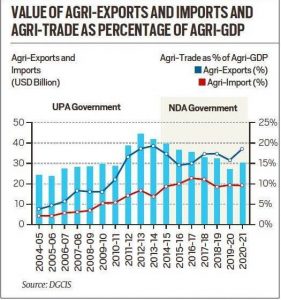
    • India’s agri-exports are facing difficulty, imports are turning attractive as domestic prices are turning much higher.
    • Rural youth are looking for jobs outside agriculture and there is a serious problem of unemployment in the countryside.
    • There are numerous instances of market failure to the detriment of producers and consumers.
    • This is turning farmers to look at the government for remunerative prices through MSP for most agricultural products.
    • The growth rate in agriculture is driven by heavy support through various kinds of subsidies and output price support.
    • These costs and losses and subsidies will take away most of the tax revenue of the central government.

    3 Provisions and their utility

    1) Relation between MSP and APMC

    • APMC has nothing to do with the payment of the MSP.
    • The necessary and sufficient conditions for the MSP are procurement by the government, with or without the APMC.
    • Experience shows that even after fruits and vegetables were de-notified from the APMC, they continued to arrive at APMC mandis in large quantities while farmers got additional options.
    • The protesting farmers have raised concerns to keep the level-playing field for the APMC and private players, and the government has shown agreement to address this fully.

    2) Criteria for traders

    • Protesting farmers are also opposing the provision of the simple requirement of a PAN card for a trader.
    • After having a PAN card, even a farmer can go for trading, his son can do agri-business and other rural youth can undertake purchases of farm commodities for direct sale to a consumer or other agribusiness firms.
    • If stringent criteria such as bank guarantee, etc. are included in the registration, then the spirit of the new law to facilitate farmers and rural youth to become agribusiness entrepreneurs will be lost.

    3) Mistaking contract farming with corporate farming

    • Critics and protesting farmers are mixing contract farming with corporate farming.
    • The new Act intends to insulate interested farmers (especially small farmers), against market and price risks.
    • The Act is voluntary and either party is free to leave it after the expiry of the agreement.
    • It prohibits the transfer, sale, lease, mortgage of the land or premises of the farmer.
    • The Act will promote diversification, quality production for a premium price, export, and direct sale of produce, with desired attributes to interested consumers.
    • It will also bring new capital and knowledge into agriculture and pave the way for farmers’ participation in the value chain.

    Conclusion

    The policy reforms undertaken by the central government through these Acts are in keeping with the changing times and requirements of farmers and farming. If they are implemented in the right spirit, they will take Indian agriculture to new heights and usher in the transformation of the rural economy.

  • National Common Mobility Card (NCMC)

    Prime Minister has launched the ambitious National Common Mobility Card (NCMC) service for the Delhi Metro’s Airport Express Line.

    Q.What is the National Common Mobility Card (NCMC)? How it a step moving towards a one nation one card system? (150W)

    National Common Mobility Card

    • The idea of NCMC was floated by the Nandan Nilekani committee set up by the Reserve Bank of India (RBI).
    • The committee had suggested that NCMC should contain two instruments – a regular debit card which can be used at an ATM and a local wallet.
    • Banks mandated by the department of financial services have been asked to make their debit cards NCMC compliant, to ensure availability of service.
    • The committee has also proposed a host of measures, including all payments by the government to citizens through the digital mode, to reduce the number of cash transactions in the country.

    Features of the NCMC

    • NCMC will allow passengers with RuPay debit cards, issued in the last 18 months by 23 banks, including SBI, UCO Bank, Canara Bank, Punjab National Bank, etc, to be swiped for Metro travel.
    • It can be used at all transit locations making all new metro and transit payments interoperable via one card.
    • NCMC is an automatic fare collection system. It will turn smartphones into an inter-operable transport card that commuters can use eventually to pay for Metro, bus, and suburban railways services.
    • NCMC service is slated to cover the entire 400km stretch of Delhi Metro.
    • It will allow entry and exit from Metro stations with the help of a smartphone, known as the automatic fare collection (AFC) system.
    • To make AFC compliant indigenous gates for metro stations, the government has engaged Bharat Electronics Limited. Eventually, all Metro stations will be fitted with AFC gates.
  • What are Zero Coupon Bonds?

    The government has used financial innovation to recapitalize a bank by issuing the lender Rs 5,500-crore worth of non-interest bearing bonds called Zero-Coupon Bonds.

    Try this PYQ:

    Q.Which of the following is issued by registered foreign portfolio investors to overseas investors who want to be part of the Indian stock market without registering themselves directly?

    (a) Certificate of Deposit

    (b) Commercial Paper

    (c) Promissory Note

    (d) Participatory Note

    Zero-Coupon Bonds

    • These are non-interest bearing, non-transferable special GOI securities that have a maturity of 10-15 years and are issued specifically to Punjab & Sind Bank.
    • These bonds are not tradable; the lender has kept them in the held-to-maturity (HTM) investments bucket, not requiring it to book any mark-to-market gains or losses from these bonds.
    • This will earn no interest for the subscriber; market participants term it both a ‘financial illusion’ and ‘great innovation’ by the government.

    How do they differ from bonds issued by private firms?

    • There is a difference between zero-coupon bonds issued by other corporates and these.
    • Zero-coupon bonds by private companies are normally issued at discount, but since these special bonds are not tradable these can be issued at par.
  • Dangers lurking beneath economic recovery

    As Indian economy recovers from the economic disruption caused by the pandemic, there are dangers of rising inequality and cosequently the rising inflation. The article deals with these issues.

    3 features of Indian recovery

    • 1) The number of new cases has fallen while the fatality rate continues to drop.
    • 2) India has rolled out one of the smallest fiscal support packages globally, with central government spending flat so far this year.
    • 3) Inflation is now a big problem, with consumer prices above the 6 per cent tolerance level for the past eight months.

    Consequences of low fiscal spending

    • It may seem that India is back on the path to recovery.
    • But  the low level of fiscal spending could leave behind other problems, such as rising inequality.
    • Although, in India there was a focus on vulnerable section, there were some misses, such as the urban poor being left out, and the overall outlay was small.
    • For instance, demand for the rural employment guarantee programme continues to outstrip supply.
    • There is the rise in inequality between large and small firms, which is likely to be felt by individual employees.
    • Large firms were helped by cost-cutting, low interest rates, access to buoyant capital markets and increased spending in the formal economy probably helped.
    • The smaller listed firms did not do as well.
    • Small firms are more labour intensive than large firms.
    • If small firms do poorly, it impacts a large number of people.
    • All this could impact demand over time.
    • Rising inequality could stoke inflation (in services particular).
    • Consumption patterns show that the rich in India tend to consume more services than the poor.
    • And rising inequality could, therefore, stoke inflation.

    Possibility of services inflation

    • 1) As a vaccine comes into play, there could be a release of pent-up demand for high-touch services.
    • 2) As large firms and their employees do relatively well, they are likely to demand more services, stoking prices.
    • 3) Many service providers did not do a regular annual price reset in 2020, so they may raise prices to cover the two years once demand picks up.
    • If inflation does become persistent and leads to tighter monetary policy, that could weigh on growth over time.

    Way forward

    • To control inflation in 2021, the RBI may have to take steps such as:-
    • 1) Gradually drain the excess liquidity in the banking sector,
    • 2) Provide a floor for short-term rates, which have fallen below the reverse repo rate.
    • 3) Narrow the policy rate corridor by raising the reverse repo rate.
    • A quicker exit from loose monetary policy could become another area where India differs from the world.

    Consider the question “What are the consequences of economic recovery in the wake of pandemic? Suggest the ways to deal with these consquences.”

    Conclusion

    Putting all of this together, it seems India will come full circle in 2021. For a while it was worried more about weak growth than high inflation. But as growth recovers, inflationary concerns could reappear.

  • What is Positive Pay System?

    With the New Year, a new concept of Positive Pay System for Cheque Truncation System (CTS) will be introduced by the Banking regulator Reserve Bank of India (RBI) seeking to further augment customer safety in cheque payments.

    Try this PYQ:

    Q.Which of the following is the most likely consequence of implementing the ‘Unified Payments Interface (UPI)’?

    (a) Mobile wallets will not be necessary for online payments.

    (b) Digital currency will totally replace the physical currency in about two decades.

    (c) FDI inflows will drastically increase.

    (d) Direct transfer of subsidies to poor people will become very effective.

    Positive Pay System

    • The concept of Positive Pay involves a process of reconfirming key details of large-value cheques.
    • Put simply, cheques will be processed for payment by the drawee bank based on information passed on by its customer at the time of issuance of the cheque.
    • When the beneficiary submits the cheque for encashment, the cheque details are compared with the details provided to the drawee bank through Positive Pay.
    • If the details match, the cheque is honoured. In case of mismatch in cheque details, the discrepancy is flagged by CTS to the drawee bank and the presenting bank, which would take redress measures.

    For cheques above 50k

    • The banks are advised to enable it for all account-holders issuing cheques for amounts of ₹50,000 and above.
    • While availing of this facility is at the discretion of the account-holder, banks may consider making it mandatory in case of cheques for amounts of ₹5 lakh and above, the RBI had said.

    Benefits of the system

    • Under the Positive Pay system, the drawee bank is already aware of the issuer the details of the high-value cheque (above ₹50,000) he has issued.
    • Without this intimation, if a cheque gets presented, then the drawee bank can reject payment and examine the case. Positive Pay is going to benefit both the issuer and the beneficiary.
    • For the issuer, the benefit from this concept is that there cannot be fraudulent cheques encashed out of issuer’s account.
    • For the beneficiary, the benefit is that the cheques handed out to him will mostly get honoured.

    Is Positive Pay the same as ‘certified cheque’?

    • The concept of ‘certified cheque’ was there long back — about 30 years back, long before technology swept across the Indian banking landscape.
    • Whenever anybody issued a cheque, banks used to certify that money is there in their customer’s bank account and, therefore, the cheque will get honoured.
    • This provided comfort to a beneficiary that cheque payment will get honoured and therefore did not insist on a pay order or demand draft.
    • Drawee banks used to earmark the amount in the account of the issuer and then certify the cheque.
    • This was adopted in an era when the cheque instrument used to travel physically for clearing.

    Why need such a system?

    • The RBI says the Positive Pay system is to augment customer safety in cheque payments and reduce instances of fraud occurring on account of tampering of cheque leaves.
    • Banks had recently witnessed a rise in frauds involving high-value cheques.