💥Join UPSC 2027,2028 Mentorship (August Batch) + XFactor Notes & Microthemes PDF

Subject: History

  • In news: Women Revolutionaries of Bengal 

    Why in the News?

    This newscard is an excerpt from the original article published in the Indian Express.

    Women in Revolutionary Movements:

    Pritilata Waddedar:

    • Early Life: Born on 5 May 1911 in Chittagong. One of the first Bengali women to lead an armed revolutionary group.
    • Education: Graduated in philosophy from Bethune College, Kolkata; became a school teacher.
    • Inspiration: Influenced by revolutionary literature and women’s activism; joined Deepali Sangha.
    • Role: Collected bomb cases, distributed pamphlets, gathered jail intelligence by posing as relatives.
    • Legacy: Left a suicide note explaining her cause; remembered as a fearless martyr.

    Kalpana Datta:

    • Early Life: Born in 1913 in Sripur, Chittagong; studied at Bethune College, joined Chhatri Sangha.
    • Activities: Conducted reconnaissance before the European Club attack; arrested a week earlier.
    • Later Role: Joined bombing attempt to free Surya Sen; sentenced to life, released in 1939.
    • Post-freedom: Became a Communist Party leader, focused on social activism.

    Bina Das:

    • Early Life: At 21, attempted assassination of Governor Stanley Jackson (1932) with a revolver supplied by Kamala Das Gupta.
    • Networks: Part of secret revolutionary student circles.
    • Court Statement: Famous for her passionate resistance plea before Calcutta High Court.

    Begum Rokeya Sakhawat Hossain:

    • Early Life: Born on 9 December 1880; pioneer of women’s rights and education.
    • Writings: Authored “Sultana’s Dream” (1908), envisioning a feminist utopia.
    • Institutions: Founded the first school for Muslim girls in Kolkata; formed Muslim Women’s Association (1916).
    • Activism: Led women’s conferences, challenged purdah, advocated education.

    Kamala Das Gupta:

    • Early Life: Born in Dhaka; completed MA in history at Kolkata. Initially Gandhian, later joined Jugantar.
    • Role: Provided shelter, weapons, and materials; arrested multiple times.
    • Connection: Supplied Bina Das with revolver for her assassination attempt.
    • Legacy: Wrote “Rakter Akshare” and “Swadhinata Sangrame Nari”; led refugee relief and vocational training.

    Nanibala Devi:

    • Early Life: Disguised as a revolutionary’s wife; spied in prisons for intelligence.
    • Sacrifice: Endured brutal police torture (including red chili powder) without revealing secrets.
    • End: Died in poverty but symbolised courage and resilience.

    Labanya Prabha Ghosh:

    • Early Life: Born on 14 August 1897, Purulia.
    • Contribution: Helped establish Shilpashram, hub of revolutionaries like Subhas Bose, C.R. Das.
    • Political Role: First woman MLA from Purulia; wrote and edited nationalist journals.
    • Later Activism: Led movements for land rights, justice for the poor.

    Matangini Hazra (“Gandhi Buri”):

    • Early Life: Born in 1870, Hogla village, Midnapore; widowed young, lived in poverty.
    • Freedom Struggle: Joined Salt Satyagraha, arrested for making salt; resisted chowkidari tax.
    • Repression: Imprisoned and beaten; served the sick during epidemics.
    • Martyrdom: Killed by police firing while leading Quit India procession (1942), holding the tricolour until death.
    [UPSC 2009] During the freedom struggle, Aruna Asaf Ali was a major woman organizer of underground activity in

    Options:

    (a) Civil Disobedience Movement

    (b) Non-Cooperation Movement

    (c) Quit India Movement*

    (d) Swadeshi Movement


  • Gopal Patha and Direct Action Day

    Why in the News?

    A recent movie depicted the 1946 “Great Calcutta Killing” — four days of communal riots on Direct Action Day (August 16, 1946), spotlighting Gopal Patha’s role in mobilising Hindu youth.

    About Direct Action Day:

    • Declaration: Called by the All-India Muslim League to press for Partition and creation of Pakistan.
    • Bengal Role: Muslim League’s H. S. Suhrawardy (then Bengal Premier) declared 16 August a public holiday.
    • Mass Rally: Nearly 1,00,000 gathered at the Maidan, Calcutta; addressed by Suhrawardy and Khwaja Nazimuddin.
    • Violence: Immediate communal clashes broke out, remembered as the Great Calcutta Killing.
    • Casualties: 5,000–10,000 killed; ~15,000 injured.
    • Spread: Violence lasted four days (16–19 August), army intervention required; later spread to Bombay, Noakhali, Bihar, Punjab.

    Who was Gopal Patha (Gopal Mukherjee)?

    • Background: Born 1916 in Bowbazar, Calcutta; nicknamed Patha (goat) since family ran a College Street mutton shop.
    • Gang Leader: Headed a street group of ~800 men; mobilized masses for defense during riots.
    • Approach: Declared aim was to retaliate against rioters but forbade harm to women, children, or ordinary people.
    • Links: Associated with revolutionary groups like Atma Unnati Samiti; influenced by Subhas Chandra Bose.
    [UPSC 2002] The last opportunity to avoid the partition of India was lost with the rejection of:

    Options: (a) Cripps Mission (b) Rajagopalachari Formula (c) Cabinet Mission* (d) Wavell Plan


  • Young Bengal Movement and Henry Derozio 

    Why in the News?

    This newscard is an excerpt from the article originally published in The Hindu.

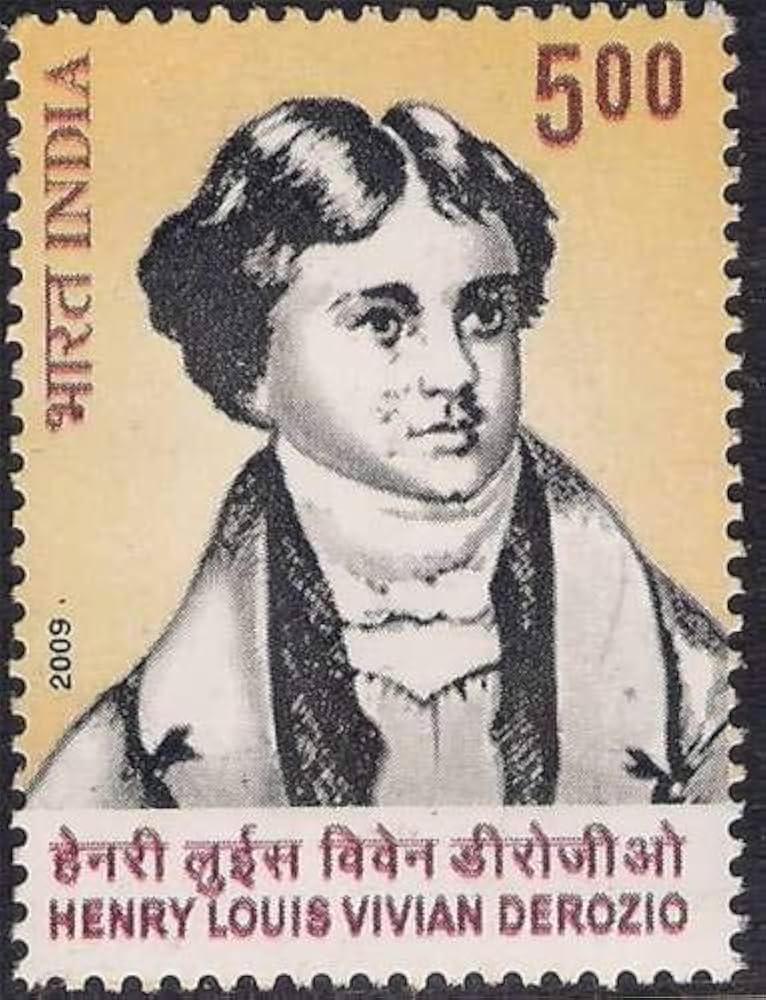
    Young Bengal Movement and Henry Derozio 

    Who was Henry Vivian Louis Derozio?

    • Birth–Death: Born 1809, died- 22 in 1831; Indo-Portuguese origin.
    • Identity: Radical thinker, poet, and educator in British India.
    • Recognition: Called the first national poet of modern India; pioneer of Anglo-Indian poetry.
    • Influences: Inspired by Enlightenment ideals and the French Revolution.
    • Career: Became lecturer at Hindu College, Calcutta in 1826 at just 17.
    • Role: Inspired students with rationalism, liberty, and free thought.
    • Writings: Poems (1827), The Fakeer of Jungheera (1828), and To India – My Native Land (first modern patriotic poem in English).
    • Themes: Expressed India’s decline with images of a caged eagle and a broken instrument; advocated freedom and abolition of slavery.
    • Dismissal: Removed from Hindu College in 1831 on charges of spreading atheism.

    The Young Bengal Movement: 

    • Formation: Radical group of his students, also called Derozians.
    • Association: Founded the Academic Association, debating social and political reform.
    • Ideals: Advocated rationalism, women’s rights, freedom of thought; opposed caste, superstition, idolatry.
    • Political Role: In 1843, with George Thompson, formed India’s first political partyBengal British India Society.
    • Notable Member: Radhanath Sikdar, mathematician who first calculated Mount Everest’s height and openly resisted colonial injustices.
    • Perception: Described by missionary Alexander Duff as a “new race of men”; historian Rosinka Chaudhuri called them India’s “first radicals.”
    • Legacy and Intellectual Impact:
      • Awakening: Though short-lived, the movement sparked Bengal’s intellectual revolution.
      • Seeds of Reform: Laid foundation for later reformist and nationalist currents.
      • Independence of Mind: Marked a sharp break from Macaulay’s vision of Anglicised Indians — Derozians were assertive and original.
    [UPSC 2021] Who among the following was associated as Secretary with Hindu Female School which later came to be known as Bethune Female School?

    Options: (a) Annie Besant (b) Debendranath Tagore (c) Ishwar Chandra Vidyasagar * (d) Sarojini Naidu


  • In news: British Conquest of Sindh

    Why in the News?

    The British conquest of Sindh in the 1840s was a key step in colonial expansion, reminding us that regions like Sindh, Punjab, and Bengal came under British rule long before the 1947 partition of India and Pakistan.

    British Conquest of Sindh:

    • Sindh was annexed by the British in 1843 after the battles of Miani and Dubbo.
    • The resistance was led by Hosh Muhammad Sheedi, a general of the Talpur army and member of the African-origin Siddi community.
    • His defiance symbolised the first major armed resistance to British expansion in northwest India.

    Political Background in Sindh:

    • Kalhora Dynasty (1701–1779): Founded by Mian Yar Muhammad Kalhoro, recognised by Mughals; ruled northern and central Sindh. Prosperous period but weakened by internal disputes.
    • Talpur Dynasty (1779–1843): Baloch Talpurs overthrew Kalhoras; consolidated Sindh under clan rule at Hyderabad and Khairpur.
    • Geopolitical Context: Sindh lay at the crossroads of British–French–Russian rivalry (The Great Game). Britain feared Russian advances through Iran and Afghanistan.
    • British Entry: East India Company forced treaties on Talpurs; captured Karachi (1839) after bombarding Manora fort.

    British Advance and the Fall of Sindh:

    • Battle of Miani (17 Feb 1843): British under Sir Charles Napier defeated Mir Nasir Khan Talpur near Hyderabad.
    • Battle of Dubbo (24 Mar 1843): Hosh Muhammad Sheedi allied with Mir Sher Muhammad Talpur of Mirpur Khas. Sheedi raised the war cry “Marvesoon par Sindh na desoon” (I may die but will not give up Sindh). He was killed in action.
    • British Annexation: After Dubbo, Sindh was annexed into the Bombay Presidency. Talpur rule ended.
    • Aftermath: Within a decade, Punjab too was annexed (1849), bringing all of northwest India under British rule.

    Legacy of Hosh Muhammad Sheedi:

    • Born into the household of Talpur rulers; of African-Siddi descent.
    • Valour acknowledged by both Indian and British chroniclers.
    • Became a folk hero of Sindh, remembered by Hindus and Muslims alike.
    • His legacy is central to the cultural memory of Sindh and highlights the role of the Siddi community in resisting colonialism.
    [UPSC 2007] The ruler of which one of the following States was removed from power by the British on the pretext of misgovernance?

    Options: (a) Awadh* (b) Jhansi (c) French (d) Satara


  • Red Fort as the Venue for Independence Day

    Why in the News?

    On August 15, 2025, Prime Minister delivered the longest Independence Day speech (103 minutes) from the Red Fort, continuing a tradition started by Jawaharlal Nehru in 1947.

    The fort’s choice as the venue reflects its historic role as Delhi’s seat of power and symbol of sovereignty.

    About the Red Fort:

    • Construction: Built in 1648 by Mughal Emperor Shah Jahan as the palace fort of Shahjahanabad, his new capital.
    • Material: Enclosed by massive red sandstone walls with royal pavilions and apartments.
    • Water Feature: Contained the Nahr-i-Behisht (“Stream of Paradise”), a continuous water channel.
    • Architectural Value: Prime example of Mughal architecture, blending Islamic traditions with Indian craftsmanship.
    • Recognition: Declared a UNESCO World Heritage Site in 2007.

    Historical Significance of Delhi and Red Fort:

    • Delhi’s Role: Seat of power for nearly a thousand years, regarded as “capital of all Hindustan” by Babur.
    • Shahjahanabad: Inaugurated in 1648 with the Red Fort at its centre.
    • Symbol of Sovereignty: Even after Mughal decline, Delhi remained central; East India Company minted coins in the emperor’s name.

    1857 Revolt and British Authority:

    • Revolt Centre: Bahadur Shah Zafar was declared leader by sepoys in Delhi.
    • Aftermath: Fall of Delhi ended Mughal rule; Zafar was exiled.
    • Fort Damage: British converted Red Fort into a military garrison, destroying ~80% of interiors.
    • Imperial Authority: Delhi Durbars (1877, 1903, 1911) asserted British control before capital shifted from Calcutta to Delhi in 1911.

    Significance of Red Fort for Independence Day:

    • INA Trials: Held in Red Fort in 1946, igniting nationalist fervour.
    • 1947 Ceremony: Jawaharlal Nehru hoisted the national flag on 15 August 1947 and gave the first Independence Day address.
    • Tradition: Since then, every Prime Minister hoists the flag and addresses the nation from its ramparts.
    • Symbolism: Site once stamped with colonial dominance, now reclaimed as a symbol of India’s sovereignty.
    [UPSC 2021] What was the exact constitutional status of India on 26th January, 1950?

    Options: (a) A democratic Republic (b) A Sovereign Democratic Republic* (c) A Sovereign Secular Democratic Republic (d) A Sovereign Socialist Secular Democratic Republic


  • Piprahwa Relics of Buddha

    Why in the News?

    The Union Culture Ministry has successfully retrieved the sacred ‘Piprahwa’ Buddhist relics, which were set to be auctioned in Hong Kong.

    Piprahwa Relics of Buddha

    About the Piprahwa Relics:

    • Discovery: Unearthed in 1898 by William Claxton Peppe, a British engineer, at Piprahwa (Siddharthnagar, Uttar Pradesh), near the Nepal border.

    • Historical Significance: Identified as ancient Kapilavastu, capital of the Shakya republic, where Prince Siddhartha (Buddha) lived before renunciation.

    • Findings at the Site: A buried stupa yielded a large stone coffer containing:

      • Bone fragments believed to be Buddha’s relics
      • Caskets made of soapstone and crystal
      • A sandstone coffer
      • Over 1,800 ornaments: pearls, rubies, sapphires, gold sheets
    • Legal Custody:

      • The British Crown claimed the relics under the Indian Treasure Trove Act, 1878.
      • Most artifacts were transferred to the Indian Museum, Kolkata.

    Stupas with Buddha’s Relics:

    • After the Buddha’s death (Mahaparinirvana), his cremated relics were divided among 8 kingdoms and a Brahmin named Drona, who coordinated their distribution.
    • Each recipient built a Stupa to enshrine their share of the relics, creating important pilgrimage sites and early centers of Buddhist worship.
    • The 9 stupas were located in Rajagriha, Vaishali, Kapilavastu, Allakappa, Ramagrama, Vethadipa, Pava, Kushinagar, and Pippalivana.
    • Emperor Ashoka (3rd century BCE) redistributed the relics from these stupas into thousands of new stupas across his empire.
    • The stupa at Ramagrama is unique because it is believed to remain untouched and still holds the original relics.
    • A typical early Buddhist stupa included a hemispherical mound (anda), a square railing (harmika), a central pillar (yashti) with umbrellas (chatra), and a path for circumambulation (pradakshinapatha).
    [UPSC 2023] With reference to ancient India, consider the following statements:

    1. The concept of Stupa is Buddhist in origin.

    2. Stupa was generally a repository of relics.

    3. Stupa was a votive and commemorative structure in Buddhist tradition. How many of the statements given above are correct?

    Options: (a) Only one (b) Only two* (c) All three (d) None


  • Paika Rebellion references omitted from NCERT books

    Why in the News?

    Former Odisha CM expressed concern over the omission of the Paika Rebellion from NCERT’s latest Class VIII history textbook, calling it a “huge dishonour” to the brave Paikas.

    Localized Revolts in Odisha Region:

    • The Paika Rebellion was part of a broader pattern of regional uprisings triggered by colonial encroachments:
      • Paralakhemundi Rebellion (1799–1814)
      • Ghumusar Revolt (1835–36)
      • Angul Uprising (1846–47)
      • Kondh and Sabara Rebellions (1855–1857)
    • These revolts were often led by dispossessed elites and tribal communities, reacting to land loss, economic distress, and erosion of traditional authority.

    About Paika Rebellion:

    • Who Were the Paikas: Traditional militia of Odisha who served local kings in exchange for rent-free land (nish-kar jagirs) and social standing.
    • Role: Functioned as hereditary foot soldiers and police for the Khurda kingdom.
    • Decline: British annexation of Odisha in 1803 ended their privileges through land revenue reforms and colonial restructuring.
    • Leader: Led by Bakshi Jagabandhu Bidyadhar, the military chief under King Mukunda Dev II of Khurda.
    • Causes of Rebellion: Loss of land rights, oppressive taxation, and marginalization of both the elite and peasantry under British rule.
    • Key Events:
      • 2 April 1817: Bakshi Jagabandhu led the Paikas, joined by tribal Kondhs and others, in open rebellion.
      • Rebel Actions: British offices at Banapur were torched, the treasury looted, and colonial officers killed.
      • British Response: Regained control by mid-1817, but rebels resorted to guerrilla tactics.
      • Bakshi’s Death: Captured in 1825, died in custody in 1829.

    Outcomes:

    • British Concessions: Temporary tax remissions, Lowered assessments, Suspended forced estate sales and fixed-land-tenures.
    • Administrative Impact: These measures showed the British were forced to reconsider exploitative policies.
    • Aftermath and Significance:
      • Historical Role: An early example of organized resistance against British colonial rule—decades before 1857.
      • Freedom Struggle Legacy: Viewed as a precursor to India’s independence movement.
      • Current Demand: Odisha leaders advocate its recognition as India’s “first war of independence.”
    [UPSC 2018] After the Santhal Uprising subsided, what was/were the measure/measures taken by the colonial government?

    1. The territories called `Santhal Paraganas’ were created. 2. It became illegal for a Santhal to transfer land to a non-Santhal.

    Select the correct answer using the code given below:

    Options: (a) 1 only (b) 2 only (c) Both 1 and 2* (d) Neither 1 nor 2


  • In news: Mangal Pandey (1827-1857)

    Why in the News?

    The Prime Minister paid tribute to the great freedom fighter Mangal Pandey on his birth anniversary.

    Who was Mangal Pandey?

    • Birth: Born on 19 July 1827 in Nagwa village, Ballia district, Uttar Pradesh.
    • Military Service: Joined the British East India Company’s army in 1849 as a sepoy in the 34th Bengal Native Infantry at Barrackpore.
    • Trigger of Revolt: Opposed the use of Enfield rifle cartridges greased with cow and pig fat, offensive to religious beliefs.
    • Rebellion: On 29 March 1857, attacked British officers and encouraged sepoys to rise in revolt.
    • Punishment: Arrested, tried, and executed by hanging on 8 April 1857.
    • Legacy: Regarded as the “Hero of the First War of Indian Independence” and a symbol of resistance.

    Back2Basics: 1857 War of Independence

    • Overview: The First War of Indian Independence or the Great Rebellion of 1857.
    • Sepoy Composition: Indians made up over 87% of the British Indian Army but faced severe discrimination.
    • Root Causes:
      • Military Discontent: Unequal pay, poor promotion prospects, denial of allowances.
      • Religious Insensitivity: Use of animal fat-greased cartridges insulted Hindu and Muslim beliefs.
      • Economic Hardship: Heavy land taxes, decline in traditional crafts, and rising unemployment.
      • Political Grievances: Annexation of Indian states and enforcement of oppressive laws.
    • Outbreak:
      • Barrackpore: Mangal Pandey’s defiance on 29 March 1857 marked the beginning.
      • Meerut: On 10 May 1857, sepoys rebelled after refusing cartridges and were imprisoned.
      • Delhi: Rebels marched to Delhi and declared Bahadur Shah II as Emperor.
    • Spread of Revolt: Uprising expanded to Kanpur, Lucknow, Jhansi, Bihar, Bareilly, Faizabad, and beyond.
    • Mass Participation: Involved sepoys, peasants, landlords, and regional rulers.

    Suppression and Its Aftermath:

    • Brutal Suppression: Rebellion was crushed by 1859; Delhi was recaptured in September 1857.
    • Administrative Shift: British East India Company was dissolved; India came under direct British Crown rule, initiating the British Raj.
    • Military Reorganization: Indian representation in the army was reduced and reorganized to prevent future revolts.
    • Increased Repression: Racial discrimination and harsh policies intensified post-revolt.


    [UPSC 2006] Who was the Governor-general of India during the Sepoy Mutiny?

    Options: (a) Lord Canning* (b) Lord Dalhousie (c) Lord Hardinge (d) Lord Lytton


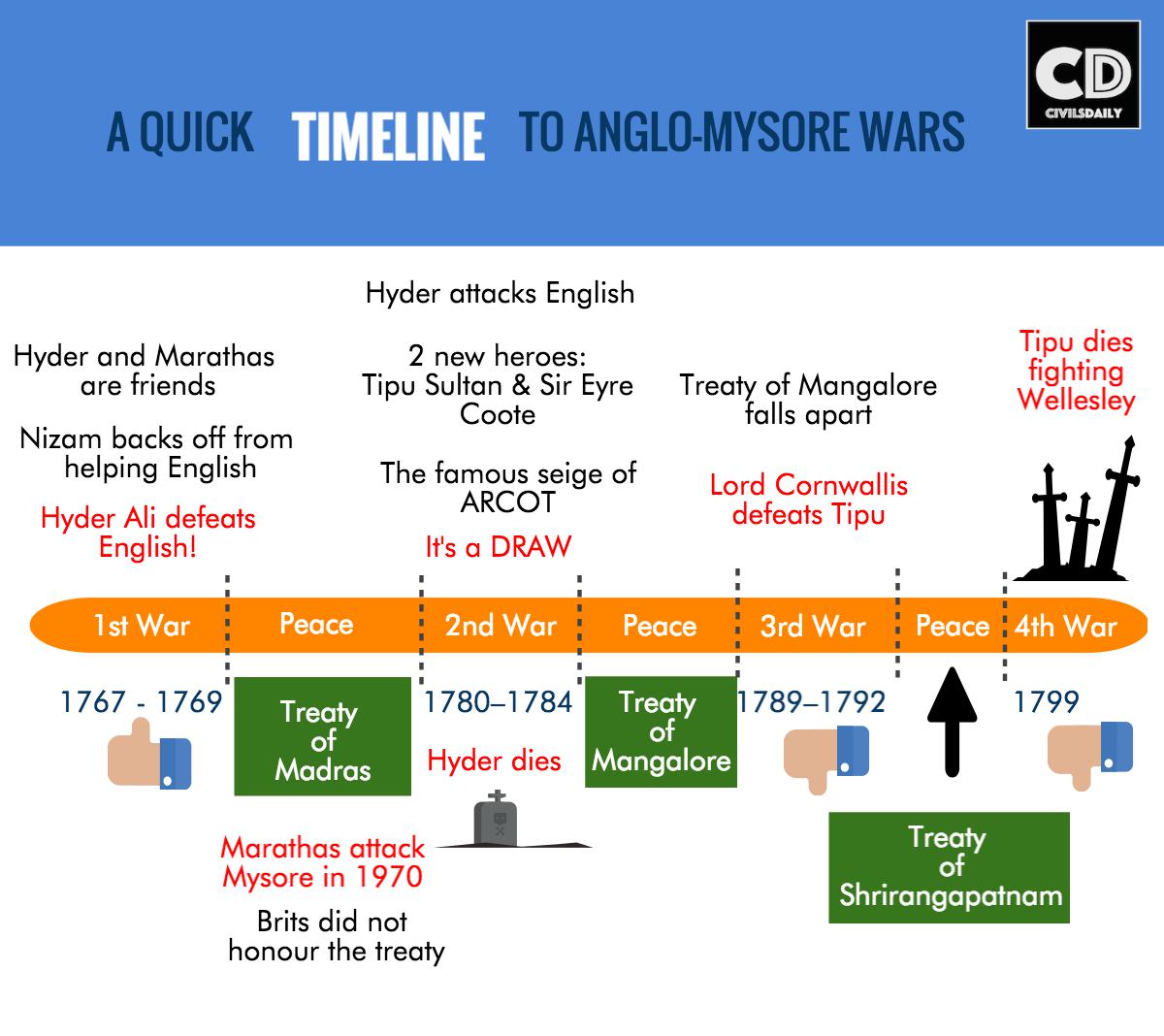
  • Tipu Sultan and Anglo-Mysore Wars (1767-1799)

    Why in the News?

    The new NCERT Class 8 Social Science textbook omits Tipu Sultan, Haidar Ali, and the Anglo-Mysore Wars from its chapter on India’s colonial era.

    Tipu Sultan and Anglo-Mysore Wars (1767-1799)

    Legend of Tipu Sultan and Haidar Ali:

    • Rise of Haidar Ali: Started as a horseman in the Mysore army and became de facto ruler by 1761 through military skill.
    • Military Reforms: Introduced Western training, built arms factories with French help, and strengthened cavalry and artillery.
    • Tipu Sultan: Born in 1751, trained by French officers and well-versed in Islamic law, Persian, Arabic, and science.
    • Administrative Innovations: Introduced a new calendar, land revenue reforms, and coins in gold, silver, and copper with Persian inscriptions.
    • Governance and Industry: Created seven departments, promoted silk industry, and envisioned the future Kannambadi Dam.
    • French Alliance: Maintained strong ties with France, alarming the British amid global Anglo-French rivalry.
    • Technological Advancement: Deployed iron-cased Mysorean rockets, which inspired British Congreve rockets.
    • Moral Governance: Banned liquor, gambling, and prostitution to enforce discipline.
    • Religious Policy: Though devoutly Islamic, he patronized temples and mathas, but faced criticism for intolerance in annexed regions.

    About the Anglo-Mysore Wars:

    First Anglo-Mysore War (1767–69)

    • Alliance Against Mysore: British, Marathas, and Nizam formed a coalition against Haidar Ali.
    • Diplomatic Victory: Haidar neutralized the Marathas and secured Nizam’s support.
    • Outcome: Treaty of Madras (1769) restored the status quo and mutual restitution of territories.

    Second Anglo-Mysore War (1780–84)

    • Trigger: British violation of the Treaty of Madras and occupation of French port Mahe.
    • Coalition Formation: Haidar allied with Marathas and Nizam against the British.
    • Major Battle: Captured Arcot and defeated Col. Baillie; Haidar died in 1782.
    • Conclusion: Tipu continued the fight; Treaty of Mangalore (1784) was the last time an Indian power dictated terms to the British.

    Third Anglo-Mysore War (1790–92)

    • Cause: Tipu’s attack on Travancore, a British ally.
    • British Response: Cornwallis led a coordinated campaign with Maratha and Nizam support.
    • Result: Tipu ceded half his territory and paid ₹3 crore under the Treaty of Seringapatam (1792).

    Fourth Anglo-Mysore War (1799)

    • British Strategy: Wellesley isolated Tipu diplomatically over his French ties.
    • Final Battle: Tipu was killed defending Seringapatam on May 4, 1799, ending native resistance in South India.

    Aftermath of the Wars:

    • Fall of Resistance: Tipu’s death marked the end of organized native military opposition in the South.
    • British Control: Wodeyars reinstated as puppet rulers under Subsidiary Alliance; key territories annexed by the British.
    • Territorial Division: Nizam received Gooty and Gurramkonda; Marathas declined British land offer.
    • Administrative Changes: Mysore came under direct British rule in 1831 due to alleged misrule; restored to Wodeyars in 1881 by Lord Ripon under a constitutional monarchy.
    • Legacy: Anglo-Mysore Wars showed how native resistance could challenge colonial power through modernization, alliances, and tactical innovation.
    • Rocketry Influence: Tipu’s military rocketry was studied and adapted by the British into European warfare.
    [UPSC 2014] With reference to the Anglo-Mysore Wars, consider the following statements:

    1. In the Third Battle of Panipat, Ahmed Shah Abdali defeated Ibrahim Lodi.

    2. Tipu Sultan was killed in the Third Anglo-Mysore War.

    3. Mir Jafar entered in a conspiracy with the English for the defeat of Nawab Siraj-ud-daulah in the Battle of Plassey.

    Which of the statements given above is/are correct?

    (a) 1, 2 and 3 (b) 3 only* (c) 2 and 3 (d) None


  • [pib] Dhammachakra Pravartana Divas

    Why in the News?

    The International Buddhist Confederation (IBC) recently celebrated Ashadha Purnima, also known as Dhammachakra Pravartana Divas at Mulagandha Kuti Vihara, Sarnath.

    About Dhammachakra Pravartana Divas:

    • First Sermon: It marks the day when Gautama Buddha delivered his first sermon after attaining enlightenment.
    • Date of Observance: The day is observed annually on the full moon of Ashadha (Ashadha Purnima), usually in July.
    • Name and Location: The sermon, called Dhammacakkappavattana Sutta, was delivered at Deer Park (Isipatana), Sarnath, near Varanasi.
    • Core Teachings Introduced: It laid the foundational teachings of Buddhism by introducing the Four Noble Truths and the Noble Eightfold Path.
    • Formation of Sangha: His five former ascetic companions—Kaundinya, Bhaddiya, Vappa, Mahanama, and Assaji—became the first monks of the Buddhist Sangha.
    • Symbolic Representation: The Dharma Chakra (Wheel of Dharma) symbolizes this “turning of the wheel of law” and spread of the Buddha’s teachings.
    • Significance:
      • Monastic Practice: It marks the beginning of the Varsha Vassa, a three-month monastic retreat during the rainy season.
      • Religious Importance: It is the second most important Buddhist festival after Buddha Purnima.

    Modern Day Significance:

    • Ambedkarite Movement: In India, it is also significant for commemorating Dr. B.R. Ambedkar’s conversion to Buddhism with his followers at Deekshabhoomi, Nagpur (14 October 1956).
    • Social Commitment: On this day, millions reaffirm their commitment to Buddhist values and the 22 vows taken to renounce caste-based discrimination.
    • Global Observance: The day is celebrated internationally under various names—Esala Poya (Sri Lanka), Asanha Bucha (Thailand), and Asadha Purnima (India).

    Tap to read more about philosophical tenets of Buddhism.

    Back2Basics: Buddhist Councils

    Council Date & Venue Patron & President Objective Key Outcomes
    1st Buddhist Council 483 BCE, Rajagriha (Bihar) Ajatashatru (Haryanka dynasty), Presided by Mahakasyapa To preserve the Buddha’s teachings after his Mahaparinirvana Vinaya Pitaka compiled by Upali (rules for monks)
    Sutta Pitaka compiled by Ananda (discourses of Buddha)
    2nd Buddhist Council 383 BCE, Vaishali (Bihar) Kalasoka (Shishunaga dynasty), Presided by Sabakami To resolve disputes over lax discipline and the ‘Ten Points’ followed by Vaishali monks – Split into Sthaviravadins (orthodox) and Mahasamghikas (liberal)
    – Reaffirmation of stricter Vinaya rules
    3rd Buddhist Council 247 BCE, Pataliputra (Patna) Ashoka (Maurya dynasty), Presided by Moggaliputta Tissa To eliminate heretical monks and consolidate Buddhist doctrine – Compilation of Abhidhamma Pitaka
    – Composition of Kathavattu (philosophical debates)
    – Launch of Buddhist missions to 9 countries
    4th Buddhist Council 72 CE, Kashmir Kanishka (Kushan dynasty), Presided by Vasumitra (with Asvaghosha) To formalize doctrines and address doctrinal splits – Formal split into Hinayana and Mahayana schools
    – Compilation of Vibhasha Sastras (commentaries)
    5th Buddhist Council 1871 CE, Mandalay (Burma) Burmese Monarchy To preserve Buddhist texts 729 stone slabs inscribed with the Pali Canon
    – Considered a Burmese affair; not internationally recognized
    6th Buddhist Council 1954 CE, Yangon (Burma) Burmese Govt & International Sangha To commemorate 2500 years of Buddhism and preserve Theravada canon – Global recitation and review of entire Pali Canon
    – Participation from monks across Buddhist countries


    [UPSC 2008] The concept of Eight-fold path forms the theme of-

    Options: (a) Dipavamsa (b) Divyavadana (c) Mahaparinibban Sutta (d) Dharma Chakara Pravartana Sutta*