💥Mains Ready By December. Smash Mains & Smash PYQ Admissions Open

Subject: United Nations,Agencies,Adjacent Bodies

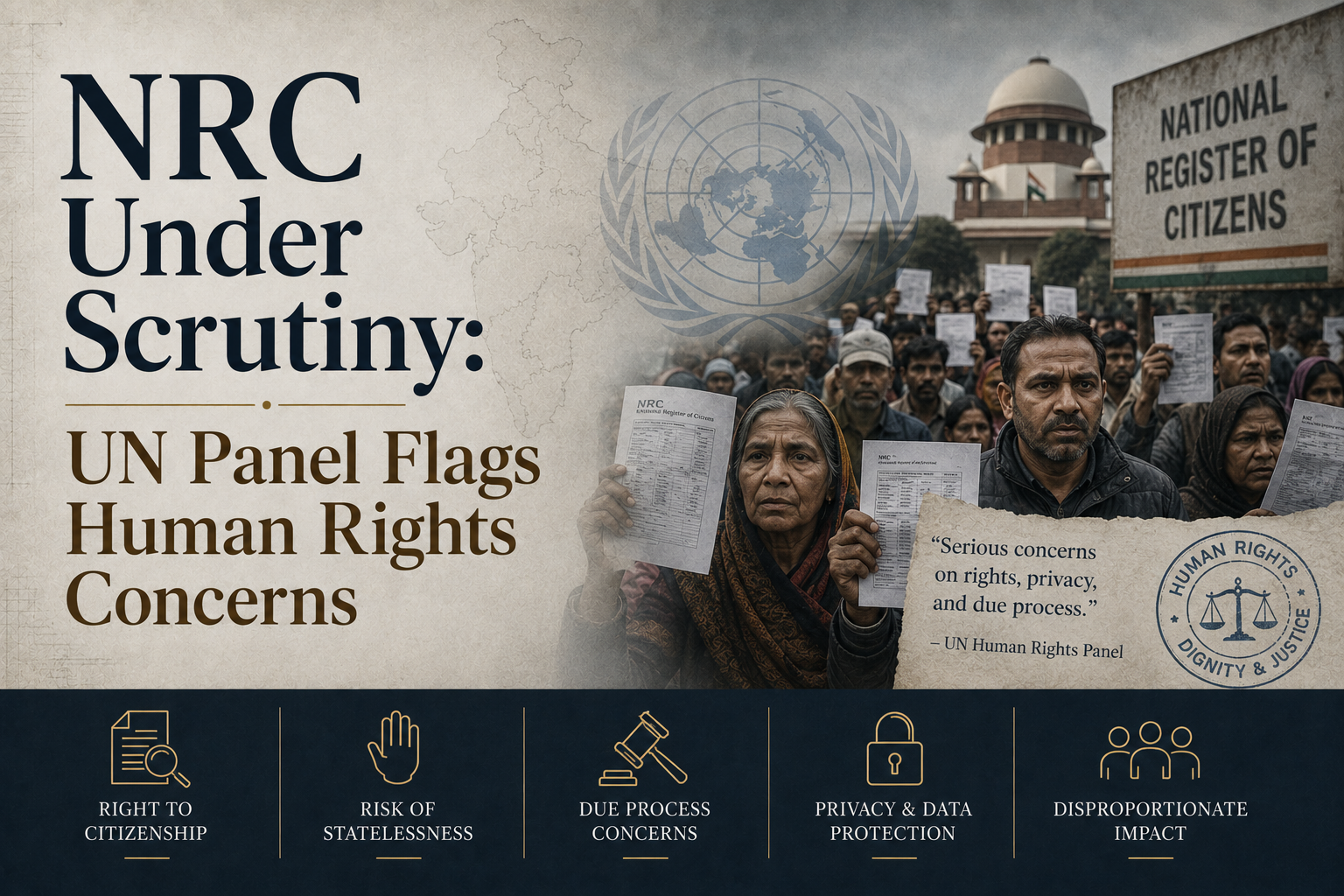
  • UN panel flags ‘human rights violations’ in India, urges Delhi to suspend, review NRC

    UN panel flags ‘human rights violations’ in India, urges Delhi to suspend, review NRC

    Why in the News

    The UN Committee on the Elimination of Racial Discrimination (CERD) has released concluding observations, following its eleventh periodic review of India on August 11-12, criticising the implementation of the National Register of Citizens (NRC) in Assam and calling for its suspension. This is a One development, one row item; The Hindu and The Indian Express both carried the Committee’s findings, and this entry is filed from the Indian Express account, which reports the call to suspend the NRC and the Committee’s specific concern about the Special Intensive Revision (SIR) process, in more detail.

    What did the Committee find, and what did it call on India to do?

    1. The Committee criticised the NRC’s implementation in Assam: It found that the process subjected Bengali-speaking Muslims to what it described as “systematic and structural racial discrimination,” and called for the NRC to be suspended and India’s legislative framework around it to be reviewed.
    2. The Special Intensive Revision process was separately flagged: The Committee raised concern that Bengali-speaking Muslim voters were reportedly disproportionately affected by the Election Commission’s SIR process in West Bengal and Assam.
    3. The Committee’s concern extends to Scheduled Castes, Scheduled Tribes, and Rohingya refugees: It said it was “gravely concerned” about reports of large-scale violations by law enforcement officials against ethnic and ethno-religious groups, including Scheduled Tribes, Scheduled Castes (particularly Dalits), and non-citizens, and cited allegations of racially motivated violence, excessive use of force, extrajudicial killings, arbitrary detention, torture and sexual violence.
    4. It called for accountability, not merely acknowledgement: The Committee asked India to conduct prompt, thorough and impartial investigations into these allegations and ensure accountability for those responsible, and to urgently address hate speech and hate crimes against Rohingya, Bengali-speaking Muslims, migrants and asylum-seekers.
    5. India’s response came through its review delegation: India sent the Solicitor-General as head of delegation for the underlying periodic review held on August 11-12, ahead of these concluding observations.

    Conclusion

    CERD’s concluding observations place NRC suspension, a review of the associated legislative framework, and law enforcement accountability toward Scheduled Castes, Scheduled Tribes and Rohingya refugees on record as a formal treaty-body finding against India, made under the same UN human rights review process, rather than as commentary on a single incident, with India’s substantive reply yet to be reported.

    Back2Basics

    1. UN Committee on the Elimination of Racial Discrimination (CERD): The treaty body of independent experts that monitors States parties’ implementation of the International Convention on the Elimination of All Forms of Racial Discrimination (ICERD), which India ratified in 1968, through periodic reviews and concluding observations.
    2. National Register of Citizens (NRC), Assam: A register, first prepared in 1951 and updated under Supreme Court supervision, intended to identify genuine Indian citizens in Assam by excluding illegal migrants, particularly in the context of the Assam Accord (1985).
  • ‘Killer robots’ are closer than ever, warn UN, ICRC

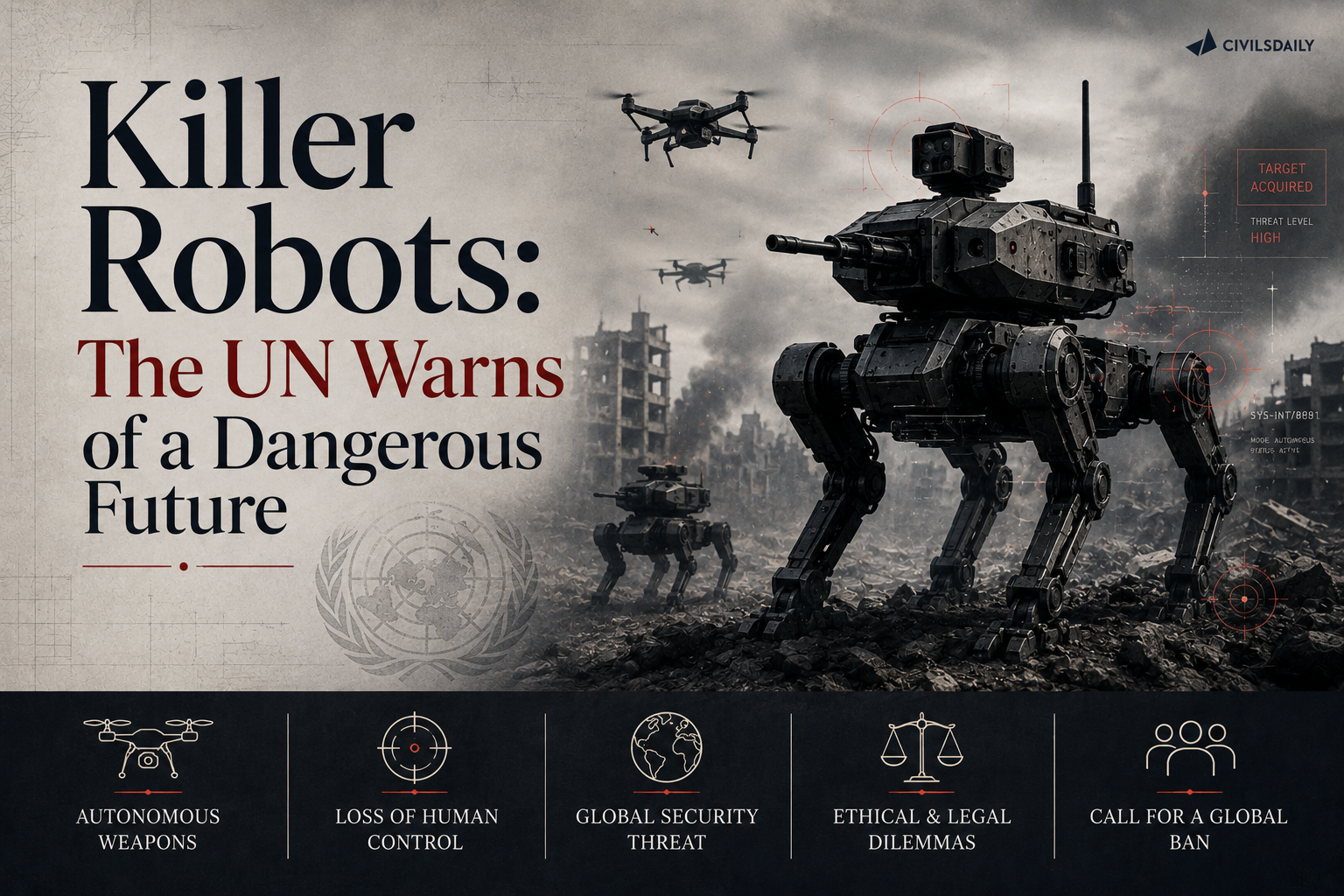
    ‘Killer robots’ are closer than ever, warn UN, ICRC

    Why in the News

    The United Nations and the International Committee of the Red Cross (ICRC) have jointly warned that the world is dangerously close to the autonomous targeting of humans by machines, renewing an urgent appeal for international regulation of lethal autonomous weapon systems. The statement renews a 2023 call by the UN Secretary General and the ICRC president for specific bans and restrictions on the technology by this year.

    Note: Lethal autonomous weapon systems are weapon systems that select targets and apply force without human intervention.

    What is the concern, and how has it changed since 2023?

    1. The warning has hardened, not softened: The two bodies stated their fundamental concerns remain unchanged from 2023 but that the underlying risks have intensified since then.
    2. The alarm includes the technology’s own developers: The statement highlights that scientists and engineers involved in developing these weapon systems have themselves raised concerns about the direction the technology is taking.
    3. No confirmed use yet, but the trajectory is the concern: Experts state there has been no confirmed use of fully autonomous weapons to directly target humans so far, and the warning is precautionary rather than a report of an actual deployment.

    International Regulation

    1. United Nations: The UN has repeatedly called for international rules governing autonomous weapons.
    2. Convention on Certain Conventional Weapons (CCW): Discussions on LAWS have taken place under the CCW framework.
    3. UN Secretary General and ICRC: Both have advocated prohibiting weapons that operate without meaningful human control and imposing strict restrictions on other autonomous weapons.
    4. International Humanitarian Law (IHL): Existing principles such as distinction, proportionality and precaution remain central to assessing autonomous weapons.

    India’s Position

    1. India has participated in international discussions on Lethal Autonomous Weapon Systems under the CCW.
    2. India has generally emphasised the importance of human control, international law and responsible development of emerging military technologies.
    3. For India, the issue is particularly relevant as AI, drones, robotics and autonomous systems become increasingly important in modern warfare.

    “[2025, GS2, 15 marks] “The reform process in the United Nations remains unresolved, because of the delicate imbalance of East and West and entanglement of the USA vs. Russo-Chinese alliance.” Examine and critically evaluate the East-West policy confrontations in this regard.”

    [2025] Consider the following statements regarding Al Action Summit held in Grand Palais, Paris in February 2025:
    I. Co-chaired with India, the event builds on the advances made at the Bletchley Park Summit held in 2023 and the Seoul Summit held in 2024.
    II. Along with other countries, US and UK also signed the declaration on inclusive and sustainable AI.
    Which of the statements given above is/are correct?

    [A] I only

    [B] II only

    [C] Both I and II

    [D] Neither I nor II

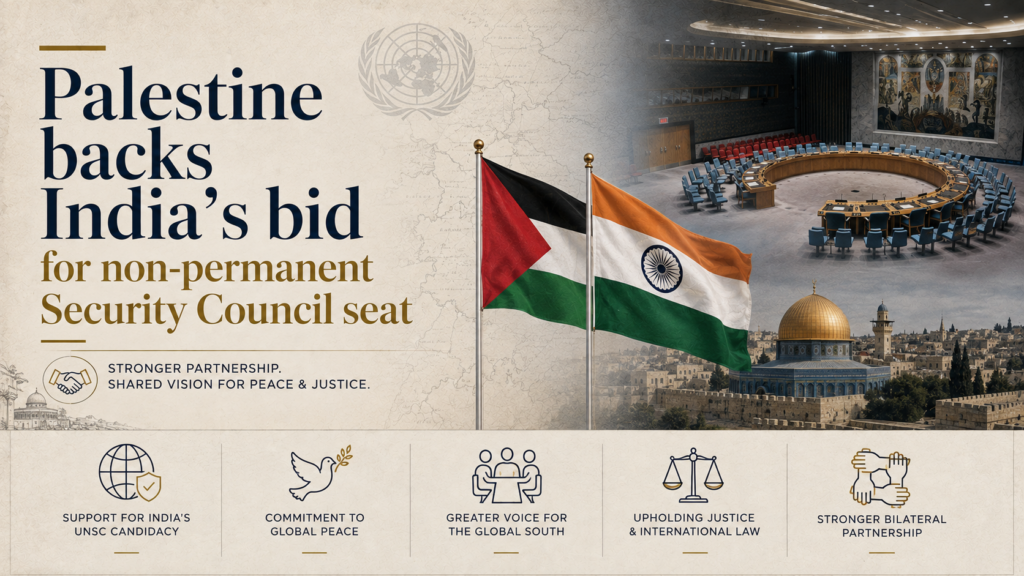
  • Palestine backs India’s bid for non-permanent Security Council seat

    Why in the News

    Palestine has backed India’s bid for a non-permanent UN Security Council seat for 2028-29. The support came during India’s renewed diplomatic engagement with Palestine, including plans for a new India-funded hospital in the West Bank and medical assistance for Gaza.

    Non-Permanent Seat of the UNSC

    • Composition: UNSC has 15 members: 5 permanent members with veto power and 10 non-permanent members.
    • Election: Elected by the UN General Assembly for a 2-year term with a two-thirds majority.
    • Distribution: Seats follow equitable geographical representation; India contests from the Asia-Pacific Group.
    • Rotation: 5 non-permanent seats are elected every year. A retiring member cannot be immediately re-elected.

    Significance of Palestine’s Support for India

    • Palestine supports India’s 2028-29 candidature and has also expressed support for India having a permanent UNSC seat.
    • It views India’s economic and political weight as important for advancing Palestinian interests.
    • Palestine expects India to use its relations with Israel to facilitate the peace process.
    • The endorsement strengthens India’s image as a country capable of engaging both sides of the Israel-Palestine conflict.

    India’s Development Assistance to Palestine

    • West Bank: India is finalising an India-funded hospital.
    • Vocational training: Support for a vocational training centre.
    • Gaza: Discussions on artificial limbs for amputees.
    • Medical equipment: Talks on supplying dialysis machines and other equipment, potentially through Jordan.

    India’s Position on Palestine

    • India has consistently supported:
      • A negotiated two-state solution.
      • An independent Palestine coexisting peacefully with Israel.
      • Development and humanitarian assistance to the Palestinian people.
    • The recent visit to Ramallah marked India’s first high-level visit to the affected region since the October 2023 conflict.

    India’s De-hyphenated Israel-Palestine Policy

    India follows a de-hyphenated approach, treating relations with Israel and Palestine independently.

    • Full diplomatic relations with Israel were established in 1992.
    • India has deepened strategic cooperation with Israel while continuing to support Palestinian statehood.
    • India has continued supporting Palestinian-related resolutions at the UN.
    • This balancing gives India diplomatic credibility and leverage with both sides.

    “[2009] The Security Council of UN consists of 5 permanent members, and the remaining 10 members are elected by the General Assembly for a term of

    (a) 1 year

    (b) 2 years

    (c) 3 years

    (d) 5 years

  • ‘Too little cash, too much politics, leaves UNESCO fighting for life.’ Discuss the statement in the light of US’ withdrawal and its accusation of the cultural body as being ‘anti-Israel bias’.

    UNESCO, established in 1945, promotes education, culture, heritage, and scientific cooperation as pillars of global peace.

    Context of US Withdrawal

    The United States withdrew from UNESCO in 2017, accusing it of anti-Israel bias.

    The trigger was UNESCO’s 2011 recognition of Palestine as a full member, and resolutions declaring East Jerusalem and Hebron as occupied Palestinian territories.

    The US described this as “politicization of culture”

    The US also objected to inefficient governance within the organization.

    It rejoined in 2023 but again withdrew in 2025 citing bias against Israel.

    Impact of the US Withdrawal

    Geopolitical Power Shift- Creates space for China’s greater influence within UNESCO.

    The US was UNESCO’s largest contributor (22% of its budget) – withdrawal caused program cuts.

    Cultural preservation, education, and global literacy programs suffered from lack of funds.

    Political polarization among members eroded UNESCO’s credibility and neutrality.

    Developing nations’ initiatives faced delays due to resource shortages.

    Highlights US unpredictability and undermines credibility of multilateral institutions

    Way Forward

    Depoliticize cultural resolutions and heritage conservation.

    Diversify funding sources to reduce reliance on a few donors.

    Strengthen transparency and consensus-based decision-making.

    Strengthen South-South and regional cooperation for promoting capacity-building in developing nations

    UNESCO’s revival requires inclusive governance and financial sustainability to rebuild global trust, credibility and address the ‘crisis of confidence’ in multilateralism.

  • Critically examine the role of WHO in providing global health security during the Covid-19 pandemic.

    The WHO, established in 1948, is the UN’s specialized agency responsible for global public health coordination. During the COVID-19 pandemic, its actions were criticized for lack of timeliness, transparency, and independence.

    Positive Role of WHO during the Pandemic

    Early Alerts: Declared COVID-19 a Public Health Emergency of International Concern (PHEIC) in January 2020.

    Technical Guidance: Issued scientific protocols, travel advisories, and surveillance guidelines to member states.

    Global Solidarity Mechanisms: Launched the Access to COVID-19 Tools Accelerator (ACT-A) and COVAX Facility to ensure equitable vaccine distribution.

    Information Sharing: Provided daily situation reports and facilitated exchange of data among countries.

    Support to Developing Nations through logistics, diagnostics, and training.

    Research and development about the virus – transmission, mutation, and vaccination.

    Criticisms and Limitations

    Delayed Declaration of Pandemic: Accused of underestimating the early outbreak in Wuhan and relying too heavily on China’s official data.

    Political Influence: inadequate scrutiny of China’s early containment measures.

    Weak Enforcement Powers: WHO lacks authority to compel nations to share data or enforce health regulations under the International Health Regulations (2005).

    Vaccine Inequity: Despite COVAX, vaccine access remained highly unequal.

    Funding Dependence: Over 80% of WHO’s budget comes from voluntary contributions.

    Confusion among public and healthcare professionals due to inconsistencies in communication

    Way Forward

    Strengthen the International Health Regulations (IHR) for faster response and accountability.

    Establish a Global Health Emergency Council for coordinated crisis action.

    Financial autonomy to reduce donor dependency.

    To ensure future global health security, WHO must evolve into a more independent, transparent, and empowered institution, capable of acting decisively in the face of global emergencies.

  • ‘Sea is an important Component of the Cosmos’. Discuss in the light of the above statement the role of the IMO(International Maritime Organisation) in protecting environment and enhancing maritime safety and security.

    The oceans cover nearly 71% of the Earth’s surface and are the foundation of planetary life. The IMO, a UN specialized agency established in 1959, plays a critical role in promoting safe, secure, and environmentally sustainable use of the seas.

    Sea as an Important Component of the Cosmos

    It regulates climate, supports biodiversity, and drives global trade (over 80% of international trade by volume)

    Oceans absorb about 30% of global CO₂ emissions, produce half of the world’s oxygen, and absorb 90% of excess heat generated.

    Biodiversity and Life: Marine ecosystems host nearly 80% of all life forms

    Moral Value as part of the “common heritage of mankind”

    Engine of the Blue Economy: fisheries, renewable ocean energy, tourism, and seabed resources

    Role of IMO in Environmental Protection

    Net-Zero Framework – a global mechanism to price carbon emissions from ships and use the proceeds to help developing countries transition to green shipping.

    Pollution Prevention through MARPOL convention:

    Regulates oil, chemical, sewage, garbage, and air pollution.

    Enforce low-sulphur fuel standards and Energy Efficiency Design for new ships

    IMO’s Initial GHG Strategy targets 50% reduction in ship emissions by 2050 (from 2008 levels).

    Promotes green shipping and alternative fuels (LNG, methanol, hydrogen), and carbon intensity.

    Prevents transfer of invasive aquatic species through Ballast Water Management Convention

    IMO’s Polar Code addresses safety and environmental protection in polar waters

    Role in Maritime Safety and Security

    IMO provides a legal and technical framework for cleaner and safer shipping.

    SOLAS (Safety of Life at Sea, 1974) is IMO’s flagship convention, setting global ship design and emergency standards.

    STCW Convention (1978): Mandates uniform global training and certification for seafarers.

    ISPS Code (2002): Strengthens ship-port security against terrorism and piracy.

    IMO assists regional frameworks like Djibouti Code of Conduct (Somalia Basin) and ReCAAP (Asia) to combat piracy.

    Introduced e-navigation and Global Maritime Distress and Safety System (GMDSS) to improve real-time communication.

    Challenges

    Weak Enforcement: IMO relies on flag states’ compliance.

    Developing countries face technological and financial limitations for meeting emission targets.

    Emerging Threats: Cybersecurity and illegal fishing.

    Slow Decision-Making due to consensus-based model.

    Climate-Trade Dilemma: Balancing decarbonization with global trade competitiveness remains difficult.

    Recently, negotiations on the net zero framework have been adjourned for a year after opposition from the US and Saudi Arabia.

    Way Forward

    Stronger Monitoring Mechanisms through real-time tracking.

    Capacity Building of developing nations under a “Common but Differentiated Responsibility” framework.

    Strengthening R&D : green shipping corridors, hydrogen fuel, and maritime innovation hubs

    Global Cooperation among IMO, UNEP, UNDP, and regional maritime bodies like IORA

    As seas sustain both life and livelihood, global cooperation under IMO’s leadership is essential to achieve a safe, secure, and sustainable ocean future.

  • Terrorism has become a significant threat to global peace and security’. Evaluate the effectiveness of the United Nations Security Council’s Counter-Terrorism Committee (CTC) and its associated bodies in addressing and mitigating this threat at the international level.

    Terrorism refers to the use of violence or threat to create fear and achieve political, ideological, or religious objectives by targeting civilians and governments.

    Terrorism as a Threat to Global Peace and Security

    Non-traditional global security challenge undermining state sovereignty, human rights, and economic stability.

    Evolving nature – cross-border networks, online radicalization, financing through illicit trade, and use of emerging technologies (drones, crypto-assets).

    Threats

    Economic – Terrorism and organised crime linkage. Eg- role of D-Company in Bombay Blasts 1993

    Bioterrorism – Eg- use of chemical weapons in Syria

    State sponsored terrorism – Eg- Pakistan

    Cyber terrorism – Eg- online radicalization by ISIS

    Regional Instability – Eg- Taliban in Afghanistan

    United Nations Security Council’s Counter-Terrorism Committee (CTC) and Associated Bodies

    Established under UNSC Resolution 1373 (2001) after 9/11.

    CTC’s mandate: Enhance state co-operation and capacity building to deal with global terror

    Associated Bodies:

    CTED (Counter-Terrorism Committee Executive Directorate): Provides technical assistance to member states.

    UNOCT (UN Office of Counter-Terrorism): Coordinates UN counter-terror programs.

    FATF : Monitors terror financing and money laundering globally.

    Positive Role

    Global Framework: Universal adoption of Resolution 1373, creating a global legal framework.

    Capacity Building: Support to developing states in border management, cyber surveillance, and financial tracking.

    Curbing Terror Financing: Criminalization of fund-raising and cross-border money flows.

    Information Sharing: Enhanced coordination among INTERPOL, UNODC, and regional organizations (ASEAN, AU, SAARC).

    1267 Sanctions Regime: Travel bans and arms embargoes on listed terrorist entities.

    Limitations

    No Universal Definition of Terrorism: Political differences hinder cohesive action.

    Enforcement Limitations: CTC cannot impose sanctions; compliance depends on state will.

    Selectivity and Geopolitics: Veto politics within UNSC prioritizes strategic interests over global consensus. Eg- China blocking Masood Azhar terrorist designation

    TRF, designated a terrorist group by India, has not been formally designated as a terrorist organisation by the UNSC 1267 Sanctions Committee.

    Unequal Capacities: Developing nations lack financial and technological resources to meet obligations.

    Emerging Threats: Cyber-terrorism, lone-wolf attacks, and digital radicalization outpace global responses.

    Human Rights Concerns: Some counter-terror laws compromise due process and civil liberties.

    Lack of consensus – as per T.S. Tirumurti, the world has gone back to the era of “my terrorist” and “your terrorist” and consensus reached after 9/11, to fight terror comprehensively, has run its course.

    Way Forward

    3C Approach: Collaborate, Coordinate, and Cooperate among nations.

    UNSC Reforms: voice to Global South and democratization of decision-making.

    Early finalization of Comprehensive Convention on International Terrorism (CCIT)

    A comprehensive consensus-based approach on zero tolerance for corruption is needed to tackle the menace of terrorism.