💥Join UPSC 2027,2028 Mentorship (July Batch) + XFactor Notes & Microthemes PDF

Subject: Various Acts

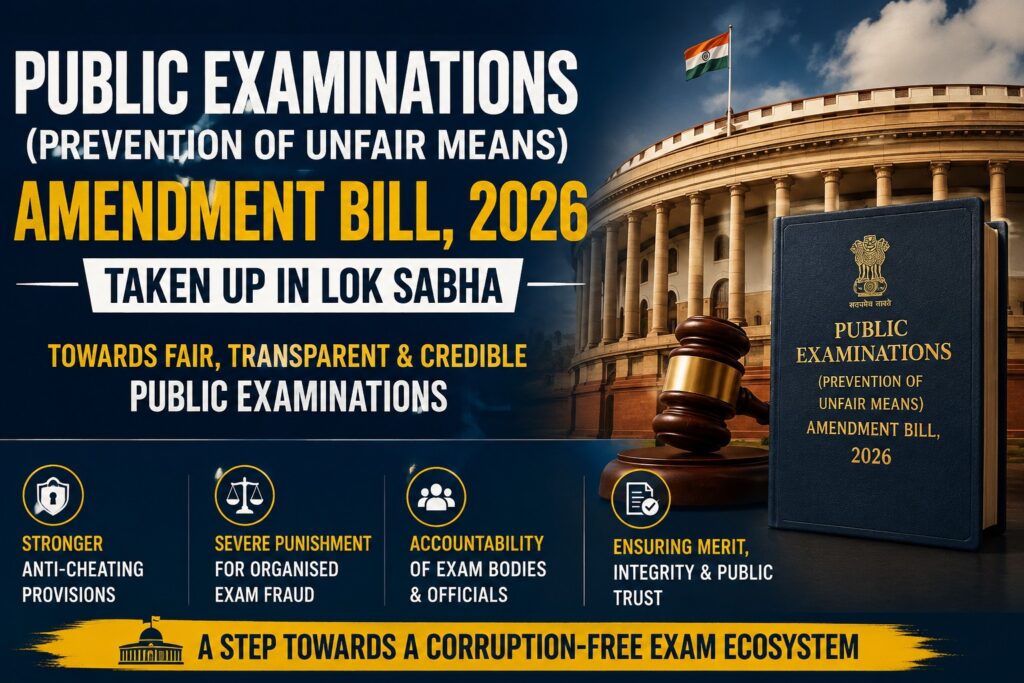
  • The Public Examinations (Prevention of Unfair Means) Amendment Bill, 2026 passed by both houses

    Why in News

    The Public Examinations (Prevention of Unfair Means) Amendment Bill, 2026 has been passed by both Houses of Parliament, having first been cleared by the Lok Sabha on July 29, 2026, followed by approval from the Rajya Sabha on July 30, 2026.

    Key Highlights

    • Stricter punishment: Maximum imprisonment for offences involving unfair means increased to 10 years, from the earlier 3 to 5 years.
    • Higher penalty: Maximum fine for individual offences enhanced to ₹50 lakh.
    • Organised examination fraud: Punishable with a minimum imprisonment of 7 years and a fine up to ₹10 crore.
    • Procedural reforms: Provides for fast-track courts and mandates completion of investigations within two months.
    • Companion legislation: The Prevention of Insults to National Honour (Amendment) Bill, 2026 was also introduced during the same session.

    Background

    • The amendment strengthens the Public Examinations (Prevention of Unfair Means) Act, 2024.
    • The Act aims to prevent paper leaks, impersonation, organised cheating and other examination-related malpractices in public examinations conducted by designated authorities.

    Objectives

    • Ensure fairness, transparency and credibility in recruitment and entrance examinations.
    • Deter organised examination fraud through stringent penalties.
    • Protect the interests of genuine candidates.
    • Improve the speed of investigation and prosecution.

    Significance

    • Enhances the integrity of public recruitment and competitive examinations.
    • Acts as a deterrent against paper leak mafias and organised crime networks.
    • Strengthens public confidence in examination systems.
    • Supports merit-based selection and good governance.

    [2026] Mr. X, a senior officer, was overseeing a critical vaccination programme during a pandemic. He found that a private service provider responsible for vaccine distribution was compromising on quality to make profits. Despite immense pressure to manage the issue due to vested interests, he raised his voice based on the principles of public administration which he learnt during various training programmes attended across his career. He reported the issue to the appropriate vigilance authority and halted the contract to ensure citizen welfare.
    Which one among the following principles of public administration was most strongly demonstrated by Mr. X’s actions?

    [A] Esprit de corps

    [B] Equity

    [C] Accountability

    [D] Delegation
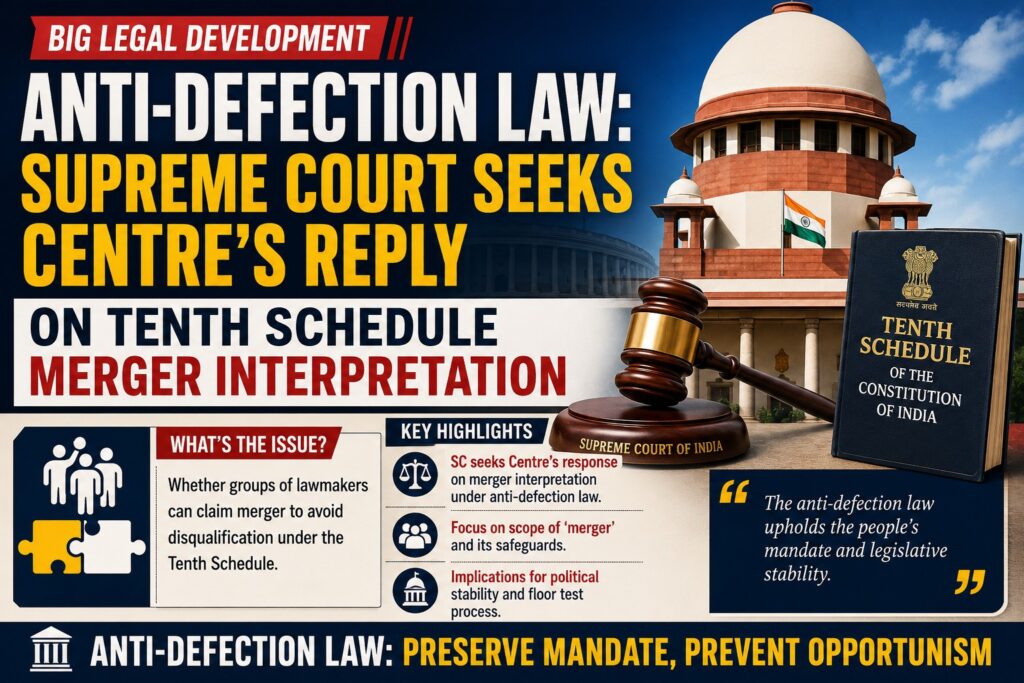
  • Anti-defection law: Supreme Court seeks Centre’s reply on Tenth Schedule merger interpretation

    Why in News

    The Supreme Court has issued notice on a plea filed by Kapil Sibal challenging the prevailing interpretation of the merger exception under the Tenth Schedule (Anti-Defection Law). The plea, linked to the 2022 Goa defection case, argues that the current interpretation undermines the purpose of the Anti-Defection Law by allowing legislators to avoid disqualification without a genuine party merger.

    What is the Merger Exception?

    • Paragraph 4 of the Tenth Schedule provides an exception to disqualification in cases of a merger.
    • A merger is protected when not less than two-thirds of the legislators of a political party agree to merge with another party.
    • The present dispute is whether a legislative party alone can claim a merger, or whether the original political party must also merge.

    About the Tenth Schedule (Anti-Defection Law)

    • Added by the 52nd Constitutional Amendment Act, 1985.
    • Strengthened by the 91st Constitutional Amendment Act, 2003, which removed the earlier exemption for one-third splits.
    • Seeks to curb political defections, ensure government stability, and uphold party discipline.
    • The Presiding Officer (Speaker/Chairman) decides questions relating to disqualification.

    Constitutional Provisions

    • Articles 102(2) and 191(2): Provide for disqualification of MPs and MLAs under the Tenth Schedule.
    • Tenth Schedule: Contains provisions relating to disqualification on grounds of defection.

    Landmark Judgments

    • Kihoto Hollohan v. Zachillhu (1992): Upheld the constitutional validity of the Tenth Schedule and held that the Speaker’s decision is subject to judicial review.
    • Keisham Meghachandra Singh v. Speaker, Manipur (2020): Directed Speakers to decide disqualification petitions within a reasonable period, ordinarily three months.

    Issues with the Current Law

    • Delay in deciding disqualification petitions.
    • Allegations of partisan conduct by the Speaker.
    • Ambiguity regarding the merger exception.
    • Weakens representative democracy when mass defections alter electoral mandates.

    [2013, GS2, 10M] The role of individual MPs (Members of Parliament) has diminished over the years and as a result healthy constructive debates on policy issues are not usually witnessed. How far can this be attributed to the anti-defection law, which was legislated but with a different intention?”

    [2022] With reference to anti-defection law in India, consider the following statements:

    1. The law specifies that a nominated legislator cannot join any political party within six months of being appointed to the House.

    2. The law does not provide any time-frame within which the presiding officer has to decide a defection case.

    Which of the statements given above is/are correct?

    (a) 1 only

    (b) 2 only

    (c) Both 1 and 2

    (d) Neither 1 nor 2

  • Which of the following statements about a Zero First Information Report (Zero FIR) under the Bharatiya Nagarik Suraksha Sanhita (BNSS), 2023 is/are correct

    Which of the following statements about a Zero First Information Report (Zero FIR) under the Bharatiya Nagarik Suraksha Sanhita (BNSS), 2023 is/are correct?
    1. A Zero FIR can be lodged at a police station, even though the place of commission of a cognizable/non-cognizable offence is outside the territorial jurisdiction of that police station.
    2. The Officer-in-Charge of the police station where a Zero FIR has been lodged may, with the permission of the competent authority, initiate a preliminary enquiry.
    3. Under Zero FIR, it is obligatory for the informant to furnish information electronically.
    Select the answer using the code given below: