đŸ’„Join UPSC 2027,2028 Mentorship (July Batch) + XFactor Notes & Microthemes PDF

Subject: Women

  • CSIR ASPIRE-SHAKTI

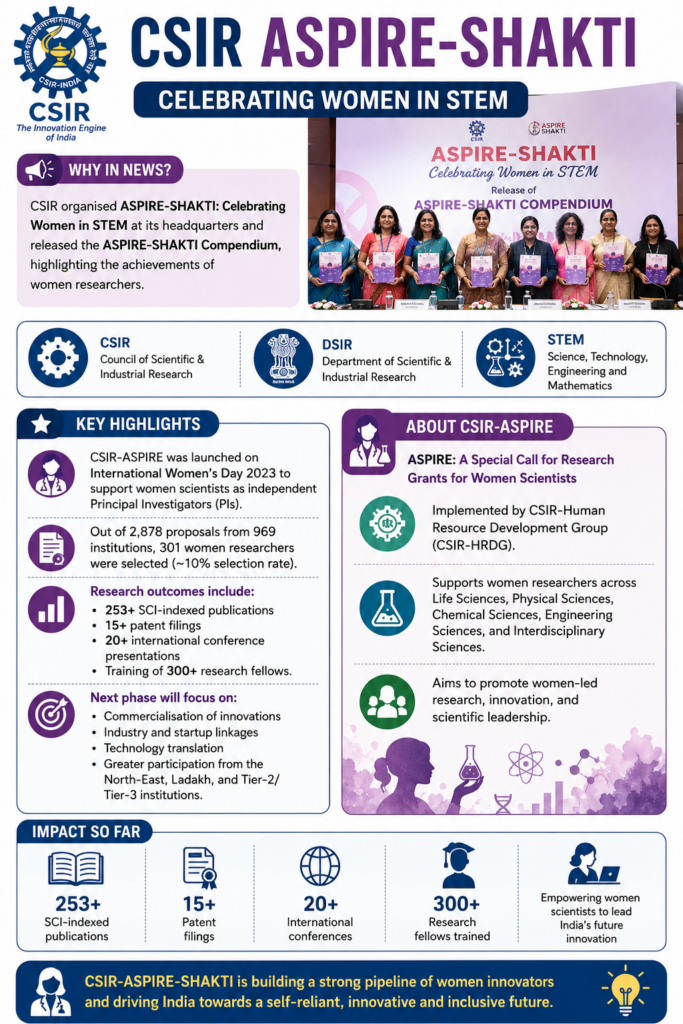
    Why in News?

    CSIR organised ASPIRE-SHAKTI: Celebrating Women in STEM at its headquarters and released the ASPIRE-SHAKTI Compendium, highlighting the achievements of women researchers.

    Key Highlights

    • CSIR: Council of Scientific & Industrial Research
    • DSIR: Department of Scientific & Industrial Research
    • STEM: Science, Technology, Engineering and Mathematics
    • CSIR-ASPIRE was launched on International Women’s Day 2023 to support women scientists as independent Principal Investigators (PIs).
    • Out of 2,878 proposals from 969 institutions, 301 women researchers were selected (~10% selection rate).
    • Research outcomes include:
      • 253+ SCI-indexed publications
      • 15+ patent filings
      • 20+ international conference presentations
      • Training of 300+ research fellows.
    • Next phase will focus on:
      • Commercialisation of innovations
      • Industry and startup linkages
      • Technology translation
      • Greater participation from the North-East, Ladakh, and Tier-2/Tier-3 institutions.

    About CSIR-ASPIRE

    • ASPIRE: A Special Call for Research Grants for Women Scientists
    • Implemented by CSIR-Human Resource Development Group (CSIR-HRDG).
    • Supports women researchers across Life Sciences, Physical Sciences, Chemical Sciences, Engineering Sciences, and Interdisciplinary Sciences.
    • Aims to promote women-led research, innovation, and scientific leadership.

    [2018] Consider the following statements :
    Human capital formation as a concept is better explained in terms of a process which enables
    1. individuals of a country to accumulate more capital.
    2. increasing the knowledge, skill levels and capacities of the people of the country.
    3. accumulation of tangible wealth.
    4. accumulation of intangible wealth.
    Which of the statements given above is/are correct?

    [A] 1 and 2

    [B] 2 only

    [C] 2 and 4

    [D] 1, 3 and 4

  • “Though women in post-Independent India have excelled in various fields, the social attitude towards women and feminist movement has been patriarchial.” Apart from women education and women empowerment schemes, what interventions can help change this milieu?

    “One is not born, but rather becomes, a woman.” – Simone de Beauvoir

    Despite progress in education, employment, and leadership – from Kalpana Chawla to Nirmala Sitharaman – Indian society continues to be guided by deep-rooted patriarchal norms.

    Women Excelling in Various Fields

    Political Sphere:

    Droupadi Murmu became India’s first tribal woman President (2022).

    Over 46% of PRI representatives are women (MoPR, 2024).

    Economic Sphere: Women-led startups form 47.6% of DPIIT-recognized startups (2023).

    Science and Technology: Nigar Shaji, ISRO project director for Aditya-L1

    Sports: Avani Lekhara (Paralympics), Nikhat Zareen (boxing), and Smriti Mandhana (cricket).

    Academics: Women constitute 43% of STEM graduates

    Patriarchal Attitudes Persisting in Society

    The enduring Devī-Dāsī dichotomy-idolizing women as sacred yet accepting their subjugation-reveals deep-rooted cultural norms that legitimize gender inequality.

    Tokenism in representation: Eg-“Sarpanch Pati” culture undermines effective female leadership

    Unpaid care burden: Women spend 299 mins/day on unpaid work (NSSO), vs. 97 mins by men.

    Triple Burden – Household, Childcare, Work

    Media stereotypes: Gender-biased portrayals reinforce traditional roles.

    ‘Glass ceiling’ – women are less likely to be hired or promoted in sectors such as technology, finance, or engineering. (McKinsey)

    Interventions Needed to Change the Milieu

    Legal and Institutional Reforms

    Gender Sensitisation in Governance: Mandatory training for bureaucrats and police.

    Implementation of Nari Shakti Vandan Adhiniyam (2023): Ensure 33% reservation in legislatures.

    Strengthen POSH Act, 2013: Extend coverage to informal, gig, and agricultural sectors.

    Gender Audit Mechanisms: Periodic audits across ministries, corporates, and universities.

    Establish fast-track courts for crimes against women as per Nirbhaya Committee recommendations.

    Economic and Structural Interventions

    Property and Inheritance Rights: Enforce Hindu Succession (Amendment) Act, 2005 effectively at the ground level.

    Labour Market Reforms: Provide maternity benefits, crĂšche facilities, and flexible work arrangements.

    Recognize and Monetize Unpaid Labour: Integrate unpaid domestic work into GDP measurement and social protection systems.

    Social and Cultural Interventions

    Curriculum Reform: Integrate gender-sensitivity and equality lessons from school level.

    Media Accountability: Enforce SC’s 2024 guidelines against gender stereotyping in films and advertisements.

    Community Mobilisation: Engage SHGs, PRIs, and youth clubs to challenge gender norms at local level.

    Faith-Based Dialogue: Partner with religious leaders to reinterpret traditions supporting equality.

    Behavioural and Psychological Change

    Male Inclusion Campaigns: Expand “Men for Women” and “HeForShe” initiatives to rural areas.

    Positive Role Modelling: Showcase success stories of women achievers in governance and innovation.

    Public Awareness Drives: Use Beti Bachao Beti Padhao 2.0 to challenge gender bias in families and media.

    Adopting ILO’s 5Rs (recognition, reduction, redistribution, reward, representation) can help in realising Nari Shakti and SDG 5.

  • Women’s social capital complements in advancing empowerment and gender equity. Explain.

    Social capital refers to networks, relationships, and norms that enable collective action for mutual benefit. For women, social capital is built through Self-Help Groups (SHGs), PRIs, and grassroots networks.

    Women’s Social Capital Advancing Empowerment

    Strengthening Collective Voice in governance and community decision-making.

    Economic Empowerment – Social capital facilitates microfinance, entrepreneurship, and livelihood diversification. Eg- Kudumbashree (Kerala) and Jeevika (Bihar)

    Promoting Information and Knowledge Sharing – Eg- Mahila Kisan Sashaktikaran Pariyojana (MKSP) enables peer learning in sustainable agriculture and technology use.

    Building Social Solidarity and Mutual Support – Women’s collectives provide psychosocial and emotional support against domestic violence, exclusion, and crises.

    Expanding Political Participation- Women constitute 46% of Panchayati Raj representatives (MoPR, 2024), many emerging from SHG or NGO networks.

    Improving Social Accountability – act as watchdogs, ensuring transparency in welfare programs. Eg- SHG federations in Andhra Pradesh monitor PDS.

    Women’s Social Capital Promoting Gender Equity

    Challenging Patriarchal Norms -Collective action enables women to question gender stereotypes and claim public space.

    Redistributing Power -women influence policy and community priorities.

    Inclusive Development -Strengthens intersectional representation (Dalit, tribal, minority women).

    Bridging Social Divides -Networks connect women across caste, class, and regional boundaries, fostering shared identity and solidarity.

    Challenges

    The enduring Devī-Dāsī dichotomy-idolizing women as sacred yet accepting their subjugation-reveals deep-rooted cultural norms that legitimize gender inequality.

    Tokenism in representation: Eg-“Sarpanch Pati” culture undermines effective female leadership

    “Missing Middle” finance trap – SHGs they outgrow microcredit but cannot access medium-scale loans.

    Regional Imbalance: Concentration of SHGs in southern states (71%); weak in the north and northeast.

    Way Forward

    Gender Sensitisation in Governance: Mandatory training for bureaucrats and police.

    Implementation of Nari Shakti Vandan Adhiniyam (2023): Ensure 33% reservation in legislatures.

    Integrate unpaid domestic work into GDP measurement and social protection systems.

    Adopting ILO’s 5Rs (recognition, reduction, redistribution, reward, representation) can help in realising Nari Shakti and SDG 5.

    Human Resources