💥Mains Ready By December. Smash Mains & Smash PYQ Admissions Open

Type: Prelims Only

  • [pib] Ramappa – Kakatiya Rudreshwara Temple

    The Union Minister for Culture, Tourism has unveiled the UNESCO World Heritage Listing plaque at Ramappa – Kakatiya Rudreshwara Temple in Palampet.

    Rudreswara Temple

    • The Rudreswara temple was constructed in 1213 AD during the reign of the Kakatiya Empire by Recharla Rudra, a general of Kakatiya king Ganapati Deva.
    • It is also known as the Ramappa temple, after the sculptor who executed the work in the temple for 40 years.
    • The main temple is flanked by the collapsed structures of the Kateshwarayya and Kameshwarayya temples in Palampet, about 220 km from Hyderabad.
    • An inscription dates the temple to 1135 Samvat-Saka on the eighth day of Magha (January 12, 1214).
    • It is India’s 39th UNESCO World Heritage Site. (Total 40 in number after Dholavira).

    Its architecture

    • The temple complexes of Kakatiyas have a distinct style, technology, and decoration exhibiting the influence of the Kakatiyan sculptor.
    • The temple stands on a 6 feet high star-shaped platform with walls, pillars, and ceilings adorned with intricate carvings that attest to the unique skill of the Kakatiyan sculptors.
    • The foundation is built with the “sandbox technique”, the flooring is granite, and the pillars are basalt.
    • The lower part of the temple is red sandstone while the white gopuram is built with light bricks that reportedly float on water.
    • European merchants and travelers were mesmerized by the beauty of the temple and one such traveler had remarked that the temple was the “brightest star in the galaxy of medieval temples of the Deccan”.

    Surviving through ages

    • According to the temple priest, some of the iconography on the temple was damaged during the invasion of Malik Kafur in 1310.
    • Treasure hunters vandalized the rest.
    • But the biggest test for the temple was an earthquake in the 17th century (one of the biggest was that of 7.7-8.2-magnitude on June 16, 1819).

    Answer this PYQ in the comment box:

    Q.Which one of the following was a very important seaport in the Kakatiya kingdom? (CSP 2017)

    (a) Kakinada

    (b) Motupalli

    (c) Machilipatnam (Masulipatnam)

    (d) Nelluru


    [wpdiscuz-feedback id=”j1r8z6yr20″ question=”Please leave a feedback on this” opened=”1″]Post your answers here.[/wpdiscuz-feedback]


    Back2Basics: UNESCO World Heritage Sites

    • A World Heritage Site is a landmark or area, selected by the UN Educational, Scientific and Cultural Organization (UNESCO) for having cultural, historical, scientific, or other forms of significance, which is legally protected by international treaties.
    • The sites are judged to be important for the collective and preservative interests of humanity.
    • To be selected, a WHS must be an already-classified landmark, unique in some respect as a geographically and historically identifiable place having special cultural or physical significance (such as an ancient ruin or historical structure, building, city, complex, desert, forest, island, lake, monument, mountain, or wilderness area).
    • It may signify a remarkable accomplishment of humanity, and serve as evidence of our intellectual history on the planet.
    • The sites are intended for practical conservation for posterity, which otherwise would be subject to risk from human or animal trespassing, unmonitored/uncontrolled/unrestricted access, or threat from local administrative negligence.
    • The list is maintained by the international World Heritage Program administered by the UNESCO World Heritage Committee, composed of 21 “states parties” that are elected by their General Assembly.

    UNESCO World Heritage Committee

    • The World Heritage Committee selects the sites to be listed as UNESCO World Heritage Sites, including the World Heritage List and the List of World Heritage in Danger.
    • It monitors the state of conservation of the World Heritage properties, defines the use of the World Heritage Fund, and allocates financial assistance upon requests from States Parties.
    • It is composed of 21 states parties that are elected by the General Assembly of States Parties for a four-year term.
    • India is NOT a member of this Committee.


    UPSC 2022 countdown has begun! Get your personal guidance plan now! (Click here)
  • What are Non-Transgenic Gene Editing techniques?

    The Centre is yet to decide on a research proposal from scientists which would allow plants to be genetically modified without the need for conventional transgenic technology.

    What is Genome Editing?

    • Genome editing (also called gene editing) is a group of technologies that give scientists the ability to change an organism’s DNA.
    • These technologies allow genetic material to be added, removed, or altered at particular locations in the genome.
    • Several approaches to genome editing have been developed.

    Techs for Genome Editing

    The core technologies now most commonly used to facilitate genome editing are

    1. Clustered regularly interspaced short palindromic repeats (CRISPR)- associated protein 9 (Cas9)
    2. Transcription activator-like effector nucleases (TALENs)
    3. Zinc-finger nucleases (ZFNs)
    4. Homing endonucleases or meganucleases

    Newer technologies

    • The Institute has now moved to newer technologies such as Site-Directed Nuclease (SDN) 1 and 2.
    • They aim to bring precision and efficiency into the breeding process using gene-editing tools such as CRISPR, whose developers won the Nobel Prize for Chemistry in 2020.

    About CRISPR

    • CRISPR-Cas9 was adapted from a naturally occurring genome editing system in bacteria.
    • The bacteria capture snippets of DNA from invading viruses and use them to create DNA segments known as CRISPR arrays.
    • The CRISPR arrays allow the bacteria to “remember” the viruses (or closely related ones).
    • If the viruses attack again, the bacteria produce RNA segments from the CRISPR arrays to target the viruses’ DNA.
    • The bacteria then use Cas9 or a similar enzyme to cut the virus DNA apart, which disables the virus.
    • This method is faster, cheaper, more accurate, and more efficient than other existing genome editing methods.

    What is Non-Transgenic Gene Editing?

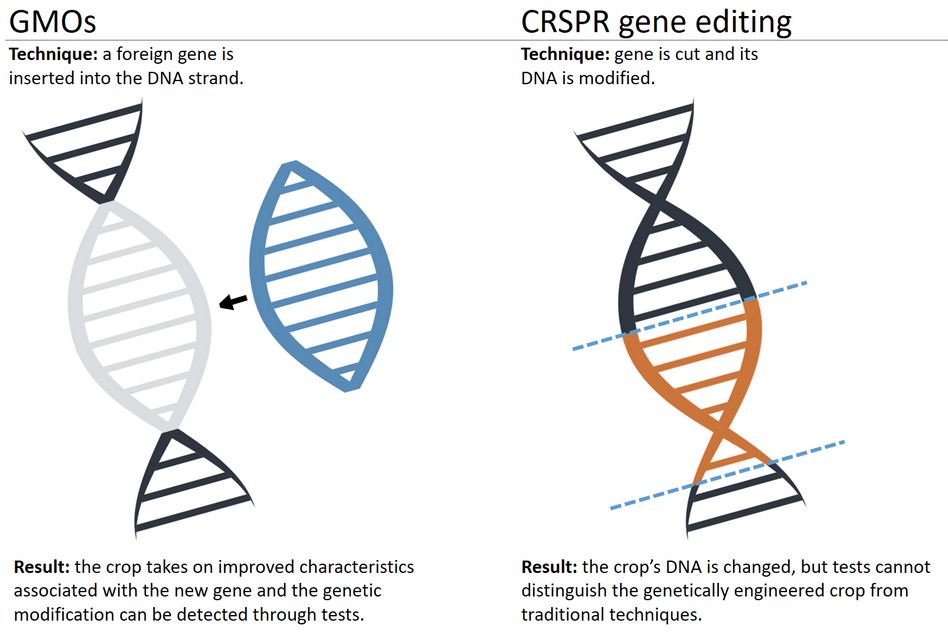
    • Unlike the older GM technology which involves the introduction of foreign DNA, the new proposal involves the use of gene editing tools to directly tweak the plant’s own genes instead.
    • It does not involve inserting any foreign DNA.

    Use in India

    • Scientists at the Indian Agricultural Research Institute (IARI) are in the process of developing resilient and high-yield rice varieties using such gene editing techniques.
    • However, this proposal has been pending with the Genetic Engineering Appraisal Committee (GEAC) for almost two years.

    Why need such technique?

    • Similar to natural mutation: But in this case, this protein is right there in the plant, and is being changed a little bit, just as nature does through mutation.
    • Faster and cheaper: It is much faster and far more precise than natural mutation or conventional breeding methods which involve trial and error and multiple breeding cycles.
    • Safe for consumption: When a protein comes from an outside organism, then you need to test for safety.
    • Pathbreaking: It is potentially a new Green Revolution.

    No approval issues

    • The SDN 1 and SDN 2 categories of genome-edited plants do not contain any foreign DNA when they are taken to the open field trials.
    • The US, Canada, Australia and Japan are among the countries which have already approved the SDN 1 and 2 technologies as not akin to GM.
    • So, such varieties of rice can be exported without any problem.
    • The European Food Safety Authority has also submitted its opinion that these technologies do not need the same level of safety assessment as conventional GM.


    UPSC 2022 countdown has begun! Get your personal guidance plan now! (Click here)

  • Punjab farmers create Bio-Enzymes from Kinnow

    Some farmers in Punjab, especially in the Kinnow belt, have started making Bio-Enzymes (BEs) from this waste fruit — peel and ‘D’ grade, very small kinnows.

    What is a Kinnow?

    • The ‘Kinnow’ is a high yield citrus fruit cultivated extensively in the wider Punjab region of India and Pakistan.
    • It is a year-long duration crop and the main harvesting period is from November-end to March.
    • It looks similar to orange but is smaller in size.

    Agricultural significance of Kinnows

    • Fallen fruit is a major challenge for kinnow farmers in the state as one needs to dig up small pits to bury them, otherwise the fallen fruit rot and invite a fly attack on the healthy fruit still on the plants.
    • But now, some farmers are using this waste kinnow to improve the pH level and soil fertility of their land by making BEs from this waste fruit.

    What are Bio-Enzymes?

    • Chemically, the Bio Enzymes are a mixture of complex organic substances such as proteins, salts and other materials that are by-products of the bacteria/yeast.
    • They produced through fermentation of organic waste including various fruits, vegetable peels and flowers, by mixing in sugar, jaggery/molasses and water.
    • BE’s also have a lot of usage in our daily lives. They can be used as natural cleansers.

    Benefits offered by BEs

    • BEs have a lot of good microbes and one of the major methods which helps overall improvement of our ecology.
    • It helps in mitigating the imbalance occurred due to overuse of chemicals, in our soil, air and water.
    • In a state like Punjab where water table is depleting fast and water contamination is also major issue, BEs can bring the soil back to life.
    • It helps in better water recharging and also stops the contamination of water by improving the health of soil.


    UPSC 2022 countdown has begun! Get your personal guidance plan now! (Click here)

  • What is the Lucy Mission?

    The NASA has launched Lucy, the spacecraft on a 12-year cruise to look back into the origins of the solar system through Trojans.

    Lucy Mission

    • Lucy will fly by eight Jupiter asteroids—seven Trojans and one main-belt asteroid — over the next 12 years.
    • It is NASA’s first single spacecraft mission in history to explore so many different asteroids.
    • Lucy will run on solar power out to 850 million kilometers away from the Sun.
    • This makes it the farthest-flung solar powered spacecraft ever, according to NASA.

    What is Jupiter Trojan Asteroids?

    • Simply known as Trojans, they are a large group of asteroids that share Jupiter’s orbit around the Sun.
    • Thousands of such asteroids exist in a gravitationally stable space.
    • The swarms lead and follow the planet Jupiter along its orbit around the Sun.

    What exactly are Trojans?

    • Lucy’s Trojan destinations are trapped near Jupiter’s Lagrange (L) points, which are gravitationally stable locations — it is where the gravity from the Sun and from Jupiter cancel each other out.
    • This means their orbits are stable and the Trojans are trapped in the space between.
    • This also means that asteroids are as far away from Jupiter as they are from the Sun.
    • Jupiter’s leading and trailing Lagrangian points (L4 and L5) have been stable over the age of the solar system.
    • This means that their orbits have accumulated many, many asteroids.
    • It makes sense to call a Trojan a co-orbital object, which moves around one of the two stable Lagrangian points.

    When and how were they discovered?

    • It took many a scientist to understand Trojans, and subsequently, name them so.
    • A German astro-photographer in 1906 made an important discovery: An asteroid with a particularly unusual orbit. As Jupiter moved, this asteroid remained ahead of Jupiter.
    • It was observed that the asteroid was nearly 60 degrees in front of Jupiter.

    Students with engineering background would better understand who Lagrange was. Rest need not care.

    Lagrange’s propositions

    • This specific position of a peculiar behaviour was predicted by the Italian-French mathematician Joseph-Louis Lagrange over 100 years earlier.
    • Lagrange had argued that if a small celestial body is placed at one of two stable points in a planet’s orbit around the Sun (the L4 and L5), the asteroid would remain stationary from the planet’s perspective.
    • This is due to the combined gravitational forces of the planet and the Sun.
    • Thus, Lagrange’s prediction acquired credibility. More such asteroids were discovered over subsequent months in Jupiter’s Lagrange point L5.

    Behind the name: Lucy

    • It is the fossil of a hominin that lived 3.2 million years ago.
    • She is known to be one of the most famous pre-human fossil in history.
    • Nearly 40 per cent of the fossilised skeleton of this hominin was discovered in 1974 by a team of paleoanthropologists led by Donald Johanson.
    • The name was inspired from the famous Beatles song “Lucy in the Sky With Diamonds,” which Johanson’s team listened to at camp the night of their discovery.


    UPSC 2022 countdown has begun! Get your personal guidance plan now! (Click here)


    Back2Basics: Lagrange Points

    • Lagrange points are positions in space where objects sent there tend to stay put.
    • They are named after Italian-French mathematician Josephy-Louis Lagrange.
    • At Lagrange points, the gravitational pull of two large masses precisely equals the centripetal force required for a small object to move with them.
    • These points in space can be used by spacecraft to reduce the fuel consumption needed to remain in position.
    • There are five special points where a small mass can orbit in a constant pattern with two larger masses.


  • Places in news: Mawsmai Cave

    A micro snail species named Georissa mawsmaiensis has recently been discovered from Mawsmai, a limestone cave in Meghalaya, 170 years after the last such discovery was made.

    Georissa mawsmaiensis

    • Georissa is found in soil or subterranean habitats in lowland tropical forest as well as high altitude evergreen forests or on rock surfaces rich in calcium.
    • The members of the Georissa genus are widely distributed across and reported from Africa, Asia, and the Pacific.
    • However, they are confined to microhabitats consisting of limestone caves or karst landscapes formed by the dissolution of limestone.

    About Mawsmai Cave

    • The Mawsmai cave is situated in the small village of Mawsmai, around four kilometres from Cherrapunjee (Sohra) in the East Khasi Hills district of Meghalaya.
    • It is located at an altitude of 1,195 metres above sea level and is indirectly influenced by the streams of the Kynshi river originating from the East Khasi Hills.
    • The term ‘Mawsmai’ means ‘Oath Stone’ in the Khasi language. The Khasi people use the local term ‘Krem’ for the cave.
    • It is famous for its fossils, some which can be spotted looking at the walls and formations inside.
    • The longest is Krem Liat Prah in the Jaintia Hills, which is 30,957 m (31 km approx.)


    UPSC 2022 countdown has begun! Get your personal guidance plan now! (Click here)

  • [pib] Exercise Cambrian Patrol

    A team from Gorkha Rifles which represented the Indian Army at the prestigious Cambrian Patrol Exercise at Brecon, Wales, UK, has been awarded a Gold medal.

    Ex Cambrian Patrol

    • Organized by the UK Army, this exercise is considered the ultimate test of human endurance, team spirit and is sometimes referred as the Olympics of Military Patrolling.
    • The aim of The Cambrian Patrol is to provide a challenging patrols exercise in order to enhance operational capability.
    • The event has evolved into a cost-effective, ready-made exercise that Commanding Officers can use to test the basic training standards of their soldiers, in preparation for future operations.
    • It is mission-focused and scenario-based with role players used to enhance the training benefit.

    How it is conducted?

    • During the exercise, teams are assessed for their performance under harsh terrain and inclement cold weather conditions.
    • They undergo various challenges in addition to the complex real-world situations painted to them so as to assess their reactions in combat settings.


    UPSC 2022 countdown has begun! Get your personal guidance plan now! (Click here)

  • Zeolite Oxygen Concentrators: Chemistry in 3-D

    To meet the demand of oxygen supply in the country during the peak of pandemic, the Defence Research and Development Organisation (DRDO) had chartered the Air India to import ‘Zeolite’ from different countries.

    What are Zeolites?

    • Zeolites are highly porous, 3-dimensional meshes of silica and alumina.
    • In nature, they occur where volcanic outflows have met water.
    • Synthetic zeolites have proven to be a big and low-cost boon.

    Uses in Oxygen Concentrator

    • One biomedical device that has entered our lexicon during the pandemic is the oxygen concentrator.
    • This device has brought down the scale of oxygen purification from industrial-size plants to the volumes needed for a single person.
    • At the heart of this technology are synthetic frameworks of silica and alumina with nanometer-sized pores that are rigid and inflexible.
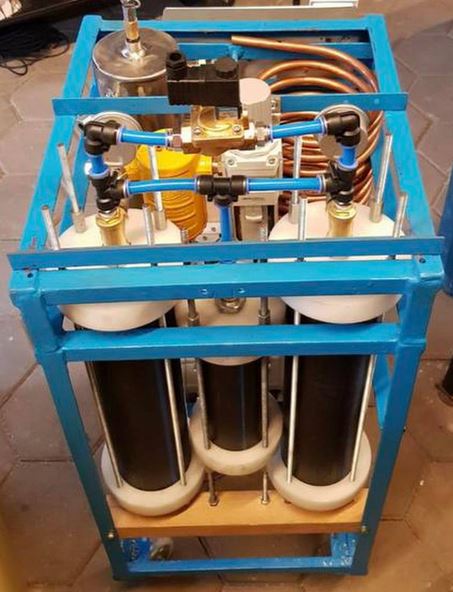
    • Beads of one such material, zeolite 13X, about a millimeter in diameter, are packed into two cylindrical columns in an oxygen concentrator.

    How does it work?

    • Zeolite performs the chemistry of separating oxygen from nitrogen in air.
    • Being highly porous, zeolite beads have a surface area of about 500 square meters per gram.
    • At high pressures in the column, nitrogen is in a tight embrace, chemically speaking, with the zeolite.
    • Interaction between the negatively charged zeolite and the asymmetric nucleus (quadrupole moment) of nitrogen causes it to be preferentially adsorbed on the surface of the zeolite.
    • Oxygen remains free, and is thus enriched.
    • Once nitrogen is captured, what flows out from the column is 90%-plus oxygen.
    • After this, lowering the pressure in the column releases the nitrogen, which is flushed out, and the cycle is repeated with fresh air.


    UPSC 2022 countdown has begun! Get your personal guidance plan now! (Click here)

  • Exercise Yudh Abhyas 2021

    The 17th edition of the India-U.S. bilateral exercise, Yudh Abhyas 2021, got underway in mountainous terrain and cold climate conditions of Alaska, US.

    Yudh Abhyas 2021

    • Exercise Yudh Abhyas is the largest running joint military training and defence cooperation endeavour between India and USA.
    • The exercise aims at enhancing understanding, cooperation and interoperability between the two armies.

    Why it is significant?

    • Interestingly, this is the only India-U.S. service exercise continuing in bilateral format.
    • The India-U.S. Malabar naval exercise became trilateral with the addition of Japan in 2015 and further brought in all the Quad partners together with the inclusion of Australia in 2020.
    • Similarly, Japan joined the India-U.S. bilateral air exercise, Cope India, as an Observer in 2018 and the plan is to make it trilateral in phases.
    • Other than the Malabar, Japan had sent observers for the first time during Cope India 2018 as an Observer in 2018. s


    UPSC 2022 countdown has begun! Get your personal guidance plan now! (Click here)
  • What is a Small Finance Bank?

    The Reserve Bank of India has issued a small finance bank (SFB) license to a consortium of fintech companies BharatPe and Centrum Financial Services Ltd.

    What is a SFB?

    • Small finance banks (SFBs) are a type of niche banks in India.
    • They can be promoted either by individuals, corporate, trusts or societies.
    • They are governed by the provisions of Reserve Bank of India Act, 1934, Banking Regulation Act, 1949 and other relevant statutes.
    • They are established as public limited companies in the private sector under the Companies Act, 2013.
    • Banks with a SFB license can provide basic banking service of acceptance of deposits and lending.

    Objectives of setting-up an SFB

    • To provide financial inclusion to sections of the economy not being served by other banks, such as small business units, small and marginal farmers, micro and small industries and unorganized sector entities

    Key features of SFBs

    • Existing non-banking financial companies (NBFC), microfinance institutions (MFI) and local area banks (LAB) can apply to become small finance banks.
    • The banks will not be restricted to any region.
    • 75% of its net credits should be in priority sector lending and 50% of the loans in its portfolio must in ₹25 lakh.
    • The firms must have a capital of at least ₹200 crore.
    • The promoters should have 10 years’ experience in banking and finance.
    • Foreign shareholding will be allowed in these banks as per the rules for FDI in private banks in India.

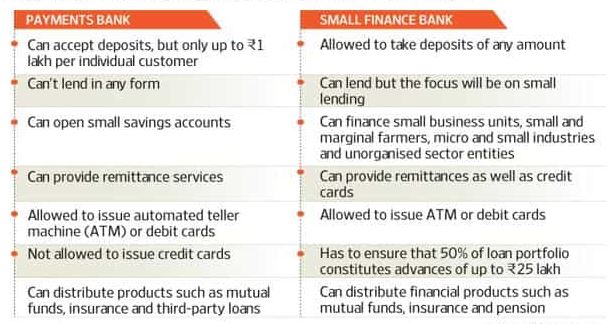
    Back2Basics: Small Payments Bank Vs. Payment Bank

    UPSC 2022 countdown has begun! Get your personal guidance plan now! (Click here)


  • Amendments to the Forest Conservation Act, 1980

    The Ministry for Environment, Forests and Climate Change (MoEFCC) has published proposed amendments to the Forest Conservation Act, 1980.

    The Forest (Conservation) Act, 1980

    The FCA is the principal legislation that regulates deforestation in the country.

    • It prohibits the felling of forests for any “non-forestry” use without prior clearance by the central government.
    • The clearance process includes seeking consent from local forest rights-holders and from wildlife authorities.
    • The Centre is empowered to reject such requests or allow it with legally binding conditions.
    • In a landmark decision in 1996, the Supreme Court had expanded the coverage of FCA to all areas that satisfied the dictionary definition of a forest; earlier, only lands specifically notified as forests were protected by the enforcement of the FCA.

    The FCA is brief legislation with only five sections of which-

    • Section 1 defines the extent of coverage of the law,
    • Section 2 restrictions of activities in forest areas and the rest deals with the creation of advisory committees, powers of rule-making and penalties.

    Why is the Act being amended now?

    • The current definition of forests has locked land across the country; even private owners cannot utilise their own property for non-forestry purposes.
    • The pressure for forest land diversion has been coming from — Ministries such as Rail and Roads.
    • Under the Act, any diversion of any forest land for any purpose, including assignment of leases, needs prior approval of the Centre.

    What defines ‘Forest’ under this act?

    • Previously, the Act had applied largely to reserve forests and national parks.
    • In 1996, ruling in T N Godavarman Thirumulpad v Union of India Case, the Supreme Court had expanded the definition and scope of forest land.
    • It would thus include all areas recorded as forest in any government record, irrespective of ownership, recognition and classification.
    • The court also expanded the definition of forests to encompass the “dictionary meaning of forests”.
    • This would mean that a forested patch would automatically become a “deemed forest” even if it is not notified as protected, and irrespective of ownership.
    • The Act would also be applicable over plantations in non-forest land.

    What are the proposed amendments?

    (A) Exemptions for Road and Railways

    • The MoEFCC has proposed that all land acquired by the Railways and Roads Ministries prior to 1980 be exempted from the Act.
    • Once the lands had been acquired for expansion, but subsequently, forests have grown in these areas, and the government is no longer able to use the land for expansion.
    • The Ministries will no longer need clearance for their projects, nor pay compensatory levies to build there.

    (B) Relaxation

    • It distinguishes individuals whose lands fall within a state-specific Private Forests Act or comes within the dictionary meaning of forest as specified in the 1996 Supreme Court order.
    • The government proposes to allow the “construction of structures for bona fide purposes’’ including residential units up to 250 sq m as a one-time relaxation.

    (C) Defense and other projects

    • Defence projects near international borders will be exempted from forest clearance.
    • Oil and natural gas extraction from forested lands will be permitted, but only if technologies such as Extended Reach Drilling are used.
    • Strip plantations alongside roads that would fall under the Act will be exempted.

    What are the concerns?

    • Legalizing private ownership of forests: The rules will facilitate corporate ownership.
    • Deforestation: The exemption of forests on private land will lead to the disappearance of large tracts of forests.
    • Fragmentation: Exemption for private residences on private forest will lead to fragmentation of forests, and open areas such as the Aravalli mountains to real estate.
    • Tribal concerns: The amendments do not address what will happen to tribals and forest-dwelling communities over the cleared lands.
    • Threat to wildlife: Exemption for roads and railways on forest land acquired prior to 1980 will be detrimental to forests as well as wildlife – especially elephants, tigers and leopards.

    Positives with the amendment

    • It has proposed making forest laws more stringent for notified forests, making offences non-bailable with increased penalties including imprisonment of up to one year.
    • It has disallowed any kind of diversion in certain forests.
    • It has attempt to define and identify forests once and for all — something that has been often ambiguous.


    UPSC 2022 countdown has begun! Get your personal guidance plan now! (Click here)