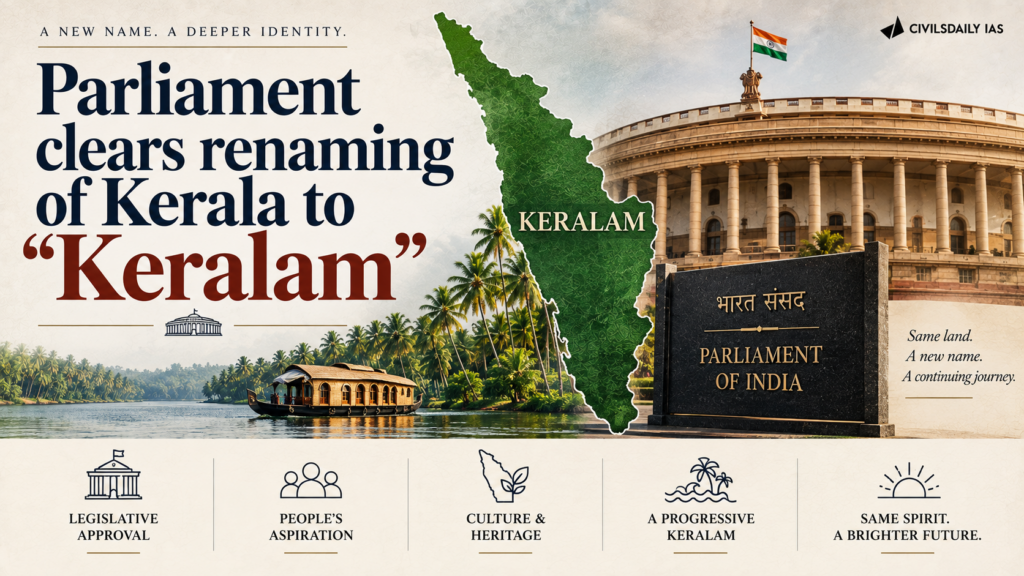
Both Houses passed a Bill to rename Kerala as “Keralam”, its name in Malayalam. The change follows two resolutions of the Kerala Assembly and routes through the constitutional process for altering a state’s name.
How is a state renamed under the Constitution?
Parliament’s power: Under Article 3, Parliament can alter the name of a state by law.
Presidential referral: Such a Bill needs the President’s recommendation and the views of the affected state legislature.
Simple majority: The change is passed by ordinary legislative majority, not a constitutional amendment.
Why “Keralam”?
Linguistic identity: “Keralam” is the state’s name in Malayalam, and the change aligns official usage with local usage.
Assembly resolutions: The Kerala Assembly twice sought the change unanimously.
Why does the process matter?
Union primacy: Only Parliament, not the state, can effect the legal renaming.
Federal courtesy: The state legislature’s view is sought, but its resolution is not binding.
Back2Basics: Article 3 of the Constitution
Scope: Formation of new states and alteration of areas, boundaries, or names of existing states.
Initiation: Only on the President’s recommendation, after seeking the state legislature’s views.
Nature: Treated as an ordinary law, reflecting the “indestructible states” feature of Indian federalism.
“[2022, GS1, 15] The political and administrative reorganization of states and territories has been a continuous ongoing process since the mid-nineteenth century. Discuss with examples.”
[2025] Consider the following pairs : State:Description 1. Arunachal Pradesh: The capital is named after a fort, and the state has two National Parks 2. Nagaland: The State came into Existence on the basis of a Constitutional Amendment Act. 3. Tripura: Initially a Part ‘C’ State, it became a centrally administered territory with the reorganization of State in 1956 and later attained the status of a full-fledged State How many of the above pairs are correctly matched?
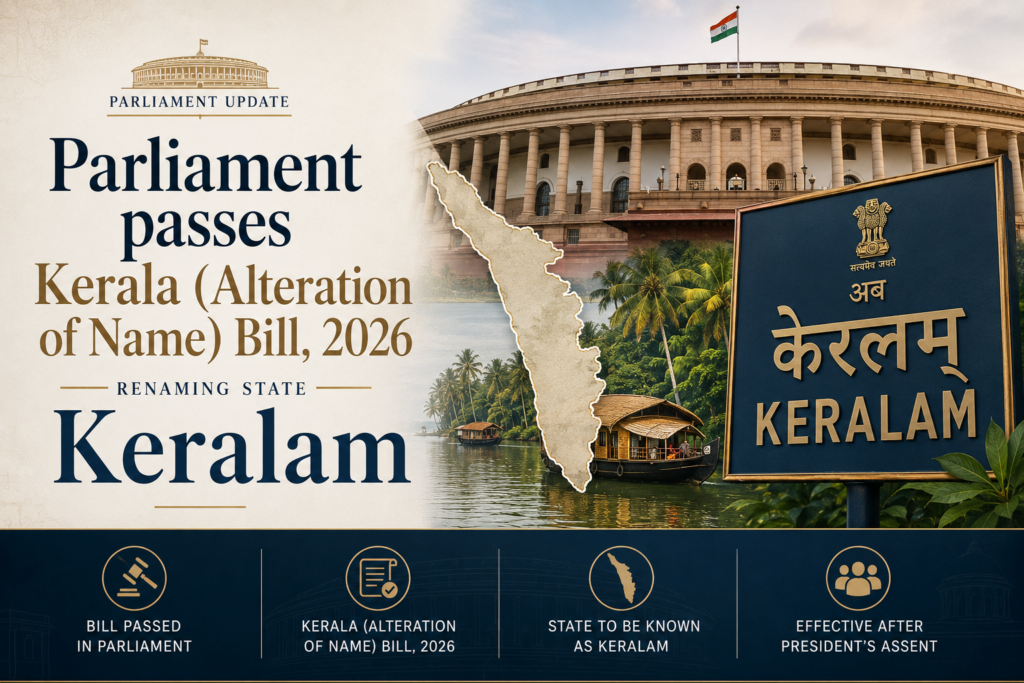
Parliament passed the Kerala (Alteration of Name) Bill, 2026, renaming the State Keralam and amending the First Schedule of the Constitution. The Rajya Sabha cleared the Bill by voice vote, over two years after the State Assembly unanimously resolved for the change. The measure has surfaced pending name change proposals from other States, including West Bengal’s request to become Bangla.
How is a State renamed under the Constitution?
Article 3 power: Parliament may by law alter the name of a State, and such a bill can be introduced only on the recommendation of the President.
State legislature reference: The President must refer the bill to the concerned State legislature for its views within a specified period, though those views are not binding.
First Schedule amendment: Renaming requires an amendment to the First Schedule, which lists the States and Union Territories, effected under Article 4 as an ordinary law.
What is the Kerala (Alteration of Name) Bill, 2026?
Core change: The Bill changes the name of the State from Kerala to Keralam and makes the consequential amendment to the First Schedule.
Origin: It continues the Kerala Assembly’s 2024 resolution urging the Union government to rename the State Keralam.
Passage: The Lok Sabha passed it on Tuesday and the Rajya Sabha by voice vote on Wednesday, with all MPs supporting the rename.
What is the current status of State name changes in India?
Precedents: Madras became Tamil Nadu, and several States and cities have been renamed over the decades.
Pending proposals: West Bengal’s proposal to become Bangla has been pending for eight years, and members sought renaming of other States, cities and railway stations.
Ordinary majority: A First Schedule amendment for renaming is passed as an ordinary law, not requiring the special majority reserved for other constitutional amendments.
Linguistic basis: Keralam is the Malayalam name of the State, and the change reflects respect for regional language identity.
Constitutional provisions related to State renaming:
Article 3: Empowers Parliament to form new States and to alter areas, boundaries or names of existing States.
Article 4: Provides that laws under Articles 2 and 3, including consequential First Schedule and Fourth Schedule amendments, are not deemed constitutional amendments under Article 368.
First Schedule: Lists the States and Union Territories and their territories, amended to record the new name.
Article 3 proviso: Requires presidential recommendation and reference to the State legislature before introduction.
What does the Bill do procedurally?
Amends the First Schedule: Substitutes Keralam for Kerala in the constitutional list of States.
Consequential amendments: Makes the necessary changes so that references in law read as Keralam.
Voice vote clearance: Passed in the Upper House by voice vote with cross party support during the Monsoon Session.
How does renaming differ from creating or altering a State?
Name only: Renaming changes only the label, leaving territory, boundaries and administrative structure intact.
Same Article, different effect: Article 3 covers both renaming and territorial reorganisation, but renaming carries no boundary or population change.
No special majority: Both are enacted by simple majority under Article 4, unlike amendments under Article 368.
What are the major debates surrounding State renaming?
Federal courtesy: Members urged that the Union work closely with States and respect regional languages, framing the change within cooperative federalism.
Pending parity: The eight year delay on West Bengal’s Bangla proposal raised the question of consistent and timely treatment of State requests.
Symbolic versus substantive: One member argued the Centre should change its behaviour on disaster funding, not just the name, contrasting symbolic recognition with substantive support.
Conclusion: Parliament has passed the Kerala (Alteration of Name) Bill, 2026, renaming the State Keralam and amending the First Schedule under Article 3. The change gives effect to the Kerala Assembly’s 2024 resolution and reflects the State’s Malayalam identity. The next step is presidential assent, after which the First Schedule stands amended.
Back2Basics: First Schedule and States reorganisation
First Schedule: Lists the 28 States and 8 Union Territories with their territorial extents.
States Reorganisation Act, 1956: Reorganised State boundaries largely on linguistic lines, the framework within which Kerala was formed.
Renaming precedents: Madras to Tamil Nadu (1969), Mysore to Karnataka (1973), Uttaranchal to Uttarakhand (2007), and Orissa to Odisha (2011).
Process anchor: Article 3 read with Article 4 governs formation, alteration and renaming of States.
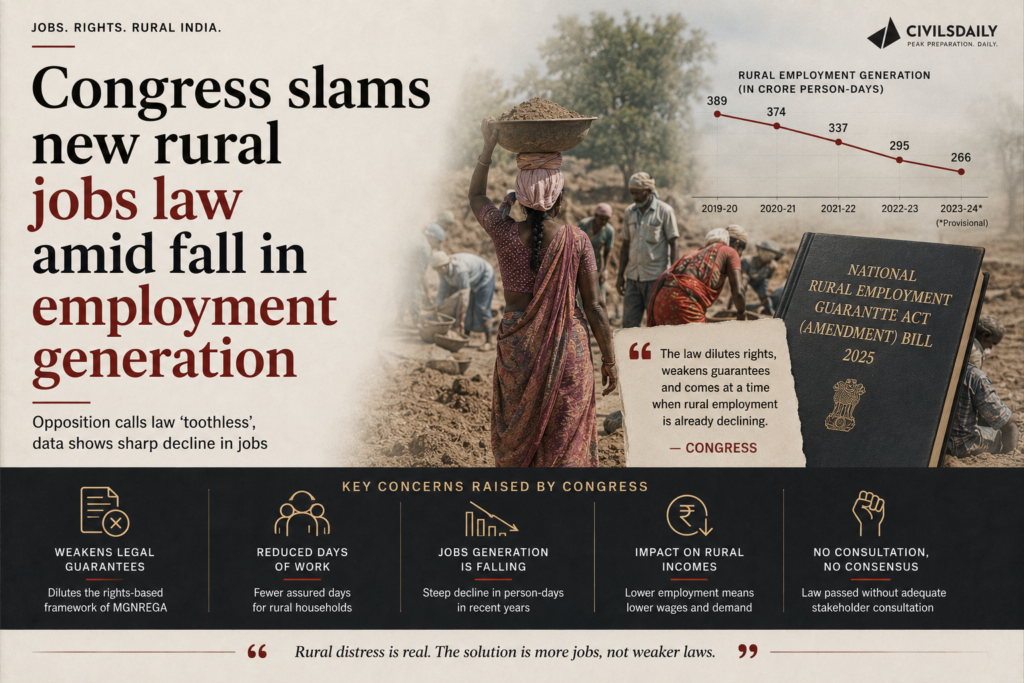
Person-days under the Viksit Bharat Guarantee for Rozgar and Ajeevika Mission (Gramin) (VB-G RAM G) fell 49.94% year-on-year in July 2026, its first month of implementation, compared with Mahatma Gandhi National Rural Employment Guarantee Act (MGNREGA). The decline has raised concerns about moving from a demand-driven legal guarantee to a more centralised, technology-dependent model.
What is the Viksit Bharat Guarantee for Rozgar and Ajeevika Mission (Gramin)?
About: VB-G RAM G is the central rural employment and livelihood scheme that replaced MGNREGA. It is administered by the Union Rural Development Ministry.
Design shift: Access is made increasingly dependent on technology and biometric authentication, and the scheme is centralised rather than run through gram panchayats.
Key change: Critics state it removes the legal guarantee of employment that defined MGNREGA, converting an entitlement into a discretionary programme.
What is a person-day and why is the July figure significant?
Person-day: A person-day is a unit that measures the amount of work done by one person in a working day, the standard metric for employment generated under rural works schemes.
The fall: Person-days generated in July 2026 were 49.94% lower than those generated under MGNREGA in July of the previous year, roughly halving recorded rural work in the first implementing month.
Why has the Opposition attacked the new scheme?
Loss of guaranteed work: The scrapping of MGNREGA stripped millions of families of their “right to work”, replaced by a scheme that wiped out around 50% of labourer employment in the first month.
Centralisation: The scheme centralises delivery and imposes a heavy financial burden on State governments, weakening the earlier panchayat-led model.
Technology gating: Making access dependent on technology and biometric authentication makes it harder for workers to claim their rights.
Loss of local autonomy: MGNREGA had empowered gram panchayats and freed workers from dependence on the political whims of the government of the day.
Pending dues: Rs 17,144 crore in pending MGNREGA funds to the States was flagged as unpaid.
What wider distress does the data point to?
Kharif shortfall: There is a 26.50% shortfall in sowing for the kharif crop, raising the demand for rural wage work at the very moment the scheme has contracted.
Drought assistance gap: The Opposition questioned whether any assistance had been provided to drought-affected States.
Funding pattern dispute: Even BJP-ruled States had demanded a review of the funding pattern of VB-G RAM G, indicating cross-party concern over State fiscal burden.
Conclusion
The near-halving of person-days in the first month captures the core risk of replacing a demand-driven legal guarantee with a centralised, technology-gated scheme, that the guarantee itself, not the branding, was what protected rural workers in distress. The data release coincides with a kharif sowing shortfall and State demands to review the funding pattern. The next test is whether the government revises the funding model and restores enrolment before the lean agricultural season deepens rural unemployment.
What is a demand-driven employment guarantee?
About: It is a legal framework under which the state must provide wage employment on demand to any eligible household, making work an enforceable entitlement rather than a target-based programme.
Rationale: It exists to provide a rural safety net during agricultural distress and to set a wage floor, with the guarantee acting as automatic stabiliser when other work dries up.
Distinguishing feature: Provision is triggered by the worker’s demand, not by a fixed budget or administrative ceiling, so contraction in person-days signals suppressed or unmet demand.
Wage payment delays: Chronic delays in wage disbursal erode the entitlement’s value and deter workers.
Fund devolution to States: Centralised control and delayed release strain State finances and stall works.
Technology exclusion: Biometric and app-based attendance systems exclude workers with poor connectivity or authentication failures.
Suppressed demand: Administrative rationing and closed muster rolls understate genuine demand for work.
Back2Basics: MGNREGA
Full name: Mahatma Gandhi National Rural Employment Guarantee Act, 2005, a UPA-era law.
Ministry: Union Ministry of Rural Development.
Aim: Guaranteed at least 100 days of wage employment in a financial year to every rural household whose adult members volunteer to do unskilled manual work.
Beneficiaries: Adult members of any rural household, without a poverty-line or caste restriction.
Design features: Legal right to work, demand-driven provision, works planned and executed through gram panchayats, and an unemployment allowance if work is not provided in time.
Government Initiatives / Schemes for Rural Livelihoods
VB-G RAM G: The current central rural employment and livelihood mission that replaced MGNREGA.
Deendayal Antyodaya Yojana – National Rural Livelihoods Mission (DAY-NRLM): Promotes self-help groups and self-employment for rural poor women.
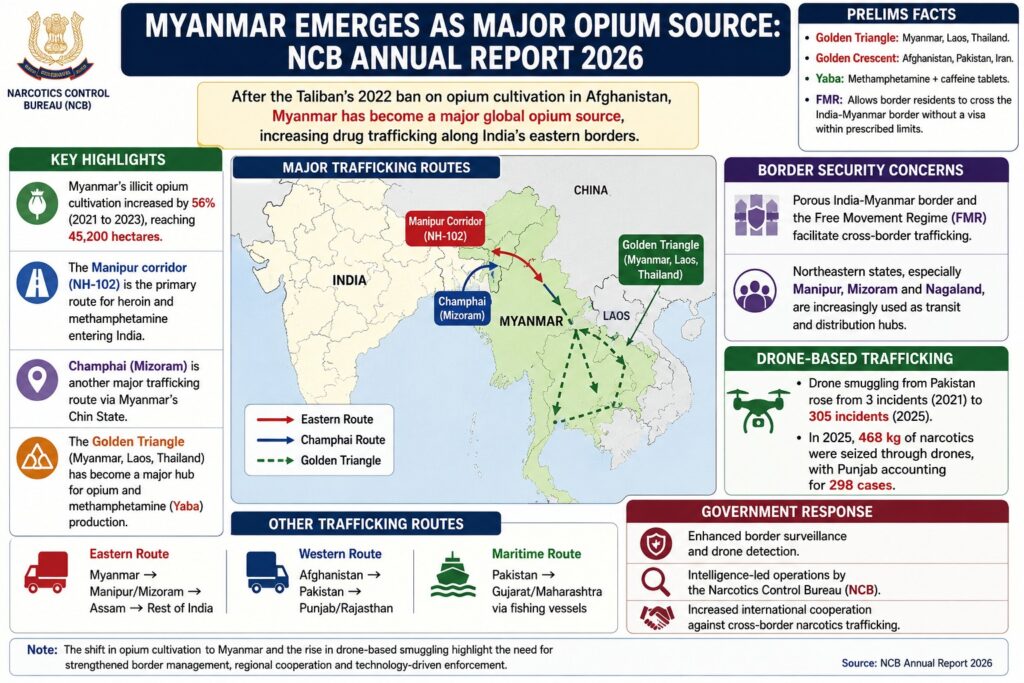
The NCB Annual Report 2026 states that after the Taliban’s 2022 ban on opium cultivation in Afghanistan, Myanmar has become a major global opium source, increasing drug trafficking along India’s eastern borders.
Key Highlights
Myanmar’s illicit opium cultivation increased by 56% (2021 to 2023), reaching 45,200 hectares.
The Manipur corridor (NH-102) is the primary route for heroin and methamphetamine entering India.
Champhai (Mizoram) is another major trafficking route via Myanmar’s Chin State.
The Golden Triangle (Myanmar, Laos, Thailand) has become a major hub for opium and methamphetamine (Yaba) production.
Border Security Concerns
Porous India-Myanmar border and the Free Movement Regime (FMR) facilitate cross-border trafficking.
Northeastern states, especially Manipur, Mizoram and Nagaland, are increasingly used as transit and distribution hubs.
Drone-Based Trafficking
Drone smuggling from Pakistan rose from 3 incidents (2021) to 305 incidents (2025).
In 2025, 468 kg of narcotics were seized through drones, with Punjab accounting for 298 cases.
Other Trafficking Routes
Eastern Route: Myanmar → Manipur/Mizoram → Assam → Rest of India.
Western Route: Afghanistan → Pakistan → Punjab/Rajasthan.
Maritime Route: Pakistan → Gujarat/Maharashtra via fishing vessels.
Government Response
Enhanced border surveillance and drone detection.
Intelligence-led operations by the Narcotics Control Bureau (NCB).
Increased international cooperation against cross-border narcotics trafficking.
Prelims Facts
Golden Triangle: Myanmar, Laos, Thailand.
Golden Crescent: Afghanistan, Pakistan, Iran.
Yaba: Methamphetamine + caffeine tablets.
FMR: Allows border residents to cross the India-Myanmar border without a visa within prescribed limits.