💥Join UPSC 2027,2028 Mentorship (July Batch) + XFactor Notes & Microthemes PDF

Year: 2016

  • DD News | Late Edition | Make in India Week

    Context: Make in India week was organised in Mumbai.

    Q. What’s the significance of such events?

    • 1.  Such events are very important as they put together under one roof major investors and entrepreneurs from developed and developing world with Indian investors and policymakers.
    • 2. It provides opportunity for collaboration between Indian and foreign investors.
    • 3. Policymakers can directly address their concerns and present India as a prime investment destination

    Q. Capital goods policy was announced in the event. Tell us it’s salient features.

    Copy Pasting from our news card

    1. News: The government introduced a National Capital Goods Policy
    2. Purpose: To spur capital goods sector and the Make in India initiative. It aims to turn the country into a world class hub for capital goods
    3. Objective: To increase production of capital goods from Rs. 2.30 lakh crore in 2014-15 to Rs. 7.50 lakh crore in 2025
    4. To raise direct and indirect employment from the current 8.4 million to 30 million by 2025
    5. Key Elements: Availability of finance, raw material, innovation and technology, productivity, quality and environment-friendly manufacturing practices, increasing skill availability, promoting exports and creating domestic demand

    Target is also to increase share of capital goods in manufacturing from 12% at present to 20% by 2025. It will hugely benefit MSME sector.

    Q. Intentions to invest are all great but what are the steps needed to realize intention to invest into actual on the ground investment?  

    Government need to improve ease of doing business in India.

    • 1. Skills building
    • 2. Infrastructure investment
    • 3. Labour reform
    • 4. Finance i.e. banking reform, resolve the NPA mess
    • 5. Tax reforms, Tax department is sending contradictory signals

    Q. What are some of the steps that govt has already taken to ease doing business in India?

    Ease of doing business ranking has improved from 142 to 130 and it is expected to improve further as government has already taken following maesures

    1.  Establishment of commercial courts
    2.  insolvency and bankruptcy code is in parliamentary
    3.  arbitration act amendment
    4.  GST bill

    But it requires smooth functioning of parliament to finally pass these legislative proposals. All the political parties should come on board for the sake of Indian economy and it’s youth who need jobs.

    Q. Even if this wish list is delivered, how can industrial sector grow in such a gloomy global economic environment?

    • Strength of Indian economy is domestic demand.  Jobs to 65% population which is under 35 will create further demand.
    • We should not wait for global economy to pick up as our major export markets are unlikely to recover any time soon. Our exports are down for 13 consecutive months.
    • That’s why we need more reforms so that FDI come in. In the 1st half of 2015, we received highest FDI in the world and in 2016, we are expected to receive over 40% more FDI.
    • PM Modi has added another D called deregulation to his 3Ds of democracy, demography and demand to encourage FDI inflows.

    Q. So what are the expectations from the budget?

    1. 1. House functions smoothly and major bills mentioned above are passed.
    2. 2. Very importantly, government has to correct inverted duty structure which leads to reverse tariff escalation.

    Inverted duty structure is an anomalous situation in which prices of raw material is costlier than prices of finished products. For instance, to protect steel manufacturers, govt  has imposed minimum import price on steel but cycle made from steel in China now becomes cheaper than Indian made cycle as Chinese manufacturers are using cheaper steel.

    Govt has to decide who it wants to protect, a handful of raw material manufacturers or finished product manufacturers who actually create so many jobs, many of them in MSME.

  • North Korean Fusion Bomb test in bid to change world power equation

    The January 6, 2016 ‘thermonuclear’ test by the Democratic People’s Republic of Korea (DPRK) is the fourth in the series of nuclear tests beginning in 2006. Is it a quest to attain credible deterrence against USA, Let’s see it!

    Let’s first go into some North Korean nuke history.

    What has North Korea tested in the past?


    • North Korea’s tests in 2006 and 2009 are thought to have been plutonium fission devices, but speculation was rife that its 2013 test was of an uranium-enriched device, though this has never been confirmed. <In general, uranium devices are much more difficult to fabricate and operate>
    • A test based on a uranium device would spell new dangers because weapons-grade plutonium enrichment happens in large facilities
    • That are easier to spot and uranium enrichment uses many, possibly small, centrifuges that can be hidden away
    • North Korea has also depleted its stocks of weapons-grade plutonium but has plentiful reserves of uranium ore
    • The fusion/H-bomb finds root in the history, as more powerful and technologically advanced than atomic weapons, such as those that devastated 2 Japanese cities in World War II
    • H-bombs use fusion, the merging of atoms to unleash massive amounts of energy, whereas atomic bombs use nuclear fission, or the splitting of atoms.
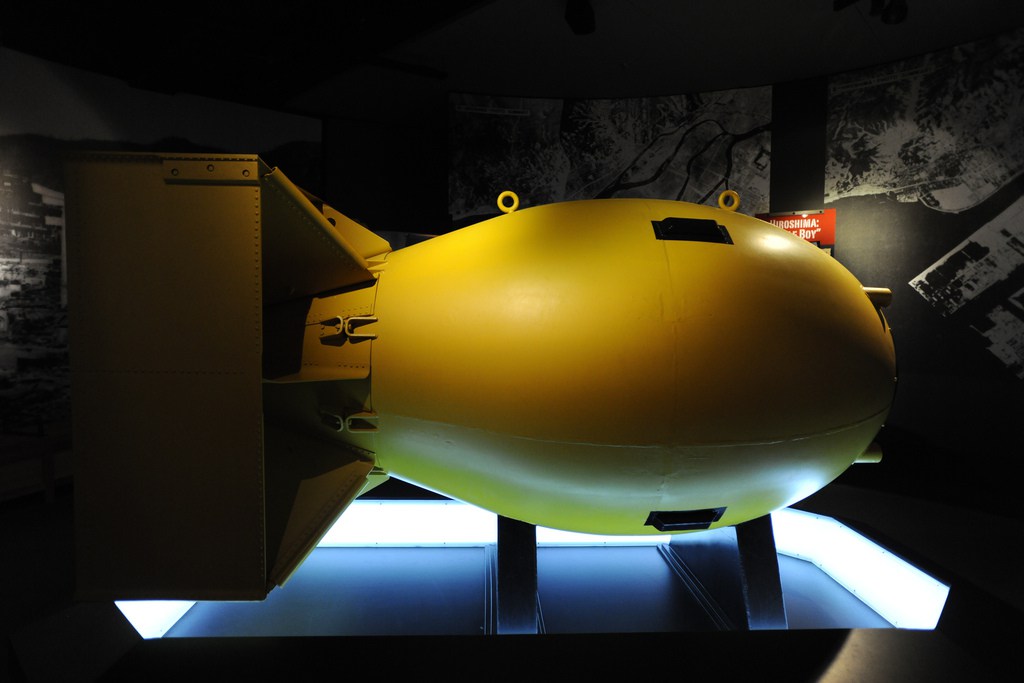
    fatMan image - A mockup of ‘Fat Man’, the bomb that blew up over Nagasaki on August 9, 1945. Credit: euthman/Flickr, CC BY 2.0
    fatMan image – A mockup of ‘Fat Man’, the bomb that blew up over Nagasaki on August 9, 1945. Credit: euthman/Flickr, CC BY 2.0


    What is Nuclear fusion?

    • In physics, nuclear fusion is the process by which multiple nuclei join together to form a heavier nucleus
    • It is accompanied by the release or absorption of energy depending on the masses of the nuclei involved.
    • In a hydrogen bomb, 2 isotopes of hydrogen, deuterium and tritium are fused to form a nucleus of helium and a neutron
    • This fusion releases 17.6 MeV of energy. Unlike nuclear fission, there is no limit on the amount of the fusion that can occur

    Let’s get back to learn some changing equations in new world order.

    Is it quest to attain deterrence against United States?

    • The supreme leader Kim Jong Un (KJU) had warned that, if aggressors dare to provoke us, even to a slight degree, we will never
      tolerate it, and respond resolutely with a merciless sacred war of justice, a great war for national reunification
    • It declared: “The United States has persisted in ignoring our just demand for replacing the Armistice Agreement with a separate pact to remove the danger of war, ease tension and create a powerful environment in the Korean peninsula. The Korean Armistice Agreement is the armistice which ended the Korean War. It was signed between U.S. and North Korea in 1953.
    • Instead, it has clung to its anachronistic policy hostile towards the DPRK, escalating the tension and egging its vassal forces on to stage a ‘human rights’ racket against the country
    • In May 2015, Pyongyang had announced that it had successfully tested a Submarine Launched Ballistic Missile (SLBM). However, South Korean experts had treated this claim with considerable scepticism 
    • Whether the most recent North Korean test was that of a Hydrogen Bomb will be known after a while, but the objective was miniaturisation of the system so that the nuclear weapon can be mounted on a missile 
    • North Korea has made it known that it wants recognition by the world community as a nuclear weapon power and no amount of external pressure would force it to pause in that quest

    What was the Global Reaction?

    • The UN Security Council condemned the nuclear test, declared that it is a ‘clear violation’ of its previous resolutions, and pledged to pursue new sanctions against North Korea
    • USA, South Korea and Japan have agreed to work together to forge a united and strong international response to North Korea’s reckless behaviour
    • Japan hinted at some unilateral measures, include strengthening of the anti-missile defence systems protecting Japan from a North Korean attack

    Who is in the real position to apply pressure on North Korea?

    • Only China is in a position to apply some credible pressure on North Korea since 88 per cent of North Korea’s foreign trade is with China
    • According to the South Koreans, China has been applying the existing UN sanctions against North Korea faithfully and the export of about 900 dual-use items has been prohibited to that country
    • China is comfortable with strategic ambiguity about the nuclear status of North Korea
    • But the insistence of an open declaration by the North of its Nuclear Weapon Power status would disrupt its strategic calculations in the region as the response from Japan could upset the regional power equation
    • Seoul expects China to do more to denuclearise North Korea particularly in view of the rapidly warming ROK-China relations

    Has North Korea’s approach towards South Korea changed?

    • In the midst of heightened tensions, there are signs that North Korea is working with the aim of driving a wedge between the United States and South Korea
    • For which it is pursuing 2 independent policies – one of nuclearisation and acceptance as a nuclear weapons power
    • The second of not upsetting the apple cart with South Korea and continue with the current policy of no peace – no war
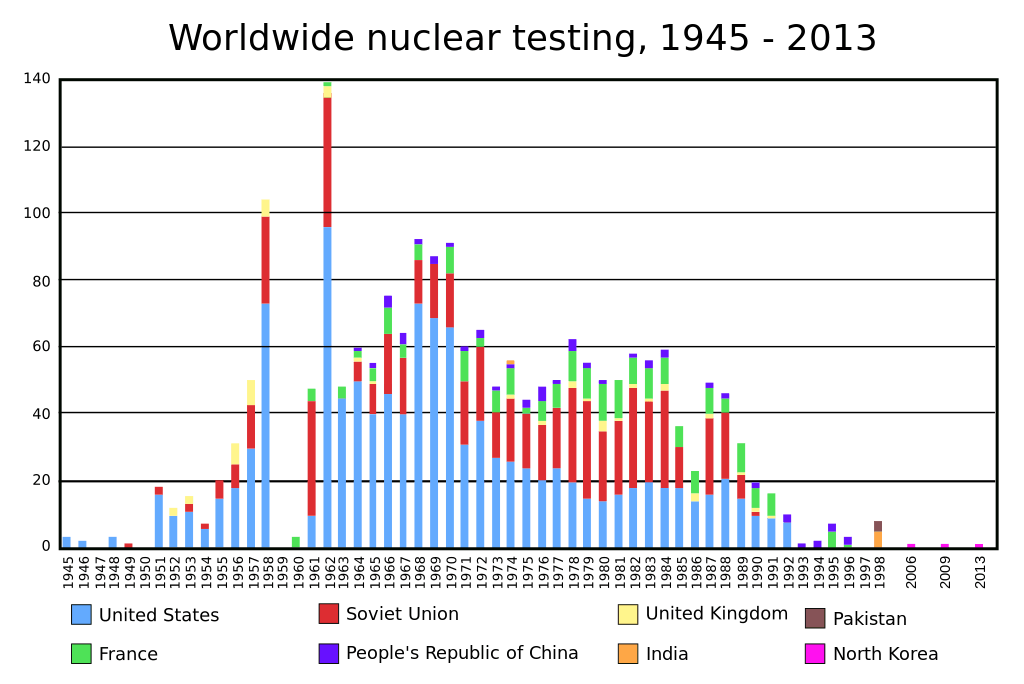
    world nuke test image - Source: Wikimedia Commons, CC BY-SA 2.5
    world nuke test image – Source: Wikimedia Commons, CC BY-SA 2.5

    Conclusion on sidelines

    • Analysing the events of the past 1 year, it would be fair to conclude that Kim Jong Un has firm control over all the levers of power in North Korea, including the military
    • The reclusive country would continue on the course set by Kim II Sung and Kim Jong II, pursuing a policy of ‘Military First’, the ‘Juche’ concept of self-reliance and seeking effective nuclear strike capability against the United States
    • Juche is a political philosophy, became the official autarkic state ideology of the DPRK in 1972 Although foreign scholars often describe juche as “self-reliance,” the true meaning of the term is much more nuanced.
    • The peninsula would continue to be divided as neither side is keen on unification despite their public protestations in favour of reuniting the long-divided country
    • The paramount objective of the DPRK leadership continues to be the survival of the regime and its politico-economic system, and it is unlikely to allow tensions with South Korea or the United States to come to a point that would lead to hostilities

    Whatever the truth of this test, for diplomacy, observers say it dashes any hopes of North Korea returning to stalled talks involving the US, Russia, China and others.


    Published with inputs from Arun
  • Can someone please explain the gravitational waves?

    In easy to understand layman terms, please….

  • Question of the Day

    Critically examine WTO-Nairobi Package and its implication on India?

  • Important judgements of Supreme Courts in 2015 | Part 1


    #1. NJAC held unconstitutional

    Supreme Court Advocates on Record Association vs. Union of India

    “The judiciary cannot risk being caught in a web of indebtedness towards the government.”

    It is after 35 years that a constitutional amendment has been quashed by the top court.

    Summary:

    Within a year of both houses of Union Legislature passed much awaited National Judicial Appointments Commission Bill, the Supreme Court struck down the NJAC Act by 4:1. Justices J S Khehar, MB Lokur, Kurian Joseph and Adarsh Kumar Goel declared the 99th Amendment and NJAC Act unconstitutional while lone minority, Justice Chelameswar upheld it. The judgement rendered by five judges runs over 1000 pages.

    Major observations of the Supreme Court:

    • Does not provide an adequate representation, to the judicial component in the NJAC.
    • Insufficient to preserve the primacy of the judiciary, in the matter of selection and appointment of Judges, to the higher judiciary (as also transfer of Chief Justices and Judges, from one High Court to another)
    • The Law Minister:

    The inclusion of the Union Minister of Law and Justice as an ex officio Member of the NJAC is:


    • ultra vires the provisions of the Constitution, because it impinges upon the principles of “independence of the judiciary” & “separation of powers
    • Violative of the “basic structure” of the Constitution
    • Against Principles of Natural Justice: Because Government is the major litigant and cases involve large sums of money. And inclusion of Law Minister would be against “judge of own case“, a part of PNJ.


    • Will of the people: The Union government had previously argued that NJAC represented the will of the people. However, rejecting the Centre’s argument, court noted that “the will of the people is the Constitution while the Parliament represents the will of the majority at a given point of time which is subordinate to the Constitution”.

    Culture of Reciprocity: Bench feared a culture of “reciprocity” of favours: FEELINGS OF PAY BACK TO POLITICAL-EXECUTIVE WOULD BE DISASTROUS TO THE INDEPENDENCE OF JUDICIARY, especially when govt is the major litigant in higher courts.


    #2. Yakub Memon & the midnight hearing

    Yakub Abdul Razak Memon vs. State of Maharashtra

    Summary:

    The year 2015 witnessed a rare event of the Apex Court opening its gates for hearing an urgent Writ petition. Yakub Memon’s final plea before the Apex Court was heard in Court Room 4 which was opened for an unprecedented 90-minute hearing that started at 3.20 AM and ended a little before dawn. The Bench comprising Justice Dipak Misra, Justice Amitava Roy and Justice P.C. Pant agreed and observed that granting further time was not necessary in the present case. The bench said the execution was “inevitable” after rejection of the mercy petitions. Yakub was executed the very next day on his birthday.

    Background:

    • Memon, a CA by profession was awarded the death sentence by a special TADA Court in Mumbai on July 27, 2007 for his role in the serial blasts.
    • Charges also included arranging finances for carrying out the 13 serial explosions.
    • Explosions left 257 dead and over 700 injured across the city on March 12, 1993.
    • In 2013, Supreme Court had upheld the TADA Court verdict convicting Memon for his role in the Bombay blasts.
    • Memon is the only one of 11 people whose death sentence in the case has been upheld. The sentences of the others were commuted to life imprisonment.

    Observations of the Supreme Court:

    • Stay on the death warrant could be a ‘travesty of justice‘: since ample opportunity was provided to Memon, after the rejection of the first mercy petition.

    Memon’s review petition was heard for ten days, when law mandates a hearing of only half an hour.

    • The President rejected after due consideration of all relevant fact. 22 years have passed since the incident. There is no error in judgments passed by this court.
    • At the drop of a hat one can add new challenges and developments and expect the President to act in exercise of power under Article 72 and thereafter on rejection of clemency they would challenge that in a court of law.

    Counter arguments:

    • The authorities were “hell bent” on executing Memon without giving him the right to challenge the rejection of his mercy petition by the President as right to life of a condemned prisoner last till his last breath.
    • How the President could have rejected Yakub’s fresh mercy plea in such a short time.
    • According to rules, the nearest legal centre must be contacted the day mercy plea gets rejected. That did not happen.

    
    Published with inputs from Swapnil
  • Current affairs from May-15 to Dec-15

    Hi CD,

    Do we have any link to download current affairs from July-15 to Dec-15 in our forum? If no, any plans to develop one like monthly editions we have. This is to cover overall glance of CA for year 2015-16.

    Best Regards,
    Kiran

  • Maldives-India India begins largest ever medical camp in Maldives

    The medical camp, held from Sunday till Tuesday at the state run Indira Gandhi Memorial Hospital (IGMH) in capital Male is run by a urologist (urinary system specialist), nephrologist (kidney specialist) and a specialist of body defects.
    India is the preferred destination for Maldivians who often travel abroad to receive medical treatment.
    In a statement, the high commission said last week that India’s largest naval ship, the aircraft carrier INS Vikramaditya, will arrive in Male on a goodwill visit to Maldives from February 15-18. INS Vikramaditya will be accompanied by two ships, INS Mysore and INS Deepak.
    The visit by an unprecedented fleet of Indian military might to the Maldives follows intensified efforts by both the Maldives and India to improve relations.

    Late last month India agreed to donate a utility aircraft and another helicopter to the Maldives.

    India had donated two utility helicopters to the Maldives in 2010. Both the choppers are operated out of the domestic airport in the southern island of Kahdhoo in Laamu atoll.

    India granted more than US$240,000 (MVR3.8 million) to the Maldives in December to establish facilities to operate and maintain the two helicopters.

    Ties between the Maldives and India are on the mend after reaching its lowest point following the premature termination in 2013 of the agreement with Indian infrastructure giant GMR, which had been managing the country’s main international airport since 2011.

    On November 1, 1965, India established diplomatic relations with the Maldives, becoming the first country to do so following the latter’s independence from Britain in July.

    India, meanwhile, has publicly sided with the Maldives government over the continued imprisonment of the country’s former president Mohamed Nasheed, an issue central to the Maldives’ relationship with its international partners.

  • Monthly compilation of Science and tech

    Sir,please provide compilation for Science and Tech.I am hnable to cope with the current affairs of science,please provide some remedie.

  • [CLOSED] Civilsdaily is looking for part-time translators

    Thanks for the amazing response. We got over 100 applications and we have shortlisted a few. We will be contacting you guys over phone. The application is closed for now. If you still wish to connect with us, feel free to drop a mail 🙂


    Hello,

    We are looking for part time translators (English to Hindi) to join the content team for its upcoming Hindi version.

    • Role: Candidates are required to translate English news cards into Hindi
    • Experience: No prior experience is required
    • What do we need? Candidates with a good command over both the languages

    You need to do a simple exercise. Translate these two english news cards into hindi. You need to read the text in english and then recreate the same magic in hindi. Do not use google auto translate. Please use google input tools instead – https://www.google.com/inputtools/try/


    You can fill up this application form or provide us with your personal details (along with text translation) over email at hello@civilsdaily.com

    Google application form - Click here

    Translate the following and send over – 

    NITI Aayog: 2nd regional consultation

    1. Context: 2nd Regional Consultations on Agricultural Development in New Delhi
    2. Held by: NITI Task Force on Agricultural Development under the chairmanship of Vice Chair Arvind Panagariya
    3. Demands: southern states pitched for preparation of a model land leasing act and higher remunerative prices for farmers
    4. Other areas: shared best practices in area of agriculture and water resources; river linking and water conservation and harvesting; emphasis on strengthening of agricultural co-operatives

    Pact to develop Vizag as smart city

    1. Context: Pact between US Trade & Development Agency (USTDA) & Andhra Pradesh Government
    2. Aim: To develop infrastructure, communications and data systems
    3. Smart city: Development is in line with its goal to become a Smart City
    4. Award: this cooperation is particularly timely as Vizag recently won 1st phase of Smart Cities Challenge by GoI
    5. Impact: Development and modernization efforts will be partially supported by the central government

    PS: This is a paid position. We are looking to extend our offerings in hindi and we are looking for 2 awesome translators to work with us on that.

  • [Video] Rajan’s solution for NPAs: Deep surgery not Band aid

    An Indian express report suggest that Public Sector Banks have written off huge sums of money from their balance sheet. It paints alarming picture of banking sector in India. Governor Rajan has suggested that mere band aid won’t do, deep surgery is required to nurse banking system to health.

    What’s the problem with the banking sector in India? Why are banks writing off such huge sums and what kind of surgery is governor Rajan prescribing? In this write up, we shall try to answer all these queries but first some basics of banking.

    https://youtu.be/wjOt13aPvJw


    A bank is a financial intermediary that connects savers (depositors, creditors) with borrowers. People deposit their money in the bank for which they get paid some interest rate. Deposit amount on bank balance sheet (account book) is put under liability category for banks have to pay that amount back with interest.

    Banks in turn lend that money to businesses and earn interest on it. Lent money is put under asset category as it generate income for the bank in the form of interest.

    Banks also have something called capital or equity which is brought in by promoters/ investors. The capital is to absorb losses if borrowers default on their commitment and do not pay back their loans.

    In summary, every banks has on its books, capital to absorb losses, assets which generate income and liabilities i.e. deposit amounts which have to be returned back with interest.

    What’s Provisioning?

    Whenever banks lend to any business, it carries with it some risk that money wouldn’t be paid back, borrower would dimply default. This risk is accounted for at the time of disbursal of loan itself in the form of keeping aside some capital in anticipation of future losses. This is called provisioning.

    For instance, if banks feel 1% of loans are likely to default, they will provision 1% against any loans they make, When a loan actually defaults, they don’t have to book huge loss for they have it already covered. Note that higher the likelihood of default, higher the amount of provisioning. Guidelines in this regard are prescribed by RBI.

    What is a non performing asset (NPA)?

    Asset is one which generates income for the bank in the form of interest. Assets are meant to perform function of generating cash flows for banks. When assets cease to perform that function i.e. do not pay back interest and installments, they become non performing and are known as non performing assets.

    Technical definition:  A non performing asset (NPA) is a loan or advance for which the principal or interest payment remained overdue for a period of 90 days.

    Banks are required to classify NPAs further into Substandard, Doubtful and Loss assets.

    1. Substandard assets: Assets which has remained NPA for a period less than or equal to 12 months.

    2. Doubtful assets: An asset would be classified as doubtful if it has remained in the substandard category for a period of 12 months.

    3. Loss assets: As per RBI, “Loss asset is considered uncollectible and of such little value that its continuance as a bankable asset is not warranted, although there may be some salvage or recovery value.”

    Let’s understand all this with an example: 

    Suppose, SBI lent 100 rs to Mallya on 1st Jan 2015 which he has to return in 10 monthly installments of 12 rs each beginning 1st jan 2016.

    Mallya returns 1st and 2nd installments on 1st jan and 1st feb 2016 but does not return 3rd installment on 1st march. He simply refuses to pay back.

    Till 1st march 2016, this asst would be considered a standard asset as it was generating regular cash flows.

    • After 90 days from due date i.e. 1st june (1st March due date), it becomes an NPA.
    • From 1st june 2016 to 1st June 2017, it remains a substandard asset.
    • After 1st june 2017 it becomes a doubtful asset.

    When bank or auditors feel it’s virtually unrecoverable, it is termed as loss asset and after that it is taken off balance sheet in what is termed as writing off.

    Why wouldn’t banks want to declare bad loans as NPA?

    As NPAs carry higher risk of eventual default, provisioning for NPAs is higher than standard assets. They carry 15% provisioning. What this means is that banks have to set aside 15 rs to cover future losses, the same money they could have lent to someone else and earn interest on it. It basically brings down profitability of banks and erode their capital base.

    But isn’t it like extending problem to the future?

    Well, banks feel if they can continue lending to these assets so that they could repay interest (refinancing), some day economy will return and they will be able to repay all the debt. so they simply restructure the loan and keep these assets as standard assets. Rajan calls it policy of extending and pretending i.e. extending the loan and pretending as if everything’s alright even though there are serious underlying problems. This is what Rajan calls applying band aid.

    Total stressed assets = Gross NPAs + Restructured assets

    It’s true that some sectors are affected by economic downturn and would revive once economic cycle picks up speed but extending every loan for a long time creates problem of moral hazard and promoters simply lose interest in reviving the project for interest cost becomes too high with the rising debt. Banks keep on throwing good money after bad, day of reckoning eventually arrives when banks are forced to book huge losses and tax payers suffer.

    In PSBs, restructured assets are more than double of NPAs and analysts feel restructured assets to be as bad as NPAs.

    The other thing banks can do is recognize NPA as NPA and try to put project back on track. This would then lead to active intervention on the part of all parties concerned. Banks would take some hit on their balance sheet, write off some part, promoters will bring more equity, govt will provide clearances, tarriff authority can increase the tariff etc.

    What are all the things that banks can do?

    1. If management is inefficient, banks can change the management.
    2. Acquire majority stakes under strategic debt restructuring (SDR) and sell the asset to new promoters.
    3. Start liquidation proceedings if turnaround seems unlikely under SARFAESI act.
    4. Sell asset to Asset Reconstruction Companies (ARCs).

    This is what Rajan calls deep surgery but it would require recognizing the problem as NPA first. It would put strain on the profitability in the short run but cleaned up balance sheets would reflect true picture of the state of banks. Government will infuse capital in the banks so that banks are ready to lend money to deserving businesses which will lead to economic recovery as well as expand asset base.

    Economic recovery will help stressed assets to pay back their loans while expanded asset base will increase denominator bringing NPA ratio down thus starting a virtuous cycle.

    Gross NPA ratio = Total NPA/ Total asset base

    We can decrease NPA ratio by increasing the denominator i.e. lending more.

    A few more points:

    Banks lend against capital and Basal committee on banking supervision prescribes norms for capital adequacy.

    Capital Adequacy Ratio (CAR) = Total Capital/ Total risk weighted assets

    This ratio has to be maintained for soundness of banking system. It’s clear from the above that to expand asset base, banks need more capital and for PSBs government has to infuse more capital.

    PS– This article is to be read alongside this discussion to know the causes and ways of resolution of this mess.

    Read this analysis of RSTV