Why in the News?
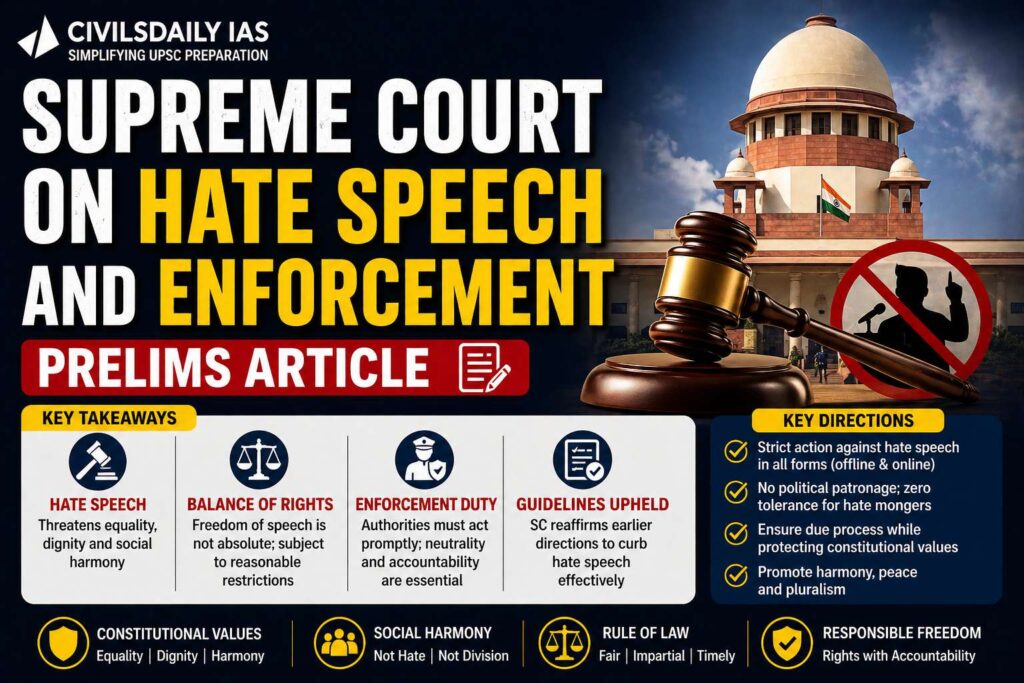
The Supreme Court of India, in an April 2026 judgment, highlighted that hate speech and rumour mongering threaten the constitutional value of fraternity, but declined to direct enactment of new laws, emphasizing effective enforcement of existing legal provisions.
Key Observations of the Court
- Hate speech arises from an “us versus them” mindset
- It promotes exclusion and discrimination
- Undermines fraternity and unity in a diverse society
- Considered against constitutional morality and civilisational ethos
- Linked to the idea of “Vasudhaiva Kutumbakam” (world is one family)
Constitutional Provisions Involved
- Article 19(1)(a): Guarantees freedom of speech and expression
- Article 19(2): Allows reasonable restrictions on grounds like:
- Public order
- Decency
- Morality
- Sovereignty and integrity
- Fraternity (Preamble): Ensures unity and sense of brotherhood among citizens
Legal Position on Hate Speech
- No single comprehensive law exclusively defining hate speech
- Covered under various provisions:
- Indian Penal Code sections related to
- Promoting enmity
- Public mischief
- IT laws for online content
- Indian Penal Code sections related to
Court’s Stand
- Court cannot legislate new laws
- Responsibility lies with: Legislature and Executive
- Focus should be on better implementation of existing laws
Key Concepts
- Hate Speech: Speech that incites hatred, discrimination, or violence against groups
- Fraternity: A constitutional value promoting unity, dignity, and brotherhood
| [2017] The mind of the makers of the Constitution of India is reflected in which of the following? (a) The Preamble (b) The Fundamental Rights (c) The Directive Principles of State Policy (d) The Fundamental Duties |