Why in the News
- During the Sabarimala Temple Entry Dispute review hearing, the Union government argued before the Supreme Court that all religious practices are presumed constitutionally protected unless they violate: Public order, Morality, and Health
- The Centre also questioned the judicially evolved doctrine of “Essential Religious Practices” (ERP).
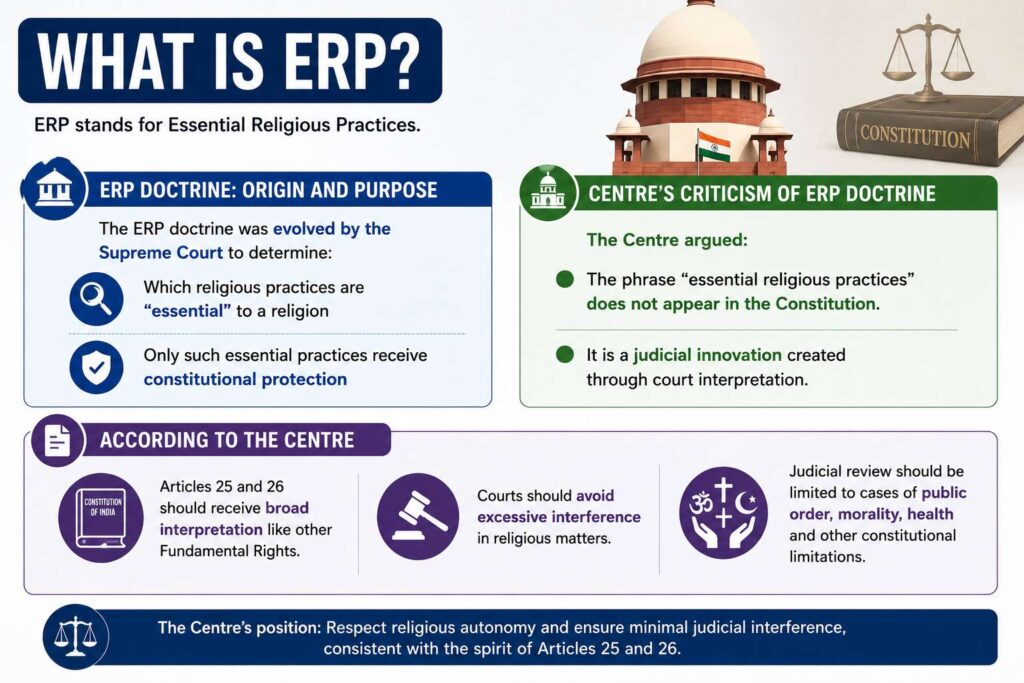
What is ERP?
The ERP doctrine was evolved by the Supreme Court to determine:
- Which religious practices are “essential” to a religion
- Only such essential practices receive constitutional protection
Centre’s Criticism of ERP Doctrine
- The Centre argued:
- The phrase “essential religious practices” does not appear in the Constitution.
- It is a judicial innovation created through court interpretation.
- According to the Centre:
- Articles 25 and 26 should receive broad interpretation like other Fundamental Rights.
- Courts should avoid excessive interference in religious matters.
Supreme Court’s Observations
- Faith Beyond Rituals: Surya Kant observed:
- One need not visit temples to be religious.
- Even lighting a lamp in a hut can express faith.
- Hinduism as a Way of Life: Justice B. V. Nagarathna remarked:
- Hinduism is a “way of life”
- It is not dependent solely on rituals or temple visits
Related Case Laws
- Shirur Mutt Case
- Origin of ERP doctrine
- Court held religion includes essential practices
- Indian Young Lawyers Association v. State of Kerala
- Allowed women of all ages entry into Sabarimala Temple
- Linked exclusion to constitutional equality
- Sardar Syedna Taher Saifuddin Case: Upheld denominational autonomy regarding excommunication
| [2020] Consider the following statements: 1. The Constitution of India defines its ‘basic structure’ in terms of federalism, secularism, fundamental rights and democracy. 2. The Constitution of India provides for ‘judicial review’ to safeguard the citizens’ liberties and to preserve the ideals on which the Constitution is based. Which of the statements given above is/are correct? a) 1 only b) 2 only c) Both 1 and 2 d) Neither 1 nor 2 |
