Why in the News?
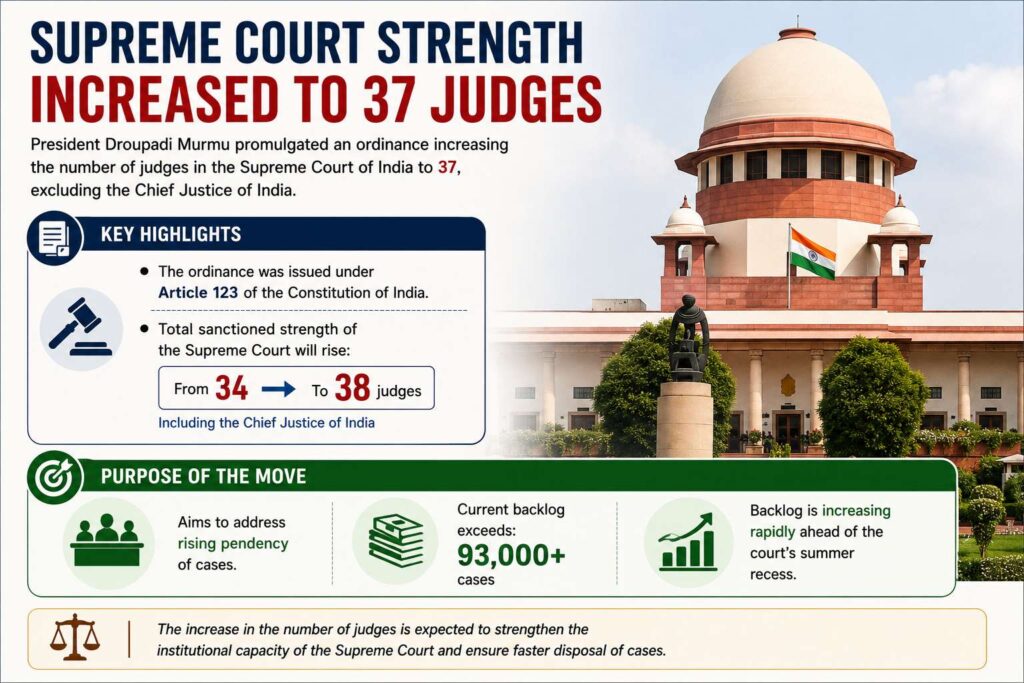
President Droupadi Murmu promulgated an ordinance increasing the number of judges in the Supreme Court of India to 37, excluding the Chief Justice of India.
Key Highlights
- The ordinance was issued under Article 123 of the Constitution of India.
- Total sanctioned strength of the Supreme Court will rise:
- From 34 to 38 judges
- Including the Chief Justice of India
Purpose of the Move
- Aims to address rising pendency of cases.
- Current backlog exceeds: 93,000 cases
- Backlog is increasing rapidly ahead of the court’s summer recess.
Amendment Made
- The ordinance amended Section 2 of the Supreme Court (Number of Judges) Act, 1956.
- Replaced “33” with “37” judges excluding the CJI.
Article 124 of the Constitution of India
- Originally provided for:
- Chief Justice of India
- Not more than seven judges
- Parliament can increase the number by law.
Evolution of Supreme Court Strength
- 1950: 7 judges
- 1956: 10
- 1960: 13
- 1977: 17
- 1986: 25
- 2009: 30
- 2019: 33
- 2026: 37
Present Vacancy Situation
Current vacancies include:
- Seat of former CJI B. R. Gavai
- Vacancy after retirement of Rajesh Bindal
More retirements due in 2026:
- Justice J.K. Maheshwari
- Justice Pankaj Mithal
- Justice Sanjay Karol
Ordinance Rules
- Ordinance must be approved by Parliament after reassembly.
- It ceases to operate after six weeks if not approved by both Houses.
| [2025] With Reference to the Indian polity, consider the following statements: I. An Ordinance can amend any central Act. II. An Ordinance can abridge a Fundamental Right. III. An Ordinance can come into effect from a back date. Which of the statements given above are correct? [A] I and II only [B] II and III only [C] I and III only [D] I, II and III |
